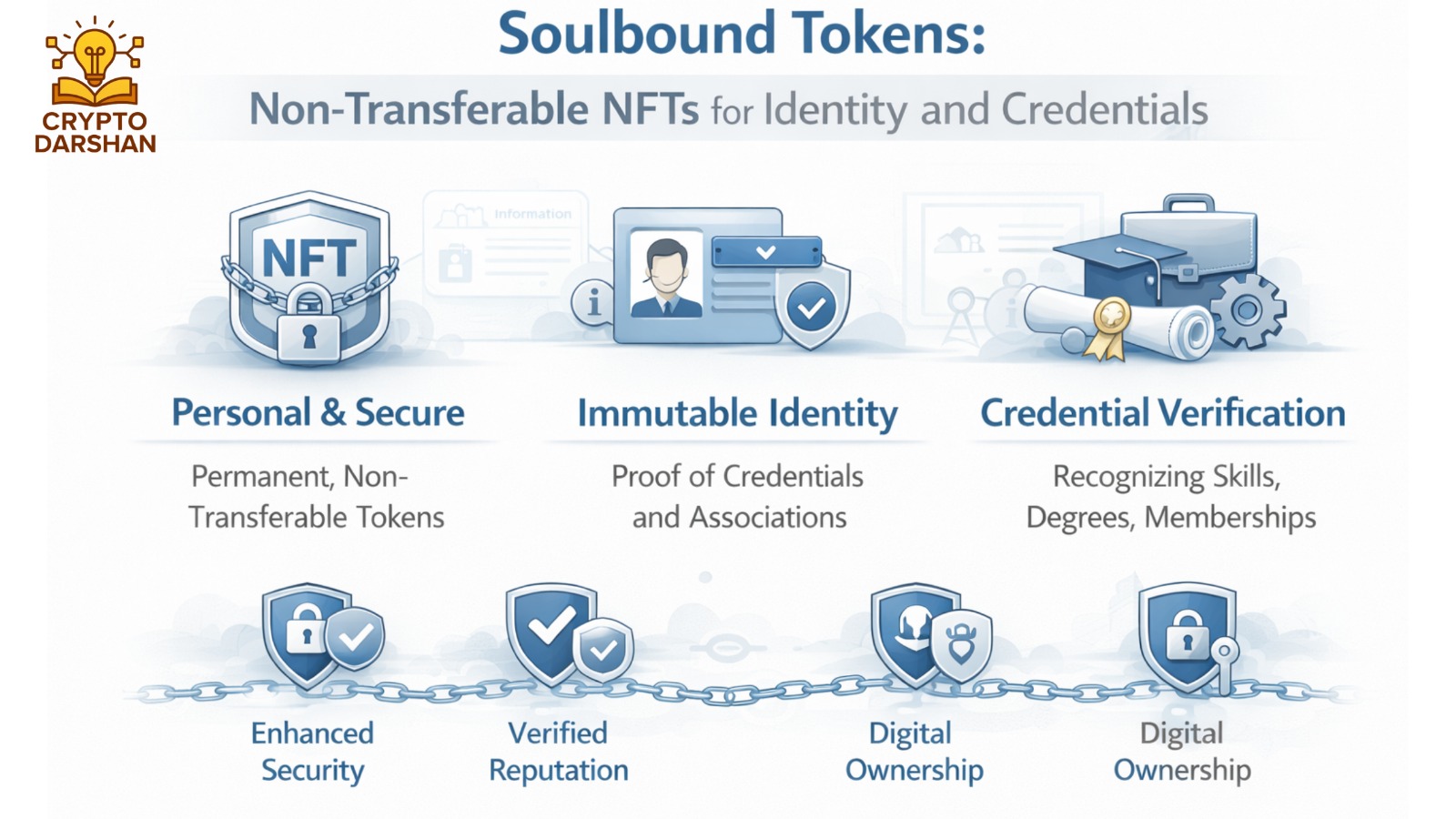
Blockchain technology continues to evolve beyond cryptocurrencies and digital collectibles. One of the most promising innovations in this space is the Soulbound Token (SBT)—a new type of non-transferable NFT designed to represent identity, reputation, and credentials in a decentralized ecosystem. Unlike traditional NFTs that can be traded or sold, Soulbound Tokens are permanently tied to a specific wallet or identity, making them ideal for representing personal achievements, certifications, memberships, and trust-based relationships.
This article explores the origins, technical foundations, use cases, benefits, challenges, and future potential of Soulbound Tokens. It also examines their role in building a Decentralized Society (DeSoc), where trust and reputation are encoded on-chain, enabling a more transparent and equitable digital ecosystem.
Understanding Soulbound Tokens

What Are Soulbound Tokens?
Soulbound Tokens (SBT) are a theoretical concept of non-transferable digital tokens that could potentially represent a person’s identity and achievements in the Web3 ecosystem. Once issued to a wallet, these tokens cannot be sold or transferred, ensuring that they remain permanently associated with the holder’s digital identity.
The concept was introduced by Vitalik Buterin, E. Glen Weyl, and Puja Ohlhaver in their 2022 paper Decentralized Society: Finding Web3’s Soul. The authors envisioned a world where individuals could build verifiable digital reputations through non-transferable tokens that reflect their real-world experiences and relationships.
Key Characteristics
- Non-Transferable: Tokens cannot be sold or traded.
- Verifiable: Stored on the blockchain for transparency and authenticity.
- Personalized: Each token represents a unique aspect of identity or achievement.
- Revocable: Issuers can revoke or update tokens if necessary.
- Decentralized: Operates without centralized intermediaries.
The Concept of “Souls”
In the SBT framework, a Soul represents a blockchain wallet or account that holds Soulbound Tokens. Each Soul can contain multiple SBTs issued by different entities, forming a verifiable record of a person’s digital identity, reputation, and affiliations.
The Evolution from NFTs to SBTs

Traditional NFTs
NFTs revolutionized digital ownership by allowing users to buy, sell, and trade unique digital assets. However, their transferability makes them unsuitable for representing personal credentials or identity-related data. The rise of non-transferable NFTs also shows how digital ownership is evolving beyond collectibles, a topic we explored in The Future of NFTs Beyond Art and Collectibles.
The Need for Non-Transferable Tokens
As Web3 expands, the need for trust and authenticity becomes critical. Transferable NFTs cannot reliably represent personal credentials because ownership can change hands. Soulbound Tokens solve this by being non-transferable, ensuring that the data they represent remains tied to the rightful owner.
The Transition to Soulbound Tokens
SBTs extend NFTs beyond ownership to identity and reputation. They enable verifiable digital identities that reflect real-world experiences, achievements, and affiliations, creating a foundation for decentralized trust.
Technical Foundations of Soulbound Tokens

Smart Contracts and Non-Transferability
Soulbound Tokens are implemented using smart contracts on blockchain networks like Ethereum. The key difference from standard NFTs lies in the token’s transfer logic. In an SBT contract, the transfer function is disabled or restricted, preventing tokens from being moved between wallets.
Token Standards
Developers are exploring new token standards to support non-transferable functionality:
- ERC-1238: Designed for achievements and credentials.
- Modified ERC-721 or ERC-1155: Adapted to disable transfers.
- Custom Smart Contracts: Tailored for specific use cases.
Privacy and Data Protection
Since SBTs store identity-related information, privacy is crucial. Technologies like zero-knowledge proofs (ZKPs) and selective disclosure allow users to prove ownership or validity of a credential without revealing sensitive details.
Interoperability and Layer-2 Solutions
To enhance scalability and reduce transaction costs, SBTs can be deployed on Layer-2 networks such as Polygon or Arbitrum. Cross-chain interoperability ensures that SBTs can function across multiple ecosystems, enabling seamless identity verification.
Use Cases of Soulbound Tokens

1. Digital Identity Verification
SBTs can serve as verifiable digital IDs representing a person’s credentials, affiliations, and achievements. Examples include:
- Government-issued IDs for secure verification.
- University degrees or professional certifications.
- Memberships in organizations or communities.
2. Education and Credentials
Educational institutions can issue SBTs to graduates as proof of completion. These tokens can include metadata such as course details, grades, and issuing authority. Employers can verify credentials directly on-chain, reducing fraud.
3. Employment and Professional Reputation
Employers can issue SBTs to employees to represent work experience, skills, or performance achievements. Freelancers can build verifiable portfolios, enhancing trust in decentralized job markets.
4. Healthcare Records
Medical institutions can issue SBTs representing vaccination records, prescriptions, or medical certifications. Patients retain control over their data while allowing authorized entities to verify authenticity.
5. Decentralized Finance (DeFi) and Credit Scoring
In DeFi, SBTs can represent a user’s credit history or trustworthiness. Lenders can assess risk based on on-chain reputation rather than collateral, enabling reputation-based lending.
6. Governance and Voting

SBTs can represent membership or voting rights in DAOs. Since tokens are non-transferable, they prevent vote manipulation through token trading.
7. Social Reputation and Community Building
Communities can issue SBTs to recognize contributions, participation, or achievements. These tokens build a verifiable reputation system that encourages trust and accountability.
8. Event Participation and Achievements
Event organizers can issue SBTs as proof of attendance or participation. These tokens can serve as digital badges that reflect engagement and loyalty.
9. Supply Chain and Product Authenticity
Manufacturers can issue SBTs to verify product authenticity and ownership history. This ensures transparency and reduces counterfeit risks.
10. Real Estate and Property Records
SBTs can represent verified property ownership or rental history, simplifying verification processes in real estate transactions.
Benefits of Soulbound Tokens

1. Enhanced Trust and Authenticity
SBTs create a verifiable link between individuals and their credentials, reducing fraud and misrepresentation.
2. Decentralized Identity Management
By storing identity attributes on-chain, SBTs eliminate the need for centralized identity providers.
3. Immutable and Transparent Records
All SBTs are recorded on the blockchain, ensuring transparency and immutability.
4. Reduced Fraud and Misuse
Since SBTs cannot be transferred or sold, they prevent impersonation and credential fraud.
5. Interoperability Across Platforms
SBTs can be used across multiple decentralized applications (dApps), enabling seamless verification of identity and reputation.
6. Empowerment of Individuals
SBTs give individuals ownership of their digital identities, allowing them to control how their data is shared and used.
7. Cost Efficiency
Automated verification through blockchain reduces administrative costs for institutions and organizations.
8. Long-Term Data Integrity
Blockchain’s immutability ensures that credentials remain verifiable for decades, unlike paper-based systems that degrade over time.
Challenges and Limitations

1. Privacy Concerns
Publicly visible SBTs may expose sensitive information. Privacy-preserving technologies are essential to protect user data.
2. Revocation and Error Handling
If an SBT is issued in error or needs to be revoked, mechanisms must exist to update or remove it without compromising integrity.
3. Wallet Security
Losing access to a wallet containing SBTs could result in the permanent loss of identity credentials. Social recovery wallets can mitigate this risk.
4. Standardization and Adoption
The lack of standardized protocols for Soulbound Tokens may slow adoption across blockchain ecosystems. Industry-wide collaboration will likely be required to establish common frameworks that ensure interoperability and security. While Soulbound Tokens introduce powerful identity and credential capabilities, they also add another layer of complexity for everyday users. This raises broader usability concerns discussed in Are Blockchains Becoming Too Complex for Average Users?, where the growing technical barriers of Web3 adoption are explored.
5. Ethical and Social Implications
Encoding identity and reputation on-chain raises ethical questions about surveillance, discrimination, and data ownership.
6. Scalability and Gas Fees
High transaction costs on major blockchains can limit large-scale adoption. Layer-2 solutions and sidechains can help reduce costs.
Soulbound Tokens and the Decentralized Society (DeSoc)

The Vision of DeSoc
A Decentralized Society (DeSoc) envisions a world where social relationships, trust, and reputation are encoded on the blockchain. In this society, individuals and communities interact based on verifiable credentials rather than centralized intermediaries.
SBTs serve as the building blocks of DeSoc by enabling trust without intermediaries. They allow individuals to prove their qualifications, affiliations, and reputations directly on-chain.
Social Recovery and Community Trust
In DeSoc, recovery mechanisms rely on social trust rather than centralized authorities. If a user loses access to their wallet, trusted contacts (represented by SBTs) can collectively verify and restore access.
Economic and Social Coordination
SBTs can facilitate new forms of economic coordination, such as reputation-based lending, community governance, and collaborative projects. They enable systems where trust and contribution are measurable and verifiable.
Building a Web of Trust
SBTs can interconnect individuals and organizations through verifiable relationships, forming a Web of Trust that underpins decentralized economies and communities.
Expanding the Role of Soulbound Tokens in the Digital Economy

The potential of Soulbound Tokens extends far beyond identity verification. They can reshape how digital economies function by introducing trust-based interactions that reduce dependency on intermediaries. In traditional systems, trust is often established through centralized authorities such as banks, universities, or governments. With SBTs, trust can be verified cryptographically, allowing individuals and organizations to interact directly.
In the creator economy, SBTs can serve as proof of authenticity for artists, musicians, and content creators. Instead of relying on centralized platforms to verify ownership or reputation, creators can issue SBTs that represent their verified works, collaborations, or achievements. Fans and collaborators can view these tokens to confirm authenticity, fostering transparency and reducing plagiarism.
In corporate ecosystems, SBTs can streamline hiring and background verification. Companies can issue SBTs to employees upon completion of training programs or successful project deliveries. Future employers can verify these credentials instantly, eliminating the need for manual verification processes. This approach can also extend to freelance marketplaces, where verified SBTs can serve as trust indicators for clients and contractors.
The gaming industry can also benefit from SBTs. Players can earn non-transferable tokens that represent achievements, rankings, or participation in exclusive events. These tokens can serve as digital trophies that cannot be sold or traded, preserving the authenticity of player accomplishments.
In philanthropy and social impact, SBTs can track charitable contributions and volunteer work. Nonprofits can issue tokens to donors or volunteers as proof of participation, creating transparent records of social contributions. This can enhance accountability and encourage more people to engage in community-driven initiatives.
As the digital economy becomes more interconnected, SBTs can act as universal trust credentials that bridge multiple industries. Whether in education, healthcare, finance, or entertainment, these tokens can provide a unified framework for verifying authenticity and reputation across platforms.
Real-World Examples and Projects

1. Binance Account Bound (BAB) Token
Binance introduced the BAB Token, one of the first real-world implementations of SBTs. It serves as proof of identity for Binance users who have completed KYC verification.
2. Project Galaxy (Galxe)
Galxe allows organizations to issue non-transferable credentials to users based on their on-chain and off-chain activities.
3. Ethereum Name Service (ENS) Integration
ENS domains can integrate with SBTs to create verifiable digital identities linked to human-readable names.
4. Academic Credentialing Platforms
Blockchain-based education platforms are exploring SBTs for issuing verifiable diplomas and certificates.
5. Civic and Identity Platforms
Projects like Civic and BrightID are experimenting with decentralized identity verification systems that align with the principles of SBTs.
6. Metaverse Identity Systems
In virtual worlds, SBTs can represent avatars, achievements, and social status, creating persistent digital identities across metaverse platforms.
The Future of Soulbound Tokens

The future of Soulbound Tokens lies in their ability to merge digital identity with real-world trust. As blockchain adoption grows, SBTs could become the foundation for a universal digital identity layer that connects individuals, institutions, and communities across the internet. Governments may adopt SBTs for issuing verifiable IDs, while universities and corporations could use them to manage credentials and certifications securely.
In the coming years, cross-chain interoperability will play a major role in expanding SBT functionality. Users will be able to carry their verified identities across multiple blockchains, ensuring seamless access to decentralized applications, financial services, and metaverse environments. Additionally, AI-driven analytics could enhance SBT ecosystems by evaluating reputation scores, detecting fraudulent issuances, and improving trust models.
Another emerging trend is the integration of SBTs with Internet of Things (IoT) devices. Smart homes, vehicles, and wearable devices could use SBTs to authenticate users and manage access rights securely. For example, a car could verify its owner’s identity through an SBT stored in a digital wallet, eliminating the need for physical keys.
As sustainability becomes a global priority, blockchain networks supporting SBTs are shifting toward energy-efficient consensus mechanisms like Proof of Stake (PoS). This ensures that identity verification and credential management remain environmentally responsible.
Ultimately, the success of Soulbound Tokens will depend on collaboration between developers, regulators, and institutions. Establishing global standards, ensuring privacy protection, and promoting user education will be key to unlocking the full potential of SBTs in shaping a decentralized, trustworthy digital future.
Ethical Considerations

Data Ownership and Consent
Users must retain full control over their SBTs and decide who can access or verify their data.
Avoiding Social Scoring Risks
SBTs must not be used to create oppressive social scoring systems. Governance frameworks should ensure fairness and prevent misuse.
Inclusivity and Accessibility
SBT systems should be designed to include all individuals, regardless of technical literacy or access to blockchain technology.
Transparency and Accountability
Issuers of SBTs must operate transparently to maintain trust and prevent misuse of identity data.
Implementation Strategies for Organizations

1. Define Use Cases
Identify specific use cases where SBTs add value, such as credential verification, membership management, or reputation tracking.
2. Choose the Right Blockchain
Select a blockchain that supports smart contracts, scalability, and privacy features.
3. Develop Smart Contracts
Create custom smart contracts to handle minting, revocation, and verification processes securely.
4. Ensure Compliance
Legal and regulatory compliance must be considered, especially when handling personal data.
5. Educate Users
User education is critical to ensure understanding of how SBTs work and how to manage them securely.
6. Build Partnerships
Collaborate with educational institutions, corporations, and government agencies to expand adoption and interoperability.
Soulbound Tokens: Non-Transferable NFTs for Identity and Credentials – FAQ

1. What are Soulbound Tokens (SBTs)?
Soulbound Tokens are non-transferable NFTs that are permanently linked to a blockchain wallet. Unlike traditional NFTs that can be bought or sold, SBTs remain tied to a specific digital identity and are used to represent credentials, achievements, or reputation on the blockchain. The concept was proposed by Vitalik Buterin as part of the vision for decentralized identity in Web3.
2. How are Soulbound Tokens different from traditional NFTs?
Traditional NFTs are transferable digital assets that can be traded on marketplaces. Soulbound Tokens, however, cannot be transferred or sold once issued. They are designed to function more like digital certificates or credentials, proving identity, achievements, or membership rather than ownership of collectible assets.
3. What are the main use cases of Soulbound Tokens?
Soulbound Tokens can be used for many real-world applications, including:
- Educational credentials such as diplomas and certificates
- Professional achievements or employment history
- Membership badges for communities or organizations
- Reputation scores in decentralized finance (DeFi)
- Digital identity verification in Web3 platforms
4. How can Soulbound Tokens improve digital identity?
Soulbound Tokens enable verifiable, blockchain-based identity records that cannot be altered or transferred. This helps individuals maintain a trusted digital identity while reducing fraud in areas like education, employment verification, and online communities.
5. Can Soulbound Tokens be revoked or updated?
Yes. Depending on the system design, the issuer of a Soulbound Token—such as a university or organization—may have the ability to revoke or update credentials if necessary. This ensures that the information tied to the token remains accurate and trustworthy.
6. Which blockchain networks support Soulbound Tokens?
Soulbound Tokens can be implemented on several blockchain platforms, but most early experiments are taking place on Ethereum due to its strong smart contract ecosystem and widespread adoption in Web3 development.
7. How do Soulbound Tokens impact DeFi lending?
In decentralized finance, Soulbound Tokens could enable reputation-based lending. Instead of relying only on collateral, lenders could evaluate a borrower’s on-chain reputation and credentials, potentially making DeFi more accessible to users without large crypto holdings.
8. Are Soulbound Tokens secure and private?
Soulbound Tokens rely on blockchain security and cryptography, which makes them difficult to forge. However, privacy is still an ongoing challenge, since publicly visible credentials could expose personal data if not designed carefully.
Conclusion
Soulbound Tokens represent a transformative step in the evolution of blockchain technology. By introducing non-transferable digital assets, SBTs enable a new paradigm of trust, identity, and reputation in decentralized ecosystems. They bridge the gap between the digital and real worlds, allowing individuals to carry verifiable credentials, achievements, and affiliations across platforms.
As the foundation of the Decentralized Society (DeSoc), SBTs have the potential to revolutionize how identity and trust are managed online. While challenges such as privacy, standardization, and ethical concerns remain, the benefits of transparency, authenticity, and empowerment make SBTs one of the most promising innovations in Web3.
The future of digital identity lies in systems that are secure, verifiable, and user-controlled—and Soulbound Tokens are poised to lead this transformation.