ICT Trading, short for Inner Circle Trader Trading, is a comprehensive trading methodology developed by Michael J. Huddleston, known as “The Inner Circle Trader.” This approach focuses on understanding how institutional traders, often referred to as “smart money”, manipulate price movements in financial markets. ICT Trading emphasizes liquidity, market structure, order flow, and price imbalances to identify high-probability trading setups.
In the world of cryptocurrency, where volatility and manipulation are common, ICT Trading provides a structured framework for analyzing price action. It helps traders understand how large players accumulate and distribute positions, how liquidity is engineered, and how price reacts to key institutional levels. Two of the most important ICT Trading concepts are Order Blocks and Fair Value Gaps (FVGs). These tools allow traders to pinpoint potential reversal zones, continuation areas, and optimal trade entries.
This guide explores ICT Trading in depth, focusing on how Order Blocks and Fair Value Gaps apply to crypto markets. It explains the theory behind these concepts, how to identify them on charts, and how to use them effectively in trading strategies.
Understanding ICT Trading

What Is ICT Trading?
ICT stands for Inner Circle Trader, a comprehensive trading methodology developed by Michael J. Huddleston. It’s not just a strategy, it’s a full framework that helps traders understand how institutional players actually move the markets.
ICT is a part of Smart Money Concepts (SMC), Unlike retail strategies that rely on indicators, ICT Trading analyzes raw price data, liquidity zones, and market structure to determine where the price is likely to move next. The goal is to trade in alignment with institutional order flow rather than against it.
ICT Trading teaches that markets are not random. Instead, they are engineered to move liquidity from one area to another. Price seeks liquidity, fills institutional orders, and then moves in the direction of least resistance. By understanding this process, traders can anticipate market moves with greater accuracy.
The Philosophy Behind ICT Trading

The philosophy of ICT Trading revolves around the idea that large financial institutions control the majority of market liquidity. These institutions use specific tactics to accumulate positions at discounted prices and distribute them at premiums. Retail traders often fall victim to these tactics by entering trades at the wrong time.
ICT Trading aims to reverse this dynamic by teaching traders to think like institutions. It focuses on identifying where liquidity is resting, where imbalances exist, and where price is likely to return before continuing its trend.
Key Components of ICT Trading
ICT Trading is built on several core components that work together to form a complete trading system:
- Market Structure: Understanding the sequence of higher highs, higher lows, lower highs, and lower lows.
- Liquidity: Identifying where stop-loss orders and pending orders are likely placed.
- Order Blocks: Recognizing institutional footprints left behind by large buy or sell orders.
- Fair Value Gaps: Detecting price inefficiencies that the market tends to revisit.
- Optimal Trade Entry (OTE): Finding the best entry point within a retracement.
- Time and Price Theory: Understanding how time of day and session influence price movement.
Market Structure in ICT Trading

Before diving into Order Blocks and Fair Value Gaps, it’s essential to understand market structure, as it forms the foundation of ICT Trading.
What Is Market Structure?
Market structure refers to the way price moves in waves, forming trends and ranges. In ICT Trading, market structure is analyzed to determine the current phase of the market—whether it’s bullish, bearish, or consolidating.
- Bullish Market Structure: Characterized by higher highs (HH) and higher lows (HL).
- Bearish Market Structure: Characterized by lower highs (LH) and lower lows (LL).
- Consolidation: Price moves sideways within a defined range.
Market Structure Shifts (MSS)
A Market Structure Shift (MSS) occurs when price breaks a previous high or low, signaling a potential change in trend direction. In ICT Trading, MSS is a key signal that institutions may be reversing the market.
For example:
- In a bullish trend, if price breaks below a previous higher low, it indicates a potential bearish reversal.
- In a bearish trend, if price breaks above a previous lower high, it signals a potential bullish reversal.
Recognizing these shifts helps traders anticipate where Order Blocks and Fair Value Gaps may form.
Liquidity in ICT Trading

Liquidity is a central concept in ICT Trading. It refers to the pool of orders resting above or below key price levels. Institutions use liquidity to fill large orders without causing excessive slippage. ICT trading heavily relies on liquidity—explore how stop hunts and liquidity grabs work in real crypto markets.
Types of Liquidity
- Buy-Side Liquidity: Stop-loss orders placed above swing highs.
- Sell-Side Liquidity: Stop-loss orders placed below swing lows.
- Internal Liquidity: Liquidity within a trading range.
- External Liquidity: Liquidity outside the range, often targeted by price.
Liquidity Engineering
In ICT Trading, liquidity engineering refers to how institutions manipulate price to trigger retail stop-losses and collect liquidity. This process often creates the conditions for Order Blocks and Fair Value Gaps to form.
For example, price may sweep a previous high (collecting buy-side liquidity) before reversing sharply. This sweep often marks the beginning of a new institutional move.
Order Blocks in ICT Trading

What Are Order Blocks?
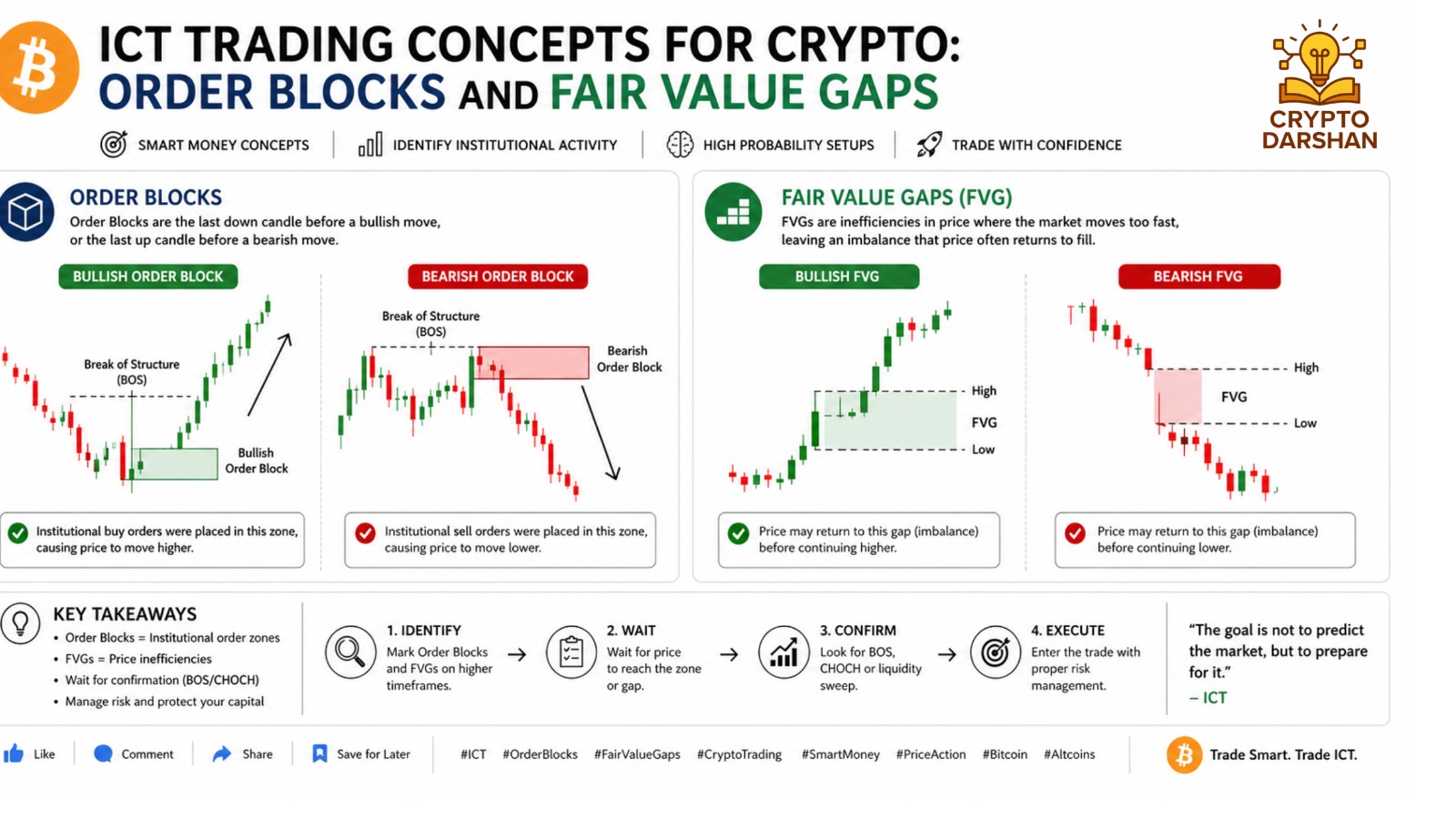
An Order Block in ICT Trading is a price zone where institutional traders have placed large buy or sell orders. These zones represent the last bullish or bearish candle before a significant market move. Order Blocks act as footprints of institutional activity and serve as potential areas of support or resistance.
- Bullish Order Block: The last bearish candle before a strong upward move.
- Bearish Order Block: The last bullish candle before a strong downward move.
Order Blocks are crucial in ICT Trading because they reveal where smart money entered the market. When price revisits these zones, it often reacts strongly, providing high-probability trade setups.
How to Identify Order Blocks
To identify an Order Block in ICT Trading:
- Look for a strong impulsive move in price.
- Identify the last opposite candle before the move.
- Mark the open and close of that candle as the Order Block zone.
- Confirm with volume or displacement (strong momentum).
For example, if Bitcoin rallies sharply after a bearish candle, that bearish candle becomes a bullish Order Block. When price retraces to that zone, it often finds support.
Why Order Blocks Work
Order Blocks work because they represent areas where institutions have unfilled orders. When price returns to these zones, institutions complete their positions, causing price to react. Retail traders can use these reactions to enter trades in the direction of the institutional move.
Trading with Order Blocks
- Identify Market Structure: Determine if the market is bullish or bearish.
- Locate the Order Block: Find the last opposite candle before the impulsive move.
- Wait for Price to Return: Allow price to retrace to the Order Block.
- Confirm Entry: Look for a Market Structure Shift or liquidity sweep.
- Set Stop-Loss: Place it below (for bullish) or above (for bearish) the Order Block.
- Take Profit: Target the next liquidity pool or Fair Value Gap.
Example in Crypto
In a bullish Bitcoin trend, a bearish candle before a strong rally may form a bullish Order Block around $25,000. If price later retraces to $25,000 and shows bullish confirmation, it signals institutional buying interest.
Fair Value Gaps in ICT Trading

What Is a Fair Value Gap?
A Fair Value Gap (FVG) in ICT Trading is a price imbalance created when price moves too quickly, leaving a gap between consecutive candles. It represents an area where not all orders were filled, creating inefficiency in the market. You can combine fair value gaps with Fibonacci retracement levels to improve entry precision and risk management.
In a three-candle pattern:
- The first candle’s high and the third candle’s low do not overlap (for bullish FVG).
- The first candle’s low and the third candle’s high do not overlap (for bearish FVG).
These gaps act as magnets for price, as the market tends to revisit them to restore balance.
Types of Fair Value Gaps
- Bullish Fair Value Gap: Occurs during a strong upward move. Price often retraces into the gap before continuing higher.
- Bearish Fair Value Gap: Occurs during a strong downward move. Price often retraces into the gap before continuing lower.
How to Identify Fair Value Gaps
To identify a Fair Value Gap in ICT Trading:
- Look for three consecutive candles with a strong displacement.
- Check if there’s a gap between the first and third candle.
- Mark the gap area as the Fair Value Gap zone.
- Wait for price to retrace into the gap for potential entries.
Why Fair Value Gaps Matter
Fair Value Gaps are important because they highlight inefficiencies in price delivery. Institutions often return to these zones to fill unexecuted orders. Traders can use FVGs to anticipate retracements and continuation moves.
Trading with Fair Value Gaps
- Identify the Trend: Determine the overall market direction.
- Locate the FVG: Find the imbalance created by strong displacement.
- Wait for Retracement: Allow price to return to the gap.
- Confirm Entry: Look for confluence with Order Blocks or liquidity sweeps.
- Set Stop-Loss: Below or above the FVG zone.
- Take Profit: At the next liquidity pool or opposing FVG.
Example in Crypto
If Ethereum surges from $1,800 to $2,000 in one candle, leaving a gap between $1,850 and $1,870, that zone becomes a bullish Fair Value Gap. When price retraces to $1,860, it often finds support before continuing upward.
Combining Order Blocks and Fair Value Gaps
In ICT Trading, the most powerful setups occur when Order Blocks and Fair Value Gaps align. This confluence increases the probability of a successful trade.
Steps to Combine Both Concepts

- Identify Market Structure: Determine the trend direction.
- Locate the Order Block: Find the institutional zone.
- Find the Fair Value Gap: Look for imbalances near the Order Block.
- Wait for Price Reaction: Allow price to retrace into the confluence zone.
- Confirm Entry: Look for a Market Structure Shift or liquidity sweep.
- Manage Risk: Place stop-loss below or above the confluence zone.
Example Setup
In a bullish Bitcoin trend:
- A bullish Order Block forms at $25,000.
- A Fair Value Gap exists between $25,000 and $25,200.
- Price retraces into this zone, sweeps liquidity, and shows bullish confirmation.
- Entry is taken at $25,100 with a target at the next liquidity pool around $26,000.
This combination of Order Block and Fair Value Gap provides a high-probability entry aligned with institutional order flow.
ICT Trading Time and Price Theory

ICT Trading emphasizes that time and price are interconnected. Certain times of the day and week are more likely to produce significant moves due to institutional activity.
Key Trading Sessions
- Asian Session: Low volatility; accumulation phase.
- London Session: High volatility; liquidity grabs and breakouts.
- New York Session: Continuation or reversal of London moves.
Optimal Trade Entry (OTE)
The Optimal Trade Entry (OTE) is a retracement entry point within the 62%–79% Fibonacci zone. It aligns with institutional retracement levels and often coincides with Order Blocks or Fair Value Gaps.
Risk Management in ICT Trading

Risk management is essential in ICT Trading. Even with high-probability setups, losses are inevitable. Proper risk control ensures long-term profitability.
Key Principles
- Risk 1–2% per Trade: Protect capital from large drawdowns.
- Use Stop-Loss Orders: Always define risk before entering.
- Set Realistic Targets: Aim for 2:1 or 3:1 reward-to-risk ratios.
- Avoid Overtrading: Focus on quality setups with confluence.
Common Mistakes in ICT Trading
- Ignoring Market Structure: Leads to trading against the trend.
- Forcing Trades: Entering without confirmation.
- Neglecting Liquidity: Missing institutional targets.
- Overcomplicating Analysis: Simplicity improves consistency.
- Lack of Patience: Waiting for price to reach key zones is crucial.
Applying ICT Trading to Crypto Markets

Cryptocurrency markets are ideal for ICT Trading due to their volatility and liquidity-driven nature. Bitcoin, Ethereum, and other major coins often display clear Order Blocks and Fair Value Gaps.
Benefits of ICT Trading in Crypto
- High Volatility: Creates frequent imbalances and liquidity sweeps.
- Transparency: Price action is easily observable on all timeframes.
- Institutional Presence: Large players influence crypto markets similarly to forex.
Example: Bitcoin ICT Setup
- Market Structure: Bullish.
- Bullish Order Block: $25,000 zone.
- Fair Value Gap: $25,000–$25,200.
- Entry: $25,100 after liquidity sweep.
- Stop-Loss: $24,900.
- Target: $26,000.
This setup aligns with ICT Trading principles, combining structure, liquidity, and imbalance.
Advanced ICT Trading Concepts

Liquidity Voids
A Liquidity Void is a large price movement with minimal retracement. It often acts as a magnet for price to return later. Liquidity Voids are similar to Fair Value Gaps but occur on higher timeframes.
Breaker Blocks
A Breaker Block forms when an Order Block fails and price breaks through it. It then acts as a reversal zone. Breaker Blocks are used to identify failed institutional setups.
Mitigation Blocks
A Mitigation Block occurs when price returns to an Order Block to fill remaining orders before continuing in the original direction. It represents institutional re-entry.
Building an ICT Trading Strategy

1. Analyze Higher Timeframes
Start by studying higher timeframes like the daily or 4-hour chart. This helps identify the overall market trend and key institutional zones. Higher timeframes reveal where major liquidity and Order Blocks are located, guiding lower timeframe entries.
2. Mark Liquidity Pools
Locate areas where stop-loss orders are likely resting, above swing highs and below swing lows. These zones act as liquidity pools that institutions target before reversing price. Knowing where liquidity lies helps anticipate potential market moves.
3. Identify Order Blocks and Fair Value Gaps

Spot the last bullish or bearish candle before a strong move (Order Block) and any price imbalances (Fair Value Gaps). These areas often act as magnets for price and serve as high-probability entry or exit zones.
4. Wait for Confirmation
Patience is key. Wait for a Market Structure Shift (MSS) or liquidity sweep before entering. This confirms that institutions are active and the market is ready to move in the desired direction.
5. Enter with Precision
Use retracements or Optimal Trade Entry (OTE) zones—typically between 62% and 79% Fibonacci levels—to enter trades. Combine this with confluence from Order Blocks or Fair Value Gaps for higher accuracy.
6. Manage Risk
Always define risk before entering a trade. Place stop-loss orders below bullish setups or above bearish ones. Aim for at least a 2:1 reward-to-risk ratio to ensure long-term profitability.
7. Review and Refine
After each trade, review what worked and what didn’t. Analyze entries, exits, and market conditions. Continuous refinement helps improve consistency and confidence in applying ICT Trading principles.
FAQ: ICT Trading Concepts for Crypto

1. What are ICT trading concepts in crypto?
ICT (Inner Circle Trader) concepts are advanced trading strategies focused on institutional behavior. They help traders understand how smart money moves the market using tools like order blocks, liquidity zones, and fair value gaps.
2. What is an order block in crypto trading?
An order block is a price zone where large institutional orders were placed, causing a strong move in the market. These zones often act as support or resistance when price revisits them.
3. What is a Fair Value Gap (FVG)?
A Fair Value Gap (FVG) is an imbalance in price where the market moves too quickly, leaving a gap between candles. Price often returns to this area to “fill” the imbalance before continuing its trend.
4. How do order blocks work in Bitcoin and altcoins?
Order blocks represent areas where institutions accumulated or distributed positions. When price returns to these zones, traders look for reactions like reversals or continuations.
5. How can traders identify a valid order block?
A strong order block usually has:
- A sharp price move away from the zone.
- High trading volume.
- Clear structure break (change in market direction).
6. How do you trade Fair Value Gaps?
Traders typically:
- Wait for price to return to the gap.
- Look for confirmation (candlestick patterns or structure)
- Enter trades in the direction of the trend.
7. Are ICT concepts suitable for beginners?
ICT concepts can be complex for beginners. It’s recommended to first learn basic price action, support/resistance, and market structure before applying these strategies.
8. What is the difference between order blocks and support/resistance?
- Support/Resistance: General price levels where price reacts.
- Order Blocks: Specific institutional zones with strong buying/selling activity.
Conclusion
The ICT Trading methodology offers a deep understanding of how institutional traders move markets. By mastering concepts like Order Blocks and Fair Value Gaps, traders can identify high-probability setups and align with smart money flow. In the volatile world of cryptocurrency, ICT Trading provides clarity, structure, and precision.
From analyzing market structure to identifying liquidity zones, ICT Trading transforms how traders view price action. It shifts focus from random movements to purposeful manipulation, allowing traders to anticipate rather than react. Whether trading Bitcoin, Ethereum, or altcoins, applying ICT Trading principles can significantly enhance consistency and profitability.
By combining Order Blocks, Fair Value Gaps, and liquidity analysis, traders gain a complete roadmap for navigating crypto markets with confidence and discipline.