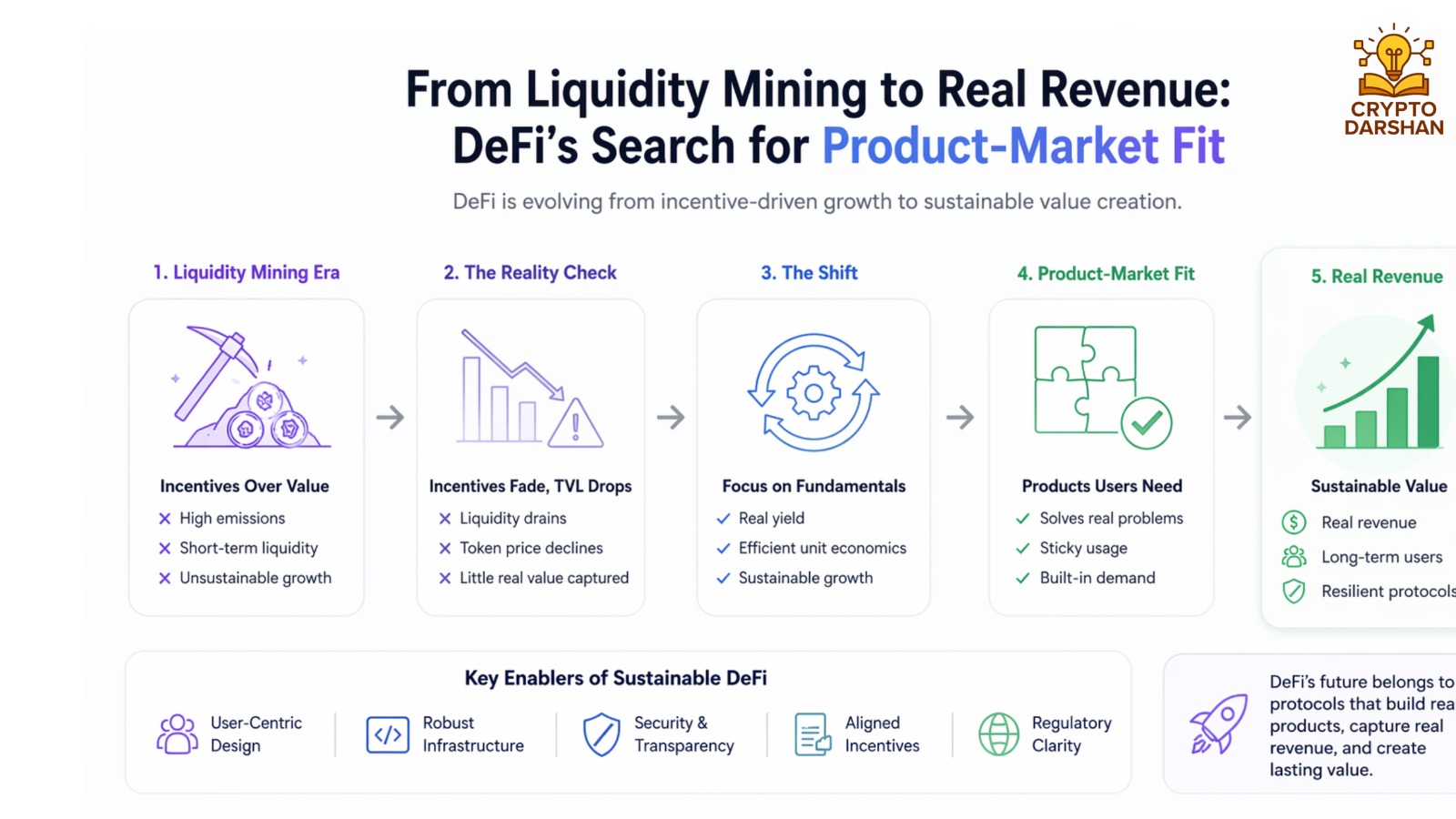
Decentralized Finance (DeFi) has transformed the way people think about money, banking, and investing. Built on blockchain technology, DeFi removes intermediaries and allows users to interact directly with financial protocols. In its early years, DeFi was driven by innovation, speculation, and the promise of high yields. Liquidity mining, yield farming, and token incentives became the engines of growth. However, as the market matured, it became clear that these mechanisms were not sustainable long-term. The next phase of DeFi’s evolution focuses on finding real product‑market fit, creating products that generate sustainable revenue and deliver genuine value to users.
This article explores the journey of DeFi from liquidity mining to real revenue. It examines the challenges of token‑driven growth, the shift toward sustainable business models, and the emerging trends that define the future of decentralized finance.
The Rise of DeFi and the Liquidity Mining Boom

The Birth of DeFi
DeFi began as an experiment in open finance. Early projects like MakerDAO, Compound, and Uniswap introduced decentralized lending, borrowing, and trading. These protocols allowed users to earn interest, provide liquidity, and trade assets without relying on centralized exchanges or banks. The concept of “money legos” emerged developers could combine different protocols to create new financial products.
Liquidity Mining Explained
Liquidity mining is a way for users to earn extra income with their crypto through a protocol within decentralized finance (DeFi), by making their crypto available in exchange for rewards. The model became a major catalyst for DeFi’s explosive growth in 2020, a period widely known as “DeFi Summer.”
Under this system, users who deposited assets into liquidity pools received governance tokens as incentives. These tokens often represented voting rights and partial ownership in the protocol, and their market prices frequently surged during the early DeFi boom.
The result was a powerful growth cycle: as liquidity increased, protocols became more attractive to traders and investors, which boosted activity and token demand, drawing even more participants into the ecosystem.
The Yield Farming Craze
Yield farming took liquidity mining to the next level. Users began moving funds between protocols to chase the highest yields. Complex strategies emerged, involving multiple layers of staking, lending, and borrowing. Platforms like Yearn Finance automated these strategies, making it easier for users to maximize returns. The result was a frenzy of activity and innovation, but also a growing sense of instability. Many of these newer yield models are connected to staking-based strategies, particularly liquid staking tokens that allow users to earn staking rewards while still using their assets across DeFi protocols. These mechanisms are explored in more detail in Liquid Staking Explained: LSTs, Restaking, and New DeFi Yields.
The Problem with Token‑Driven Growth

Unsustainable Incentives
Liquidity mining and yield farming were effective at bootstrapping liquidity, but they came with a cost. Most of the growth was driven by token incentives rather than genuine demand for the product. When token rewards decreased or prices fell, liquidity often vanished. This created a cycle of short‑term growth followed by sharp declines.
The “Ponzinomics” Critique
Critics argued that many DeFi projects relied on “Ponzinomics” using new investors’ funds to pay returns to earlier participants. While not always accurate, the criticism highlighted a real issue: many protocols lacked sustainable revenue streams. Token emissions diluted value over time, and without real utility or cash flow, token prices eventually collapsed.
User Retention Challenges
DeFi users became highly mercenary, moving funds wherever yields were highest. This made it difficult for protocols to build loyal communities or long‑term user bases. Without sticky products or meaningful differentiation, many projects struggled to retain users once incentives ended.
The Shift Toward Sustainable Revenue

The Need for Real Business Models
As the hype faded, DeFi projects began focusing on sustainability. The goal shifted from attracting liquidity at any cost to building products that generate real revenue. This required rethinking tokenomics, improving user experience, and identifying genuine market needs.
Protocol Fees and Revenue Sharing
Many protocols introduced fees for services such as trading, borrowing, or staking. These fees created a source of real revenue that could be shared with token holders or reinvested into the protocol. For example, Uniswap introduced a small trading fee that goes to liquidity providers, while Curve and Aave implemented similar mechanisms to reward participants sustainably.
Treasury Management and Diversification
Protocols began managing their treasuries more strategically. Instead of relying solely on native tokens, they diversified holdings into stablecoins or other assets. This allowed them to fund development, pay contributors, and weather market downturns without constant token dilution.
Case Studies: DeFi Projects Finding Product‑Market Fit

Uniswap: From Incentives to Utility
Uniswap’s success lies in its simplicity and utility. As an automated market maker (AMM), it allows users to trade tokens directly from their wallets. While early growth was fueled by liquidity mining, Uniswap’s real strength came from its product design. The protocol generates consistent trading fees, and its brand has become synonymous with decentralized trading. Uniswap’s focus on user experience and reliability helped it achieve genuine product‑market fit.
Aave: Building a Sustainable Lending Market
Aave started as a simple lending platform but evolved into a robust ecosystem. It generates revenue through interest rate spreads and protocol fees. Aave’s innovation in flash loans and collateral management attracted both retail and institutional users. By focusing on security, transparency, and continuous improvement, Aave built a sustainable business model that doesn’t rely on token emissions.
MakerDAO: Real‑World Collateral and Stability
MakerDAO pioneered decentralized stablecoins with DAI, backed by crypto collateral. Over time, it expanded to include real‑world assets (RWAs) such as tokenized bonds and loans. This diversification created stable revenue streams and reduced dependence on volatile crypto markets. MakerDAO’s integration of RWAs represents a major step toward bridging DeFi and traditional finance.
Curve Finance: Specialization and Efficiency
Curve Finance focused on stablecoin trading, optimizing for low slippage and high capital efficiency. Its specialized design attracted large volumes and institutional liquidity. Curve’s governance model and fee structure ensure that participants are rewarded based on long‑term engagement rather than short‑term speculation.
The Role of Tokenomics in Sustainable Growth

Redefining Token Utility
Tokens remain central to DeFi, but their role is evolving. Instead of serving purely as speculative assets, tokens are being designed to capture real value. This includes governance rights, revenue sharing, staking rewards, and access to premium features. The goal is to align incentives between users, developers, and investors.
Reducing Emissions and Inflation
Many protocols have reduced token emissions to prevent dilution. Some have introduced buyback and burn mechanisms, where a portion of protocol revenue is used to repurchase tokens from the market. This creates deflationary pressure and ties token value directly to protocol performance.
Governance and Decentralization
Effective governance is key to long‑term sustainability. Decentralized autonomous organizations (DAOs) allow token holders to vote on proposals, allocate funds, and shape protocol direction. However, governance must balance decentralization with efficiency. Too much bureaucracy can slow innovation, while too little oversight can lead to mismanagement.
The Institutionalization of DeFi

The Entry of Institutional Capital
As DeFi matured, institutional investors began to take notice. Hedge funds, venture capital firms, and even banks started exploring DeFi opportunities. They were attracted by the transparency, efficiency, and yield potential of blockchain‑based finance. However, institutions demanded higher standards of security, compliance, and risk management.
Compliance and Regulation
Regulation has become a defining issue for DeFi’s future. Governments and regulators are developing frameworks to address concerns around money laundering, consumer protection, and financial stability. While some fear that regulation could stifle innovation, others see it as necessary for mainstream adoption. Projects that proactively engage with regulators and implement compliance measures are better positioned for long‑term success.
The Rise of Hybrid Models
A new wave of “CeDeFi” (Centralized‑Decentralized Finance) platforms is emerging, combining the transparency of DeFi with the compliance and user experience of traditional finance. These hybrid models aim to bridge the gap between crypto‑native users and institutional investors, creating a more inclusive financial ecosystem.
Real Revenue Streams in DeFi

Trading Fees
Trading remains one of the most reliable sources of revenue in DeFi. AMMs like Uniswap, SushiSwap, and Curve generate millions in daily fees. These fees are distributed to liquidity providers or used to fund protocol development. As trading volumes grow, these revenue streams become increasingly significant.
Lending and Borrowing Interest
Lending protocols such as Aave, Compound, and MakerDAO earn revenue from interest rate spreads. Borrowers pay interest on loans, while lenders earn a portion of that interest. The difference funds protocol operations and reserves. This model mirrors traditional banking but operates transparently on the blockchain.
Liquidation and Stability Fees
In lending protocols, liquidations occur when collateral values fall below required thresholds. The fees generated from these events contribute to protocol revenue. Similarly, stability fees in systems like MakerDAO ensure that stablecoins maintain their peg while generating income for the protocol.
Staking and Validator Rewards
Proof‑of‑stake (PoS) networks reward validators for securing the network. DeFi protocols built on these networks can share staking rewards with users. This creates a sustainable yield based on network activity rather than inflationary token emissions.
Real‑World Asset Integration
The tokenization of real‑world assets (RWAs) such as real estate, bonds, and invoices is unlocking new revenue opportunities. Protocols like Centrifuge and Goldfinch enable investors to earn yield from real‑world credit markets. This diversification reduces reliance on crypto market cycles and introduces stable, predictable income streams.
Challenges on the Road to Product‑Market Fit

Security and Smart Contract Risks
Security remains a major concern in DeFi. Hacks, exploits, and rug pulls have cost users billions of dollars. Achieving product‑market fit requires building trust through rigorous audits, bug bounties, and transparent governance. Without security, even the most innovative products cannot sustain long‑term growth.
User Experience and Accessibility
DeFi interfaces are often complex and intimidating for newcomers. Wallet management, gas fees, and transaction confirmations can be confusing. Simplifying user experience is essential for mass adoption. Projects that prioritize intuitive design and education are more likely to achieve lasting success.
Market Volatility
Crypto markets are inherently volatile, which affects DeFi protocols that rely on collateralized assets. Sudden price swings can trigger liquidations and destabilize systems. Developing mechanisms for risk management, such as insurance pools and dynamic collateral ratios, is crucial for stability.
Regulatory Uncertainty
Unclear or inconsistent regulations create uncertainty for developers and investors. While some jurisdictions embrace DeFi innovation, others impose strict restrictions. Navigating this landscape requires adaptability and proactive engagement with policymakers.
Emerging Trends Shaping DeFi’s Future

Layer‑2 Scaling Solutions
High gas fees and network congestion on Ethereum have limited DeFi’s scalability. Layer‑2 solutions like Arbitrum, Optimism, and zkSync are addressing these issues by processing transactions off‑chain while maintaining security. This reduces costs and improves speed, making DeFi more accessible to everyday users.
Cross‑Chain Interoperability
The future of DeFi is multi‑chain. Projects like Cosmos, Polkadot, and Chainlink are enabling seamless communication between blockchains. Cross‑chain bridges allow assets and data to move freely, expanding liquidity and unlocking new use cases.
Decentralized Identity and Reputation
Decentralized identity (DID) systems are emerging to solve trust issues in DeFi. By linking on‑chain activity to verifiable credentials, users can build reputations without sacrificing privacy. This enables credit scoring, undercollateralized lending, and personalized financial services.
Real‑World Adoption and Integration
DeFi 2.0 refers to the next generation of protocols focused on sustainability, capital efficiency, and user ownership. These projects aim to fix the flaws of early DeFi by introducing mechanisms such as protocol-owned liquidity, dynamic incentives, and self-repaying loans. The emphasis is shifting toward long-term value creation rather than short-term speculation.
As the ecosystem matures, new experiments are also emerging at the intersection of decentralized finance and artificial intelligence, where protocols aim to generate sustainable revenue through data, automation, and algorithmic strategies. This trend is explored further in Top AI Crypto Coins in 2026: Where Smart Money Is Going.
Measuring Product‑Market Fit in DeFi

Key Metrics
- Revenue Growth: Sustainable, recurring revenue from fees or services.
- User Retention: Consistent user activity without reliance on incentives.
- Liquidity Stability: Steady liquidity levels even after token rewards end.
- Governance Participation: Active community involvement in decision‑making.
- Protocol Security: Minimal exploits and strong audit history.
Community and Ecosystem Development
A strong community is a sign of product‑market fit. Engaged users contribute to governance, provide feedback, and promote the protocol organically. Ecosystem partnerships, integrations, and developer activity also indicate healthy growth.
Real‑World Impact
Ultimately, product‑market fit means solving real problems. DeFi protocols that improve financial access, reduce costs, or enable new forms of economic participation demonstrate genuine value. The more DeFi integrates into everyday life, the closer it comes to achieving its mission.
The Road Ahead: Building the Future of Finance
DeFi’s journey from liquidity mining to real revenue marks a turning point in the evolution of blockchain technology. The early phase of experimentation and speculation laid the groundwork for innovation, but sustainability requires more than token incentives. The next generation of DeFi projects must focus on real utility, robust governance, and long‑term value creation.
The future of DeFi will likely blend decentralized infrastructure with real‑world applications. As regulation matures and technology scales, DeFi has the potential to become the backbone of a new financial system one that is open, transparent, and accessible to all.
The Human Element: Trust, Education, and Inclusion

Building Trust in a Trustless System
While DeFi is built on the principle of “trustless” transactions, human trust remains essential. Users must believe that protocols are secure, transparent, and fair. Building this trust requires consistent communication, open‑source development, and community engagement. Projects that hide behind anonymity or lack transparency often struggle to gain credibility.
Financial Education and Onboarding
Education is one of the biggest barriers to DeFi adoption. Many potential users are unfamiliar with blockchain concepts, private keys, or smart contracts. Simplified interfaces, tutorials, and educational campaigns can help bridge this gap. As users become more comfortable with DeFi tools, adoption will accelerate.
Inclusion and Global Access
DeFi’s promise lies in financial inclusion. In regions with limited access to banking, DeFi offers an alternative. Anyone with an internet connection can lend, borrow, or invest without permission. This democratization of finance can empower millions, especially in developing economies where traditional systems exclude large populations.
The Role of Innovation and Collaboration

Open‑Source Development
DeFi thrives on open‑source collaboration. Developers can build on existing protocols, fork codebases, and create new combinations of financial tools. This culture of innovation accelerates progress and ensures that the best ideas rise to the top. However, it also requires strong community governance to prevent fragmentation and maintain quality.
Partnerships and Ecosystem Growth
Collaboration between DeFi projects, traditional institutions, and regulators will shape the next phase of growth. Partnerships can bring liquidity, compliance, and credibility to the ecosystem.
For example, collaborations between DeFi protocols and fintech companies can create hybrid products that appeal to both crypto‑native and mainstream users.
Continuous Experimentation
DeFi’s strength lies in its ability to experiment rapidly. New models such as algorithmic stablecoins, synthetic assets, and decentralized insurance continue to push boundaries. While not all experiments succeed, each contributes to the collective learning that drives the industry forward.
FAQ: From Liquidity Mining to Real Revenue in DeFi

1. What is liquidity mining in DeFi?
Liquidity mining is a reward mechanism where DeFi protocols distribute tokens to users who provide liquidity to their platforms. By depositing assets into liquidity pools, users earn incentives such as governance tokens, trading fees, or additional yield.
2. Why did early DeFi protocols rely on liquidity mining?
Early DeFi projects used liquidity mining to quickly attract users, bootstrap liquidity, and build network effects. Token rewards encouraged participation even before protocols generated sustainable revenue.
3. What problems did liquidity mining create?
Liquidity mining often created short-term incentives rather than long-term users. When token rewards decreased, liquidity frequently moved to other platforms offering higher yields, leading to unstable ecosystems and unsustainable token emissions.
4. What does “real revenue” mean in DeFi?
Real revenue refers to income generated from actual product usage, such as trading fees, lending interest, liquidation penalties, or protocol services. Unlike token emissions, this revenue comes from genuine economic activity.
5. Why is real revenue important for DeFi sustainability?
Real revenue makes DeFi protocols more sustainable because it reduces reliance on inflationary token rewards. Protocols that generate consistent fees can fund development, reward contributors, and support long-term growth.
6. How are modern DeFi protocols generating revenue?
Many newer DeFi protocols generate revenue through trading fees, lending spreads, derivatives markets, asset management services, and infrastructure services. Some protocols also share a portion of revenue with token holders or stakers.
7. What is protocol revenue sharing in DeFi?
Protocol revenue sharing distributes a portion of platform earnings to token holders, stakers, or governance participants. This model aligns incentives between users and the protocol by rewarding long-term participation.
8. How does product-market fit apply to DeFi?
Product-market fit in DeFi means a protocol solves a real financial need and attracts consistent users without relying heavily on token incentives. Sustainable DeFi platforms retain users because their products deliver genuine value.
Conclusion
DeFi’s search for product‑market fit is reshaping the landscape of digital finance. The era of liquidity mining and unsustainable yields is giving way to a more mature, revenue‑driven ecosystem. Projects that prioritize real utility, security, and user experience are emerging as leaders. By aligning incentives, embracing regulation, and integrating with the broader economy, DeFi can move beyond speculation and build lasting value.
The transition from liquidity mining to real revenue is not just a business evolution it is a philosophical shift. It represents DeFi’s maturation from an experimental playground to a legitimate financial system capable of transforming global markets. The protocols that succeed in this new era will be those that deliver genuine solutions, create sustainable income, and earn the trust of users worldwide.