
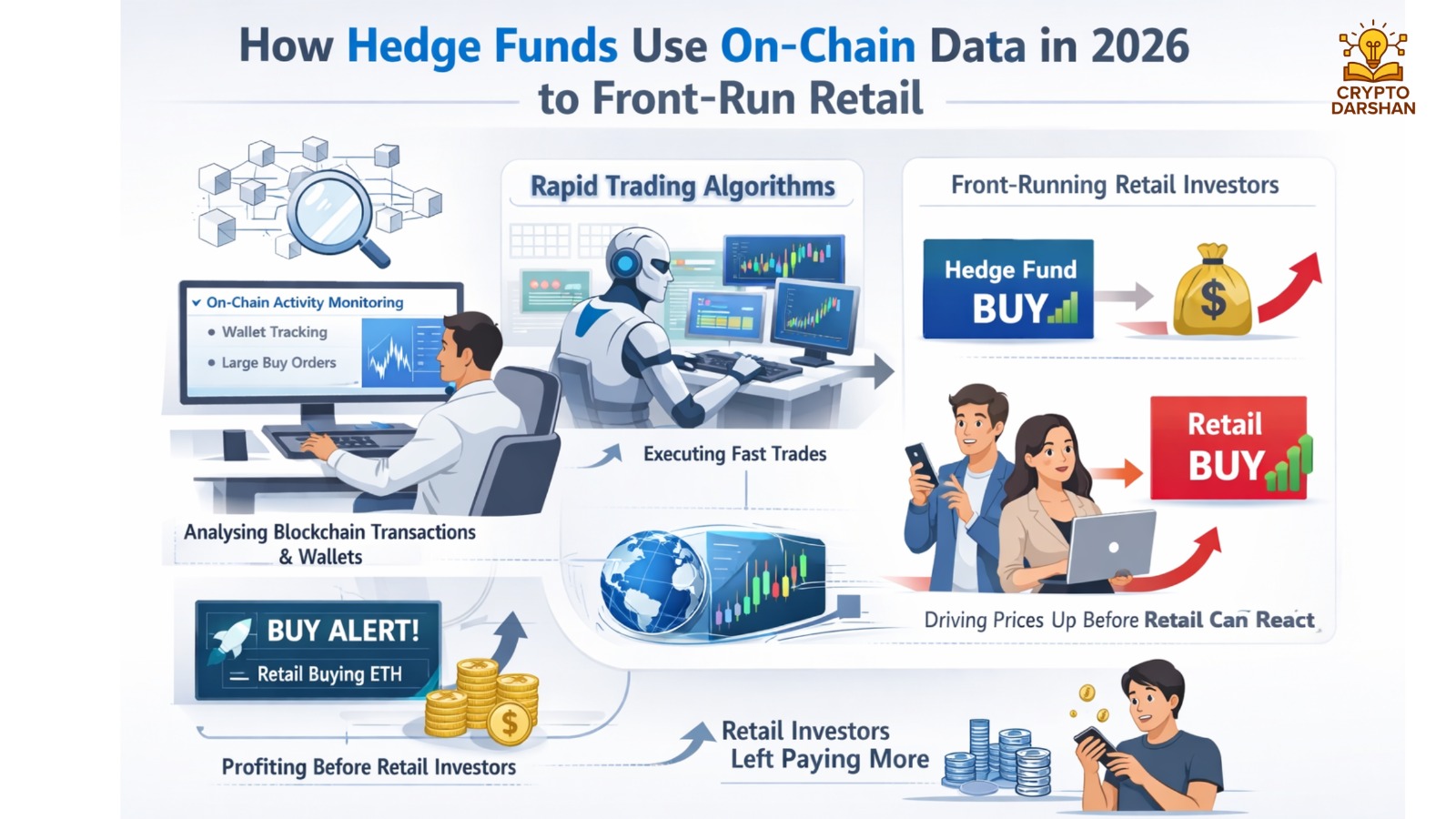
In 2026, the cryptocurrency market has matured into a trillion‑dollar ecosystem where institutional players dominate trading volumes. Hedge funds, once cautious about digital assets, now deploy sophisticated strategies powered by artificial intelligence, machine learning, and on‑chain analytics. These tools allow them to anticipate market movements, identify liquidity flows, and, in many cases, front‑run retail investors. Understanding how hedge funds use on‑chain data provides insight into the evolving power dynamics of decentralized finance (DeFi) and the broader blockchain economy.
This article explores how hedge funds leverage on‑chain data to gain an edge, the technologies behind their strategies, the ethical and regulatory implications, and what retail investors can do to protect themselves. The discussion covers blockchain transparency, data aggregation, predictive modeling, and the rise of algorithmic trading in decentralized markets.
1. The Rise of On‑Chain Data as a Strategic Asset

1.1 The Transparency Advantage
Blockchain technology records every transaction on a public ledger. This transparency creates a unique data environment where anyone can observe wallet movements, token transfers, and smart contract interactions in real time. For hedge funds, this is a goldmine of actionable intelligence. Unlike traditional finance, where insider information is tightly regulated and often hidden, blockchain data is open to all—yet only those with the tools and expertise to interpret it can extract value.
1.2 From Raw Data to Market Intelligence
Raw blockchain data is vast and unstructured. Hedge funds use specialized analytics platforms to transform this data into usable insights. These platforms aggregate information from multiple blockchains, index smart contracts, and apply machine learning models to detect patterns. The result is a continuous stream of intelligence that can inform trading decisions, risk management, and portfolio optimization.
1.3 The Institutional Shift Toward Data‑Driven Crypto Strategies
By 2026, most major hedge funds have dedicated crypto divisions. These teams combine quantitative analysts, data scientists, and blockchain engineers. Their goal is to exploit inefficiencies in decentralized markets. On‑chain data allows them to monitor liquidity pools, track whale movements, and identify arbitrage opportunities before retail traders react.
2. Understanding Front‑Running in the Blockchain Era

2.1 What Is Front‑Running?
Front‑running occurs when a trader uses advanced knowledge of pending transactions to execute trades ahead of others, profiting from the subsequent price movement. Front-running, also known as tailgating, is the illegal act of trading stocks, bonds, or other securities based on insider knowledge of a pending transaction that’ll affect their price. In traditional markets, this practice is illegal. However, in decentralized finance, where transactions are publicly visible in the mempool before confirmation, front‑running can occur algorithmically and often within legal gray areas.
2.2 The Role of the Mempool
The mempool is a waiting area for unconfirmed blockchain transactions. Hedge funds monitor mempool data to detect large pending trades, especially those involving decentralized exchanges (DEXs). By identifying these transactions early, they can execute their own trades first, influencing prices and capturing profits before the original transaction is finalized.
2.3 MEV: Miner Extractable Value and Its Evolution
Miner Extractable Value (MEV), now often referred to as Maximal Extractable Value, represents the profit that can be made by reordering, including, or excluding transactions within a block. Hedge funds in 2026 use MEV bots and private relay networks to capture MEV opportunities. These systems analyze transaction flows and strategically position trades to benefit from predictable price movements.
3. The Tools and Technologies Behind On‑Chain Intelligence

3.1 Blockchain Analytics Platforms
Hedge funds rely on advanced analytics platforms such as Nansen, Arkham Intelligence, and proprietary in‑house systems. These platforms provide dashboards that visualize wallet activity, token flows, and liquidity movements. They also integrate with APIs that deliver real‑time alerts when significant transactions occur.
3.2 Machine Learning and Predictive Modeling
Machine learning models process historical on‑chain data to forecast future market behavior. These models can identify correlations between wallet activity and price changes, detect accumulation or distribution phases, and predict token launches or liquidity migrations. By 2026, many hedge funds use reinforcement learning algorithms that continuously adapt to new data.
3.3 Natural Language Processing for Sentiment Analysis
In addition to on‑chain data, hedge funds analyze off‑chain signals such as social media sentiment, news headlines, and governance proposals. Natural language processing (NLP) models extract sentiment trends and correlate them with on‑chain activity. This fusion of data sources enhances predictive accuracy and helps funds anticipate retail behavior.
3.4 Private Node Infrastructure and Low‑Latency Execution
Speed is critical in front‑running strategies. Hedge funds operate private blockchain nodes to reduce latency and ensure faster access to mempool data. They also use private transaction relays to bypass public mempools, minimizing the risk of being front‑run themselves. These infrastructures mirror high‑frequency trading setups in traditional finance.
4. Case Studies: How Hedge Funds Exploit On‑Chain Data

4.1 Liquidity Pool Monitoring
Hedge funds track liquidity movements across decentralized exchanges like Uniswap, Curve, and Balancer. When large liquidity providers add or remove funds, it signals potential price shifts. By analyzing these patterns, funds can anticipate market direction and adjust positions accordingly.
4.2 Whale Tracking and Behavioral Analysis
Whales, wallets holding large amounts of cryptocurrency, often influence market sentiment. Hedge funds maintain databases of known whale addresses and monitor their activity. When a whale begins accumulating a token, it can indicate an upcoming rally. Conversely, large sell‑offs may precede price declines. Automated systems detect these movements and trigger algorithmic trades.
4.3 Token Launch Arbitrage
New token launches and airdrops create temporary inefficiencies. Hedge funds use bots to scan for new smart contracts, assess liquidity conditions, and execute trades within seconds of launch. By entering early, they capture price appreciation before retail traders can react.
4.4 Cross‑Chain Arbitrage
With the rise of multi‑chain ecosystems, price discrepancies often occur between blockchains. Hedge funds deploy cross‑chain bots that monitor token prices across networks like Ethereum, Solana, and Avalanche. When a price gap appears, the bots execute simultaneous buy and sell orders to lock in risk‑free profits.
To truly understand how hedge funds extract an edge, it’s important to explore the tools behind the data. In our guide on Blockchain Analytics Tools: How On-Chain Data Fights Fraud and Crime, we break down the platforms and dashboards institutions use to monitor wallet activity, detect patterns, and act before the market reacts.
5. The Ethical and Regulatory Landscape

5.1 The Legal Gray Zone of On‑Chain Front‑Running
While front‑running is illegal in traditional markets, decentralized finance operates under different rules. Transactions are public, and anyone can act on visible data. Regulators face challenges defining what constitutes unfair advantage in a permissionless environment. Some jurisdictions are beginning to classify certain MEV practices as market manipulation, but enforcement remains limited.
5.2 Transparency vs. Exploitation
Blockchain transparency was designed to promote fairness, yet it also enables exploitation. Hedge funds argue that their strategies simply leverage publicly available information. Critics contend that these practices undermine the spirit of decentralization by concentrating power among those with superior resources.
5.3 The Role of Regulators in 2026
By 2026, regulatory bodies such as the SEC, ESMA, and MAS have introduced frameworks for DeFi oversight. These include disclosure requirements for algorithmic trading systems and guidelines for fair transaction ordering. However, enforcement remains fragmented across jurisdictions, allowing hedge funds to operate in regulatory arbitrage zones.
6. The Evolution of MEV and Private Marketplaces

6.1 The Rise of MEV‑Resistant Protocols
Developers have introduced MEV‑resistant designs such as encrypted mempools and fair sequencing services. These systems aim to prevent front‑running by concealing transaction details until confirmation. However, hedge funds often find ways to adapt, using statistical inference and cross‑chain data to maintain their edge.
6.2 Private Order Flow and Dark Pools in DeFi
Private order flow mechanisms, similar to dark pools in traditional finance, have emerged in DeFi. Hedge funds use these private marketplaces to execute large trades without revealing their intentions. While this reduces slippage, it also decreases transparency, raising concerns about market fairness.
6.3 The Integration of Zero‑Knowledge Proofs
Zero‑knowledge proofs (ZKPs) allow transactions to be verified without revealing details. Some DeFi protocols now use ZKPs to protect user privacy. Hedge funds, however, employ advanced cryptographic analysis to infer hidden patterns, maintaining partial visibility into private markets.
7. Data Sources and Analytical Frameworks

7.1 On‑Chain Metrics
Key on‑chain metrics include transaction volume, active addresses, token velocity, and liquidity depth. Hedge funds use these indicators to assess market health and identify accumulation zones. For example, a rise in active addresses combined with stable prices may signal stealth accumulation.
7.2 Smart Contract Interactions
Analyzing smart contract interactions reveals user behavior. Hedge funds monitor contract calls to detect new staking activities, governance votes, or yield farming migrations. These insights help predict capital flows across protocols.
7.3 Wallet Clustering and Entity Attribution
Through clustering algorithms, hedge funds group wallet addresses that likely belong to the same entity. This process uncovers relationships between exchanges, market makers, and large investors. Entity attribution enhances the accuracy of behavioral models and improves risk assessment.
7.4 Cross‑Referencing Off‑Chain Data
Combining on‑chain data with off‑chain sources such as exchange order books, social media sentiment, and macroeconomic indicators provides a holistic view of market dynamics. Hedge funds integrate these datasets into unified dashboards for real‑time decision‑making.
8. The Role of Artificial Intelligence in On‑Chain Trading

8.1 Reinforcement Learning Agents
Reinforcement learning agents simulate trading environments and learn optimal strategies through trial and error. These agents continuously adapt to changing market conditions, improving execution efficiency and profitability.
8.2 Predictive Analytics for Token Movements
AI models analyze historical price data, liquidity changes, and wallet activity to forecast token movements. Predictive analytics enables hedge funds to position themselves ahead of major market shifts, effectively front‑running retail sentiment.
8.3 Anomaly Detection and Risk Management
Machine learning algorithms detect anomalies such as sudden liquidity withdrawals or unusual transaction patterns. These alerts help hedge funds manage risk and avoid exposure to potential exploits or rug pulls.
8.4 Automated Governance Participation
Some hedge funds use AI to participate in decentralized governance. By analyzing proposals and voting patterns, they influence protocol decisions that align with their investment strategies.
9. The Impact on Retail Investors

9.1 The Information Asymmetry Problem
Although blockchain data is public, interpreting it requires advanced tools and expertise. Retail investors often lack access to institutional‑grade analytics, creating an information asymmetry that favors hedge funds. This imbalance allows institutions to anticipate retail behavior and trade accordingly.
9.2 Slippage and Price Manipulation
When hedge funds front‑run retail transactions, retail traders experience slippage, buying at higher prices or selling at lower ones. Over time, this erodes profitability and discourages participation in decentralized markets.
9.3 The Rise of Retail Analytics Tools
To level the playing field, new platforms offer simplified on‑chain analytics for retail users. These tools provide wallet tracking, token alerts, and sentiment analysis. While helpful, they still lag behind institutional systems in speed and depth.
9.4 Education and Awareness
Retail investors increasingly recognize the importance of understanding on‑chain data. Educational initiatives and community‑driven analytics projects aim to democratize access to blockchain intelligence, fostering a more informed user base.
10. Countermeasures and Emerging Solutions

10.1 Encrypted Mempools
Encrypted mempools conceal transaction details until confirmation, preventing front‑running. Projects like Flashbots Protect and Eden Network have pioneered such solutions, offering users private transaction submission channels.
10.2 Fair Sequencing Services
Fair sequencing services randomize transaction ordering to eliminate priority advantages. These systems ensure that all transactions within a block are processed equitably, reducing MEV exploitation.
10.3 Decentralized Privacy Layers
Privacy‑focused protocols integrate zero‑knowledge proofs and homomorphic encryption to obscure transaction data. This limits the ability of hedge funds to analyze wallet behavior in real time.
10.4 Community‑Driven Transparency Initiatives
Open‑source analytics projects promote transparency by exposing MEV activities and front‑running patterns. By making this information public, they pressure institutions to adopt fairer practices.
11. The Future of On‑Chain Data and Institutional Trading

11.1 Integration with Traditional Finance
As tokenization expands, traditional assets such as stocks, bonds, and real estate are increasingly represented on‑chain. Hedge funds apply the same analytical frameworks to these tokenized assets, merging DeFi and TradFi strategies.
11.2 Quantum Computing and Cryptographic Challenges
Quantum computing poses potential risks to blockchain encryption. Hedge funds invest in quantum‑resistant algorithms and explore quantum‑enhanced data analysis to maintain their competitive edge.
11.3 The Rise of Autonomous Funds
Autonomous hedge funds operate with minimal human intervention, relying entirely on AI‑driven decision systems. These entities continuously analyze on‑chain data, execute trades, and optimize portfolios without manual oversight.
11.4 Ethical AI and Responsible Trading
As AI‑driven trading becomes dominant, ethical considerations gain importance. Industry groups advocate for responsible AI use, transparency in algorithmic decision‑making, and adherence to fair market principles.
12. Strategic Implications for the Crypto Ecosystem

12.1 Market Efficiency vs. Manipulation
Hedge funds argue that their activities enhance market efficiency by narrowing price discrepancies and providing liquidity. Critics counter that excessive front‑running distorts price discovery and undermines trust in decentralized systems.
12.2 The Institutionalization of DeFi
Institutional participation brings stability and liquidity but also centralization risks. As hedge funds dominate trading volumes, governance power may shift away from grassroots communities toward corporate entities.
12.3 Innovation Driven by Competition
The presence of hedge funds accelerates innovation in DeFi infrastructure. Developers create new protocols to counteract institutional advantages, leading to more robust and privacy‑preserving systems.
12.4 The Role of Decentralized Autonomous Organizations (DAOs)
DAOs play a growing role in setting ethical standards and governance frameworks. Community‑led initiatives can influence how data is used and ensure that DeFi remains open and equitable.
13. Practical Steps for Retail Investors

13.1 Monitoring On‑Chain Activity
Retail investors can use free or low‑cost analytics tools to track wallet movements and liquidity changes. Staying informed about large transactions helps anticipate market volatility.
13.2 Using Private Transaction Channels
Submitting transactions through private relays reduces exposure to front‑running. Many wallets now integrate these features, offering users greater protection.
13.3 Diversifying Across Protocols
Diversification across multiple blockchains and protocols mitigates risk from localized manipulation. It also exposes investors to different ecosystems with varying levels of institutional presence.
13.4 Supporting Fair‑Trade Protocols
Participating in protocols that prioritize fair sequencing and transparency strengthens the overall integrity of the DeFi ecosystem.
14. FAQ: How Hedge Funds Use On-Chain Data to Front-Run Retail

1. What is on-chain data in simple terms?
On-chain data refers to all publicly available information recorded on a blockchain—such as wallet balances, transactions, smart contract interactions, and liquidity movements. Unlike traditional finance, this data is transparent and can be analyzed in real time.
2. Why is on-chain data so valuable to hedge funds?
Hedge funds value on-chain data because it provides real-time market signals rather than delayed reports. In 2026, data has become the core source of trading advantage, with funds investing heavily in faster processing and interpretation to gain an edge.
3. How do hedge funds “front-run” retail using on-chain data?
They don’t front-run in the illegal sense—instead, they:
- Track large wallet movements (“whales”)
- Monitor inflows/outflows into protocols
- Detect early liquidity shifts
- Use algorithms to act before retail reacts
Retail traders often respond to price changes, while hedge funds act on data before price moves.
4. What kind of on-chain signals do institutions track?
Common signals include:
- Whale wallet activity
- Exchange inflows/outflows
- DeFi liquidity pool changes
- Token unlocks and vesting schedules
- Smart contract interactions
These signals help predict supply, demand, and volatility shifts before they appear on charts.
5. How do hedge funds process this data so quickly?
They use:
- AI and machine learning models
- Automated trading systems
- Low-latency infrastructure
In 2026, competition is driven by information speed and execution speed, not just data access.
6. Are retail traders at a disadvantage?
Yes—primarily because:
- Retail relies on delayed indicators (price, news, social media)
- Institutions use raw, real-time blockchain data
- Execution speed is significantly slower for retail
This creates an information asymmetry, even though the data itself is public.
7. Is this different from traditional finance?
Very much so. In traditional markets, insider data is restricted. In crypto:
- Data is public
- But analysis capability is the real edge
This shifts the advantage to those who can process data fastest, not those who have exclusive access.
15. Conclusion
By 2026, hedge funds have transformed on‑chain data into a powerful instrument for market dominance. Through advanced analytics, AI‑driven models, and low‑latency infrastructure, they can anticipate and often front‑run retail behavior. While these practices enhance liquidity and efficiency, they also raise ethical and regulatory concerns about fairness and decentralization.
The future of decentralized finance depends on balancing transparency with privacy, innovation with regulation, and institutional participation with community empowerment. As technology evolves, both hedge funds and retail investors must adapt to a landscape where data is the ultimate currency—and those who interpret it best hold the keys to market power.