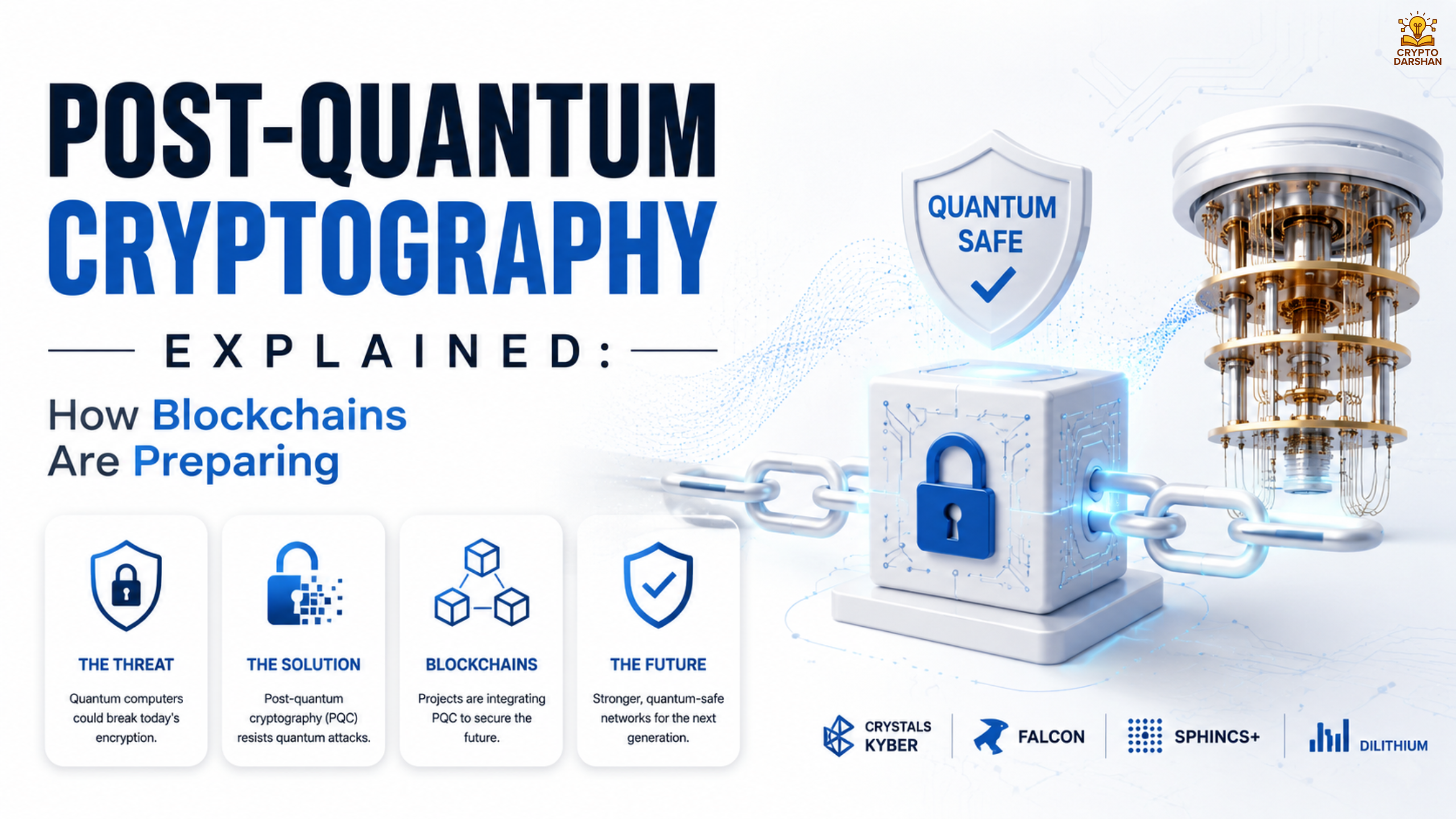
The digital world depends on cryptography to protect data, secure transactions, and maintain trust across networks. Every time a message is encrypted, a transaction is signed, or a blockchain block is verified, cryptographic algorithms ensure that information remains safe from unauthorized access. However, the rise of quantum computing threatens to disrupt this foundation. Quantum computers, powered by the strange laws of quantum mechanics, could one day break the cryptographic systems that secure today’s digital infrastructure. This challenge has given birth to a new field known as Post-Quantum Cryptography.
Post-Quantum Cryptography (PQC) focuses on developing cryptographic algorithms that can resist attacks from quantum computers. These algorithms are designed to protect data even when quantum computers become powerful enough to break traditional encryption methods. For blockchain technology, which relies heavily on cryptography for security and decentralization, preparing for the quantum era is not optional—it is essential.
This article explores Post-Quantum Cryptography in detail, explains how quantum computing threatens current cryptographic systems, and examines how blockchain networks are preparing for a quantum-secure future. It also discusses the leading PQC algorithms, real-world blockchain initiatives, and the challenges of transitioning to quantum-resistant systems.
Understanding Quantum Computing

What Is Quantum Computing?
Quantum computing is a new form of computation that uses the principles of quantum mechanics to process information. Unlike classical computers, which use bits that represent either 0 or 1, quantum computers use qubits—quantum bits that can exist in multiple states at once through a property called superposition. This allows quantum computers to perform many calculations simultaneously.
Another key property, entanglement, enables qubits to be linked in such a way that the state of one qubit can depend on the state of another, even across large distances. These properties give quantum computers exponential computational power for certain types of problems.
Why Quantum Computing Threatens Cryptography
Most modern cryptographic systems rely on mathematical problems that are easy to compute in one direction but extremely difficult to reverse. For example, factoring large prime numbers or solving discrete logarithms is computationally infeasible for classical computers. However, quantum computers can solve these problems efficiently using algorithms like Shor’s algorithm and Grover’s algorithm.
- Shor’s Algorithm: Can factor large integers exponentially faster than classical algorithms, threatening RSA and elliptic curve cryptography (ECC).
- Grover’s Algorithm: Speeds up brute-force attacks on symmetric encryption, effectively halving the key strength.
Networks that successfully adapt to emerging threats such as quantum computing may gain an advantage, as discussed in Why Some Crypto Ecosystems Grow While Others Quietly Die. These breakthroughs mean that once large-scale quantum computers become practical, they could decrypt data, forge digital signatures, and compromise blockchain networks. This is why Post-Quantum Cryptography is becoming a global priority.
The Quantum Threat to Cryptography
Vulnerable Cryptographic Systems
The cryptographic systems most at risk from quantum attacks include:
- RSA (Rivest–Shamir–Adleman): Used for secure communications, digital signatures, and key exchanges. Vulnerable to Shor’s algorithm.
- Elliptic Curve Cryptography (ECC): Common in blockchain systems like Bitcoin and Ethereum. Also vulnerable to Shor’s algorithm.
- Diffie–Hellman Key Exchange: Used for secure key sharing. Quantum computers can break it using similar techniques.
Symmetric encryption algorithms like AES are less vulnerable but still affected. Grover’s algorithm can reduce their effective key strength, meaning AES-256 would offer the equivalent of 128-bit security against quantum attacks.
The Timeline of the Quantum Threat
While fully functional quantum computers capable of breaking RSA or ECC do not yet exist, progress is accelerating. Experts estimate that within the next 10 to 20 years, quantum computers could reach the scale needed to threaten current cryptographic systems. This timeline may seem distant, but given the long lifespan of digital data and blockchain records, the need for Post-Quantum Cryptography is urgent.
Data encrypted today could be stored and decrypted later when quantum computers become powerful enough—a concept known as “harvest now, decrypt later.” This makes proactive adoption of Post-Quantum Cryptography essential for long-term data protection.
What Is Post-Quantum Cryptography?
Definition and Purpose
Post-Quantum Cryptography refers to cryptographic algorithms designed to be secure against both classical and quantum attacks. Unlike quantum cryptography, which uses quantum mechanics for secure communication, PQC operates on classical computers but relies on mathematical problems believed to be resistant to quantum attacks.
The goal of Post-Quantum Cryptography is to ensure that digital systems remain secure even after quantum computers become practical. These algorithms must be efficient, scalable, and compatible with existing infrastructure.
Key Requirements for Post-Quantum Cryptography
- Quantum Resistance: Must withstand attacks from both classical and quantum computers.
- Efficiency: Should be computationally feasible for real-world applications.
- Interoperability: Must integrate with existing protocols and systems.
- Scalability: Should support large-scale deployment across networks.
- Security Proofs: Must be based on well-studied mathematical assumptions.
Leading Post-Quantum Cryptographic Algorithms
The U.S. National Institute of Standards and Technology (NIST) has been leading the global effort to standardize Post-Quantum Cryptography algorithms. After years of evaluation, NIST announced several finalists and selected algorithms for standardization.
1. Lattice-Based Cryptography
Lattice-based cryptography is one of the most promising approaches to Post-Quantum Cryptography. It relies on the hardness of problems like the Learning With Errors (LWE) problem, which remains difficult even for quantum computers.
- Examples: CRYSTALS-Kyber (key encapsulation), CRYSTALS-Dilithium (digital signatures)
- Advantages: Strong security proofs, efficient performance, and versatility
- Use Cases: Secure communications, blockchain signatures, and key exchanges
2. Code-Based Cryptography
Code-based cryptography is based on the difficulty of decoding random linear codes. It has been studied for decades and is considered highly secure.
- Example: Classic McEliece
- Advantages: Proven security and resistance to quantum attacks
- Disadvantages: Large key sizes, which can limit practical use
3. Multivariate Polynomial Cryptography
This approach uses systems of multivariate quadratic equations over finite fields. Solving these equations is computationally hard for both classical and quantum computers.
- Examples: Rainbow, GeMSS
- Advantages: Fast signature generation
- Disadvantages: Larger key sizes and potential vulnerabilities discovered in some schemes
4. Hash-Based Cryptography
Hash-based cryptography relies on the security of cryptographic hash functions. It is particularly suitable for digital signatures.
- Examples: SPHINCS+, XMSS
- Advantages: Simple design and strong security assumptions
- Disadvantages: Larger signature sizes and limited key reuse
5. Isogeny-Based Cryptography
Isogeny-based cryptography uses mathematical structures called elliptic curve isogenies. It offers small key sizes and potential for efficient implementations.
- Example: SIKE (Supersingular Isogeny Key Encapsulation)
- Status: Once promising, but later broken by classical attacks, showing the importance of ongoing research in Post-Quantum Cryptography.
How Blockchains Use Cryptography

Cryptographic Foundations of Blockchain
Blockchains rely on cryptography for three main purposes:
- Hash Functions: Used to link blocks and ensure data integrity. Examples include SHA-256 (Bitcoin) and Keccak-256 (Ethereum).
- Digital Signatures: Used to verify ownership and authorize transactions. Most blockchains use ECDSA (Elliptic Curve Digital Signature Algorithm).
- Consensus Mechanisms: Depend on cryptographic proofs like Proof of Work (PoW) or Proof of Stake (PoS) to validate transactions.
- As blockchains explore quantum-resistant security measures, they must still balance the challenges outlined in Blockchain Trilemma Explained: Security, Scalability, and Decentralization
Why Blockchains Are Vulnerable to Quantum Attacks
Quantum computers could undermine blockchain security in several ways:
- Breaking Digital Signatures: Shor’s algorithm could derive private keys from public keys, allowing attackers to forge transactions.
- Compromising Hash Functions: Grover’s algorithm could reduce the security of hash-based mining and consensus mechanisms.
- Attacking Smart Contracts: Quantum attacks could exploit cryptographic vulnerabilities in decentralized applications.
Because blockchain data is immutable, any vulnerability in past transactions could be exploited once quantum computers become powerful enough. This is why Post-Quantum Cryptography is critical for blockchain survival. User trust depends heavily on security, making post-quantum preparedness an important factor alongside the strategies discussed in How Crypto Protocols Build Loyalty Without Paying Users Forever
Preparing Blockchains for the Quantum Era
1. Quantum-Resistant Signatures
Replacing ECDSA with post-quantum signature schemes is a top priority. Lattice-based and hash-based signatures are leading candidates for blockchain integration.
- Lattice-Based Signatures: CRYSTALS-Dilithium offers strong security and efficient verification.
- Hash-Based Signatures: SPHINCS+ provides robust security but with larger signatures.
2. Hybrid Cryptographic Systems
Many blockchain projects are exploring hybrid cryptography, combining classical and Post-Quantum Cryptography algorithms. This approach ensures backward compatibility while adding quantum resistance.
For example, a transaction could be signed using both ECDSA and a PQC algorithm, requiring both signatures for validation.
3. Quantum-Safe Key Management
Quantum-resistant key generation and storage are essential. Hierarchical deterministic wallets and multi-signature schemes can be adapted to use Post-Quantum Cryptography algorithms.
4. Upgradable Protocols
Blockchains must be designed with upgradeability in mind. Protocols that allow cryptographic agility—easy replacement of algorithms—will be better prepared for quantum threats.
Ethereum’s transition to Ethereum 2.0 and Bitcoin’s Taproot upgrade demonstrate the importance of flexible cryptographic frameworks.
5. Quantum-Resistant Consensus Mechanisms
Consensus algorithms may also need to evolve. Quantum-resistant hash functions and randomness generation methods can strengthen Proof of Work and Proof of Stake systems.
Real-World Blockchain Initiatives in Post-Quantum Security

Bitcoin
Bitcoin’s public keys are not directly exposed until a transaction is made, offering some protection. However, once a transaction is broadcast, the public key becomes visible and vulnerable to quantum attacks. Researchers are exploring ways to integrate Post-Quantum Cryptography signatures into Bitcoin’s scripting system.
Ethereum
Ethereum’s smart contract ecosystem makes it more exposed to quantum risks. The Ethereum Foundation has discussed potential PQC transitions, including hybrid signature schemes and quantum-safe key exchanges.
Algorand
Algorand uses a cryptographic primitive called Verifiable Random Functions (VRFs). The team is researching lattice-based alternatives to ensure long-term quantum resistance through Post-Quantum Cryptography.
IOTA
IOTA’s Tangle network already uses Winternitz One-Time Signatures (WOTS), a hash-based scheme that offers partial quantum resistance. Future versions aim to adopt fully quantum-safe algorithms from Post-Quantum Cryptography research.
Cardano
Cardano’s research-driven approach includes exploring Post-Quantum Cryptography for its Ouroboros consensus protocol and wallet infrastructure.
Quantum-Resistant Ledger (QRL)
QRL is one of the first blockchains built entirely around Post-Quantum Cryptography. It uses XMSS (Extended Merkle Signature Scheme), a hash-based signature algorithm standardized by NIST. QRL demonstrates how a blockchain can be designed from the ground up for quantum safety.
Challenges in Adopting Post-Quantum Cryptography

1. Performance and Efficiency
Many Post-Quantum Cryptography algorithms have larger key and signature sizes, which can increase transaction sizes and slow down verification. Optimizing these algorithms for blockchain environments is a major challenge.
2. Compatibility and Integration
Existing blockchains are deeply tied to classical cryptographic primitives. Transitioning to Quantum Cryptography requires careful planning to maintain backward compatibility and avoid network splits.
3. Standardization and Interoperability
Until PQC standards are finalized and widely adopted, implementing them across different blockchains could lead to fragmentation and security inconsistencies.
4. Security Proofs and Maturity
Some Post-Quantum Cryptography algorithms are relatively new and may not have undergone the same level of scrutiny as classical systems. Ongoing research and testing are essential to ensure their robustness.
5. Governance and Coordination
Upgrading blockchain protocols requires consensus among developers, miners, validators, and users. Coordinating a global transition to Post-Quantum Cryptography will be complex and time-consuming.
The Role of NIST and Global Standardization

The NIST Post-Quantum Cryptography Standardization Project is the cornerstone of global PQC efforts. In 2022, NIST announced the first group of algorithms selected for standardization:
- CRYSTALS-Kyber (Key Encapsulation)
- CRYSTALS-Dilithium (Digital Signatures)
- FALCON (Digital Signatures)
- SPHINCS+ (Hash-Based Signatures)
These algorithms are expected to form the foundation of future cryptographic systems, including blockchain networks. International organizations and governments are also developing guidelines to ensure interoperability and security in the quantum era.
The Future of Quantum-Resistant Blockchains

Quantum-Ready Architecture
Future blockchains will likely adopt quantum-ready architectures, designed to switch cryptographic primitives without disrupting the network. This flexibility will allow seamless upgrades as new Post-Quantum Cryptography algorithms emerge.
Decentralized Quantum Key Distribution (QKD)
While Post-Quantum Cryptography operates on classical systems, quantum key distribution uses quantum mechanics to securely exchange keys. Integrating QKD with blockchain could create hybrid systems combining the strengths of both approaches.
Quantum-Resistant Smart Contracts
Smart contracts will need to incorporate Post-Quantum Cryptography algorithms for secure execution and verification. This will require updates to virtual machines, compilers, and programming languages used in blockchain ecosystems.
Cross-Chain Quantum Security
As interoperability between blockchains grows, ensuring consistent quantum resistance across networks will be critical. Cross-chain bridges and oracles must also adopt Post-Quantum Cryptography to prevent vulnerabilities.
Steps Toward a Quantum-Safe Blockchain Future

1. Research and Development
Research and development form the foundation of quantum-safe blockchain evolution. This step involves rigorous testing of Post-Quantum Cryptography algorithms within real blockchain environments to understand how they perform under actual network conditions. Scientists and developers must evaluate factors like transaction speed, signature verification time, network bandwidth consumption, and computational overhead. They need to simulate various attack scenarios to ensure these algorithms can withstand both current and future quantum threats. For blockchain companies, preparing for a post-quantum future is part of the broader challenge described in The Hardest Part of Building a Blockchain Business.
2. Standardization
Standardization ensures that all blockchain platforms adopt consistent, proven, and interoperable quantum-resistant algorithms. This step centers on implementing NIST-approved Post-Quantum Cryptography algorithms across different blockchain ecosystems. When every blockchain network uses the same standardized cryptographic primitives, it becomes easier to create cross-chain bridges, facilitate interoperability, and maintain security consistency across the entire decentralized landscape. Standardization also helps developers by providing clear guidelines, reference implementations, and best practices for integrating quantum-safe cryptography. It reduces fragmentation in the blockchain space and ensures that security measures are uniform and reliable.
3. Hybrid Implementations
Hybrid implementations represent a practical transition strategy that combines classical cryptography with Post-Quantum Cryptography algorithms. This approach allows blockchain networks to maintain backward compatibility with existing systems while simultaneously adding quantum resistance. In a hybrid system, transactions might be signed using both traditional ECDSA signatures and quantum-resistant signatures like CRYSTALS-Dilithium. This dual-signature approach ensures that even if one cryptographic method is compromised, the other remains secure. Hybrid implementations give blockchain networks time to test new algorithms in production environments without risking complete system failure.
4. Community Education
Community education focuses on raising awareness and building knowledge among all blockchain stakeholders about quantum computing threats and Post-Quantum Cryptography solutions. This includes developers who need to understand how to implement quantum-resistant algorithms, miners and validators who must upgrade their systems, wallet providers who need to support new signature schemes, and everyday users who should understand the importance of migrating to quantum-safe addresses. Educational initiatives include creating comprehensive documentation, hosting workshops and conferences, publishing research papers in accessible language, developing online courses, and producing video tutorials.
5. Protocol Upgrades
Protocol upgrades involve designing blockchain systems with built-in flexibility and cryptographic agility, allowing them to evolve as new threats emerge and better algorithms are developed. This means creating blockchain architectures that can seamlessly switch from one cryptographic primitive to another without requiring hard forks or causing network disruptions. Modern blockchain protocols should include governance mechanisms that enable rapid deployment of security updates when necessary. They should support modular cryptographic components that can be replaced independently without affecting other system functions.
FAQ: Post-Quantum Cryptography Explained: How Blockchains Are Preparing

1. What is post-quantum cryptography (PQC)?
Post-quantum cryptography refers to cryptographic algorithms designed to remain secure against attacks from both classical and quantum computers.
2. Why are quantum computers a threat to blockchain security?
Quantum computers could potentially break widely used public-key cryptography systems, allowing attackers to forge signatures, steal funds, or compromise blockchain networks.
3. Which blockchain components are most vulnerable to quantum attacks?
Digital signature schemes, wallet addresses with exposed public keys, and cryptographic key management systems are considered the most vulnerable components.
4. Can quantum computers break Bitcoin today?
No. Current quantum computers are not powerful enough to break Bitcoin’s cryptography, but future advancements could create risks if networks do not upgrade in time.
5. What is Shor’s Algorithm, and why is it important?
Shor’s Algorithm is a quantum computing method capable of efficiently solving mathematical problems that secure many current cryptographic systems, making it a major concern for blockchain security.
6. How does post-quantum cryptography protect blockchains?
PQC uses quantum-resistant algorithms that are believed to be secure even against powerful quantum computers, helping safeguard transactions and digital identities.
7. Are any blockchains already preparing for quantum threats?
Yes. Several blockchain projects and research groups are exploring quantum-resistant signatures, hybrid cryptographic models, and future migration strategies.
8. Will existing cryptocurrencies need to upgrade their cryptography?
Most likely. Many blockchain networks may eventually adopt quantum-resistant algorithms to maintain long-term security.
Conclusion
Quantum computing represents both a technological breakthrough and a profound security challenge. While the full impact of quantum computers may still be years away, the threat they pose to current cryptographic systems is real and growing. Blockchains, which depend on cryptographic integrity for trust and decentralization, must act now to prepare for the quantum era.
Post-Quantum Cryptography offers a path forward. Through lattice-based, hash-based, and other quantum-resistant algorithms, the blockchain community can build systems that remain secure in a post-quantum world. The transition will not be simple—it requires research, collaboration, and global coordination—but it is essential for the long-term survival of decentralized technologies.
As NIST finalizes Post-Quantum Cryptography standards and blockchain projects begin integrating them, the foundation for a quantum-secure digital future is being laid. The next generation of blockchains will not only be decentralized and scalable but also resilient against the most powerful computers ever conceived.