
As blockchain technology continues to evolve, one of the biggest challenges remains scalability and high transaction fees. Ethereum, the most widely used blockchain for decentralized applications (dApps), often struggles with congestion and expensive gas fees. This has led to the rise of Layer 2 Networks, which are designed to make transactions faster, cheaper, and more efficient while maintaining the security of the main blockchain.
By 2026, Layer 2 Networks have become essential for the growth of decentralized finance (DeFi), non-fungible tokens (NFTs), and Web3 applications. These networks help reduce costs, improve transaction speed, and make blockchain technology more accessible to users worldwide. This guide explores the best Layer 2 Networks in 2026, explaining how they work, their benefits, and why they are crucial for the future of crypto.
What Are Layer 2 Networks?
Layer 2 Networks are secondary frameworks or protocols built on top of existing blockchains (Layer 1), such as Ethereum. Their main goal is to handle transactions off the main chain, reducing congestion and lowering fees. Once transactions are processed, the results are sent back to the main blockchain for final confirmation.
In simple terms, Layer 2 Networks act as helpers that take some of the workload off the main blockchain. They allow users to enjoy faster and cheaper transactions without compromising on security or decentralization.
Key Functions of Layer 2 Networks
- Scalability: They increase the number of transactions a blockchain can handle per second.
- Cost Reduction: They significantly lower gas fees by processing transactions off-chain.
- Speed: They confirm transactions in seconds instead of minutes.
- Security: They rely on the main blockchain’s security for final verification.
- Interoperability: They allow assets and data to move easily between Layer 1 and Layer 2.
Why Layer 2 Networks Are Important in 2026

By 2026, the demand for blockchain applications has grown exponentially. Millions of users interact daily with DeFi platforms, NFT marketplaces, and Web3 games. However, the main blockchains like Ethereum and Bitcoin still face limitations in speed and cost. Layer 2 Networks solve these issues by offering scalable solutions that make blockchain technology practical for everyday use.
1. Lower Transaction Fees
High gas fees have been a major barrier to entry for new users. Layer 2 Networks drastically reduce these costs, allowing users to send, trade, and interact with dApps at a fraction of the price.
2. Faster Transactions
Transactions on Layer 2 Networks are processed almost instantly. This speed is essential for gaming, trading, and real-time applications where delays can affect user experience.
3. Enhanced User Experience
By reducing costs and improving speed, Layer 2 Networks make blockchain applications more user-friendly. This encourages mass adoption and helps bridge the gap between traditional and decentralized systems.
4. Support for Developers
Developers can build complex applications without worrying about high gas fees or network congestion. Layer 2 Networks provide the scalability needed to support millions of users simultaneously.
5. Sustainability
Many Layer 2 Networks use energy-efficient consensus mechanisms, making them more environmentally friendly compared to traditional blockchains.
How Layer 2 Networks Work

Layer 2 Networks operate by processing transactions off the main blockchain and then submitting a summary or proof of those transactions back to the main chain. This reduces the amount of data stored on the main blockchain, improving efficiency.
Step-by-Step Process
1. Off-Chain Transaction Processing
Layer 2 Networks handle transactions away from the main blockchain (Layer 1). Instead of recording every transaction directly on Ethereum or Bitcoin, these networks process them separately in their own environment. This removes the burden from the main chain, allowing it to focus on security and final verification while Layer 2 handles the heavy lifting of processing thousands of transactions simultaneously.
2. Transaction Batching
Multiple individual transactions are grouped together into single batches. Rather than sending each transaction separately to the main blockchain, Layer 2 Networks collect dozens or even hundreds of transactions and bundle them into one compressed package. This batching method dramatically reduces the amount of data that needs to be stored on the main chain, resulting in lower costs and faster processing times.
3. Cryptographic Proofs and Verification
Layer 2 Networks use advanced cryptographic techniques to prove that transactions are valid. Technologies like Zero-Knowledge proofs or fraud proofs ensure that all off-chain transactions are legitimate without requiring the main blockchain to check each one individually. These mathematical proofs provide security guarantees while maintaining efficiency and speed throughout the entire process.
4. Final Settlement on Main Chain
After processing transactions off-chain, Layer 2 Networks submit the results back to the main blockchain for final confirmation. This settlement process anchors the Layer 2 transactions to Layer 1’s security, ensuring that all transactions are permanently recorded and protected by the main blockchain’s consensus mechanism. This connection maintains trust and decentralization while enjoying Layer 2’s speed benefits.
5. Bridging Between Layers
Users can move assets between Layer 1 and Layer 2 using specialized bridge protocols. When you transfer tokens to Layer 2, they’re locked on the main chain and equivalent tokens are created on Layer 2. When withdrawing back to Layer 1, the process reverses. This bridging mechanism allows seamless interaction between both layers while keeping assets secure throughout the transfer process.
This process allows Layer 2 Networks to handle thousands of transactions per second while keeping fees low.
Types of Layer 2 Networks
There are several types of Layer 2 Networks, each using different technologies to achieve scalability and cost reduction.
1. Rollups
Rollups bundle multiple transactions into one and post them to the main blockchain. There are two main types:
- Optimistic Rollups: Assume transactions are valid by default and only verify them if challenged.
- Zero-Knowledge (ZK) Rollups: Use cryptographic proofs to verify transactions instantly.
2. State Channels
State channels allow users to transact directly with each other off-chain. Only the opening and closing transactions are recorded on the main blockchain, reducing fees and delays.
3. Plasma Chains
Plasma chains are smaller blockchains connected to the main chain. They handle transactions independently and periodically report back to the main blockchain.
4. Sidechains
Sidechains are independent blockchains that run parallel to the main chain. They have their own consensus mechanisms but are connected to the main blockchain through bridges.
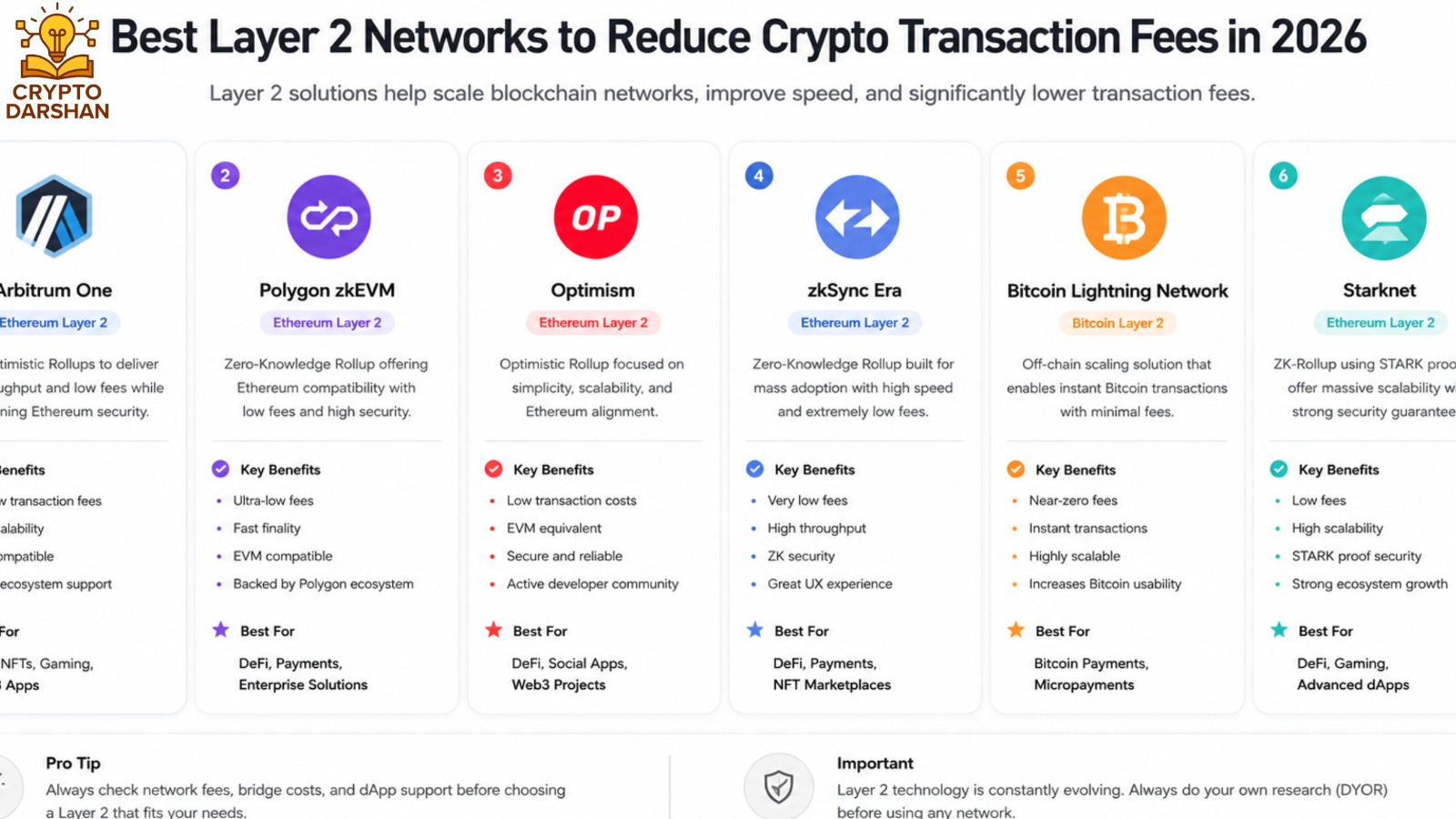
Best Layer 2 Networks to Reduce Crypto Transaction Fees in 2026
1. Polygon (MATIC)
Polygon remains one of the most popular Layer 2 Networks in 2026. It provides a scalable framework for building and connecting Ethereum-compatible blockchains. Polygon’s Proof of Stake (PoS) chain offers fast and low-cost transactions while maintaining Ethereum’s security.
Key Features:
- Processes up to 65,000 transactions per second.
- Extremely low gas fees.
- Fully compatible with Ethereum tools and smart contracts.
- Supports multiple scaling solutions like zkEVM and Supernets.
Use Cases: Polygon is widely used in DeFi, NFTs, and gaming. Platforms like Aave, OpenSea, and Decentraland rely on Polygon for affordable and fast transactions.
2. Arbitrum
Arbitrum is another leading Layer 2 Network that uses Optimistic Rollups to scale Ethereum. It offers high throughput and low fees while maintaining compatibility with Ethereum smart contracts.
Key Features:
- Uses Optimistic Rollups for efficient transaction processing.
- Fully compatible with Ethereum Virtual Machine (EVM).
- Reduces gas fees by up to 90%.
- Strong developer ecosystem and community support.
Use Cases: Arbitrum is popular among DeFi platforms like Uniswap and GMX, which require fast and cost-effective transactions.
3. Optimism
Optimism is a powerful Layer 2 Network built to enhance Ethereum’s scalability. It uses Optimistic Rollups to process transactions off-chain and then submits proofs to Ethereum for final verification.
Key Features:
- Reduces gas fees significantly.
- Maintains Ethereum-level security.
- Easy migration for Ethereum dApps.
- Focuses on decentralization and community governance.
Use Cases: Optimism is used by major DeFi projects such as Synthetix and Curve Finance. It’s also a favorite among developers for its simplicity and reliability.
4. zkSync
zkSync is a Layer 2 Network that uses Zero-Knowledge Rollups (ZK-Rollups) to achieve scalability. It provides instant transaction finality and strong security guarantees.
Key Features:
- Uses ZK-Rollups for fast and secure transactions.
- Near-zero gas fees.
- Supports Ethereum smart contracts through zkEVM.
- High throughput and privacy features.
Use Cases: zkSync is ideal for payments, DeFi, and NFT platforms that require fast and secure transactions. It’s gaining popularity for its advanced cryptographic technology.
5. StarkNet
StarkNet is a decentralized Layer 2 Network that uses STARK-based Zero-Knowledge proofs. It offers scalability and privacy while maintaining Ethereum compatibility.
Key Features:
- Uses STARK proofs for scalability and security.
- Supports complex smart contracts.
- Reduces gas fees significantly.
- Developer-friendly environment.
Use Cases: StarkNet is used in DeFi, gaming, and enterprise applications that require high performance and privacy.
6. Loopring

Loopring is a Layer 2 Network focused on decentralized exchanges (DEXs) and payments. It uses ZK-Rollups to enable fast and low-cost trading.
Key Features:
- High-speed trading with minimal fees.
- Non-custodial and secure.
- Supports Ethereum-based tokens.
- Energy-efficient and scalable.
Use Cases: Loopring powers decentralized exchanges and payment systems, allowing users to trade and transfer assets efficiently.
7. Immutable X
Immutable X is a Layer 2 Network designed for NFTs and gaming. It uses ZK-Rollups to provide instant transactions with zero gas fees.
Key Features:
- Zero gas fees for NFT minting and trading.
- Carbon-neutral and eco-friendly.
- High transaction throughput.
- Built specifically for gaming and digital collectibles.
Use Cases: Immutable X is used by NFT marketplaces and blockchain games like Gods Unchained and Illuvium, offering seamless user experiences.
8. Metis
Metis is a Layer 2 Network that combines Optimistic Rollups with decentralized autonomous company (DAC) features. It focuses on scalability, speed, and community governance.
Key Features:
- Fast and low-cost transactions.
- Supports decentralized business structures.
- Compatible with Ethereum smart contracts.
- Strong focus on community-driven development.
Use Cases: Metis is used for DeFi, DAOs, and Web3 projects that require scalability and governance flexibility.
9. Boba Network
Boba Network is an advanced Layer 2 Network that enhances Ethereum’s performance using Optimistic Rollups. It focuses on improving user experience and reducing transaction costs.
Key Features:
- Hybrid compute technology for faster processing.
- Low transaction fees.
- Supports cross-chain transfers.
- Developer-friendly tools and APIs.
Use Cases: Boba Network is used in DeFi, gaming, and NFT platforms that need fast and affordable transactions.
10. Aztec Network
Aztec Network is a privacy-focused Layer 2 Network that uses Zero-Knowledge proofs to enable confidential transactions on Ethereum.
Key Features:
- Privacy-preserving transactions.
- Low gas fees.
- Supports private DeFi applications.
- Strong cryptographic security.
Use Cases: Aztec is ideal for users and businesses that require privacy in financial transactions, such as private DeFi and confidential payments.
Comparison of Top Layer 2 Networks
| Network | Technology | Transaction Speed | Fee Reduction | Main Use Case |
| Polygon | PoS + zkEVM | Fast | Very High | DeFi, NFTs, Gaming |
| Arbitrum | Optimistic Rollups | Fast | High | DeFi, dApps |
| Optimism | Optimistic Rollups | Fast | High | DeFi, Governance |
| zkSync | ZK-Rollups | Very Fast | Very High | Payments, NFTs |
| StarkNet | STARK Proofs | Fast | High | DeFi, Privacy |
| Loopring | ZK-Rollups | Very Fast | Very High | DEXs, Payments |
| Immutable X | ZK-Rollups | Instant | Zero Fees | NFTs, Gaming |
| Metis | Optimistic Rollups | Fast | High | DAOs, DeFi |
| Boba Network | Optimistic Rollups | Fast | High | Cross-Chain Apps |
| Aztec Network | ZK-Rollups | Fast | High | Private DeFi |
Benefits of Using Layer 2 Networks

Layer 2 Networks offer several advantages that make them essential for the future of blockchain technology.
1. Cost Efficiency
They drastically reduce transaction fees, making blockchain accessible to everyone.
2. Speed and Scalability
They process thousands of transactions per second, enabling real-time applications.
3. Security
They inherit the security of the main blockchain, ensuring safe and reliable transactions.
4. Developer Flexibility
Developers can build scalable and affordable dApps without worrying about high gas costs.
5. Environmental Sustainability
Most Layer 2 Networks use energy-efficient mechanisms, reducing the environmental impact of blockchain operations.
The Future of Layer 2 Networks

By 2026, Layer 2 Networks are expected to play an even bigger role in the blockchain ecosystem. As adoption grows, these networks will continue to evolve, offering better performance, interoperability, and user experience.
Key Trends for the Future
1. Enhanced Interoperability
Layer 2 Networks will become more interconnected, allowing seamless communication between different networks and blockchains. Users will be able to transfer assets and data across multiple Layer 2 solutions without returning to Layer 1 each time. Cross-chain bridges and universal standards will enable a unified ecosystem where different networks work together, creating a more fluid and accessible blockchain experience for everyone.
2. Advanced Privacy Features
Privacy will become a central focus as more Layer 2 Networks integrate Zero-Knowledge proof technology. Users will be able to conduct confidential transactions while still maintaining transparency and security. This development will attract businesses and individuals who need privacy for financial operations, personal data, and sensitive information, making blockchain technology suitable for enterprise and institutional adoption.
3. Mass Adoption and Mainstream Integration
Layer 2 Networks will drive blockchain technology into everyday life as transaction costs approach zero and speeds match traditional payment systems. Major companies, financial institutions, and governments will adopt Layer 2 solutions for payments, supply chain management, and digital identity verification. This mainstream integration will bring millions of new users into the crypto ecosystem, making decentralized technology as common as using credit cards or mobile apps.
4. Specialized Layer 2 Solutions
Different Layer 2 Networks will emerge for specific use cases and industries. Gaming-focused networks will optimize for real-time interactions, DeFi networks will prioritize security and liquidity, and enterprise solutions will emphasize privacy and compliance. This specialization will create a diverse ecosystem where each network excels in its particular domain, offering tailored solutions that meet specific industry requirements and user needs.
5. Decentralized Governance and Community Control
Layer 2 Networks will increasingly adopt decentralized governance models where token holders and community members make key decisions about protocol upgrades, fee structures, and development priorities. This shift toward community-driven development will ensure that networks evolve according to user needs rather than centralized control. Decentralized autonomous organizations (DAOs) will play a major role in shaping the future direction and policies of Layer 2 ecosystems.
FAQ: Best Layer 2 Networks to Reduce Crypto Transaction Fees in 2026

1. What are Layer 2 networks?
Layer 2 networks are blockchain solutions built on top of existing blockchains, such as Ethereum, to improve scalability, speed, and transaction costs without compromising the security of the main network.
2. Why are Layer 2 networks important in 2026?
As blockchain adoption continues to grow, network congestion can lead to high fees and slower transactions. Layer 2 networks help address these issues by processing transactions more efficiently.
3. How do Layer 2 networks reduce transaction fees?
Layer 2 networks bundle or process transactions off the main blockchain before settling them on the base layer. This reduces the amount of data that needs to be processed on the main network, lowering costs.
4. What are some of the most popular Layer 2 networks in 2026?
Popular Layer 2 networks include Polygon, Arbitrum, Optimism, Base, and zkSync. Each offers unique features, fee structures, and ecosystem advantages.
5. Which Layer 2 network has the lowest fees?
Transaction fees vary depending on network activity and the type of transaction. Networks such as zkSync, Polygon, and Base are often recognized for offering very low transaction costs.
6. Are Layer 2 networks as secure as Ethereum?
Most Layer 2 solutions inherit security from Ethereum in different ways. However, security models vary, so users should understand how each network operates before transferring funds.
7. What is the difference between optimistic rollups and zero-knowledge rollups?
Optimistic rollups assume transactions are valid unless challenged, while zero-knowledge rollups use cryptographic proofs to verify transactions. Both approaches aim to improve scalability and reduce costs.
Conclusion
Layer 2 Networks have become the backbone of blockchain scalability and affordability. They solve the biggest challenges of high fees and slow transactions, making decentralized technology practical for global use. In 2026, networks like Polygon, Arbitrum, Optimism, zkSync, and StarkNet lead the way in reducing crypto transaction fees and improving user experience.
As blockchain adoption continues to grow, Layer 2 Networks will remain essential for building a faster, cheaper, and more inclusive decentralized future. Whether for DeFi, NFTs, gaming, or enterprise solutions, these networks are shaping the next era of blockchain innovation.