
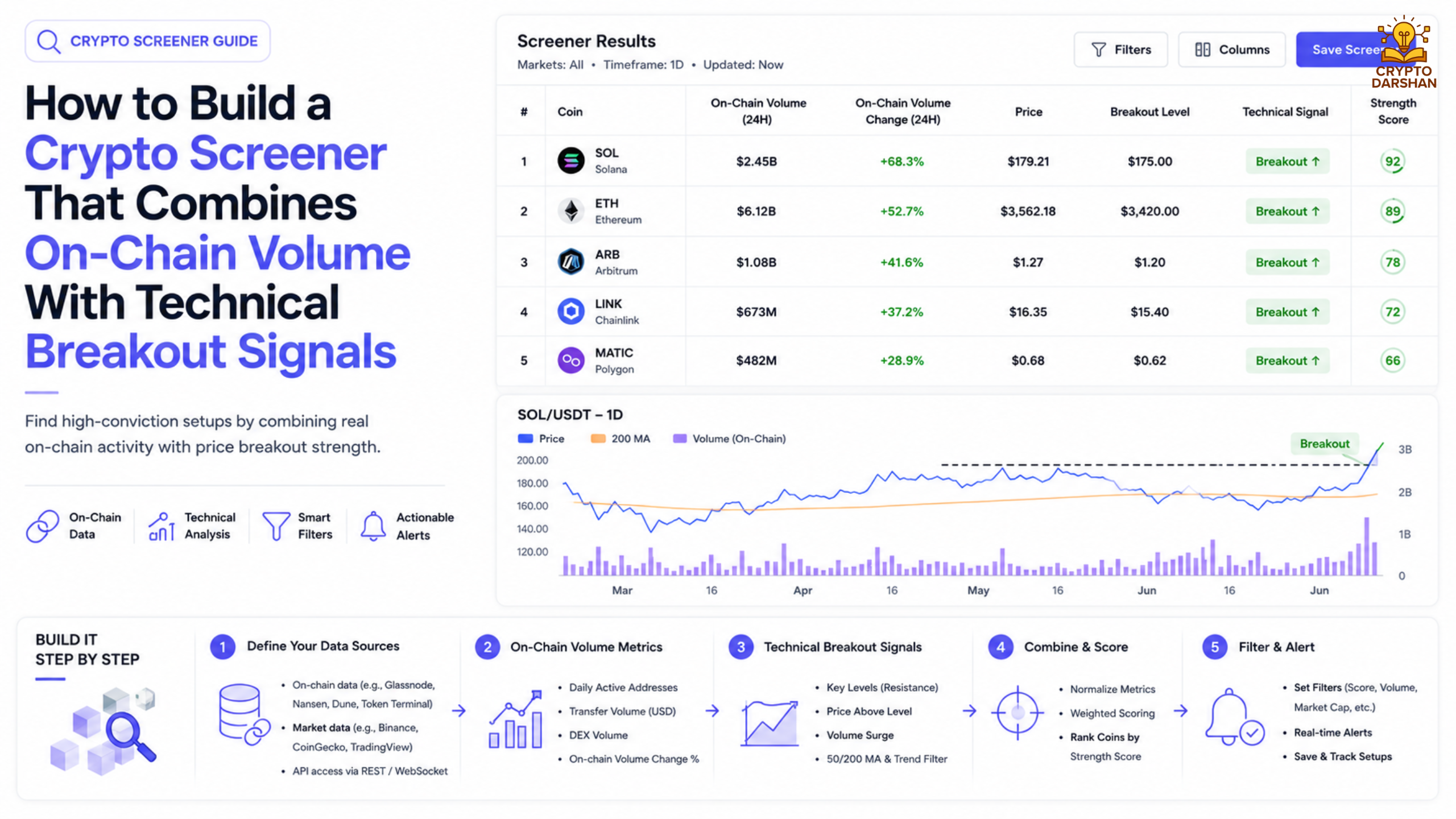
The cryptocurrency market moves fast, and traders need tools that can keep up. A Crypto Screener is one of the most powerful tools for identifying profitable opportunities in real time. It helps traders filter thousands of coins based on specific metrics such as price, volume, market cap, and technical indicators. However, most traditional screeners rely only on price and volume data from exchanges. To gain a real edge, combining on-chain volume with technical breakout signals can create a next-level Crypto Screener that captures both blockchain activity and market momentum.
Since many breakout traders use leverage to maximize potential returns, understanding Crypto Leverage Trading 2026: Best Strategies, Platforms, and Trading Tips can help investors manage risk when acting on high-momentum screener signals.
This guide explains how to build a Crypto Screener that merges on-chain analytics with technical analysis. It covers everything from data sources and architecture to algorithms and visualization. The goal is to create a system that identifies coins showing both blockchain activity spikes and technical breakout patterns, giving traders early insights into potential market moves.
Understanding the Role of a Crypto Screener

A cryptocurrency screener is a tool through which traders monitor the market.It helps traders and investors quickly identify coins that meet specific conditions, such as:
- Price crossing above a moving average
- Volume increasing by a certain percentage
- RSI (Relative Strength Index) entering overbought or oversold zones
- Market cap growth over a defined period
The best Crypto Screener tools allow users to combine multiple filters, visualize data, and receive alerts when conditions are met. By integrating on-chain data, a Crypto Screener can go beyond surface-level price action and detect deeper market signals.
Why Combine On-Chain Volume With Technical Breakout Signals
Traditional technical analysis focuses on price and volume data from exchanges. While useful, it doesn’t always reveal what’s happening behind the scenes. On-chain data, on the other hand, provides insights into blockchain activity — such as wallet movements, transaction counts, and token transfers. When combined, these two data types create a more complete picture.
Benefits of Combining On-Chain and Technical Data
Early Detection of Market Moves
On-chain volume spikes often precede price breakouts. A Crypto Screener that tracks both can identify coins before they trend.
Improved Accuracy
Technical breakouts confirmed by on-chain activity are more reliable. This reduces false signals and improves trade success rates.
Deeper Market Insights
On-chain metrics reveal investor behavior, such as accumulation or distribution phases, which a Crypto Screener can use to refine alerts.
Enhanced Risk Management
By combining multiple data sources, a Crypto Screener helps traders avoid traps caused by fake breakouts or manipulated volume.
Core Components of a Crypto Screener
Building a Crypto Screener that integrates on-chain and technical data requires several key components:
Data Collection Layer
- Gathers data from APIs, blockchain nodes, and exchange feeds.
- Includes both on-chain metrics (transactions, wallet activity) and market data (price, volume, indicators).
Data Processing Layer
- Cleans, normalizes, and stores data in a structured format.
- Handles large datasets efficiently for real-time screening.
Analysis Engine
- Applies algorithms to detect breakout patterns and on-chain anomalies.
- Combines signals to generate actionable insights.
The analysis engine becomes even more valuable when identifying suspicious volume surges and momentum shifts, making the insights from Crypto Pump 2026: Pump & Dump Patterns useful for distinguishing genuine breakouts from potential market manipulation.
User Interface (UI)
- Displays filtered results, charts, and alerts.
- Allows users to customize filters and view historical data.
Alert System
- Sends notifications when conditions are met.
- Can integrate with email, Telegram, or trading bots.
Each of these layers plays a vital role in ensuring the Crypto Screener operates efficiently and delivers accurate results.
Step 1: Collecting On-Chain Data
The foundation of a powerful Crypto Screener lies in its data. On-chain data can be sourced from blockchain explorers, APIs, or direct node connections. Key metrics to track include:
- Transaction Volume: Total number of transactions within a time frame.
- Active Addresses: Number of unique addresses sending or receiving tokens.
- Token Transfers: Movement of tokens between wallets.
- Whale Activity: Large wallet movements that may indicate institutional interest.
- Gas Fees: Network congestion and transaction costs.
Popular On-Chain Data Sources
- Glassnode – Provides detailed on-chain metrics for major blockchains.
- Dune Analytics – Allows custom SQL queries on blockchain data.
- Nansen – Focuses on wallet tracking and smart money movements.
- Etherscan API – Offers raw Ethereum transaction data.
Integrating these sources into the Crypto Screener ensures comprehensive coverage of blockchain activity.
Step 2: Gathering Market and Technical Data

In addition to on-chain data, the Crypto Screener must collect market data from exchanges. This includes:
- Price Data: Open, high, low, close (OHLC) values.
- Volume Data: Trading volume across exchanges.
- Order Book Data: Buy and sell orders for liquidity analysis.
- Technical Indicators: Moving averages, RSI, MACD, Bollinger Bands, etc.
Reliable Market Data Sources
- Binance API
- CoinGecko API
- CoinMarketCap API
- CryptoCompare API
These APIs provide real-time and historical data that the Crypto Screener can use to detect technical breakouts.
MStep 3: Designing the Data Architecture
A well-structured data architecture ensures the Crypto Screener runs smoothly. The architecture typically includes:
Data Ingestion Layer
- Collects data from multiple APIs and blockchain nodes.
- Uses asynchronous requests for efficiency.
Data Storage Layer
- Stores data in databases such as PostgreSQL or MongoDB.
- Uses time-series databases like InfluxDB for historical analysis.
Processing Layer
- Cleans and normalizes data.
- Applies transformations for analysis.
Analytics Layer
- Runs algorithms to detect signals.
- Combines on-chain and technical data for scoring.
Presentation Layer
- Displays results in dashboards or charts.
- Allows filtering and sorting within the Crypto Screener interface.
This modular design ensures scalability and flexibility as the Crypto Screener evolves.
Step 4: Implementing On-Chain Volume Analysis
On-chain volume analysis helps identify coins with increasing blockchain activity. The Crypto Screener can calculate metrics such as:
- Transaction Growth Rate:
(Current Transactions – Previous Transactions) / Previous Transactions
- Active Address Growth:
(Current Active Addresses – Previous Active Addresses) / Previous Active Addresses
- Whale Movement Index:
Measures large wallet transfers relative to total volume.
By setting thresholds, the Crypto Screener can flag coins showing unusual on-chain activity. For example, a 50% increase in active addresses combined with rising transaction volume may indicate growing interest. Investors interested in interpreting blockchain activity beyond cryptocurrencies can also explore the On-Chain Government Bonds Guide, which demonstrates how on-chain data is being used to track ownership, transfers, and transparency in tokenized financial assets.
Step 5: Detecting Technical Breakout Signals
Technical breakouts occur when price moves beyond key resistance or support levels. The Crypto Screener can use various indicators to detect these events:
Common Breakout Indicators
- Moving Average Crossovers
When a short-term moving average crosses above a long-term one, it signals bullish momentum.
- Bollinger Band Breakouts
Price closing outside the upper band often indicates strong volatility and potential continuation.
- RSI Divergence
When price makes new highs but RSI doesn’t, it may signal a reversal or breakout setup.
- MACD Histogram Expansion
Increasing MACD histogram values suggest strengthening momentum.
- Volume Confirmation
Breakouts accompanied by high trading volume are more reliable.
The Crypto Screener should combine these indicators to confirm breakout strength.
Step 6: Combining On-Chain and Technical Signals

The real power of this Crypto Screener lies in merging on-chain and technical data. This can be achieved through a scoring system:
| Metric | Weight | Condition | Score |
| On-Chain Volume Growth | 30% | > 40% increase | +3 |
| Active Address Growth | 20% | > 25% increase | +2 |
| Moving Average Crossover | 20% | Bullish crossover | +2 |
| RSI Level | 15% | Between 50–70 | +1 |
| Volume Spike | 15% | > 2x average | +2 |
Coins with a total score above a threshold (e.g., 7/10) are flagged by the Crypto Screener as potential breakout candidates.
Step 7: Building the User Interface

The user interface (UI) is where traders interact with the Crypto Screener. It should be intuitive, responsive, and data-rich. Key UI components include:
- Filter Panel: Allows users to set conditions for on-chain and technical metrics.
- Results Table: Displays coins that meet criteria with sortable columns.
- Charts: Visualize price, volume, and on-chain data trends.
- Alerts Section: Lists triggered signals with timestamps.
- Customization Options: Save filters, adjust thresholds, and export data.
A clean and interactive UI enhances the usability of the Crypto Screener and encourages adoption.
Step 8: Setting Up Alerts and Notifications
Alerts make the Crypto Screener proactive. Instead of manually checking data, users receive notifications when conditions are met. Alerts can be configured for:
- On-chain volume surges
- Technical breakouts
- Combined signal confirmations
Notification Channels
- Email Alerts for daily summaries
- Telegram Bots for instant updates
- Webhooks for integration with trading bots
This automation ensures traders never miss critical opportunities detected by the Crypto Screener.
Step 9: Backtesting and Optimization
Before deploying the Crypto Screener, backtesting ensures its accuracy. Historical data is used to simulate how the screener would have performed in past market conditions.
Backtesting Steps
- Collect historical on-chain and market data.
- Apply the same filters and scoring model.
- Measure performance metrics such as win rate, average return, and drawdown.
- Adjust weights and thresholds for optimal results.
Continuous optimization keeps the Crypto Screener effective as market dynamics evolve.
Step 10: Deploying and Scaling the Crypto Screener
Once tested, the Crypto Screener can be deployed on cloud platforms like AWS, Google Cloud, or Azure. Key considerations include:
- Scalability: Use load balancers and caching for high traffic.
- Security: Protect API keys and user data.
- Performance: Optimize queries and use efficient data structures.
- Maintenance: Schedule regular updates for new coins and indicators.
A well-deployed Crypto Screener can handle thousands of users and real-time data streams efficiently.
Advanced Features for a Next-Generation Crypto Screener

To stand out, the Crypto Screener can include advanced features such as:
Machine Learning Predictions
Use historical data to train models that predict breakout probabilities.
Sentiment Analysis
Integrate social media and news sentiment to gauge market mood.
Portfolio Integration
Allow users to track holdings and receive personalized alerts.
Custom Indicator Builder
Enable users to create and test their own formulas.
Multi-Chain Support
Expand beyond Ethereum to include Solana, BNB Chain, and others.
AI-Powered Signal Ranking
Rank signals based on confidence levels derived from AI models.
Community Insights
Add a social layer where users can share filters and strategies within the Crypto Screener.
Mobile App Integration
Provide push notifications and real-time updates on mobile devices.
These features make the Crypto Screener more powerful and adaptable to diverse trading strategies.
Common Challenges and Solutions

1. Data Latency
Challenge: On-chain data updates slower than exchange data.
Solution: Use caching and asynchronous updates to minimize delays.
2. API Rate Limits
Challenge: Frequent API calls may exceed limits.
Solution: Implement rate limiting and data aggregation.
3. False Breakouts
Challenge: Not all breakouts lead to sustained moves.
Solution: Combine multiple indicators and on-chain confirmations.
4. Scalability
Challenge: Handling large datasets efficiently.
Solution: Use distributed databases and cloud infrastructure.
5. Data Quality
Challenge: Inconsistent data from different sources.
Solution: Normalize and validate data before analysis.
6. User Education
Challenge: Many users may not understand on-chain metrics.
Solution: Include educational tooltips and tutorials within the Crypto Screener.
By addressing these challenges, the Crypto Screener remains reliable and accurate.
Real-World Use Cases

- Early Altcoin Discovery
Traders use the Crypto Screener to find low-cap coins with rising on-chain activity before price surges.
- Whale Tracking
The Crypto Screener identifies coins with sudden large wallet movements, signaling potential accumulation.
- Breakout Confirmation
Technical traders confirm chart patterns with on-chain volume spikes for higher confidence.
- Market Sentiment Analysis
Combining on-chain and social data helps the Crypto Screener detect hype-driven rallies.
- Institutional Flow Monitoring
The Crypto Screener can track large transfers to and from exchanges, indicating institutional buying or selling.
- DeFi Protocol Tracking
Monitor liquidity pool movements and token staking activity to identify DeFi trends early.
- NFT Market Integration
The Crypto Screener can extend to NFT collections, tracking wallet activity and floor price breakouts.
These use cases demonstrate the versatility of a well-designed Crypto Screener.
Example Workflow of the Crypto Screener

- Data Collection: Fetch on-chain and market data every minute.
- Signal Detection: Apply algorithms to identify breakouts and volume spikes.
- Scoring: Combine signals into a unified score.
- Filtering: Display only coins above a certain score threshold.
- Alerting: Notify users when new opportunities arise.
- User Feedback Loop: Collect user feedback to refine algorithms.
- Performance Tracking: Measure accuracy and adjust models regularly.
This workflow ensures the Crypto Screener operates continuously and efficiently.
Security and Compliance Considerations
A professional Crypto Screener must prioritize security and compliance to protect user data and maintain trust. Since it handles sensitive information such as API keys and trading data, strong safeguards are essential.
Data Encryption
All sensitive data should be encrypted both in storage and during transmission. Using AES-256 for stored data and TLS for network communication ensures that even if data is intercepted, it remains unreadable to unauthorized parties.
Privacy and security remain major priorities across the blockchain industry, and Crypto Mixer 2026: Tornado Cash Alternative explores how users leverage privacy-focused tools to protect transaction data while navigating evolving regulatory requirements.
API Key Management
API keys used to connect exchanges or data providers must be stored securely in vaults like AWS Secrets Manager or HashiCorp Vault. Regular key rotation and limited access permissions reduce the risk of exposure.
Regulatory Compliance
The Crypto Screener must comply with privacy laws such as GDPR and CCPA. Clear policies on data collection, storage, and deletion help maintain transparency and meet legal obligations.
Audit Logs
Maintaining audit logs of user actions and system events helps detect suspicious activity and supports accountability. Logs should be tamper-proof and accessible only to authorized administrators.
User Authentication
Implementing two-factor authentication (2FA) adds an extra layer of protection. Strong password policies and session timeouts further secure user accounts.
Access Control
Role-based access control (RBAC) ensures that only authorized users can perform sensitive operations. Administrative privileges should be limited to trusted personnel.
By following these practices, the Crypto Screener enhances reliability, protects user data, and builds long-term trust with its community.
Future of Crypto Screeners

The next generation of Crypto Screener tools will integrate artificial intelligence, decentralized data sources, and predictive analytics. As blockchain ecosystems expand, screeners will evolve to include:
- Cross-Chain Analytics
- DeFi Protocol Monitoring
- NFT Market Tracking
- AI-Driven Signal Generation
- Predictive On-Chain Modeling
- Decentralized Data Feeds
The fusion of on-chain intelligence and technical analysis will redefine how traders discover opportunities. The Crypto Screener of the future will not only identify trends but also forecast them with high accuracy, empowering traders to act before the crowd.
FAQ: How to Build a Crypto Screener That Combines On-Chain Volume With Technical Breakout Signals

1. What is a crypto screener that combines on-chain volume and technical breakout signals?
A crypto screener is a tool that filters cryptocurrencies based on specific criteria. By combining on-chain volume data with technical breakout indicators, traders can identify assets experiencing both increasing blockchain activity and strong price momentum.
2. Why combine on-chain data with technical analysis?
Technical analysis shows what is happening in the market, while on-chain data helps explain why it may be happening. Combining both can reduce false signals and improve trade selection.
3. What is on-chain volume?
On-chain volume refers to the value or number of transactions recorded directly on a blockchain. Rising on-chain volume often indicates growing network usage and investor interest.
4. What is a technical breakout?
A technical breakout occurs when an asset’s price moves above resistance or below support with increased trading activity. Breakouts often signal the start of a new trend.
5. Which on-chain metrics should be included in the screener?
Common metrics include:
- Transaction volume
- Active addresses
- Whale transactions
- Exchange inflows and outflows
- Network growth
- Total value transferred
6. Which technical indicators work best for breakout detection?
Popular breakout indicators include:
- Bollinger Bands
- Relative Strength Index (RSI)
- Moving Averages (MA)
- Volume Profile
- Average True Range (ATR)
- Donchian Channels
7. How can rising on-chain volume confirm a breakout?
If price breaks above resistance while on-chain activity increases significantly, the breakout is more likely to be supported by genuine demand rather than short-term speculation.
8. What data sources are commonly used?
Developers typically gather data from:
- Blockchain explorers
- Exchange APIs
- Market data aggregators
- On-chain analytics platforms
- WebSocket feeds for real-time updates
Conclusion
Building a Crypto Screener that combines on-chain volume with technical breakout signals offers a powerful advantage in the fast-moving crypto market. By merging blockchain activity with price action, traders can identify early trends, confirm breakouts, and make data-driven decisions. The process involves collecting reliable data, designing scalable architecture, implementing smart algorithms, and creating an intuitive interface.
A well-built Crypto Screener not only saves time but also enhances trading accuracy. As the crypto ecosystem grows, integrating on-chain analytics will become essential for any serious trader or developer. The future belongs to intelligent, data-driven tools — and the Crypto Screener that unites on-chain and technical insights is at the forefront of this evolution.