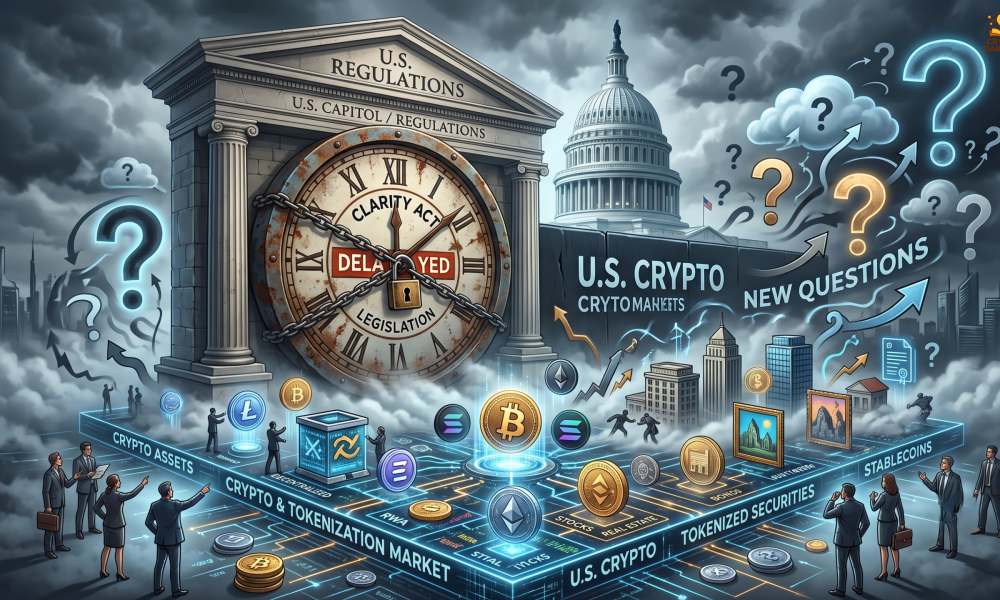
CLARITY Act Delay has left the U.S. cryptocurrency industry without a clear timeline for new market rules, while JPMorgan warns the uncertainty could allow Wall Street to dominate the future of tokenized assets.
The development creates fresh uncertainty for crypto companies, investors, exchanges, and blockchain developers. It also highlights a growing divide between public blockchain networks and private systems being built by major financial institutions.
Senate Puts Crypto Bill on Hold

The CLARITY Act was designed to create clearer rules for digital assets in the United States. One of its main goals is to define which cryptocurrencies should be treated as securities and which should fall under commodity rules.
Under the proposed framework, the Commodity Futures Trading Commission would receive wider authority over digital commodities. The Securities and Exchange Commission would continue to oversee investment contracts and tokenized securities.
The bill could also reduce confusion for crypto exchanges and blockchain projects. At present, many companies face uncertainty because regulators can apply different interpretations to similar digital assets. This has encouraged some businesses to move operations outside the United States.
However, the Senate has now placed the legislation on the back burner as lawmakers focus on other priorities before the August recess. The bill requires 60 votes to advance in the Senate, meaning it cannot pass without some Democratic votes. Reports indicate that disagreements over stablecoin rules and other provisions remain unresolved.
Why the Delay Matters to Crypto

The Senate’s decision does not immediately make existing crypto products illegal. Bitcoin, major exchanges, and stablecoin issuers can continue operating under the current system.
The larger issue is that the industry still lacks a long-term legal framework. Without clear rules, companies may delay product launches, reduce hiring, or move development teams to countries with more defined regulations. This uncertainty could also slow the rollout of tokenized settlement networks as financial institutions wait for greater regulatory certainty.
For investors, the delay may also limit institutional participation. Banks, asset managers, and pension funds often require clear compliance rules before committing large amounts of capital. A slower legislative process could therefore postpone new crypto investment products and services.
The CLARITY Act was viewed by many market participants as a possible catalyst for broader institutional adoption. Its delay may make that adoption more gradual, especially for digital assets that do not already have clear regulatory treatment.
JPMorgan Warns About Tokenization

JPMorgan’s analysis adds another concern. The bank has warned that tokenization could grow inside traditional financial networks instead of public blockchain ecosystems if regulators fail to act.
Tokenization refers to the process of representing real-world assets, such as stocks, bonds, funds, or U.S. Treasuries, as digital tokens on a blockchain. In theory, tokenization could make financial markets faster, more transparent, and available around the clock.
Yet major banks are increasingly developing private or permissioned blockchain systems. These networks allow financial institutions to control access, manage compliance, and limit participation to approved users.
JPMorgan, Citigroup, BNY Mellon, Nasdaq, and other major firms have already explored blockchain-based settlement and tokenized assets. The Depository Trust and Clearing Corporation also completed a pilot involving tokenized equities, Treasuries, and exchange-traded funds.
Could Wall Street Capture the Boom?

JPMorgan’s warning does not mean tokenization will disappear from crypto. Instead, it suggests that public networks may receive a smaller share of the growth than many blockchain advocates expect.
If banks build most tokenized products on private infrastructure, the benefits may remain within the existing financial system. Traditional institutions could control custody, settlement, trading access, and transaction data.
This could weaken the role of public blockchains in some parts of financial markets. Public networks may still support stablecoins, decentralized finance, and open trading, but they could face stronger competition from bank-led platforms.
Estimates also show why the sector is attracting attention. Citi has projected that tokenized financial assets could reach trillions of dollars by 2030, although forecasts vary and depend on regulation, demand, and technical adoption.
Growing interest from banks also reflects the broader trend of institutional crypto adoption as traditional finance expands into digital assets.
What Happens Next?

The CLARITY Act may return after the Senate recess, but its future remains uncertain. Lawmakers must still resolve key policy disagreements and secure enough votes for passage.
For now, crypto businesses are likely to continue operating in a difficult regulatory environment. Meanwhile, Wall Street firms are moving ahead with tokenized deposits, funds, and securities whether Congress passes new crypto legislation or not.
The delay may therefore become more than a political setback. It could help determine whether the next phase of digital finance is led by open blockchain networks or by private systems controlled by the world’s largest financial institutions.