Bitcoin is the world’s first and most valuable cryptocurrency. It introduced a new way of transferring money without banks or governments. At the heart of Bitcoin’s system is a process called Proof of Work (PoW). This method keeps the network secure, decentralized, and trustworthy. Over the years, many new cryptocurrencies have adopted another system called Proof of Stake (PoS). PoS is often described as faster, cheaper, and more energy-efficient. So, why does Bitcoin still use Proof of Work instead of switching to Proof of Stake?
This article explains the reasons behind Bitcoin’s choice, how both systems work, and why Proof of Work remains essential to Bitcoin’s identity. The goal is to make this topic simple and easy to understand, even for readers new to blockchain technology.
Understanding the Basics of Blockchain.

Before diving into Proof of Work and Proof of Stake, it’s important to understand what a blockchain is.
A blockchain is a digital ledger that records transactions across many computers. Each group of transactions is stored in a “block,” and these blocks are linked together in a chain. Once a block is added, it cannot be changed or deleted.
This system ensures transparency and security. Everyone can see the transactions, but no one can alter them. The challenge, however, is deciding who gets to add the next block and how to make sure they play fair. That’s where consensus mechanisms like Proof of Work and Proof of Stake come in.
What Is Proof of Work?

Proof of Work is the original consensus mechanism used by Bitcoin. It was introduced by Bitcoin’s creator, Satoshi Nakamoto, in 2009.
In Proof of Work, computers called miners compete to solve complex mathematical puzzles. These puzzles require a lot of computing power and electricity. The first miner to solve the puzzle gets to add a new block of transactions to the blockchain and earns a reward in Bitcoin.
This process is called mining, and it serves two main purposes:
- It verifies and secures transactions.
- It creates new Bitcoins and releases them into circulation.
How Proof of Work Keeps Bitcoin Secure.
The difficulty of the puzzles ensures that no one can easily take control of the network. To attack Bitcoin, a person or group would need to control more than half of the total mining power, something that would cost billions of dollars in hardware and electricity.
This high cost makes attacks nearly impossible, keeping Bitcoin safe and decentralized.
What Is Proof of Stake?

Proof-of-Stake (PoS) revolutionizes the way cryptocurrencies process transactions and build new blocks by utilizing a consensus mechanism that relies on randomly selected validators, rather than the computationally intensive process seen in Proof-of-Work (PoW) systems.
Instead of using computing power, Proof of Stake relies on ownership. People who hold coins can “stake” them, meaning they lock up their coins as collateral. The network then randomly selects one of these stakers to validate the next block of transactions.
The more coins someone stakes, the higher their chance of being chosen. In return, they earn rewards, similar to miners in Proof of Work.
How Proof of Stake Works.
- Validators lock up a certain amount of cryptocurrency as a stake.
- The system randomly selects a validator to create the next block.
- If the validator acts honestly, they earn rewards.
- If they cheat or try to manipulate the system, they lose part or all of their staked coins.
Proof of Stake uses much less energy than Proof of Work because it doesn’t require powerful computers to solve puzzles. However, it changes how trust and control work in the network.
Proof of Work vs Proof of Stake.

| Feature | Proof of Work (PoW) | Proof of Stake (PoS) |
| Basis of Validation | Computing power | Amount of coins staked |
| Energy Use | High | Low |
| Security | Very strong, but energy-intensive | Strong, but depends on wealth distribution |
| Decentralization | Open to anyone with hardware | Favors those with more coins |
| Attack Cost | Requires massive computing power | Requires owning a large share of coins |
| Reward System | Mining rewards (new coins + fees) | Staking rewards (interest + fees) |
| Example Coins | Bitcoin, Litecoin | Ethereum, Cardano, Solana |
Why Bitcoin Uses Proof of Work.

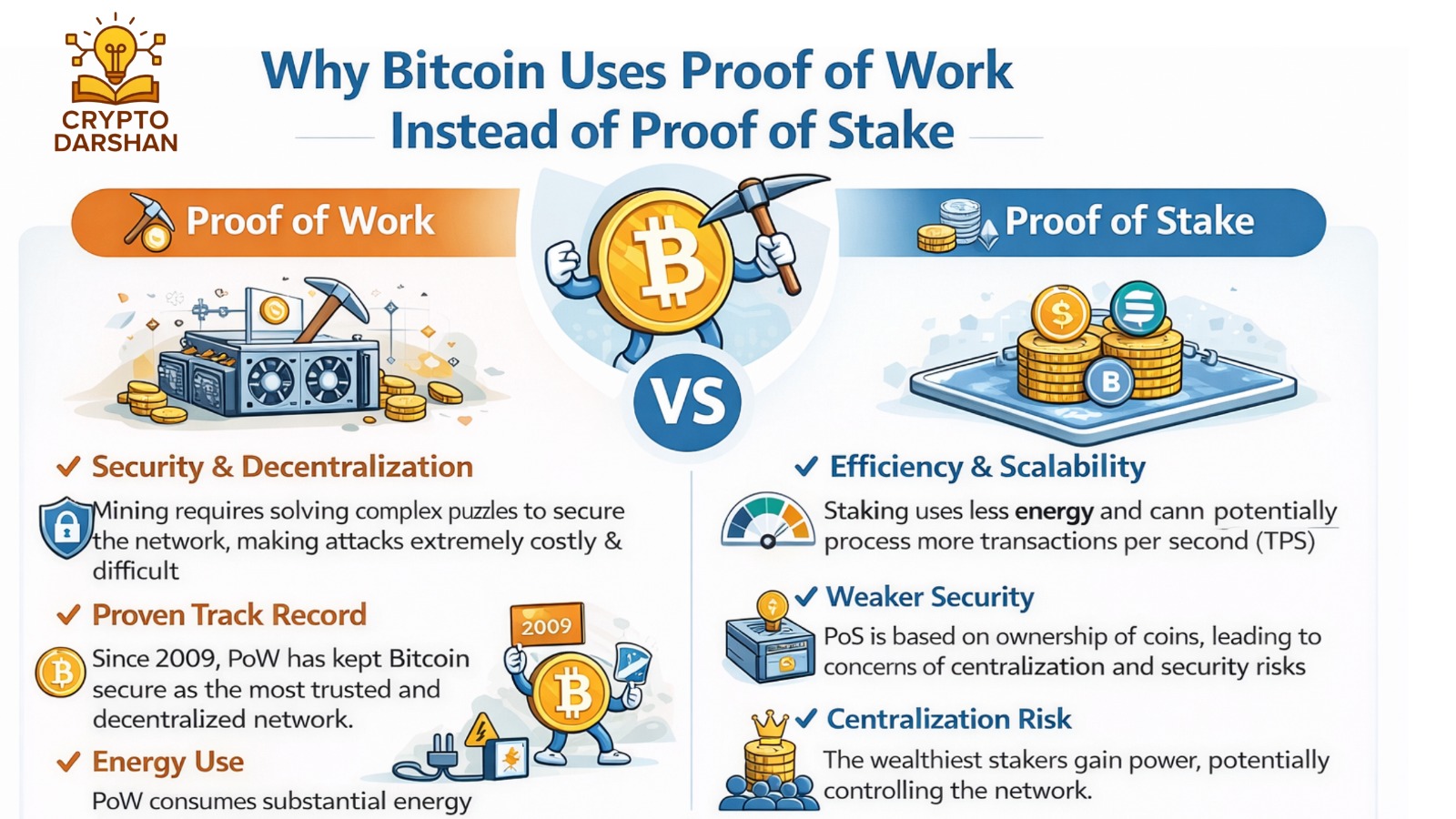
Bitcoin’s use of Proof of Work is not accidental. It’s a deliberate choice that aligns with its goals of security, decentralization, and fairness. Below are the main reasons why Bitcoin continues to rely on Proof of Work.
1. Security Comes First.
Bitcoin’s top priority is security. Proof of Work provides one of the most secure systems ever created for digital money.
Because miners must spend real resources, electricity, and hardware to add blocks, it becomes extremely expensive to cheat. To attack Bitcoin, someone would need to control more than 50% of the total mining power. This would require enormous amounts of energy and equipment, making it practically impossible.
In Proof of Stake, however, an attacker only needs to buy or control a large number of coins. If a wealthy individual or organization acquires enough coins, they could influence the network. This risk goes against Bitcoin’s goal of being a system that no one can control.
2. True Decentralization.
Bitcoin was designed to be decentralized, meaning no single person, company, or government controls it. Proof of Work supports this by allowing anyone with a computer to participate in mining. While mining has become more competitive over time, it remains open to anyone who wants to join.
Proof of Stake, on the other hand, tends to favor the rich. The more coins someone owns, the more power they have in the network. This can lead to centralization, where a few large holders’ control most of the decision-making.
3. Proven Reliability.

Proof of Work has been tested for over a decade. Since Bitcoin’s launch in 2009, the network has never been hacked or compromised. It has processed billions of dollars in transactions safely.
This long track record gives users confidence that Proof of Work works as intended. Proof of Stake, while promising, is still relatively new and has not been tested at Bitcoin’s scale for as long.
4. Fair Distribution of Coins.
When Bitcoin started, anyone with a regular computer could mine and earn coins. This helped distribute Bitcoin fairly among early users.
Proof of Stake, however, rewards those who already own a lot of coins. The more coins someone has, the more rewards they earn, which can make the rich richer. Bitcoin’s Proof of Work system avoids this by rewarding effort and energy spent, not just wealth.
5. Resistance to Manipulation.
Proof of Work makes it extremely difficult to rewrite or alter the blockchain. Once a block is added, changing it would require redoing all the work for that block and every block after it.
This feature ensures that Bitcoin’s history cannot be changed or faked. Proof of Stake systems, while secure, can be more vulnerable to certain types of attacks, such as the “nothing at stake” problem, where validators can vote on multiple versions of the blockchain without cost.
6. Energy Use as a Feature, Not a Flaw.
One of the biggest criticisms of Proof of Work is its energy consumption. Bitcoin mining uses a lot of electricity, leading some to call it wasteful.
However, Bitcoin supporters argue that this energy use is what gives Bitcoin its strength. The energy spent on mining is what makes the network secure and valuable. It’s similar to how gold mining requires effort and resources, which gives gold its worth.
Moreover, many mining operations now use renewable energy sources like hydro, solar, and wind power. Some even use excess or wasted energy that would otherwise go unused.
7. Stability and Predictability.
Bitcoin’s community values stability. Changing from Proof of Work to Proof of Stake would require rewriting the core of Bitcoin’s code and could divide the community.
Proof of Work provides a predictable and transparent system that users trust. It ensures that Bitcoin remains consistent and reliable, which is essential for a global financial network.
The Philosophy Behind Proof of Work.

Bitcoin is not just a technology; it’s a philosophy. It represents freedom, fairness, and independence from centralized control.
Proof of Work fits perfectly with this philosophy because it ties digital money to real-world effort. It ensures that value is created through work, not just ownership.
In Proof of Stake, wealth itself becomes power. In Proof of Work, power comes from effort, competition, and innovation. This aligns with Bitcoin’s vision of a fair and open financial system.
Common Criticisms of Proof of Work.

While Proof of Work has many strengths, it also faces criticism. Understanding these concerns helps explain why some people prefer Proof of Stake.
1. High Energy Consumption.
Mining requires large amounts of electricity, which can be costly and harmful to the environment if powered by fossil fuels.
2. Mining Centralization.
Over time, mining has become dominated by large companies with specialized hardware. This concentration of power can reduce decentralization.
3. Slower Transactions.
Proof-of-work networks like Bitcoin process fewer transactions per second than Proof-of-stake systems. This can lead to slower confirmation times during high demand.
4. Environmental Concerns.
Critics argue that Bitcoin’s energy use contributes to carbon emissions. However, many miners are shifting to renewable energy, and studies show that Bitcoin’s energy mix is becoming greener over time.
Why Bitcoin Won’t Switch to Proof of Stake.

Despite the rise of Proof-of-Stake, Bitcoin is unlikely to switch. Here’s why:
- Security Trade-offs: Proof of Stake changes the security model in ways that could make Bitcoin more vulnerable.
- Community Resistance: Bitcoin’s community values decentralization and stability. A major change like this would likely cause division.
- Philosophical Differences: Bitcoin’s identity is built around Proof of Work. It represents real-world effort and fairness.
- Technical Challenges: Switching would require rewriting Bitcoin’s codebase and could introduce new risks.
Bitcoin’s strength lies in its simplicity and consistency. Proof of Work has proven itself for over a decade, and there’s no strong reason to change what already works.
Comparing Bitcoin’s Goals With Other Cryptocurrencies.

Bitcoin’s main goal is to be a secure, decentralized, and censorship-resistant store of value. It’s often called “digital gold.” Other cryptocurrencies, like Ethereum, focus more on smart contracts and decentralized applications. These different goals explain why Ethereum moved to Proof of Stake while Bitcoin stayed with Proof of Work.
Bitcoin prioritizes security and stability over speed and flexibility. Proof of Work perfectly supports that mission.
The debate between Proof of Work and Proof of Stake often appears in discussions comparing Bitcoin vs Ethereum. While Bitcoin continues to rely on Proof of Work for maximum security and decentralization, Ethereum transitioned to Proof of Stake to improve energy efficiency and scalability, highlighting the philosophical and technical differences between the two networks.
The Economic Impact of Proof of Work.

Proof of Work also plays a key role in Bitcoin’s economy. It ensures that new coins are released at a predictable rate, following a schedule known as the halving. Every four years, the reward for mining new blocks is cut in half.
This limited supply makes Bitcoin scarce, similar to gold. The effort and cost of mining add to its value, creating a digital asset that cannot be easily inflated or manipulated.
The Environmental Evolution of Bitcoin Mining.

While energy use remains a concern, the Bitcoin mining industry is rapidly evolving. Many miners are moving to regions with cheap renewable energy, such as hydroelectric power in Canada, geothermal energy in Iceland, and solar power in Texas.
Some mining operations even use stranded energy power that would otherwise go to waste, such as excess natural gas or unused hydroelectric capacity.
This shift is turning Bitcoin mining into a driver of renewable energy innovation rather than an environmental threat.
The Role of Proof of Work in Global Freedom.

Bitcoin’s Proof of Work system also supports global freedom. In countries with unstable currencies or strict financial controls, Bitcoin provides a way for people to store and transfer value safely.
Because Proof of Work makes Bitcoin nearly impossible to censor or shut down, it gives individuals financial independence. This is especially important in regions where governments restrict access to money or banking services.
To understand why Bitcoin relies on Proof of Work, it’s important to first understand how Bitcoin mining works. Proof of Work requires miners to solve complex mathematical problems using computational power, which secures the network and validates transactions. This process makes Bitcoin extremely resistant to attacks and censorship, forming the backbone of its decentralized security model.
The Long-Term Vision.

Bitcoin’s long-term vision is to remain a secure, decentralized, and global financial network. Proof of Work is the foundation that makes this possible.
While other systems may come and go, Bitcoin’s strength lies in its simplicity and reliability. Proof of Work ensures that Bitcoin remains the most trusted and secure digital currency in the world.
The Future of Proof of Work.

As technology evolves, Proof of Work is also improving. Innovations like more efficient mining hardware, renewable energy use, and layer-2 solutions (like the Lightning Network) are making Bitcoin faster and greener.
Some countries are even using Bitcoin mining to balance their energy grids or capture wasted energy from oil and gas production. This shows that Proof of Work can coexist with sustainability when managed responsibly.
FAQ.

Why did Bitcoin choose Proof of Work instead of Proof of Stake?
Bitcoin’s creator, Satoshi Nakamoto, chose Proof of Work (PoW) because it was the only proven mechanism at the time that could secure a decentralized network without relying on trust. PoW ensures security by requiring miners to expend real-world computational power, making attacks extremely costly and impractical
Is Proof of Work more secure than Proof of Stake?
Yes, Proof of Work is generally considered more battle-tested and resistant to attacks. It requires attackers to control massive computing power and energy, which is economically difficult. Proof of Stake can be vulnerable to issues like wealth concentration and governance manipulation if not designed carefully.
Why can’t Bitcoin simply switch to Proof of Stake?
Switching Bitcoin to Proof of Stake would require changing its core protocol, which could split the network and damage trust. Bitcoin prioritizes stability, decentralization, and security, and most of the community believes PoW aligns better with Bitcoin’s original design and values.
Does Proof of Work make Bitcoin more decentralized?
Yes. Proof of Work allows anyone with mining hardware and electricity to participate in securing the network. It does not depend on how many coins a person owns, unlike Proof of Stake, which may favor wealthy holders and increase centralization over time.
Is Proof of Stake more energy-efficient than Proof of Work?
Yes, Proof of Stake is significantly more energy-efficient because it does not require continuous mining computations. However, Bitcoin developers argue that energy use in PoW contributes to network security and increasingly relies on renewable or excess energy sources.
Does Proof of Work prevent manipulation better than Proof of Stake?
Proof of Work reduces manipulation by linking influence to computational effort rather than coin ownership. In Proof of Stake, large holders may gain disproportionate control over validation and governance, raising concerns about power concentration.
What is the “Nothing at Stake” problem in Proof of Stake?
The “Nothing at Stake” problem occurs when validators in Proof of Stake can validate multiple competing chains with no cost, potentially weakening consensus. Proof of Work avoids this because mining on multiple chains requires real financial and energy costs.
How does Proof of Work protect Bitcoin from double-spending?
Proof of Work makes rewriting transaction history extremely difficult. To double-spend, an attacker would need to outperform the entire global mining network, which is computationally and financially unrealistic.
Why does Bitcoin prioritize security over energy efficiency?
Bitcoin’s primary mission is to be a secure, censorship-resistant store of value. The network prioritizes immutability, trustlessness, and resilience, even if that requires higher energy consumption.
Can Proof of Stake ever replace Proof of Work in Bitcoin?
While technically possible, it is highly unlikely due to Bitcoin’s conservative development philosophy and community consensus. Bitcoin prefers proven, stable systems over experimental changes.
Is Proof of Work better for Bitcoin’s long-term vision?
Many experts believe PoW aligns better with Bitcoin’s role as “digital gold”, offering predictable monetary policy, strong security guarantees, and independence from governance politics or wealthy validators.
What are the biggest risks of Proof of Stake compared to Proof of Work?
Potential risks include:
- Wealth concentration
- Governance capture
- Validator collusion
- Reduced resistance to censorship
- Increased reliance on social trust instead of computational trust
Why does Ethereum use Proof of Stake but Bitcoin does not?
Ethereum shifted to Proof of Stake to reduce energy consumption and support scalability, while Bitcoin focuses on maximum security, simplicity, and decentralization. The two networks serve different purposes.
Does Proof of Work guarantee Bitcoin’s immutability?
Yes. PoW makes Bitcoin’s blockchain extremely difficult to alter, ensuring historical transactions remain permanent and protecting the network from retroactive attacks.
Conclusion
Bitcoin uses Proof of Work instead of Proof of Stake because it provides unmatched security, fairness, and decentralization.
Proof of Work ties digital money to real-world effort, making it costly to cheat and impossible to control. It has proven reliable for over a decade, protecting trillions of dollars in value.
While Proof of Stake offers efficiency and speed, it also introduces risks of centralization and wealth concentration. Bitcoin’s mission is not just to be fast it’s to be free, fair, and secure for everyone.
In the end, Proof of Work is more than a technical choice. It’s the foundation of Bitcoin’s philosophy a system where trust is earned through work, not wealth. And that’s what makes Bitcoin truly revolutionary.