
Bitcoin mining is one of the most fascinating parts of the cryptocurrency world. It’s the process that keeps the Bitcoin network alive, secure, and decentralized. Yet, for many beginners, the concept of mining can seem confusing or overly technical. Terms like “hash rate,” “block reward,” and “proof of work” might sound intimidating, but the truth is that Bitcoin mining can be understood in simple terms.
This guide breaks down Bitcoin mining step by step, using plain language and real-world examples. By the end, the entire process from how miners create new bitcoins to how they secure the blockchain will make sense. This article also explores the equipment used, the costs involved, and whether mining is still profitable today.
What Is Bitcoin Mining?

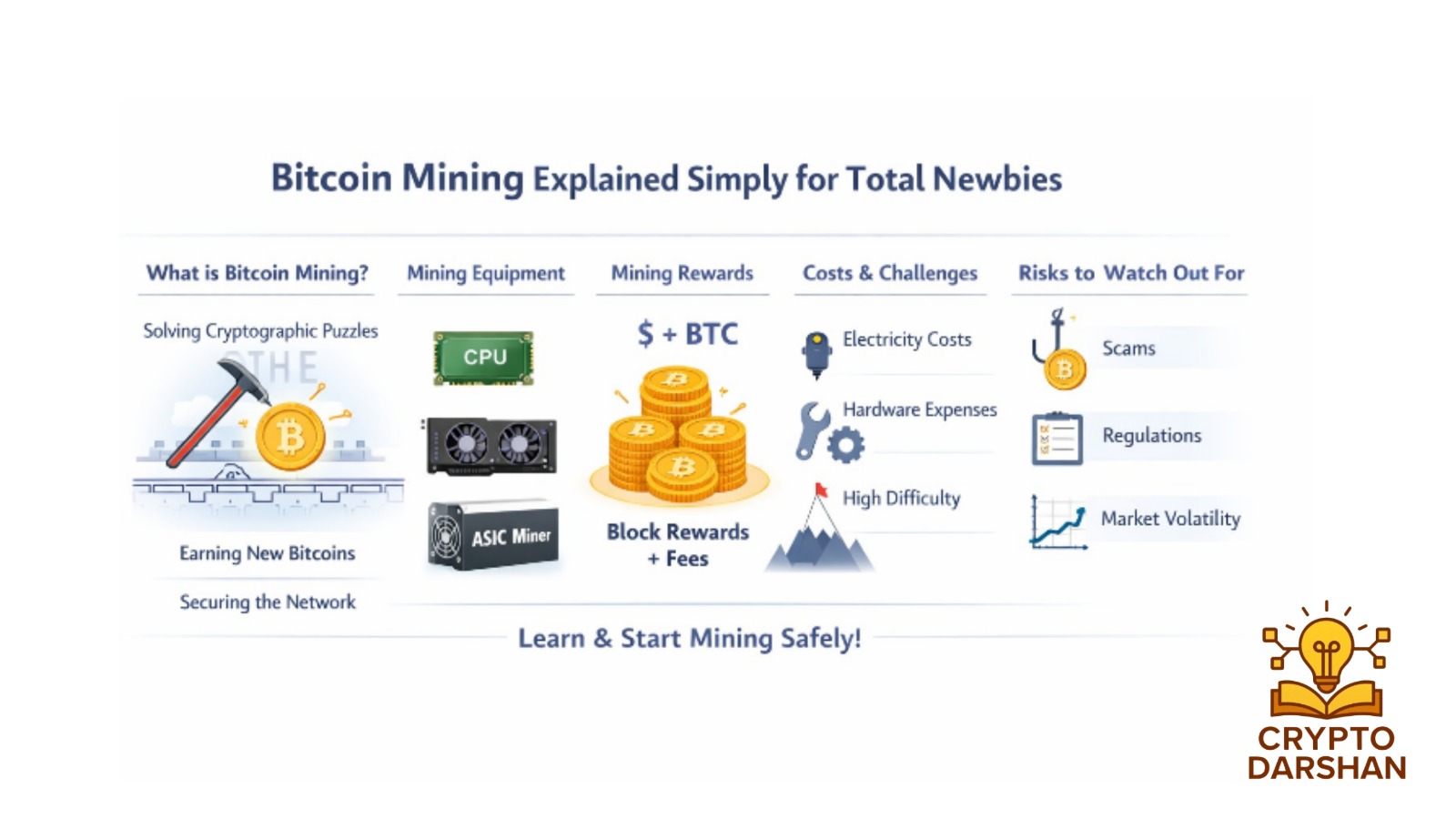
Bitcoin mining is the process of verifying and adding new transactions to the Bitcoin blockchain. It’s also how new bitcoins are created. Think of it as a digital version of gold mining. Instead of digging through rock, miners use computers to solve complex math problems. When they solve one, they earn a reward in the form of new bitcoins.
Every time someone sends Bitcoin, that transaction needs to be confirmed. Miners compete to confirm these transactions by solving a cryptographic puzzle. The first miner to solve it gets to add a new “block” of transactions to the blockchain and receives a reward.
In short:
- Mining secures the Bitcoin network.
- It verifies transactions.
- It releases new bitcoins into circulation.
The Role of Miners in the Bitcoin Network
Miners are the backbone of the Bitcoin system. Without them, the network would not function. Their main roles include:
- Transaction Verification
Every Bitcoin transaction must be verified to prevent fraud. Miners check that the sender has enough balance and that the transaction follows Bitcoin’s rules. - Block Creation
Verified transactions are grouped into blocks. Miners compete to add these blocks to the blockchain. - Network Security
Mining ensures that no single person or group can control the Bitcoin network. The more miners there are, the harder it becomes for anyone to manipulate the system. - Issuing New Bitcoins
Mining is the only way new bitcoins enter circulation. The reward for mining a block is how new coins are created.
How Bitcoin Mining Works Step by Step.
Step 1: Transactions Are Broadcast
When someone sends Bitcoin, the transaction is broadcast to the network. It includes details like the sender’s address, receiver’s address, and the amount sent.
Step 2: Transactions Enter the Mempool
Unconfirmed transactions go into a waiting area called the “mempool.” Miners pick transactions from this pool to include in the next block.
Step 3: Miners Compete to Solve a Puzzle
Each miner tries to solve a cryptographic puzzle. This puzzle involves finding a special number called a “nonce” that, when combined with the block’s data, produces a hash that meets Bitcoin’s difficulty target.
Step 4: The First Miner to Solve It Wins
The first miner to find the correct hash broadcasts it to the network. Other miners verify the solution. If it’s correct, the block is added to the blockchain.
Step 5: The Miner Gets a Reward
The winning miner receives a block reward newly created bitcoins plus transaction fees from the transactions in that block.
Understanding the Blockchain
The blockchain is a public ledger that records all Bitcoin transactions. Each block contains a list of transactions and a reference to the previous block. This creates a chain of blocks hence the name “blockchain.”
Because every block is linked to the one before it, altering any transaction would require changing all subsequent blocks. This makes the blockchain extremely secure and tamper-resistant.
What Is Proof of Work?

Proof of Work (PoW) is the system that makes Bitcoin mining possible. It’s a consensus mechanism that ensures all participants agree on the state of the blockchain.
In PoW, miners must perform computational work to add a new block. This work involves solving the cryptographic puzzle mentioned earlier. The difficulty of the puzzle adjusts automatically so that a new block is mined roughly every 10 minutes.
Proof of Work prevents spam and attacks because solving these puzzles requires real-world resources electricity and hardware. It ensures that miners have “skin in the game.”
Mining Difficulty and Hash Rate

Mining Difficulty
Mining difficulty measures how hard it is to find a valid hash for a block. The Bitcoin network adjusts this difficulty every 2,016 blocks (about every two weeks) to keep block times consistent.
If more miners join the network, blocks are found faster, and the difficulty increases. If miners leave, the difficulty decreases.
Hash Rate
Hash rate is the total computational power used by miners. It’s measured in hashes per second (H/s). A higher hash rate means more security for the network because it becomes harder for anyone to attack it.
The Block Reward and Halving Events

When Bitcoin launched in 2009, the block reward was 50 BTC. Every 210,000 blocks (roughly every four years), this reward is cut in half in an event called a “halving.”
Halving events reduce the rate at which new bitcoins are created, making Bitcoin scarcer over time. This scarcity is one reason Bitcoin is often compared to gold.
Bitcoin Halving History
| Year | Block Reward (BTC) | Event |
| 2009 | 50 | Bitcoin Launch |
| 2012 | 25 | First Halving |
| 2016 | 12.5 | Second Halving |
| 2020 | 6.25 | Third Halving |
| 2024 | 3.125 | Fourth Halving |
Eventually, around the year 2140, all 21 million bitcoins will have been mined. After that, miners will earn only transaction fees.
Mining Equipment: From CPUs to ASICs
In Bitcoin’s early days, anyone could mine using a regular computer (CPU). As competition grew, miners switched to more powerful hardware.
1. CPU Mining
CPU mining is the process of mining cryptocurrency using a computer’s central processing unit (CPU) instead of specialized hardware like GPUs or ASIC miners.
In the early days of Bitcoin, CPU mining was common because the network difficulty was low. Today, however, CPU mining is mostly used for privacy-focused and newer cryptocurrencies, as Bitcoin and Ethereum mining are no longer profitable with CPUs.
2. GPU Mining
Graphics cards (GPUs) offered much higher performance. They could perform many calculations simultaneously, making them more efficient for mining.
3. FPGA Mining
FPGA mining uses Field-Programmable Gate Arrays (FPGAs) to mine cryptocurrency. An FPGA is a specialized chip that can be reprogrammed to perform specific mining algorithms more efficiently than CPUs and GPUs, but with more flexibility than ASICs.
FPGA mining sits between GPU and ASIC mining in terms of performance, cost, and power efficiency.
4. ASIC Mining
Application-Specific Integrated Circuits (ASICs) are machines built specifically for mining Bitcoin. They are extremely powerful and energy-efficient but expensive.
Today, ASICs dominate Bitcoin mining. Without them, it’s nearly impossible to compete.
Mining Pools Explained

Bitcoin mining is highly competitive. As more miners join the network, the chances of any single miner solving a block and earning the reward become extremely small. To overcome this challenge, miners often join forces through mining pools.
What Is a Mining Pool?
A mining pool is a group of miners who combine their computing power to increase their chances of successfully mining a block. Mining pools amplify the odds of earning cryptocurrency by uniting miners to solve blockchain problems. This collective approach accelerates the block discovery process, which alone demands substantial computational power and resources.
Think of it like a lottery syndicate: one person’s chance of winning is tiny, but if a group buys many tickets together, their collective chance improves. When they win, the prize is divided among everyone.
Why Mining Pools Exist
Mining difficulty has increased dramatically since Bitcoin’s early days. Back then, individuals could mine using regular computers and occasionally earn rewards. Today, mining requires specialized hardware (ASICs) and massive energy consumption. Mining pools make it possible for smaller miners to still earn consistent income without needing to compete directly with industrial-scale operations.
How Mining Pools Work
- Miners Join the Pool
Each miner connects their hardware to the pool’s server using mining software. The pool assigns small tasks to each miner. - Work Distribution
Instead of all miners working on the same block, the pool divides the work into smaller pieces. Each miner works on finding partial solutions. - Submitting Shares
When a miner finds a partial solution (called a “share”), it’s sent to the pool to prove they’re contributing work. These shares don’t always solve the block but show effort. - Block Discovery
When the pool collectively finds a valid block, it’s added to the blockchain. The Bitcoin network confirms it, and the pool receives the block reward plus transaction fees. - Reward Distribution
The pool divides the reward among members based on the number of valid shares each miner submitted.
Reward Distribution Methods

Mining pools use different payout systems to distribute rewards fairly:
- PPS (Pay Per Share):
Miners are paid a fixed amount for each share they submit, regardless of whether the pool finds a block. It offers steady income but usually includes higher pool fees. - PPLNS (Pay Per Last N Shares):
Rewards are distributed based on the number of shares a miner contributed to the last few blocks. It’s more variable but can be more profitable over time. - FPPS (Full Pay Per Share):
Similar to PPS, but it also includes transaction fees in the payout, giving miners slightly higher earnings. - PROP (Proportional):
Rewards are divided proportionally based on the number of shares each miner contributed during a mining round.
Advantages of Mining Pools
- Steady Income:
Instead of waiting months or years to mine a block solo, miners receive smaller, regular payouts. - Lower Risk:
Pooling resources reduces the risk of earning nothing due to bad luck. - Accessibility:
Even miners with limited hardware can participate and earn rewards.
Disadvantages of Mining Pools
- Pool Fees:
Most pools charge a small fee (usually 1–3%) for managing operations. - Centralization Risk:
If a few large pools control most of the network’s hash rate, it can reduce Bitcoin’s decentralization. - Dependence on Pool Operators:
Miners rely on the pool’s honesty and technical reliability. A dishonest or poorly managed pool can cause losses.
Popular Bitcoin Mining Pools
Some of the largest and most trusted mining pools include:
- Foundry USA
- AntPool
- F2Pool
- ViaBTC
- Binance Pool
These pools collectively control a large portion of Bitcoin’s total hash rate, helping maintain network stability.
Solo Mining vs. Pool Mining

The Role of Mining Pools in Bitcoin’s Ecosystem
Mining pools play a vital role in keeping Bitcoin’s network secure and efficient. They allow more participants to contribute to mining, which helps distribute hash power across the globe. However, maintaining decentralization is crucial if too much power concentrates in a few pools, it could pose a risk to Bitcoin’s independence.
Energy Consumption and Environmental Impact.
Bitcoin mining consumes a lot of electricity. This has led to debates about its environmental impact. However, the picture is more complex than it seems.
Many mining operations use renewable energy sources like hydro, wind, or solar power. Some even use excess energy that would otherwise go to waste.
The Bitcoin network’s energy use is tied to its security. The more energy miners expend, the harder it becomes to attack the network. This trade-off between energy and security is central to Bitcoin’s design.
Is Bitcoin Mining Profitable?
Profitability depends on several factors:
- Bitcoin price: Higher prices mean higher potential profits.
- Electricity cost: Mining consumes a lot of power, so cheap electricity is crucial.
- Hardware efficiency: Modern ASICs are more efficient but expensive.
- Mining difficulty: As difficulty rises, profits can shrink.
- Pool fees: Mining pools charge small fees for participation.
Example Profit Calculation
If a miner uses an ASIC that consumes 3,000 watts and produces 100 TH/s, and electricity costs $0.10 per kWh, the daily cost is about $7.20. If the miner earns $10 worth of Bitcoin per day, the profit is $2.80.
Profitability calculators can help estimate returns, but results vary with market conditions.
How to Start Bitcoin Mining
Starting Bitcoin mining can seem complicated, but with the right steps, anyone can begin. Whether you want to mine as a hobby or as a business, understanding the process and setting up correctly is essential. This guide breaks down everything you need to know to start mining Bitcoin from scratch.
Step 1: Understand What Bitcoin Mining Is?
Before investing time or money, it’s important to understand what mining actually does. Bitcoin mining is the process of verifying transactions and adding them to the blockchain. Miners use powerful computers to solve complex mathematical puzzles. When they succeed, they earn rewards in the form of new bitcoins and transaction fees.
Mining is not just about earning coins it’s also about maintaining the security and decentralization of the Bitcoin network.
Step 2: Choose the Right Mining Hardware.
Mining requires specialized equipment called ASICs (Application-Specific Integrated Circuits). These machines are designed specifically for mining Bitcoin and are far more efficient than regular computers or graphics cards.
Popular ASIC Models
- Bitmain Antminer S19 Pro
- MicroBT Whatsminer M30S++
- Canaan AvalonMiner 1246
When choosing hardware, consider:
- Hash rate: The speed at which the miner can process data (measured in TH/s).
- Power consumption: How much electricity it uses.
- Efficiency: The ratio of hash rate to power usage.
- Cost: Both the purchase price and ongoing electricity costs.
Efficient hardware is key to profitability.
Step 3: Set Up a Bitcoin Wallet.
You’ll need a Bitcoin wallet to receive your mining rewards. A wallet stores your private keys and allows you to send or receive Bitcoin securely.
Types of Wallets
- Hardware Wallets: Physical devices like Ledger or Trezor that store Bitcoin offline for maximum security.
- Software Wallets: Apps like Electrum or Exodus that run on your computer or phone.
- Exchange Wallets: Wallets provided by crypto exchanges, though they’re less secure since you don’t control the private keys.
For mining, a hardware or software wallet is recommended.
Step 4: Choose a Mining Pool.
Mining solo is possible, but the chances of earning rewards are extremely low due to high competition. Most miners join mining pools, where they combine computing power with others and share rewards.
Popular Mining Pools
- Foundry USA
- AntPool
- F2Pool
- ViaBTC
- Binance Pool
When selecting a pool, check:
- Pool fees: Usually between 1–3%.
- Payout method: PPS, PPLNS, or FPPS.
- Reputation and reliability: Choose established pools with transparent operations.
Step 5: Install Mining Software.
Mining software connects your hardware to the Bitcoin network and your chosen pool. It manages your mining process and monitors performance.
Common Mining Software
- CGMiner: Open-source and widely used.
- BFGMiner: Similar to CGMiner but supports more customization.
- EasyMiner: User-friendly interface for beginners.
After installation, you’ll need to configure the software with:
- The mining pool’s address.
- Your wallet address.
- Worker credentials (provided by the pool).
Step 6: Configure and Start Mining.
Once your hardware and software are ready:
- Connect your ASIC miner to a power source and the internet.
- Access the miner’s control panel through your web browser.
- Enter your mining pool details and wallet address.
- Save the settings and start mining.
Your miner will begin solving cryptographic puzzles, and you’ll start earning small portions of Bitcoin as part of the pool’s rewards.
Step 7: Monitor Performance.
Mining is a continuous process. Regularly monitor your setup to ensure it’s running efficiently.
Keep an eye on:
- Hash rate: Indicates your mining speed.
- Temperature: Overheating can damage hardware.
- Power usage: Helps manage electricity costs.
- Pool payouts: Track your earnings and ensure payments are consistent.
Many miners use monitoring tools or mobile apps to track performance remotely.
Step 8: Calculate Profitability.
Before and after starting, it’s important to calculate whether mining is profitable for you. Profitability depends on:
- Bitcoin’s market price.
- Electricity costs.
- Mining difficulty.
- Hardware efficiency.
- Pool fees.
You can use online calculators like whattomine.com or cryptocompare.com to estimate potential earnings. Enter your hardware’s hash rate, power consumption, and electricity rate to see your expected profit.
Step 9: Manage Electricity and Cooling.
Mining consumes a lot of electricity and generates heat. Efficient power management and cooling are essential for long-term success.
Tips for Managing Power and Heat
- Use energy-efficient ASICs.
- Set up in a cool, well-ventilated area.
- Consider renewable energy sources like solar or hydro power.
- Use fans or air conditioning to prevent overheating.
Electricity is often the biggest expense in mining, so optimizing energy use can significantly improve profitability.
Step 10: Stay Updated and Adapt.
The Bitcoin mining landscape changes constantly. New hardware, difficulty adjustments, and halving events can affect profitability. Stay informed about:
- Bitcoin price trends.
- Mining difficulty updates.
- New ASIC releases.
- Regulatory changes in your region.
Adapting to these changes helps you stay competitive and profitable.
Optional: Cloud Mining.
If you don’t want to buy hardware or manage electricity, you can try cloud mining. This involves renting mining power from a remote data center. You pay a fee, and the provider mines on your behalf.
Pros
- No need for equipment or maintenance.
- Easy to start.
Cons
- Lower profits due to fees.
- Risk of scams or unreliable providers.
- No control over mining operations.
Cloud mining can be convenient, but requires careful research.
Step 11: Secure Your Earnings.
Once you start earning Bitcoin, security becomes crucial. Always:
- Transfer mined Bitcoin to your personal wallet.
- Use two-factor authentication (2FA) on all accounts.
- Keep your private keys offline.
- Avoid storing large amounts on exchanges.
Protecting your earnings ensures your mining efforts pay off safely.
Step 12: Scale Up (Optional).
If mining proves profitable, you can expand your operation by adding more ASICs or setting up a small mining farm. Scaling up increases potential rewards but also raises costs for electricity, cooling, and maintenance.
Before expanding, calculate your return on investment (ROI) and ensure your infrastructure can handle the additional load.
Security and Risks in Mining
Mining involves financial and technical risks:
- Hardware Failure: Mining machines run 24/7 and can overheat or break down.
- Electricity Costs: Rising energy prices can reduce profits.
- Market Volatility: Bitcoin’s price fluctuations affect earnings.
- Scams: Fake cloud mining sites and fraudulent pools exist.
- Regulatory Risks: Laws can change, affecting mining operations.
Proper planning and research can minimize these risks.
Cloud Mining: An Alternative Option.

Cloud mining allows users to rent mining power from a remote data center. Instead of buying hardware, users pay for a contract that gives them a share of the mining rewards.
Pros
- No need to manage hardware.
- Lower upfront costs.
- Easy to start.
Cons
- Lower profits due to fees.
- Risk of scams.
- No control over mining operations.
Cloud mining can be convenient but requires careful research to avoid fraudulent platforms.
Bitcoin Mining and Decentralization
Decentralization is one of Bitcoin’s core principles. Mining plays a key role in maintaining it. When mining power is spread across many participants, no single entity can control the network.
However, large mining pools can create centralization risks. The community continues to encourage geographic and operational diversity to keep Bitcoin decentralized.
Bitcoin mining may also have legal and tax implications depending on your country. Earnings from mining can be taxable, and regulations vary by region. To avoid future issues, it is important to understand the basics of crypto taxation. Our guide How Crypto Taxation Works: A Complete Beginner-to-Advanced Guide explains how taxes can apply to Bitcoin mining and crypto investments.
The Economics of Bitcoin Mining
Bitcoin mining is a competitive market. Miners must balance costs and rewards. The main economic drivers include:
- Block Rewards: The primary source of income.
- Transaction Fees: A growing source of revenue as block rewards decrease.
- Electricity Costs: The largest expense.
- Hardware Depreciation: ASICs lose value as newer models appear.
Over time, as block rewards shrink, transaction fees will become more important for miners’ income.
Bitcoin Mining vs. Other Cryptocurrencies

Not all cryptocurrencies use Proof of Work. Some, like Ethereum (after its merge), use Proof of Stake (PoS). Here’s how they differ:
| Feature | Proof of Work (Bitcoin) | Proof of Stake (Ethereum) |
| Energy Use | High | Low |
| Security | Based on computational power | Based on staked coins |
| Hardware | Requires ASICs | Requires tokens |
| Decentralization | Depends on miner distribution | Depends on validator distribution |
Bitcoin remains committed to Proof of Work because of its proven security and simplicity.
The Social and Economic Impact of Bitcoin Mining

Bitcoin mining has created entire industries and job markets. It has also encouraged innovation in renewable energy and data center efficiency.
In some regions, mining has revitalized local economies by using surplus energy. In others, it has sparked debates about energy policy and sustainability.
Mining also plays a role in financial inclusion. By securing a decentralized currency, miners help maintain a system that operates outside traditional banking structures.
Common Myths About Bitcoin Mining

Myth 1: Bitcoin Mining Is Illegal
Mining is legal in most countries. Some governments regulate it, but outright bans are rare.
Myth 2: Mining Is Only for Tech Experts
While technical knowledge helps, many mining setups are now plug-and-play. Mining pools and cloud mining services make it easier for beginners.
Myth 3: Bitcoin Mining Wastes Energy
Bitcoin’s energy use secures a global financial network. Much of the energy comes from renewable or surplus sources.
Myth 4: Bitcoin Mining Is No Longer Profitable
Profitability depends on market conditions. With efficient hardware and cheap electricity, mining can still be profitable.
The Future of Bitcoin Mining

Bitcoin mining continues to evolve. Several trends are shaping its future:
- Renewable Energy Adoption
More miners are turning to green energy to reduce costs and environmental impact. - Geographic Shifts
After China’s mining ban, operations moved to countries like the U.S., Kazakhstan, and Canada. - Technological Innovation
New ASICs are becoming more efficient, reducing energy use per hash. - Regulatory Changes
Governments are developing clearer rules for mining operations, especially regarding energy use and taxation. - Layer 2 Solutions
Technologies like the Lightning Network may reduce on-chain transactions, slightly changing miners’ revenue models.
The Endgame: When All Bitcoins Are Mined

When the final Bitcoin is mined around 2140, miners will no longer receive block rewards. Instead, they will earn only transaction fees. By then, Bitcoin’s economy is expected to be mature enough that fees alone will sustain mining operations.
The network will continue to function as it does today, with miners verifying transactions and maintaining security.
Conclusion
Bitcoin mining may seem complex at first, but at its core, it’s a simple concept: using computing power to secure the network and earn rewards. It’s the process that keeps Bitcoin decentralized, transparent, and trustworthy.
From CPUs to ASICs, from solo mining to massive data centers, mining has evolved dramatically. Yet its purpose remains the same to maintain the integrity of the Bitcoin blockchain.
For beginners, understanding mining is the first step toward grasping how Bitcoin truly works. Whether mining directly or simply learning about it, this knowledge provides a deeper appreciation for the technology that powers the world’s first decentralized currency.