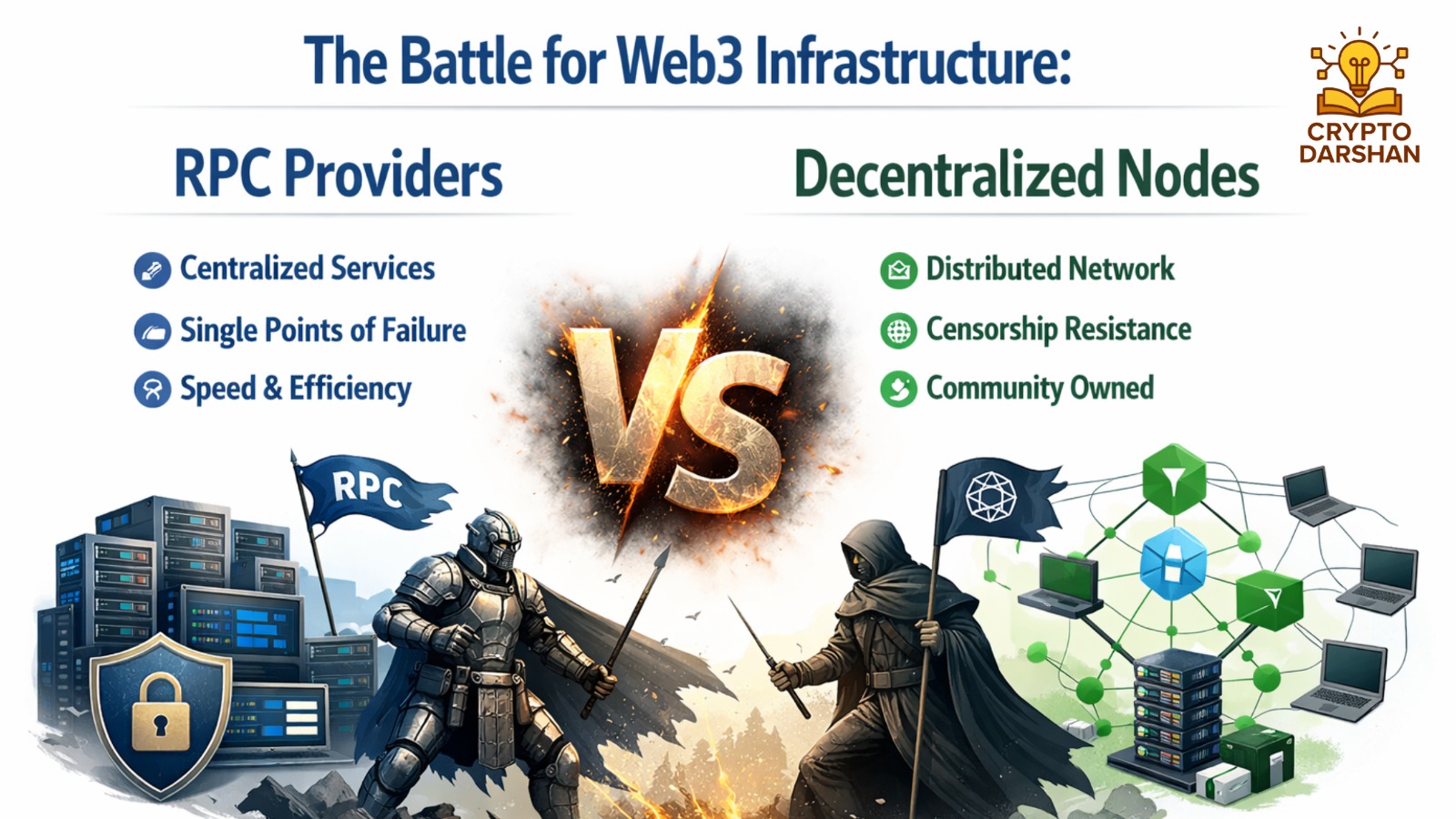
The Battle for Web3 Infrastructure pits centralized RPC providers like Alchemy and Infura against emerging decentralized nodes, challenging the core promise of blockchain resilience. The internet is evolving faster than ever before. The rise of Web3 — a decentralized, user-owned version of the web — marks a major shift in how people interact online. Unlike Web2, where large corporations control data, platforms, and user experiences, Web3 aims to return ownership and control to individuals. It does this through blockchain technology, smart contracts, and decentralized networks.
However, the dream of a fully decentralized internet depends on one critical factor: infrastructure. Behind every decentralized application (dApp), wallet, or blockchain service lies a complex network of nodes and servers that process data, verify transactions, and maintain connectivity. This infrastructure determines how fast, secure, and reliable Web3 applications can be.
At the center of this infrastructure battle are two competing forces — RPC (Remote Procedure Call) providers and decentralized node networks. RPC providers offer fast, centralized access to blockchain data, while decentralized nodes distribute that access across independent operators. Both play vital roles, but they represent different philosophies: one prioritizes performance and convenience, the other prioritizes decentralization and resilience.
This article explores the ongoing competition between RPC providers and decentralized nodes. It examines their strengths, weaknesses, and how they shape the future of Web3 infrastructure. It also looks at emerging trends, hybrid models, and the technologies that could define the next generation of blockchain connectivity.
Understanding Web3 Infrastructure
What Is Web3?
Web3 represents the next evolution of the internet — a decentralized network designed to give individuals greater ownership and control over their online activity. It’s powered by blockchain technology, which records transactions on distributed ledgers that no single entity controls.
In Web2, companies like Google, Meta, and Amazon act as intermediaries, storing user data and controlling access. In Web3, users interact directly with decentralized applications (dApps) through smart contracts. These contracts execute automatically when conditions are met, removing the need for middlemen.
Web3 also introduces digital ownership through tokens and NFTs (non-fungible tokens). Users can own digital assets, vote in decentralized organizations, and earn rewards for contributing to networks. This ownership model is what makes Web3 revolutionary — but it also demands a strong, reliable infrastructure to function.
The Role of Nodes in Web3
Nodes are the backbone of any blockchain network. They store copies of the blockchain ledger, validate transactions, and maintain consensus across the network. Each node communicates with others to ensure that all participants share the same version of the truth.
There are different types of nodes:
- Full nodes store the entire blockchain and validate all transactions.
- Light nodes store only essential data and rely on full nodes for verification.
- Archive nodes store historical blockchain data for analytics and indexing.
Running a node requires technical expertise, hardware, and bandwidth. As blockchains grow, maintaining nodes becomes more resource-intensive. This complexity has led many developers to rely on third-party services — particularly RPC providers — to access blockchain data.
What Are RPC Providers?
RPC (Remote Procedure Call) providers act as intermediaries between dApps and blockchain networks. They allow developers to send requests to blockchain nodes without running their own infrastructure.
When a dApp needs to read data from the blockchain or broadcast a transaction, it sends an RPC request to a provider. The provider then communicates with the blockchain and returns the result.
Popular RPC providers include:
- Infura (by ConsenSys)
- Alchemy
- QuickNode
- Ankr
- Blast API
These providers offer scalable APIs, analytics, and developer tools that simplify blockchain integration. They handle millions of requests per second, ensuring that dApps remain fast and responsive. As blockchain adoption grows, reliable RPC infrastructure becomes essential for decentralized applications, financial protocols, and services that rely on high on-chain activity, a trend also explored in DeFi Yields Are Rising Again — But Is It Sustainable?
Why RPC Providers Became Popular
RPC providers became essential because they solve a major problem: accessibility. Running a full node for networks like Ethereum or Solana requires terabytes of storage and constant maintenance. RPC providers eliminate this burden by offering plug-and-play access to blockchain data.
Their main advantages include:
- Ease of Use: Developers can connect to blockchains using simple API endpoints.
- Scalability: Providers handle large volumes of requests efficiently.
- Reliability: Centralized infrastructure ensures consistent uptime.
- Advanced Features: Many providers offer analytics, caching, and debugging tools.
For startups and small teams, RPC providers are a lifeline. They allow developers to focus on building products instead of managing infrastructure.
The Centralization Problem
Despite their convenience, RPC providers introduce a paradox. Web3’s mission is decentralization, yet much of its infrastructure depends on a few centralized companies.
For example, Infura powers a large portion of Ethereum’s dApps. If Infura experiences downtime, many wallets and DeFi platforms become inaccessible. This happened in November 2020, when an Infura outage disrupted Ethereum access for hours.
Centralization creates several risks:
- Single Points of Failure: Outages can disrupt entire ecosystems.
- Censorship: Providers may comply with government regulations or block certain transactions.
- Data Privacy: Centralized providers can log user activity and metadata.
- Vendor Lock-In: Developers become dependent on specific providers’ APIs and pricing models.
These issues highlight the tension between convenience and decentralization — a core challenge in Web3’s evolution.
The Rise of Decentralized Node Networks
What Are Decentralized Node Networks?
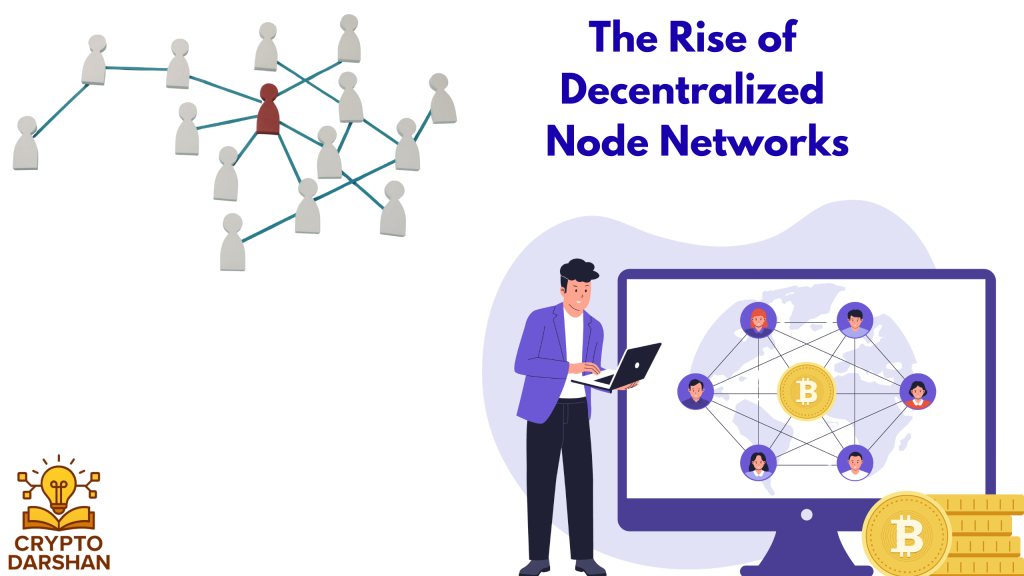
Decentralized node networks distribute blockchain access across multiple independent operators. Instead of relying on a single company’s infrastructure, these networks use token incentives and peer-to-peer protocols to coordinate node participation.
Examples include:
- Pocket Network (POKT)
- Chainstack’s Decentralized Nodes
- Ankr’s Distributed Node Marketplace
- DRPC
- Lava Network
In these systems, developers send requests to a decentralized network, which routes them to available nodes. Node operators earn rewards for processing requests, ensuring that no single entity controls access to blockchain data.
Advantages of Decentralized Nodes
Decentralized node networks align closely with Web3’s core principles. Their benefits include:
- Censorship Resistance: No central authority can block or filter requests.
- Resilience: Distributed architecture reduces the risk of outages.
- Transparency: Open participation ensures accountability.
- Economic Incentives: Token-based rewards encourage community participation.
By decentralizing infrastructure, these networks create a more robust and equitable foundation for Web3 applications.
Challenges Facing Decentralized Nodes
Despite their promise, decentralized node networks face significant hurdles:
- Performance: Latency and reliability can vary across nodes.
- Complexity: Setting up and maintaining decentralized infrastructure requires coordination.
- Adoption: Developers often prefer the simplicity of centralized APIs.
- Economic Sustainability: Token incentives must balance supply, demand, and network costs.
These challenges have slowed adoption, but innovation continues to close the gap with centralized providers.
Comparing RPC Providers and Decentralized Nodes
| Aspect | RPC Providers | Decentralized Nodes |
| Control | Centralized under a few companies | Distributed among independent operators |
| Performance | High speed and reliability | Variable, improving with optimization |
| Censorship Resistance | Vulnerable to regulation and filtering | Resistant due to distributed design |
| Ease of Use | Simple APIs and developer tools | Requires integration with decentralized protocols |
| Cost | Subscription-based pricing | Token-based or pay-per-request models |
| Transparency | Limited visibility into operations | Open and verifiable participation |
| Scalability | Scales easily with centralized infrastructure | Scales through community participation |
| Security | Dependent on provider’s safeguards | Enhanced through decentralization but variable by node quality |
Neither approach is perfect. RPC providers excel in performance and usability, while decentralized nodes offer resilience and alignment with Web3’s ideals.
The Impact on Developers and Users
Developer Experience
For developers, the choice between RPC providers and decentralized nodes often comes down to trade-offs between convenience and control. Centralized providers offer polished dashboards, analytics, and SDKs that accelerate development. Decentralized networks, while more complex, provide greater autonomy and censorship resistance.
Some developers adopt hybrid approaches — using centralized providers for non-critical operations and decentralized nodes for sensitive or mission-critical functions. This strategy balances performance with decentralization.
User Experience
End users rarely interact directly with RPC infrastructure, but they feel its effects. When a centralized provider experiences downtime, users may be unable to access their wallets or dApps. Conversely, decentralized networks can ensure continuous availability, even if some nodes fail.
As Web3 matures, users are becoming more aware of the importance of infrastructure decentralization. Projects that prioritize transparency and resilience may gain trust and long-term loyalty.
Case Studies

Infura and the Ethereum Outage
In November 2020, Infura experienced a major outage that disrupted access to Ethereum for several hours. Many dApps, wallets, and exchanges relying on Infura went offline. This incident exposed the fragility of centralized infrastructure and sparked renewed interest in decentralized alternatives.
Pocket Network’s Decentralized Approach
Pocket Network offers a decentralized RPC protocol that connects developers with thousands of independent node operators. By using its native token (POKT) for payments and rewards, the network incentivizes participation and ensures redundancy. This model demonstrates how decentralization can achieve both scalability and reliability.
Ankr’s Hybrid Model
Ankr combines centralized and decentralized infrastructure, offering developers flexibility. Its distributed node marketplace allows users to choose between performance-optimized nodes and community-operated ones. This hybrid approach bridges the gap between convenience and decentralization.
Web3 infrastructure also supports innovative work ecosystems such as blockchain-based freelance marketplaces, where smart contracts automate payments and agreements, as explained in Tokenized Freelancing: The Future of Work on Blockchain.
The Economics of Web3 Infrastructure
Centralized Pricing Models
RPC providers typically operate on subscription or usage-based pricing. Developers pay for API calls, bandwidth, and premium features. While predictable, these costs can become significant as applications scale. Moreover, pricing structures are controlled by the provider, leaving developers vulnerable to changes.
Decentralized Incentive Models
Decentralized networks use token economies to reward node operators and balance supply and demand. Developers pay in tokens for access, while node operators earn tokens for serving requests. This model promotes community participation but requires careful economic design to prevent inflation or underpayment.
Sustainability Considerations
Both models face sustainability challenges. Centralized providers must maintain profitability while ensuring accessibility. Decentralized networks must maintain token value and incentivize long-term participation. The most successful systems will likely blend economic efficiency with community-driven governance.
Security and Privacy Implications
Centralized Risks
Centralized RPC providers can log user data, monitor transactions, and comply with regulatory requests. This creates potential privacy risks, especially for users in restrictive jurisdictions. Additionally, centralized systems are attractive targets for hackers seeking to compromise large amounts of data.
Decentralized Protections
Decentralized node networks distribute data across multiple operators, reducing the risk of mass surveillance or single-point breaches. However, they must still address issues like data integrity, malicious nodes, and Sybil attacks. Advanced cryptographic techniques and reputation systems are being developed to mitigate these risks.
The Role of Emerging Technologies
Edge Computing and Web3
Edge computing can enhance decentralized node performance by processing data closer to users. Integrating edge nodes into decentralized networks can reduce latency and improve reliability, making decentralized infrastructure more competitive with centralized RPC providers.
Zero-Knowledge Proofs
Zero-knowledge proofs (ZKPs) can enhance privacy and verification in decentralized networks. By allowing nodes to prove data validity without revealing sensitive information, ZKPs can strengthen trust and security in decentralized RPC systems.
AI-Driven Optimization
Artificial intelligence can optimize routing, load balancing, and node selection in decentralized networks. AI algorithms can predict network congestion, identify reliable nodes, and dynamically allocate resources to maintain performance parity with centralized providers.
The Expanding Role of Infrastructure in Web3 Growth
As blockchain adoption accelerates, the demand for reliable infrastructure grows exponentially. The rise of decentralized finance (DeFi), non-fungible tokens (NFTs), and metaverse platforms has placed unprecedented pressure on RPC providers and node networks. Billions of daily blockchain queries require scalable, secure, and low-latency infrastructure.
In 2024 and beyond, new trends are reshaping this landscape. Modular blockchains, such as Celestia and EigenLayer, are introducing new ways to separate consensus, execution, and data availability. This modularity allows decentralized node networks to specialize in specific layers, improving efficiency and reducing redundancy. Meanwhile, RPC providers are integrating AI-driven monitoring systems to predict network congestion and reroute traffic dynamically.
Another emerging trend is geo-distributed infrastructure, where nodes are strategically placed across regions to reduce latency and comply with local regulations. This approach benefits both centralized and decentralized systems, ensuring faster response times and improved reliability for global users.
The competition between RPC providers and decentralized nodes is also driving innovation in data indexing and caching. Projects like The Graph and SubQuery are decentralizing data indexing, allowing dApps to query blockchain data more efficiently without relying on centralized APIs. These complementary technologies are helping bridge the gap between performance and decentralization.
Regulatory and Ethical Considerations

Compliance Challenges
Centralized RPC providers must comply with regional regulations, including Know Your Customer (KYC) and Anti-Money Laundering (AML) requirements. This compliance can lead to censorship or restricted access in certain regions. Decentralized networks, while more resistant to regulation, face uncertainty regarding legal accountability.
Ethical Responsibility
Infrastructure providers hold significant power over blockchain accessibility. Ethical considerations include data privacy, neutrality, and transparency. The Web3 community continues to debate how to balance innovation with responsibility.
The Future of Web3 Infrastructure
Hybrid Models
The future of Web3 infrastructure may not be purely centralized or decentralized. Hybrid models that combine the reliability of RPC providers with the resilience of decentralized nodes are emerging. These systems can dynamically route requests based on performance, cost, and trust requirements.
Interoperability and Multi-Chain Access
As multi-chain ecosystems expand, infrastructure providers must support seamless access across blockchains. Both centralized and decentralized solutions are developing cross-chain RPC protocols to simplify integration and improve user experience.
Decentralization as a Competitive Advantage
In the long term, decentralization may become a key differentiator. Users and developers increasingly value transparency, censorship resistance, and community governance. Projects that embrace these principles will likely gain credibility and adoption.
The Role of Community Governance
Decentralized governance models, such as DAOs (Decentralized Autonomous Organizations), can manage infrastructure networks democratically. Token holders can vote on protocol upgrades, pricing, and security measures, ensuring that infrastructure evolves in line with community interests.
The Road Ahead

The battle between RPC providers and decentralized nodes is not a zero-sum game. Both play vital roles in the Web3 ecosystem. Centralized providers accelerate adoption by simplifying access, while decentralized networks preserve the integrity and resilience of blockchain technology.
The future likely lies in collaboration rather than competition. Hybrid infrastructures, open standards, and community-driven governance can create a balanced ecosystem that combines performance with decentralization. As Web3 continues to evolve, the infrastructure that supports it must embody the same principles of openness, transparency, and user empowerment that define the movement itself.
The Battle for Web3 Infrastructure: RPC Providers vs Decentralized Nodes – FAQ
1. What are RPC providers in Web3 infrastructure?
RPC (Remote Procedure Call) providers are services that allow applications to interact with blockchain networks without running their own nodes. They provide APIs that developers can use to send transactions, read blockchain data, and connect decentralized applications (dApps) to networks like Ethereum or Solana.
2. What are decentralized nodes in blockchain networks?
Decentralized nodes are independently operated servers that maintain a full or partial copy of a blockchain. These nodes validate transactions, secure the network, and allow users or applications to interact with the blockchain without relying on centralized intermediaries.
3. How do RPC providers support Web3 applications?
RPC providers simplify blockchain development by offering reliable infrastructure, high uptime, and scalable API access. Developers can quickly connect their applications to blockchain networks without the technical complexity and cost of maintaining their own nodes.
4. What are the advantages of using decentralized nodes?
Decentralized nodes increase network resilience, censorship resistance, and transparency. By distributing infrastructure across many independent operators, they reduce reliance on centralized services and help preserve the core principles of Web3.
5. What are the limitations of centralized RPC providers?
Centralized RPC providers can create single points of failure and potential censorship risks. If a provider experiences downtime, rate limits, or regulatory pressure, it may affect thousands of applications relying on that service.
6. Why is decentralization important for Web3 infrastructure?
Decentralization ensures that no single entity controls the network. This improves security, reduces systemic risks, and maintains the trustless nature of blockchain ecosystems, which is essential for decentralized finance (DeFi), NFTs, and other Web3 applications.
7. How do decentralized RPC networks work?
Decentralized RPC networks distribute requests across multiple node operators. Instead of relying on a single provider, applications route their requests through a network of nodes, improving reliability, redundancy, and censorship resistance.
8. Can developers use both RPC providers and decentralized nodes?
Yes, many developers adopt a hybrid approach. They may use centralized RPC providers for speed and reliability while integrating decentralized node networks for redundancy, resilience, and greater alignment with Web3’s decentralized philosophy.
Conclusion
The battle for Web3 infrastructure reflects a deeper philosophical divide between convenience and decentralization. RPC providers offer speed, reliability, and ease of use but risk recreating the centralization that Web3 seeks to eliminate. Decentralized node networks embody the spirit of Web3 but face challenges in performance, scalability, and adoption.
Ultimately, the future of Web3 depends on finding harmony between these two approaches. By combining the strengths of centralized efficiency with decentralized resilience, the next generation of blockchain infrastructure can deliver on the promise of a truly open, user-owned internet. The outcome of this battle will shape not only the technical foundations of Web3 but also its social and economic impact for decades to come.