
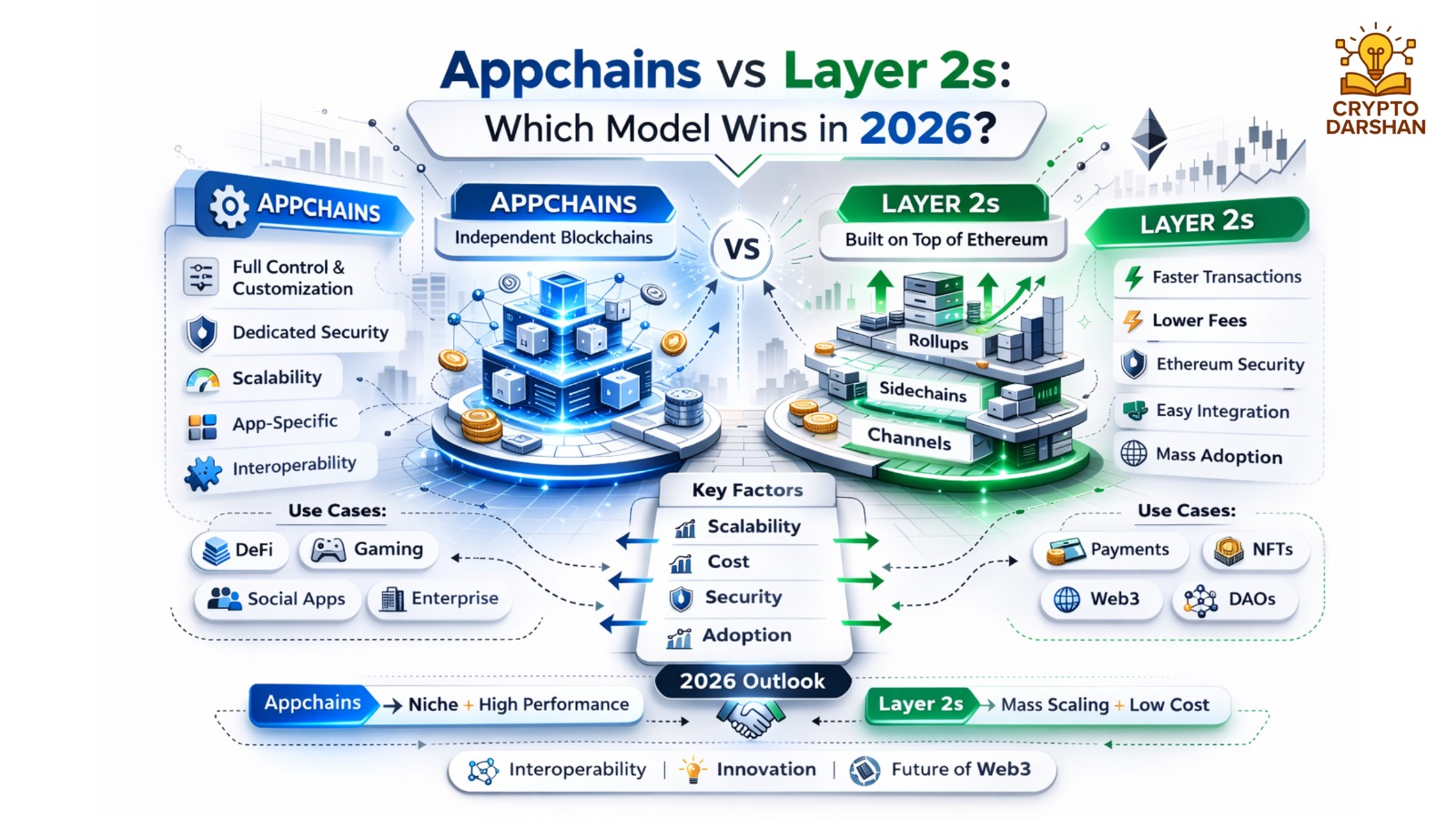
The blockchain industry has entered a new era of scalability, customization, and interoperability. As decentralized applications (dApps) continue to grow in complexity and user demand, the need for efficient blockchain infrastructure has never been greater. Two dominant models have emerged to address these challenges: Appchains vs Layer 2. Both aim to solve the scalability trilemma, balancing decentralization, security, and scalability, but they do so in fundamentally different ways.
The debate around Appchains vs Layer 2 has become one of the most important discussions in the blockchain ecosystem. Developers, investors, and users are all asking the same question: which model will define the future of blockchain technology by 2026?
This article explores the architecture, advantages, limitations, and real-world use cases of both models, providing a comprehensive analysis of Appchains vs Layer 2 and predicting which approach is likely to dominate the next phase of blockchain evolution.
Understanding the Basics of Appchains vs Layer 2

What Are Appchains?
Appchains, short for application-specific blockchains, are independent blockchains designed to serve a single application or a specific set of use cases. In the Appchains vs Layer 2 debate, Appchains represent the side of sovereignty and customization. They allow developers to build dedicated blockchains optimized for their unique requirements, rather than sharing resources with other applications on a general-purpose blockchain like Ethereum.
Appchains can be built using frameworks such as Cosmos SDK, Polkadot’s Substrate, or Avalanche Subnets. These frameworks provide modular tools that enable developers to customize consensus mechanisms, tokenomics, and governance models.
Key characteristics of Appchains:
- Independent consensus and governance
- Customizable performance and security parameters
- Native token economies
- Interoperability through cross-chain communication protocols
What Are Layer 2s?
A layer 2 refers to any off-chain network, system, or technology built on top of a blockchain (commonly known as a layer-1 network) that helps extend the capabilities of the underlying base layer network. In the Appchains vs Layer 2 comparison, Layer 2s represent the side of scalability and shared security. They process transactions off-chain and periodically settle them on the main chain, thereby increasing throughput and reducing transaction costs.
Common types of Layer 2s include:
- Optimistic Rollups
- Zero-Knowledge (ZK) Rollups
- State Channels
- Plasma Chains
Layer 2s rely on the security of their underlying Layer 1, making them ideal for applications that prioritize decentralization and trust minimization.
Key characteristics of Layer 2s:
- Built on top of existing blockchains
- Inherit security from the base layer
- Lower transaction costs and higher throughput
- Shared liquidity and composability with the main chain
The Scalability Trilemma and the Rise of Appchains vs Layer 2
The blockchain scalability trilemma, introduced by Vitalik Buterin, states that a blockchain can only optimize two of the following three properties at once:
- Decentralization
- Security
- Scalability
Layer 1 blockchains like Ethereum and Bitcoin prioritize decentralization and security, often at the expense of scalability. The emergence of Appchains vs Layer 2 represents two different approaches to solving this trilemma.
- Appchains focus on scalability and customization, sometimes sacrificing shared security.
- Layer 2s focus on scalability while maintaining the security of the base layer.
This fundamental difference defines the Appchains vs Layer 2 debate and shapes how developers choose their infrastructure. To better understand how Layer 2 scalability works, read our detailed guide on Zero-Knowledge Proofs (ZK Rollups) Explained for Beginners, where we break down how ZK rollups inherit security from Ethereum while increasing throughput.
Appchains: The Customization Powerhouse

Advantages of Appchains
Full Customization
In the Appchains vs Layer 2 discussion, Appchains stand out for their flexibility. Developers can tailor every aspect of an Appchain, from consensus algorithms to gas models—to optimize for specific use cases. For example, a gaming Appchain can prioritize speed and low fees, while a DeFi Appchain can focus on security and composability.
Dedicated Resources
Appchains operate independently, meaning they don’t compete for block space with other applications. This ensures predictable performance and eliminates congestion caused by unrelated dApps.
Sovereign Governance
Appchains have independent governance structures, allowing communities to make decisions without external interference. This autonomy fosters innovation and rapid iteration.
Native Token Economies
Each Appchain can issue its own token for gas fees, staking, and governance. This creates strong economic alignment between users, developers, and validators.
Interoperability
Frameworks like Cosmos IBC (Inter-Blockchain Communication) and Polkadot’s relay chain enable Appchains to communicate and exchange assets seamlessly.
Limitations of Appchains
Security Fragmentation
In the Appchains vs Layer 2 comparison, one of the biggest challenges for Appchains is security. Each Appchain must secure itself, often through its own validator set. Smaller chains may struggle to attract enough validators, leading to weaker security.
Liquidity Fragmentation
Since each Appchain operates independently, liquidity can become siloed, reducing composability across ecosystems.
Complex Maintenance
Running an Appchain requires managing infrastructure, validators, and upgrades—tasks that can be resource-intensive for smaller teams.
Interoperability Risks
Cross-chain bridges, while powerful, introduce potential attack vectors. Bridge exploits have historically led to significant losses.
Leading Appchain Ecosystems
- Cosmos: Home to Appchains like Osmosis, dYdX, and Secret Network. Cosmos SDK and IBC make it easy to build interoperable chains.
- Polkadot: Uses parachains connected to a central relay chain, offering shared security and cross-chain communication.
- Avalanche Subnets: Allow developers to launch custom blockchains with flexible virtual machines and validator sets.
Layer 2s: The Scaling Engine
Advantages of Layer 2s
Inherited Security
In the Appchains vs Layer 2 debate, Layer 2s have a major advantage in security. They leverage the security of their base Layer 1, reducing the need to bootstrap independent validator networks.
Lower Fees and Higher Throughput
By processing transactions off-chain, Layer 2s significantly reduce gas costs and increase transaction speeds.
Shared Liquidity and Composability
Since Layer 2s settle on the same base chain, assets and smart contracts remain interoperable, preserving the network effects of ecosystems like Ethereum.
Developer Familiarity
Developers can use existing tools, languages, and frameworks (like Solidity) to deploy on Layer 2s, minimizing friction.
User Accessibility
Users can easily bridge assets between Layer 1 and Layer 2, often through native wallets and dApps.
Limitations of Layer 2s
Complex User Experience
Bridging assets between layers can be confusing for non-technical users, especially when dealing with withdrawal delays on Optimistic Rollups.
Centralization Risks
Some Layer 2s rely on centralized sequencers or operators, which can become single points of failure.
Data Availability Challenges
Ensuring that transaction data remains accessible and verifiable is a key challenge, especially for Validiums and hybrid models.
Fragmented Ecosystem
Multiple Layer 2s (Arbitrum, Optimism, zkSync, Starknet, etc.) compete for liquidity and developer attention, leading to fragmentation.
Leading Layer 2 Ecosystems
- Arbitrum: The largest Layer 2 by total value locked (TVL), known for its Optimistic Rollup technology.
- Optimism: Focuses on scalability and governance through the Optimism Collective.
- zkSync: Uses zero-knowledge proofs for faster and more secure transaction validation.
- Starknet: A ZK-Rollup platform emphasizing scalability and privacy.
Appchains vs Layer 2: A Comparative Analysis

| Feature | Appchains | Layer 2s |
| Architecture | Independent blockchains | Built on top of Layer 1 |
| Security | Self-secured or shared via frameworks | Inherited from base layer |
| Customization | Highly customizable | Limited by base layer |
| Governance | Sovereign | Dependent on Layer 1 governance |
| Liquidity | Fragmented across chains | Shared within ecosystem |
| Performance | Optimized per application | Optimized for general scaling |
| Interoperability | Cross-chain via bridges | Native within Layer 1 ecosystem |
| Development Complexity | High | Moderate |
| Examples | Cosmos, Polkadot, Avalanche | Arbitrum, Optimism, zkSync |
This table highlights the core differences in the Appchains vs Layer 2 debate. Appchains prioritize sovereignty and customization, while Layer 2s emphasize scalability and shared security.
Real-World Use Cases in Appchains vs Layer 2

Appchain Success Stories
dYdX (Cosmos)
Originally built on Ethereum, dYdX migrated to a Cosmos Appchain to achieve full control over its order book and trading engine. This move allowed it to eliminate gas fees for users and optimize performance for high-frequency trading an important milestone in the App,chains vs Layer 2 narrative.
Osmosis (Cosmos)
A decentralized exchange (DEX) built as an Appchain, Osmosis leverages IBC for cross-chain swaps and governance autonomy.
DeFi Kingdoms (Avalanche Subnet)
A play-to-earn game that launched its own subnet to handle in-game transactions efficiently while maintaining a unique token economy.
Layer 2 Success Stories
Uniswap on Arbitrum and Optimism
Uniswap’s deployment on Layer 2s drastically reduced transaction fees, making DeFi more accessible to retail users. This success story is often cited in discussions of Appchains vs Layer 2 scalability.
Immutable X (StarkEx)
A Layer 2 solution for NFTs that enables gas-free minting and trading, powering games like Gods Unchained.
Base (Coinbase’s Layer 2)
Built on Optimism’s OP Stack, Base has become a major hub for consumer dApps, bridging millions of users to Ethereum.
Economic and Ecosystem Implications of Appchains vs Layer 2

Tokenomics
- Appchains: Each Appchain typically issues its own token, creating isolated economies. This can drive strong community alignment but may fragment liquidity.
- Layer 2s: Often use the base layer’s token (e.g., ETH) for gas fees, maintaining unified liquidity and reducing friction.
Developer Incentives
- Appchains: Offer full control over revenue models, staking rewards, and governance.
- Layer 2s: Provide easier onboarding and access to existing developer tools and user bases.
User Experience
- Appchains: Offer tailored experiences but may require cross-chain bridges.
- Layer 2s: Provide smoother integration with existing wallets and dApps.
The 2026 Landscape: Trends in Appchains vs Layer 2

1. Convergence of Models
By 2026, the line between Appchains vs Layer 2 is blurring. Hybrid models are emerging:
- App-specific Layer 2s: Custom rollups designed for individual applications.
- Shared Security Appchains: Appchains leveraging shared security from ecosystems like Cosmos Hub or Polkadot.
2. Rise of Rollup-as-a-Service (RaaS)
Platforms like Celestia, Polygon CDK, and Optimism’s OP Stack enable developers to launch custom rollups easily. This trend merges the flexibility of Appchains with the security of Layer 2s, reshaping the Appchains vs Layer 2 landscape.
3. Interoperability Becomes Standard
Cross-chain communication protocols are maturing, allowing seamless asset and data transfers between Appchains and Layer 2s. This reduces fragmentation and enhances user experience.
4. Institutional Adoption
Enterprises are increasingly adopting Appchains for private or consortium blockchains, while consumer-facing applications prefer Layer 2s for scalability and liquidity. This dual adoption strengthens both sides of the Appchains vs Layer 2 ecosystem.
As institutional adoption grows, the debate between Appchains and Layer 2s becomes even more important for tokenized assets. Explore this further in Real-World Assets (RWA) on Blockchain Explained.
5. The Modular Future
The future is modular, not monolithic. Both Appchains and Layer 2s will coexist, serving different needs within a unified, interoperable ecosystem. The Appchains vs Layer 2 debate will evolve into a conversation about collaboration rather than competition.
Technical Innovations Driving Appchains vs Layer 2

Data Availability Layers
Projects like Celestia and EigenDA are redefining how data availability works. These innovations allow both Appchains and Layer 2s to offload data storage, improving scalability and reducing costs.
Cross-Chain Messaging
Protocols like IBC, LayerZero, and Axelar are bridging the gap between Appchains and Layer 2s, enabling seamless communication and asset transfers.
Decentralized Sequencers
Layer 2s are moving toward decentralized sequencers to reduce centralization risks. Similarly, Appchains are adopting shared validator networks to enhance security. These developments are narrowing the gap in the Appchains vs Layer 2 competition.
Appchains vs Layer 2: Developer Perspectives
Why Developers Choose Appchains
- Full control over the blockchain stack
- Ability to design custom tokenomics
- Independence from Layer 1 congestion
- Tailored governance and upgrade mechanisms
Why Developers Choose Layer 2s
- Access to existing user bases and liquidity
- Lower development overhead
- Compatibility with existing Ethereum tools
- Faster time to market
In the Appchains vs Layer 2 decision, developers often weigh sovereignty against convenience. Appchains offer freedom but require more effort, while Layer 2s offer simplicity but less control.
Appchains vs Layer 2: User Perspectives

From a user standpoint, the Appchains vs Layer 2 experience depends on accessibility, cost, and interoperability.
- Appchains: Users benefit from specialized experiences, such as zero gas fees or instant transactions, but may face challenges when moving assets across chains.
- Layer 2s: Users enjoy lower fees and faster transactions while maintaining access to the broader Ethereum ecosystem.
As wallets and bridges improve, the user experience gap in Appchains vs Layer 2 continues to narrow.
The Future of Appchains vs Layer 2 in Web3

The Multi-Chain Reality
By 2026, the blockchain world is inherently multi-chain. The Appchains vs Layer 2 debate is no longer about exclusivity but about interoperability. Projects will choose the model that best fits their needs, and users will interact seamlessly across both.
The Role of Interoperability Protocols
Interoperability protocols will play a crucial role in uniting Appchains vs Layer 2 ecosystems. Technologies like IBC, LayerZero, and Wormhole are enabling a connected Web3 where assets and data flow freely.
The Rise of App-Specific Rollups
App-specific rollups combine the best of both worlds, customization from Appchains and security from Layer 2s. This hybrid model could redefine the Appchains vs Layer 2 landscape by offering flexibility without sacrificing security.
Which Model Wins in 2026?

The question of Appchains vs Layer 2 dominance in 2026 doesn’t have a single answer. Instead, the future is about coexistence and specialization.
- For Developers: Appchains offer unmatched flexibility and sovereignty, ideal for projects needing full-stack control.
- For Users: Layer 2s provide seamless access to liquidity and established ecosystems.
- For Enterprises: Appchains enable compliance, privacy, and customization.
- For DeFi and NFTs: Layer 2s remain dominant due to composability and shared liquidity.
Ultimately, Appchains vs Layer 2 is not a zero-sum game. Both models will thrive, serving different niches within the broader blockchain ecosystem. The real winner is the modular, interoperable future where Appchains and Layer 2s coexist harmoniously.
FAQ -Appchains vs Layer 2s: Which Model Wins in 2026?

1. What is the main difference between Appchains and Layer 2s?
Appchains are independent blockchains built specifically for a single application, offering full customization over consensus, fees, and governance. Layer 2s, on the other hand, are scaling solutions built on top of Layer 1 blockchains like Ethereum that process transactions off-chain while inheriting the base layer’s security.
2. Are Appchains more scalable than Layer 2s?
Appchains can achieve high scalability because they are not competing with other applications for blockspace. However, modern Layer 2s such as Optimistic and ZK rollups also offer massive throughput while maintaining strong security guarantees from the base Layer 1.
3. Which model is more secure in 2026?
Layer 2s generally inherit security from established Layer 1 networks like Ethereum. Appchains must bootstrap their own validator sets unless they use shared security models like those in the Cosmos ecosystem or restaking mechanisms such as EigenLayer.
4. Do Appchains offer better customization?
Yes. Appchains provide full control over execution environments, tokenomics, and governance rules. This makes them ideal for gaming, DeFi protocols, or SocialFi platforms that need tailored infrastructure.
5. Are Layer 2s more cost-efficient for startups?
In most cases, yes. Launching on an existing Layer 2 reduces infrastructure costs and security risks. Teams can deploy smart contracts without managing validators or maintaining an entirely new blockchain.
6. How do liquidity and network effects compare?
Layer 2s benefit from Ethereum’s liquidity and ecosystem network effects. Appchains often face liquidity fragmentation unless they build strong bridges or integrate with interoperability protocols.
7. Will Appchains replace Layer 2s by 2026?
It’s unlikely to be a winner-takes-all outcome. In 2026, we are likely to see a modular blockchain world where high-value DeFi and general-purpose apps thrive on Layer 2s, while high-performance, specialized applications migrate toward Appchains.
8. Which model is better for Web3 gaming?
Appchains are often preferred for Web3 gaming due to performance optimization and fee control. However, gaming-focused Layer 2s are also evolving rapidly, offering competitive alternatives.
Conclusion
The Appchains vs Layer 2 debate captures the essence of blockchain’s evolution—from monolithic systems to modular, interconnected networks. Appchains empower developers with sovereignty and customization, while Layer 2s deliver scalability and security through shared infrastructure.
By 2026, the blockchain ecosystem will not be defined by one model winning over the other. Instead, it will be shaped by the synergy between Appchains vs Layer 2, creating a unified, interoperable web of blockchains that power the next generation of decentralized innovation.
In the end, Appchains vs Layer 2 is not about competition—it’s about collaboration. The future belongs to the builders who can harness the strengths of both models to create scalable, secure, and user-friendly decentralized applications that redefine the digital economy.