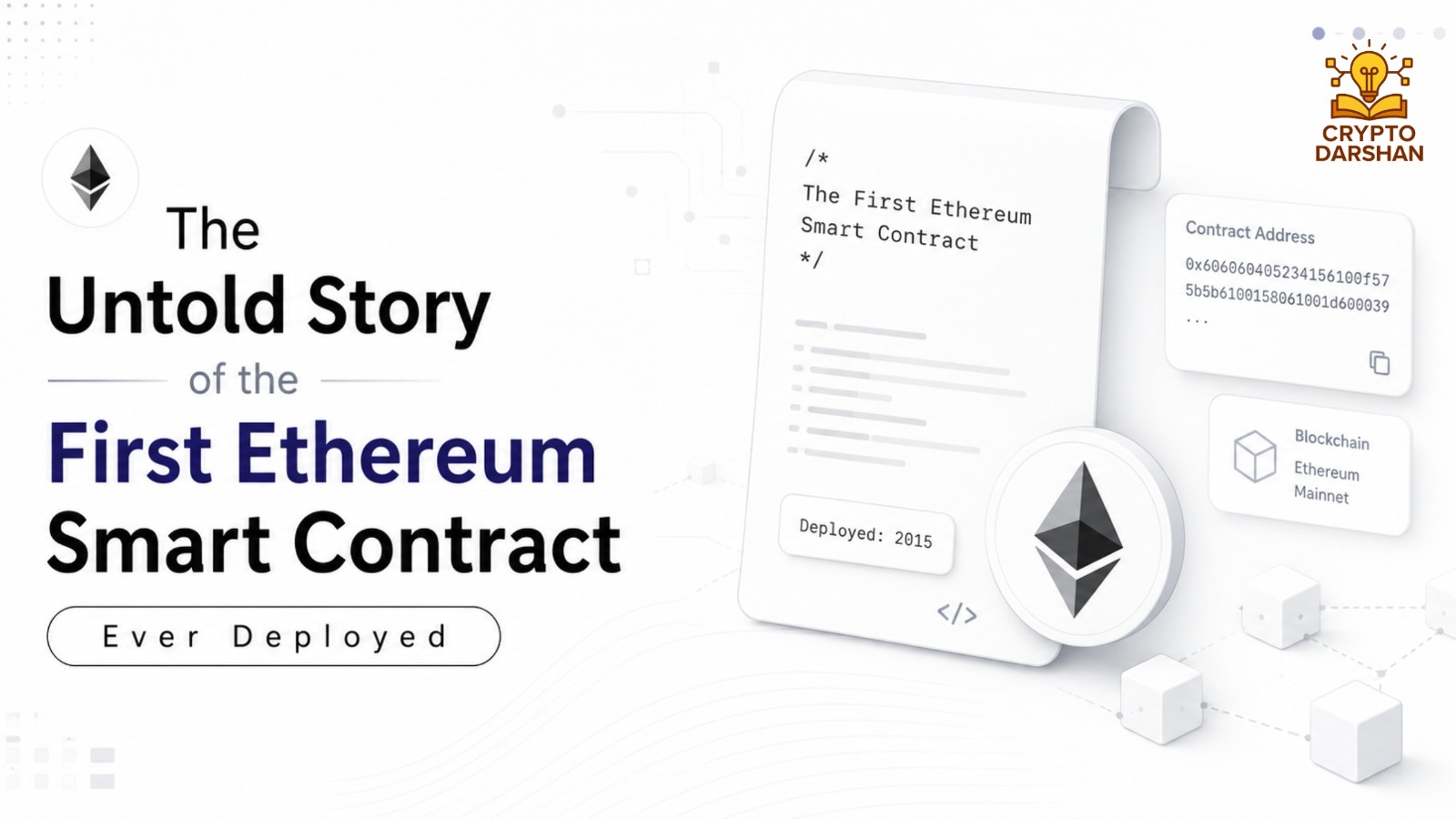
The launch of the first Ethereum Smart Contract marked a turning point in the history of blockchain technology. Before Ethereum, blockchain was primarily associated with Bitcoin—a decentralized currency system designed for peer-to-peer transactions. Ethereum expanded this concept by introducing programmable contracts that could execute automatically when certain conditions were met. This innovation transformed blockchain from a simple ledger into a global computing platform capable of running decentralized applications (dApps). The story of the first Ethereum Smart Contract is not just about code; it’s about vision, innovation, and the beginning of a decentralized revolution.
The Vision Behind Ethereum
Ethereum was conceived by Vitalik Buterin in 2013 as a response to the limitations of Bitcoin’s scripting language. Bitcoin’s blockchain was powerful but rigid—it could only handle basic transactions. Buterin envisioned a blockchain that could execute complex logic, enabling developers to build decentralized applications without relying on centralized servers. This idea led to the creation of Ethereum, a platform that introduced the concept of the Ethereum Smart Contract—a self-executing piece of code stored on the blockchain.
The Ethereum whitepaper, published in late 2013, outlined how smart contracts could automate agreements, manage assets, and even create decentralized organizations. By 2015, the Ethereum network went live, and the first Ethereum Smart Contract was deployed, setting the stage for a new era of blockchain innovation.
Understanding What an Ethereum Smart Contract Is

An Ethereum Smart Contract is a program that runs on the Ethereum Virtual Machine (EVM). It is written in a programming language called Solidity and deployed on the blockchain, where it becomes immutable and transparent. They are self-executing contracts with the terms of the agreement between buyer and seller being written into lines of code. These contracts run on the Ethereum blockchain, a decentralised and secure platform. Once deployed, the contract executes automatically when predefined conditions are met, without the need for intermediaries.
For example, a simple Ethereum Smart Contract could be programmed to release funds when a product is delivered or to transfer ownership of a digital asset when payment is received. This automation eliminates the need for trust between parties, as the blockchain ensures that the contract executes exactly as written.
Key Features of Ethereum Smart Contracts

- Decentralization: Smart contracts run on the Ethereum network, which is maintained by thousands of nodes worldwide. No single entity controls the execution.
- Transparency: The code of an Ethereum Smart Contract is visible to everyone, ensuring accountability.
- Immutability: Once deployed, the contract cannot be altered, preventing tampering or fraud.
- Automation: Contracts execute automatically when conditions are met, reducing human error and administrative costs.
- Security: The blockchain’s cryptographic structure ensures that data and transactions are secure.
The First Ethereum Smart Contract: A Historical Milestone
The first Ethereum Smart Contract was deployed shortly after the Ethereum mainnet launch in July 2015. This contract was a simple test designed to demonstrate the functionality of the Ethereum Virtual Machine. It was not a complex financial instrument or a decentralized application but rather a proof of concept showing that code could be executed on a blockchain. The first Ethereum contracts were simple compared to the copy-paste DeFi protocols developers use today
The contract’s purpose was to validate that Ethereum could handle programmable logic. It included basic functions such as storing and retrieving data, sending Ether between accounts, and verifying that the network could process transactions deterministically. This small piece of code laid the foundation for the vast ecosystem of decentralized applications that exist today. Ethereum’s earliest smart contracts laid the foundation for today’s scalable ecosystems like Polygon zkEVM
The Developers Behind the First Contract

The first Ethereum Smart Contract was created by members of the Ethereum Foundation, including Vitalik Buterin, Gavin Wood, and Jeffrey Wilcke. Gavin Wood, who also wrote the Ethereum Yellow Paper, played a crucial role in defining the technical specifications of the Ethereum Virtual Machine. The team’s goal was to test the network’s capabilities and ensure that the system could handle real-world use cases.
Their success proved that Ethereum was more than just a cryptocurrency—it was a decentralized computing platform capable of running any application that could be expressed in code.
The Technical Foundation of Ethereum Smart Contracts

To understand the significance of the first Ethereum Smart Contract, it’s essential to explore the technical foundation that made it possible. Ethereum introduced several key innovations that differentiated it from earlier blockchains.
The Ethereum Virtual Machine (EVM)
The EVM is the runtime environment for smart contracts. It allows developers to write code in high-level languages like Solidity, which is then compiled into bytecode that the EVM can execute. Every node in the Ethereum network runs the EVM, ensuring that all contracts execute consistently across the network.
Gas and Transaction Fees
Every operation in an Ethereum Smart Contract consumes computational resources. To prevent abuse and ensure fairness, Ethereum introduced the concept of “gas.” Gas measures the amount of computational effort required to execute operations. Users pay gas fees in Ether to incentivize miners (or validators) to process transactions. This mechanism ensures that the network remains efficient and secure.
Solidity: The Language of Smart Contracts
Solidity is a contract-oriented programming language designed specifically for Ethereum. It allows developers to define variables, functions, and logic that govern how contracts behave. The first Ethereum Smart Contract was written in an early version of Solidity, which has since evolved to include advanced features like inheritance, libraries, and error handling.
The Early Challenges of Ethereum Smart Contracts

While the concept of the Ethereum Smart Contract was revolutionary, the early days were not without challenges. Developers faced issues related to scalability, security, and usability.
Scalability Issues
As more contracts were deployed, the Ethereum network began to experience congestion. Each contract execution required computational power, and the network’s capacity was limited. This led to high gas fees and slower transaction times, prompting research into scaling solutions like sharding and layer-2 networks.
Security Vulnerabilities
Smart contracts are only as secure as their code. Early developers quickly learned that even small bugs could lead to significant losses. The infamous DAO hack in 2016, which exploited a vulnerability in a smart contract, resulted in millions of dollars’ worth of Ether being stolen. This incident highlighted the importance of rigorous code auditing and formal verification.
Usability and Adoption
In the beginning, writing and deploying an Ethereum Smart Contract required deep technical knowledge. Over time, tools like Remix, Truffle, and Hardhat made development more accessible, allowing more people to participate in the ecosystem.
The Evolution of Ethereum Smart Contracts

Since the deployment of the first Ethereum Smart Contract, the technology has evolved dramatically. Developers have built decentralized finance (DeFi) platforms, non-fungible tokens (NFTs), and decentralized autonomous organizations (DAOs) using smart contracts.
DeFi: The Financial Revolution
DeFi platforms use Ethereum Smart Contracts to create financial services without intermediaries. Users can lend, borrow, trade, and earn interest directly through code. Protocols like Uniswap, Aave, and Compound have billions of dollars locked in their contracts, demonstrating the power of decentralized finance.
NFTs and Digital Ownership
The rise of NFTs introduced a new use case for Ethereum Smart Contracts—digital ownership. Each NFT represents a unique asset, such as art, music, or collectibles, stored on the blockchain. Smart contracts manage the creation, transfer, and verification of these tokens, ensuring authenticity and provenance.
DAOs: Decentralized Governance
Decentralized Autonomous Organizations (DAOs) use Ethereum Smart Contracts to enable collective decision-making. Members vote on proposals, allocate funds, and manage operations through transparent, automated systems. This model has redefined how communities and organizations can function without centralized leadership.
The Impact of the First Ethereum Smart Contract
The deployment of the first Ethereum Smart Contract proved that blockchain could be more than a ledger—it could be a platform for decentralized computation. This realization sparked a wave of innovation that continues to shape industries worldwide.
Transforming Industries
From finance to supply chain management, Ethereum Smart Contracts have found applications across multiple sectors. In healthcare, they enable secure sharing of patient data. In real estate, they automate property transfers. In gaming, they power virtual economies and digital assets.
Empowering Developers and Entrepreneurs
The open-source nature of Ethereum has empowered developers to experiment and innovate. Startups and enterprises alike have leveraged Ethereum Smart Contracts to build new business models, from decentralized exchanges to tokenized assets.
Inspiring Other Blockchains
Ethereum’s success inspired the creation of other smart contract platforms like Binance Smart Chain, Solana, and Avalanche. Each of these networks builds upon the foundation laid by the first Ethereum Smart Contract, offering variations in speed, scalability, and cost. Ethereum smart contracts also inspired app-specific blockchain ecosystems and modular Web3 infrastructure
The Future of Ethereum Smart Contracts

As Ethereum continues to evolve, the future of Ethereum Smart Contracts looks promising. The transition to Ethereum 2.0, which introduces proof-of-stake consensus and sharding, aims to improve scalability and energy efficiency. These upgrades will enable more complex and efficient smart contracts.
Layer-2 Solutions
Layer-2 technologies like Optimistic Rollups and zk-Rollups are designed to process transactions off-chain while maintaining security on the main Ethereum network. This approach reduces congestion and lowers gas fees, making Ethereum Smart Contracts more accessible to users.
Interoperability and Cross-Chain Contracts
Future developments may allow Ethereum Smart Contracts to interact with other blockchains seamlessly. Cross-chain interoperability will enable assets and data to move freely between networks, expanding the possibilities for decentralized applications.
AI and Smart Contracts
The integration of artificial intelligence with Ethereum Smart Contracts could lead to adaptive and intelligent decentralized systems. AI could analyze data, make predictions, and trigger contract actions autonomously, creating smarter and more responsive applications.
Lessons from the First Ethereum Smart Contract

The first Ethereum Smart Contract was a simple yet groundbreaking experiment that changed the course of blockchain technology. It not only proved that decentralized code execution was possible but also revealed valuable insights that continue to guide developers and innovators today.
1. Innovation Requires Experimentation
The creation of the first Ethereum Smart Contract demonstrated that progress in technology often begins with experimentation. The developers behind Ethereum were not afraid to test new ideas, even when the outcome was uncertain. Their willingness to experiment led to the discovery of how programmable contracts could automate trust and transactions on a blockchain.
This lesson emphasizes that innovation thrives in environments where developers are encouraged to explore, fail, and iterate. The first contract was not perfect—it was a simple test—but it laid the foundation for the complex decentralized applications that exist today. Without that initial experiment.
2. Security Is Paramount
One of the most critical lessons from the early days of Ethereum is that security must always come first. Smart contracts are immutable once deployed, meaning that any bug or vulnerability in the code can lead to irreversible consequences. The DAO hack in 2016, which exploited a flaw in a smart contract, served as a painful reminder of this truth.
Developers learned that every Ethereum Smart Contract must undergo rigorous testing, auditing, and peer review before deployment. Security practices such as formal verification, code audits.
3. Community Drives Growth

The success of Ethereum and its smart contracts is largely due to its vibrant and collaborative community. From the beginning, Ethereum was built as an open-source project, inviting developers, researchers, and enthusiasts from around the world to contribute. The first Ethereum Smart Contract was not just a technical achievement—it was a community milestone that inspired thousands of developers to join the movement.
This lesson highlights the power of collective innovation. The Ethereum community continuously improves the platform by sharing knowledge, developing tools, and proposing upgrades through mechanisms like Ethereum Improvement Proposals (EIPs).
4. Decentralization Is the Future
The first Ethereum Smart Contract embodied the principle of decentralization—a system where no single entity has control. This concept is at the heart of Ethereum’s philosophy. By allowing code to execute automatically on a distributed network, Ethereum eliminated the need for intermediaries such as banks, brokers, or centralized authorities.
This lesson underscores why decentralization matters.
5. Simplicity Can Lead to Greatness
The first Ethereum Smart Contract was not complex—it performed basic functions like storing and retrieving data. Yet, its simplicity was its strength. It proved that even a small piece of code could demonstrate a revolutionary concept. This teaches that innovation does not always require complexity; sometimes, the simplest ideas can have the most profound impact.
Developers today can learn from this by focusing on clarity, efficiency, and purpose when designing smart contracts.
6. Continuous Improvement Is Essential
The Ethereum ecosystem has evolved significantly since the first Ethereum Smart Contract was deployed. Each upgrade, from Byzantium to the Merge, has improved scalability, security, and efficiency. This evolution reflects another key lesson: technology must continuously adapt to meet new challenges.
7. Transparency Builds Trust
Transparency is one of the defining features of blockchain technology. The first Ethereum Smart Contract showed that code could be open for anyone to inspect, ensuring that all participants could verify how it worked. This openness builds trust among users, as they can see exactly what the contract will do before interacting with it.
FAQ: The Untold Story of the First Ethereum Smart Contract Ever Deployed

1. What was the first smart contract ever deployed on Ethereum?
The first Ethereum smart contracts were simple experimental programs deployed during Ethereum’s early launch phase in 2015. They tested core blockchain functions like token transfers, data storage, and automated execution before complex DeFi apps existed.
2. Who created Ethereum smart contracts?
Smart contracts on Ethereum were made possible by Vitalik Buterin and the early Ethereum developer community. Developers used the Solidity programming language to create self-executing blockchain applications.
3. Why was the first Ethereum smart contract important?
It proved that blockchains could do more than process payments. The first contracts showed developers they could build decentralized apps (dApps), DeFi protocols, NFT systems, and DAOs directly on Ethereum.
4. What programming language was used in early Ethereum smart contracts?
Most early Ethereum contracts were written in Solidity, Ethereum’s main smart contract language. Some experimental contracts also used Serpent and LLL before Solidity became dominant.
5. Was the first Ethereum smart contract secure?
Not entirely. Early smart contracts had many vulnerabilities because blockchain security practices were still new. Lessons from those first deployments later shaped modern smart contract auditing and security standards.
6. How did the first Ethereum smart contract change crypto forever?
It introduced programmable money and automated agreements. This innovation eventually led to DeFi, NFTs, decentralized exchanges, staking systems, and Web3 applications.
7. Did the first smart contract involve DeFi?
No. DeFi didn’t exist yet. The earliest contracts were mainly experiments designed to test Ethereum’s infrastructure and scripting capabilities.
8. Can the first Ethereum smart contract still be viewed today?
Yes. Since Ethereum is public, many early smart contracts remain visible on blockchain explorers like Etherscan, including transaction histories and contract code.
9. What problems did early Ethereum smart contracts face?
They struggled with bugs, scalability limitations, high computational costs, and lack of developer tools. These issues later inspired Ethereum upgrades and Layer-2 scaling solutions.
Conclusion: The Legacy of the First Ethereum Smart Contract
The first Ethereum Smart Contract was more than a technical experiment—it was the beginning of a new digital paradigm. It demonstrated that trust could be encoded, agreements could be automated, and systems could operate without central control. From that single contract, an entire ecosystem of decentralized applications, financial systems, and digital assets has emerged.
Today, Ethereum Smart Contracts continue to redefine how people interact, transact, and build in the digital world. As technology advances, their potential will only grow, shaping the future of decentralized innovation for generations to come.