
Artificial Intelligence (AI) has become the cornerstone of modern digital transformation. From personalized recommendations to predictive analytics, AI systems are redefining how data is collected, processed, and utilized. However, the growing dominance of Big Tech companies in AI development has raised concerns about data privacy, monopolization, and ethical governance. In contrast, decentralized AI offers a new paradigm one that distributes control, enhances transparency, and empowers individuals and smaller organizations to participate in the AI ecosystem.
This article explores the fundamental differences between decentralized AI and Big Tech AI, their implications for data ownership, privacy, and innovation, and how these two models will shape the future of data-driven economies. It also examines the challenges, opportunities, and potential convergence of these systems in the coming decade.
Understanding Big Tech AI

The Centralized Model
Big Tech AI refers to artificial intelligence systems developed and controlled by large technology corporations such as Google, Amazon, Meta, and Microsoft. These companies operate centralized infrastructures where data is collected, stored, and processed within proprietary ecosystems. The centralized model allows for massive computational power, access to vast datasets, and the ability to deploy AI at scale.
Advantages of Big Tech AI
- Scalability and Efficiency
Centralized AI systems can process enormous amounts of data quickly, enabling real-time analytics and large-scale automation.
- Access to High-Quality Data
Big Tech companies have access to billions of user interactions daily, providing rich datasets for training advanced machine learning models.
- Research and Development Power
With significant financial and technical resources, these corporations can invest heavily in AI research, leading to breakthroughs in natural language processing, computer vision, and robotics.
- Integration and Ecosystem Control
Centralized AI systems are deeply integrated into existing digital ecosystems, allowing seamless user experiences across multiple platforms.
Limitations of Big Tech AI
- Data Monopolization
The concentration of data within a few corporations creates monopolistic control, limiting competition and innovation.
- Privacy Concerns
Centralized data storage increases the risk of breaches, misuse, and surveillance, raising ethical and legal concerns.
- Lack of Transparency
Proprietary algorithms often operate as “black boxes,” making it difficult for users to understand how decisions are made.
- Bias and Inequality
AI models trained on biased datasets can perpetuate discrimination, while smaller players lack access to comparable resources.
The Rise of Decentralized AI

What Is Decentralized AI?
Decentralized AI refers to the integration of artificial intelligence and blockchain technology to create AI systems that are distributed, transparent, and accessible. It leverages technologies such as blockchain, federated learning, and edge computing to enable collaborative AI development while maintaining data privacy and ownership.
Core Principles of Decentralized AI
- Data Sovereignty
Individuals and organizations retain control over their data, deciding how and when it is shared or used.
- Transparency and Trust
Blockchain-based systems ensure that all transactions and model updates are verifiable and immutable.
- Collaborative Intelligence
Multiple participants contribute to model training, creating a more diverse and representative AI ecosystem.
- Security and Privacy
Decentralized architectures reduce single points of failure and enhance data protection through encryption and distributed storage.
Technologies Enabling Decentralized AI
- Blockchain
Provides a transparent ledger for recording AI model updates, ensuring accountability and traceability.
- Federated Learning
Allows AI models to be trained across multiple devices or servers without transferring raw data, preserving privacy.
- Edge Computing
Processes data locally on devices, reducing latency and dependency on centralized servers.
- Smart Contracts
Automate agreements between participants, enabling fair compensation and governance in AI collaborations.
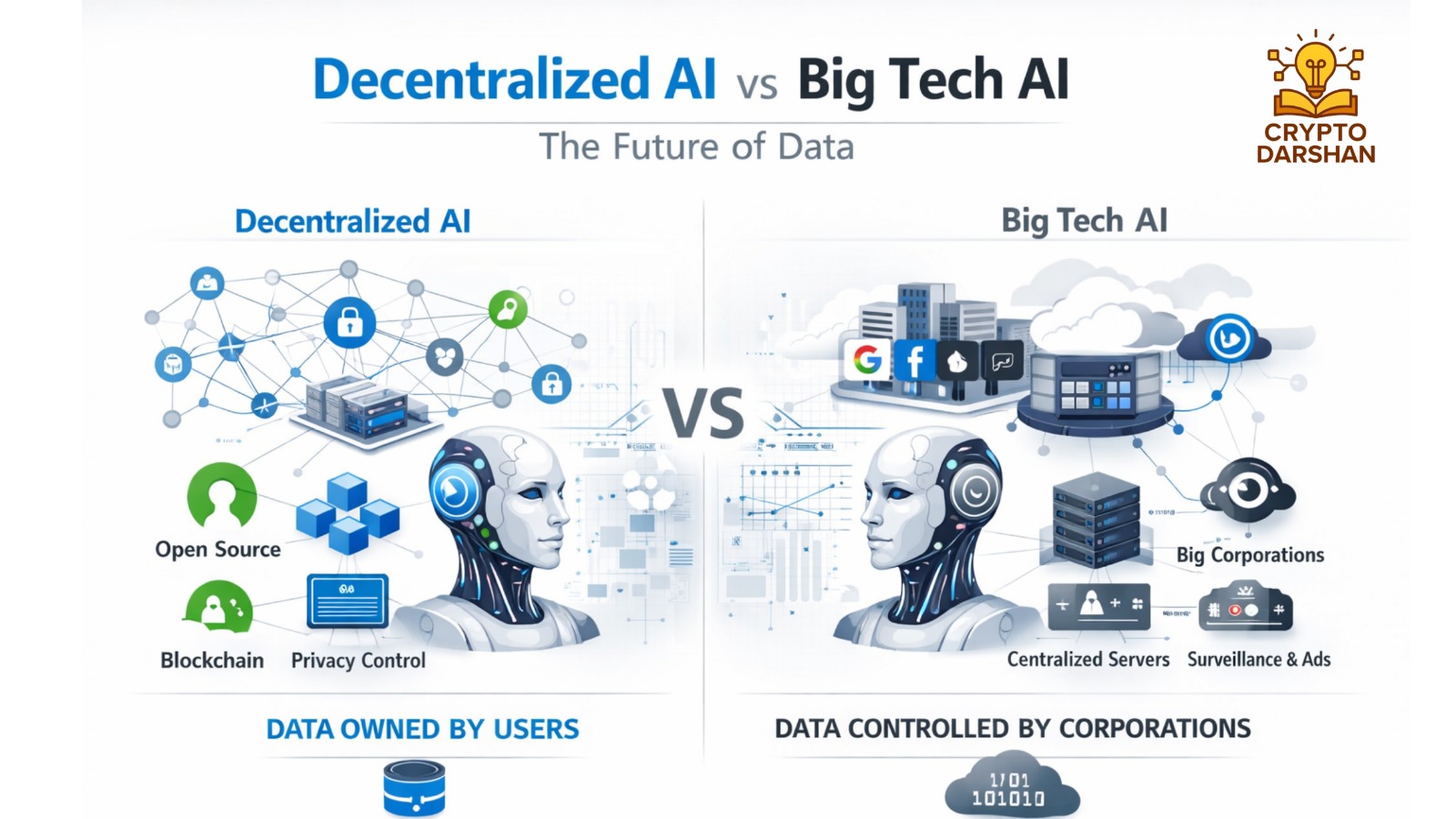
Comparing Decentralized AI and Big Tech AI

| Aspect | Big Tech AI | Decentralized AI |
| Data Ownership | Controlled by corporations | Owned by individuals or communities |
| Infrastructure | Centralized servers | Distributed nodes |
| Transparency | Limited, proprietary algorithms | Open and verifiable through blockchain |
| Privacy | High risk of data misuse | Enhanced through encryption and federated learning |
| Scalability | High due to centralized resources | Growing with distributed networks |
| Innovation | Driven by corporate R&D | Driven by community collaboration |
| Cost | High infrastructure and licensing costs | Lower through shared resources |
| Governance | Corporate-controlled | Community or DAO-based |
The Role of Data in AI Evolution

Data as the New Oil
Data fuels AI systems. The more diverse and high-quality the data, the more accurate and intelligent the models become. Big Tech companies have long leveraged their massive data reservoirs to dominate AI development. However, this centralization has created a data imbalance, where smaller entities struggle to compete.
Data Fragmentation and Accessibility
Decentralized AI aims to democratize data access. By allowing multiple participants to contribute and share data securely, it reduces fragmentation and promotes inclusivity. This approach can lead to more balanced AI models that reflect global diversity rather than corporate interests.
Ethical Data Usage
Ethical concerns around consent, bias, and surveillance are central to the AI debate. Decentralized AI introduces mechanisms for transparent data usage, where contributors can track how their data is used and even receive compensation for its value.
The Economic Impact of Decentralized AI

Empowering Small Businesses and Developers
Decentralized AI lowers entry barriers for startups and independent developers. Instead of relying on expensive cloud services, they can access distributed computing power and shared datasets through decentralized networks.
Tokenized Data Economies
Blockchain-based AI ecosystems often use tokens to reward data contributors, model trainers, and validators. This creates a circular economy where participants are incentivized to maintain data quality and system integrity.
Reducing Monopolistic Control
By distributing AI development, decentralized systems challenge the dominance of Big Tech. This fosters competition, innovation, and fairer market dynamics. Regulation may seem restrictive, but as explained in Why Crypto Regulation Is Actually Bullish Long Term, clearer policies can actually support decentralized innovation.
New Business Models
Decentralized AI introduces new business models such as data cooperatives, AI marketplaces, and decentralized autonomous organizations (DAOs). These models allow communities to pool resources, share profits, and collectively govern AI systems.
Privacy and Security in the AI Landscape

Centralized Risks
Centralized AI systems are vulnerable to data breaches, insider threats, and misuse of personal information. The concentration of sensitive data in a few locations makes them prime targets for cyberattacks.
Decentralized Solutions
Decentralized AI mitigates these risks by distributing data storage and processing. Federated learning ensures that raw data never leaves the user’s device, while blockchain provides immutable audit trails for accountability.
Regulatory Compliance
Decentralized AI aligns with global data protection regulations such as GDPR and CCPA by giving users control over their data. This compliance advantage could accelerate its adoption across industries.
The Future of AI Governance

Centralized Governance Challenges
Big Tech AI governance is often opaque, with decisions made by corporate boards rather than public consensus. This lack of transparency can lead to ethical violations and public distrust.
Decentralized Governance Models
Decentralized AI introduces community-driven governance through Decentralized Autonomous Organizations (DAOs). Participants can vote on model updates, data usage policies, and ethical guidelines, ensuring collective accountability.
Hybrid Governance Possibilities
A hybrid model combining centralized efficiency with decentralized transparency could emerge. Corporations might adopt decentralized frameworks for specific functions while maintaining centralized control over core operations.
Use Cases of Decentralized AI

- Healthcare
Hospitals can collaborate on AI models for disease detection without sharing patient data, improving accuracy while maintaining privacy.
- Finance
Decentralized AI can enhance fraud detection and credit scoring by aggregating insights from multiple institutions securely.
- Supply Chain Management
Blockchain-based AI systems can track goods transparently, ensuring authenticity and reducing counterfeiting.
- Smart Cities
Edge-based AI can manage traffic, energy, and waste systems locally, reducing latency and improving efficiency.
- Content Creation
Decentralized AI platforms can reward creators for contributing data or training models, fostering a fairer digital economy.
- Education
Decentralized AI can personalize learning experiences while protecting student data, enabling adaptive education systems.
- Environmental Monitoring
Distributed AI networks can analyze environmental data from sensors worldwide, supporting sustainability and climate action.
As discussed in our guide on Why AI and Crypto Tokens Are the Next Big Trend, decentralized networks are reshaping how AI models are trained and monetized.
Challenges Facing Decentralized AI

- Technical Complexity
Building and maintaining decentralized networks require advanced infrastructure and interoperability standards.
- Scalability Issues
Distributed systems may face latency and synchronization challenges as networks grow.
- Regulatory Uncertainty
Governments are still developing frameworks for decentralized technologies, creating legal ambiguities.
- Adoption Barriers
Transitioning from centralized to decentralized systems requires cultural and organizational shifts.
- Data Quality Control
Ensuring the accuracy and reliability of distributed data remains a significant challenge.
- Energy Consumption
Blockchain-based systems can be energy-intensive, requiring sustainable solutions for large-scale deployment.
The Convergence of Decentralized and Centralized AI

Collaborative Ecosystems
The future may not be a binary choice between centralized and decentralized AI. Instead, hybrid ecosystems could emerge where Big Tech companies integrate decentralized frameworks to enhance transparency and compliance.
Interoperability Standards
Developing universal protocols for data exchange and model training will be crucial for seamless collaboration between centralized and decentralized systems.
Ethical Synergy
Combining the efficiency of centralized AI with the ethical transparency of decentralized systems could create a balanced AI ecosystem that benefits all stakeholders.
Real-World Integration
Industries such as healthcare, logistics, and finance are already experimenting with hybrid AI models that combine centralized processing power with decentralized data governance. This integration could become the blueprint for future AI infrastructure.
The Future of Data Ownership

From Users to Stakeholders
In the decentralized AI model, users evolve from passive data providers to active stakeholders. They can monetize their data, participate in governance, and influence AI development.
Data Marketplaces
Decentralized data marketplaces will allow individuals and organizations to trade data securely, creating new economic opportunities while maintaining privacy.
The End of Data Silos
By breaking down data silos, decentralized AI promotes collaboration across industries, leading to more comprehensive and accurate AI models.
Data as a Digital Asset
In the future, data will be treated as a personal asset class. Individuals will have digital wallets containing their data, which they can lease or sell under transparent smart contracts.
Ethical and Social Implications

Democratizing AI Access
Decentralized AI ensures that innovation is not limited to a few corporations. It empowers communities, researchers, and small enterprises to contribute to and benefit from AI advancements.
Reducing Algorithmic Bias
Diverse data sources and collaborative model training can reduce bias, leading to fairer and more inclusive AI systems.
Building Public Trust
Transparency and accountability are key to public acceptance of AI. Decentralized systems provide verifiable mechanisms that enhance trust in AI-driven decisions.
Human-Centric AI
Decentralized AI aligns with the vision of human-centric technology, where AI serves collective interests rather than corporate agendas. It prioritizes fairness, inclusivity, and sustainability.
The Role of Governments and Policy Makers

Encouraging Innovation
Governments can play a vital role in supporting decentralized AI by funding open-source projects, creating innovation hubs, and promoting cross-border collaboration.
Establishing Ethical Standards
Policymakers must define ethical frameworks that ensure AI systems centralized or decentralized, operate transparently and responsibly.
Balancing Regulation and Freedom
Overregulation could stifle innovation, while underregulation could lead to misuse. A balanced approach is essential to foster trust and progress.
The Role of Open Source in Decentralized AI

Open source plays a foundational role in the growth and success of decentralized AI. It provides the transparency, collaboration, and accessibility needed to build trust and accelerate innovation in a distributed ecosystem. Unlike proprietary AI systems controlled by Big Tech, open-source frameworks allow anyone to inspect, modify, and contribute to the codebase, ensuring that AI development remains inclusive and community-driven.
Transparency and Accountability
Open-source AI projects make their algorithms and data-handling processes visible to the public. This transparency helps prevent hidden biases, unethical data usage, and manipulation. Developers and researchers can audit the code, identify flaws, and propose improvements, creating a self-regulating environment that promotes accountability.
Collaboration and Innovation
Decentralized AI thrives on collaboration. Open-source platforms enable developers, researchers, and organizations worldwide to work together on shared goals. This collective intelligence accelerates innovation, as improvements made by one participant can benefit the entire ecosystem. Projects like OpenMined, TensorFlow Federated, and Hugging Face exemplify how open collaboration can drive privacy-preserving and ethical AI development.
Accessibility and Inclusion
Open-source tools lower the barriers to entry for startups, students, and independent developers. Instead of relying on expensive proprietary software, they can use freely available frameworks to build and deploy AI models. This inclusivity ensures that innovation is not limited to wealthy corporations but is accessible to anyone with the skills and creativity to contribute.
Security and Trust
Because open-source code is publicly available, it undergoes continuous peer review. This collective scrutiny helps identify vulnerabilities faster and strengthens the overall security of decentralized AI systems. In a decentralized environment where trust is distributed, open-source transparency becomes a key factor in ensuring reliability.
Driving Ethical AI
Open-source communities often emphasize ethical AI principles such as fairness, privacy, and accountability. By embedding these values into the development process, open-source projects help ensure that decentralized AI systems align with human rights and societal well-being.
The Future of Open Source in Decentralized AI

As decentralized AI continues to evolve, open-source collaboration will become even more critical. Future advancements may include decentralized repositories for AI models, blockchain-based version control, and tokenized incentives for contributors. These innovations will create a self-sustaining ecosystem where open-source development and decentralized governance work hand in hand to shape the next generation of ethical, transparent, and inclusive AI.
The Future Workforce and AI Collaboration

Redefining Jobs
AI will not only automate tasks but also create new roles in data governance, AI ethics, and decentralized infrastructure management. The workforce of the future will need to adapt to these changes.
Skill Development
Education systems must evolve to teach skills in blockchain, AI ethics, and decentralized computing. Lifelong learning will become essential for staying relevant in the AI-driven economy.
Decentralized AI vs Big Tech AI: The Future of Data – FAQ

1. What is Decentralized AI?
Decentralized AI refers to artificial intelligence systems built on distributed networks like blockchain, where data and model control are not owned by a single company. Instead, users contribute data, computing power, or governance, making the system more transparent and community-driven.
2. What is Big Tech AI?
Big Tech AI is artificial intelligence developed and controlled by large technology companies such as Google, Microsoft, and Meta. These companies manage massive centralized data centers and proprietary AI models.
3. How does data ownership differ between Decentralized AI and Big Tech AI?
In Big Tech AI, user data is typically stored in centralized servers and controlled by the company. In Decentralized AI, users often retain greater control over their data, sometimes through blockchain-based identity and permission systems.
4. Is Decentralized AI more secure than Big Tech AI?
Decentralized AI can reduce single points of failure, making it harder for hackers to attack one central database. However, security depends on network design and governance. Big Tech AI benefits from large cybersecurity budgets but remains vulnerable to centralized breaches.
5. Which model is better for privacy?
Decentralized AI generally promotes stronger privacy because data can remain distributed and encrypted. Big Tech AI often relies on collecting and analyzing large volumes of user data, which can raise privacy concerns.
6. How does decentralization impact innovation?
Big Tech AI can innovate faster due to massive funding and infrastructure. Decentralized AI encourages open collaboration and community contributions, potentially leading to more transparent and inclusive innovation.
7. What role does blockchain play in Decentralized AI?
Blockchain enables secure data sharing, transparent governance, and token-based incentives in decentralized AI networks. It ensures that no single entity has full control over the system.
8. Can Decentralized AI compete with Big Tech AI?
While Big Tech currently dominates AI research and deployment, decentralized AI is growing rapidly, especially in Web3 ecosystems. Its success will depend on scalability, funding, and adoption.
Conclusion
The battle between decentralized AI and Big Tech AI represents more than a technological rivalry it is a struggle over the future of data ownership, privacy, and digital power. While Big Tech AI offers efficiency and scale, it also raises concerns about monopolization and ethical governance. Decentralized AI, on the other hand, promises transparency, inclusivity, and user empowerment.
The future of data will likely be shaped by a convergence of these two paradigms. A hybrid ecosystem that combines the strengths of both models could redefine how AI is developed, deployed, and governed. As society moves toward a data-driven future, the balance between centralization and decentralization will determine not only the trajectory of AI innovation but also the ethical foundation of the digital world.