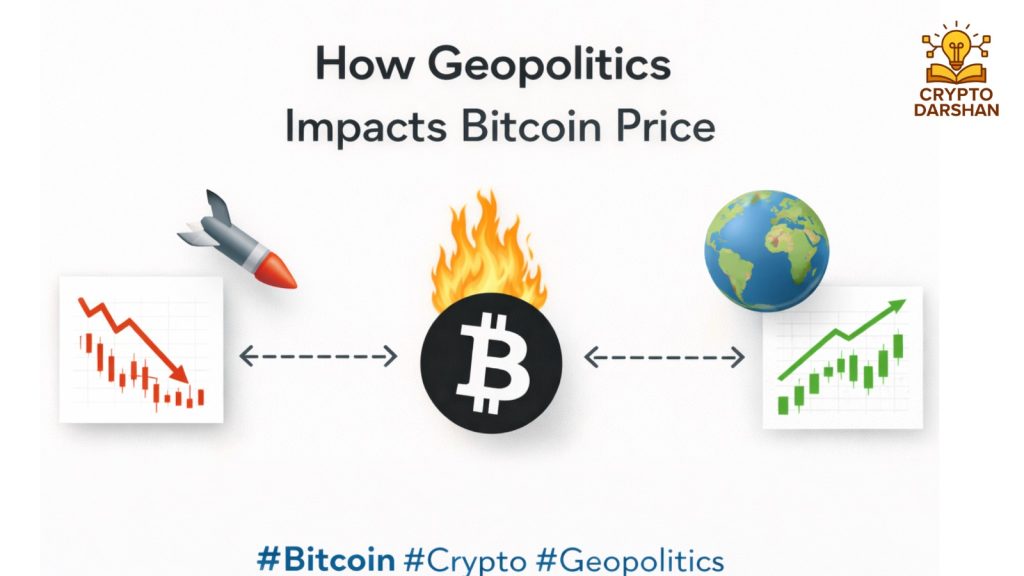
Bitcoin Geopolitics Effects dominate 2026 trends, with BTC swinging wildly amid U.S.-China trade wars and regional conflicts that position it as both risk asset and hedge. Bitcoin, the world’s first decentralized digital currency, has transformed from a niche technological innovation into a global financial phenomenon. Its price movements are influenced by a complex interplay of factors, including market demand, investor sentiment, regulatory developments, and macroeconomic conditions. Among these, geopolitics stands out as a powerful force shaping Bitcoin’s valuation. Geopolitical events ranging from wars and sanctions to trade disputes and political instability can trigger significant fluctuations in Bitcoin’s price.
This article explores how geopolitics impacts Bitcoin’s price, examining historical examples, economic mechanisms, and future trends. It also analyzes how Bitcoin’s decentralized nature positions it as both a hedge and a speculative asset during times of global uncertainty.
The Nature of Bitcoin and Its Global Role

Bitcoin operates on a decentralized blockchain network, independent of any government or central authority. This autonomy makes it appealing to individuals and institutions seeking alternatives to traditional financial systems. Its limited supply of 21 million coins and borderless nature contribute to its reputation as “digital gold.”
However, Bitcoin’s global accessibility also means it is sensitive to international developments. When geopolitical tensions rise, investors often seek assets perceived as safe havens. Bitcoin’s role in this dynamic has evolved from a speculative instrument to a potential hedge against geopolitical and economic instability.
Understanding Bitcoin Geopolitics and Its Economic Influence
Geopolitics refers to how geography, politics, and power influence international relations and global economics. It encompasses issues such as:
- Wars and conflicts
- Trade agreements and disputes
- Economic sanctions
- Political instability
- Energy crises
- Shifts in global alliances
Each of these factors can disrupt global markets, alter investor confidence, and influence capital flows. Because Bitcoin operates outside traditional financial systems, it often reacts differently to geopolitical events compared to fiat currencies or equities.
Historical Overview: Bitcoin’s Price and Geopolitical Events
1. The 2013 Cyprus Banking Crisis
In 2013, Cyprus faced a severe banking crisis that led to capital controls and bank closures. Citizens were unable to withdraw their savings, prompting many to turn to Bitcoin as an alternative store of value. Bitcoin’s price surged from around $30 to over $200, marking one of the first instances where geopolitical and economic instability directly influenced its price.
2. The 2016 Brexit Referendum
The United Kingdom’s decision to leave the European Union created uncertainty in global markets. The British pound fell sharply, and investors sought alternative assets. Bitcoin’s price rose as traders viewed it as a hedge against currency devaluation and political uncertainty.
3. The 2019 U.S.-China Trade War
The trade tensions between the United States and China disrupted global supply chains and financial markets. During periods of heightened tension, Bitcoin’s price often increased as investors looked for assets uncorrelated with traditional markets. The perception of Bitcoin as a “digital safe haven” gained traction during this time.
4. The 2022 Russia-Ukraine Conflict
The Russian invasion of Ukraine in 2022 had a profound impact on global markets. Sanctions against Russia led to currency devaluation and restrictions on international transactions. Bitcoin trading volumes surged in both Russia and Ukraine as citizens sought to protect their wealth and bypass financial restrictions. The conflict highlighted Bitcoin’s utility in times of geopolitical crisis, even as its price experienced volatility due to broader market uncertainty.
5. The 2023 Global Inflation and Energy Crisis
In 2023, rising energy prices and inflationary pressures across Europe and North America led to renewed interest in Bitcoin. As central banks struggled to control inflation, investors turned to Bitcoin as a hedge against fiat currency depreciation. This period reinforced Bitcoin’s role as a potential inflation-resistant asset.
Mechanisms Through Which Geopolitics Affects Bitcoin
1. Capital Flight and Safe-Haven Demand
During geopolitical crises, investors often move their assets from riskier markets to safer ones. Traditionally, gold and U.S. Treasury bonds have served as safe havens. During global conflicts and economic uncertainty, many investors start viewing Bitcoin as digital gold. As discussed in Is Bitcoin a Hedge Asset in 2026?, geopolitical stress often strengthens this narrative. However, Bitcoin’s decentralized nature and limited supply have positioned it as a modern alternative. When political instability threatens fiat currencies or banking systems, Bitcoin demand tends to rise.
2. Currency Devaluation and Inflation
Geopolitical tensions often lead to economic sanctions, trade disruptions, and inflationary pressures. When national currencies lose value, citizens and investors seek assets that can retain purchasing power. Bitcoin, with its fixed supply, is often viewed as a hedge against inflation. As inflation rises, so does interest in Bitcoin, pushing its price upward.
3. Regulatory Responses and Government Policies
Governments respond to geopolitical events with policies that can either support or hinder Bitcoin adoption. For instance, during times of conflict or sanctions, some governments may restrict cryptocurrency transactions to prevent capital flight. Others may embrace Bitcoin as a means of bypassing international restrictions. These regulatory shifts can significantly influence Bitcoin’s price.
4. Energy Markets and Mining Economics
Geopolitical events affecting energy markets can also impact Bitcoin. Since Bitcoin mining relies heavily on electricity, fluctuations in energy prices can alter mining profitability. For example, sanctions on energy-producing nations or disruptions in oil supply can increase energy costs, affecting miners’ operations and influencing Bitcoin’s supply dynamics.
5. Investor Sentiment and Market Psychology
Geopolitical uncertainty often triggers emotional responses in financial markets. Fear, uncertainty, and doubt (FUD) can lead to sell-offs, while optimism about Bitcoin’s resilience can drive buying sprees. Social media, news coverage, and public perception amplify these effects, contributing to Bitcoin’s volatility during geopolitical crises.
6. Technological and Cybersecurity Risks
Geopolitical conflicts increasingly involve cyber warfare. Attacks on financial systems, exchanges, or blockchain networks can influence Bitcoin’s price. For example, state-sponsored cyberattacks targeting exchanges or wallets can undermine investor confidence, while successful defenses can strengthen Bitcoin’s reputation as a secure asset.
Case Studies: Geopolitical Events and Bitcoin Price Movements

Case Study 1: The Russia-Ukraine War
The Russia-Ukraine conflict demonstrated Bitcoin’s dual role as both a refuge and a speculative asset. As sanctions isolated Russia from global financial systems, Bitcoin trading volumes in rubles spiked. Ukrainians also turned to Bitcoin for cross-border donations and financial stability. Despite short-term volatility, Bitcoin’s use as a financial lifeline underscored its geopolitical relevance.
Case Study 2: U.S.-China Relations and Technological Rivalry
The ongoing technological rivalry between the U.S. and China has implications for Bitcoin. China’s crackdown on cryptocurrency mining in 2021 led to a temporary drop in Bitcoin’s hash rate and price. However, the mining industry quickly relocated to other countries, demonstrating Bitcoin’s resilience. The event also highlighted how geopolitical decisions in one major economy can ripple across the global Bitcoin ecosystem.
Case Study 3: Middle East Tensions and Oil Market Volatility
Tensions in the Middle East often lead to fluctuations in oil prices, which can influence global inflation and investor sentiment. During periods of heightened tension, Bitcoin has occasionally benefited from increased demand as investors seek diversification away from traditional commodities and currencies.
Case Study 4: Latin American Political Instability
In countries like Argentina and Venezuela, political instability and hyperinflation have driven citizens toward Bitcoin as a store of value. These nations illustrate how local geopolitical and economic crises can accelerate Bitcoin adoption, influencing global demand and price trends.
Bitcoin as a Geopolitical Tool
1. Circumventing Sanctions
Bitcoin’s decentralized nature allows individuals and entities to bypass traditional financial systems. In sanctioned countries, Bitcoin can facilitate international trade and remittances. While this raises regulatory concerns, it also demonstrates Bitcoin’s potential as a geopolitical tool.
2. Financial Sovereignty and Decentralization
For nations and individuals seeking independence from dominant financial powers, Bitcoin offers a path toward financial sovereignty. Countries exploring central bank digital currencies (CBDCs) or alternative payment systems often view Bitcoin as a model for decentralized finance.
3. Humanitarian Aid and Cross-Border Transactions
During conflicts or crises, traditional banking systems may become inaccessible. Bitcoin enables direct, borderless transactions, allowing humanitarian organizations to deliver aid efficiently. This utility enhances Bitcoin’s reputation as a neutral, global financial network.
4. The Rise of Bitcoin Diplomacy
Some nations are beginning to use Bitcoin strategically in international relations. For example, El Salvador’s adoption of Bitcoin as legal tender in 2021 positioned it as a pioneer in digital finance, attracting global attention and investment. This move also challenged traditional financial institutions, signaling a shift in global economic power dynamics.
Geopolitical Alliances and Bitcoin Adoption
Geopolitical alliances are beginning to influence Bitcoin adoption patterns. Regional blocs such as BRICS (Brazil, Russia, India, China, and South Africa) have discussed alternatives to the U.S. dollar for trade settlements. While Bitcoin is not officially part of these discussions, its decentralized nature aligns with the bloc’s goal of reducing dependence on Western financial systems.
Similarly, smaller nations in Africa and Latin America are exploring Bitcoin as a means of financial inclusion and independence. These geopolitical alliances could accelerate Bitcoin’s integration into global trade, especially in regions seeking to bypass traditional banking infrastructure dominated by Western powers.
The Role of Institutional Investors and Global Markets
Institutional investors increasingly view Bitcoin as part of a diversified portfolio. Geopolitical instability often prompts these investors to reassess risk exposure. When traditional markets falter, Bitcoin can attract institutional capital seeking uncorrelated returns. Conversely, during periods of extreme uncertainty, institutions may reduce exposure to volatile assets, leading to price declines.
Global financial markets also influence Bitcoin through liquidity and risk sentiment. For example, when central banks implement monetary easing in response to geopolitical crises, excess liquidity can flow into Bitcoin and other digital assets, driving prices higher.
The Impact of Sanctions and Financial Isolation

Economic sanctions are a key geopolitical tool used to exert pressure on nations. However, they can also accelerate Bitcoin adoption. When countries are cut off from the global banking system, Bitcoin provides an alternative means of conducting international transactions. This dynamic was evident in Iran, North Korea, and Russia, where sanctions spurred interest in cryptocurrencies. Government responses to geopolitical tensions often result in stricter crypto policies. However, as explained in Why Crypto Regulation Is Actually Bullish Long Term, clear regulations can strengthen long-term investor confidence.
At the same time, increased scrutiny from regulators and financial institutions can create downward pressure on Bitcoin’s price. Exchanges may face restrictions, and compliance requirements can limit liquidity. The balance between adoption and regulation determines Bitcoin’s price trajectory in such contexts.
Bitcoin’s Correlation with Traditional Safe Havens
Bitcoin’s relationship with traditional safe-haven assets like gold and the U.S. dollar has evolved. In some geopolitical crises, Bitcoin behaves similarly to gold, rising as investors seek protection. In others, it behaves more like a risk asset, declining alongside equities. This duality reflects Bitcoin’s transitional status between a speculative investment and a store of value.
Over time, as Bitcoin matures and adoption increases, its correlation with traditional markets may decrease, strengthening its role as a geopolitical hedge.
Bitcoin Geopolitics and Risk Premium
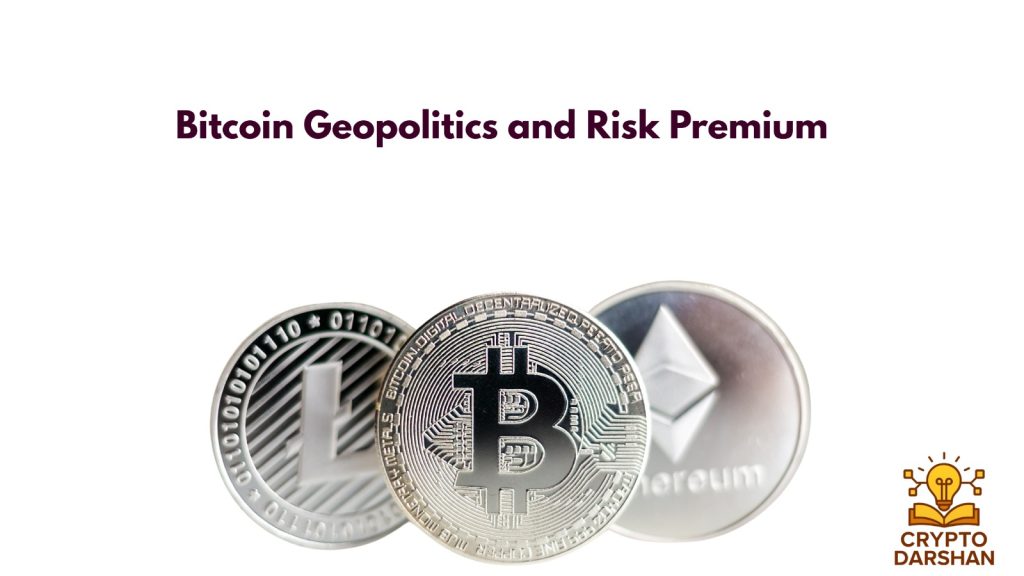
As Bitcoin matures, analysts have begun to identify a “geopolitical risk premium” in its valuation. This premium reflects the additional demand for Bitcoin during periods of heightened global tension. Similar to how oil prices rise during conflicts in energy-producing regions, Bitcoin’s price often includes a risk premium when investors anticipate instability.
For instance, during the 2022–2024 period of global unrest, Bitcoin’s price often spiked in response to news of military escalations or sanctions. This pattern suggests that Bitcoin is increasingly viewed as a geopolitical hedge, with its value partially driven by global uncertainty rather than purely speculative interest.
The Role of Media and Public Perception

Media coverage plays a crucial role in shaping Bitcoin’s response to geopolitical events. Positive narratives such as Bitcoin enabling financial freedom during crises can boost demand. Negative narratives such as its use in evading sanctions can trigger regulatory crackdowns and price declines. Public perception, amplified by social media, often drives short-term volatility.
Future Outlook: Geopolitics and Bitcoin’s Evolution
1. Increasing Role in Global Finance
As geopolitical tensions reshape global trade and finance, Bitcoin’s role is likely to expand. Nations seeking alternatives to the U.S. dollar-dominated system may explore Bitcoin or other digital assets for international settlements.
2. Regulatory Harmonization
Global coordination on cryptocurrency regulation will influence Bitcoin’s stability. Clearer frameworks could reduce uncertainty and attract institutional investment, while fragmented regulations may sustain volatility.
3. Technological Advancements
Improvements in Bitcoin’s scalability, privacy, and energy efficiency could enhance its resilience to geopolitical disruptions. Innovations such as the Lightning Network and renewable energy mining may strengthen Bitcoin’s global appeal.
4. Shifts in Global Power Dynamics
As emerging economies gain influence, Bitcoin adoption may accelerate in regions seeking financial independence. Geopolitical realignments could thus drive long-term demand for decentralized assets.
5. The Role of Central Bank Digital Currencies (CBDCs)
Central bank digital currencies (CBDCs) are digital forms of a country’s fiat currency issued and regulated by its central bank, and are fixed in value by the government. The rise of CBDCs introduces new geopolitical dynamics. While CBDCs offer governments more control over monetary policy, they also highlight Bitcoin’s contrasting decentralized nature. The competition between CBDCs and Bitcoin could shape the future of global finance.
6. Environmental and Energy Politics
As nations transition toward renewable energy, Bitcoin mining could become a focal point in energy geopolitics. Countries with abundant renewable resources may attract mining operations, influencing global hash rate distribution and Bitcoin’s environmental footprint.
How Geopolitics Impacts Bitcoin Price – FAQ
1. How does geopolitics affect Bitcoin’s price?
Geopolitical events like wars, sanctions, trade tensions, and political instability can increase market uncertainty. During uncertain times, investors may move capital into alternative assets like Bitcoin, which can drive price volatility.
2. Does Bitcoin act as a safe-haven asset during global conflicts?
Bitcoin is sometimes compared to gold as a hedge during crises. In events such as the Russia-Ukraine War, Bitcoin initially saw increased demand in certain regions. However, it remains highly volatile and does not always behave like a traditional safe-haven asset.
3. How do economic sanctions influence Bitcoin markets?
When countries face sanctions, citizens and businesses may turn to Bitcoin for cross-border transactions. For example, after sanctions on Russia, crypto usage reportedly increased as access to global banking systems became restricted.
4. Can inflation caused by geopolitical tensions boost Bitcoin?
Yes, geopolitical conflicts can disrupt supply chains and raise inflation. In such scenarios, investors may look to Bitcoin as a hedge against currency devaluation, similar to how they treat Gold.
5. How do government regulations during crises impact Bitcoin prices?
Governments may introduce emergency financial regulations during political instability. Strict crypto regulations can cause short-term price drops, while supportive policies may increase investor confidence and drive price growth.
6. Does the US dollar’s strength affect Bitcoin during geopolitical events?
Yes. When global tensions rise, investors often move into the US dollar as a safe asset. A stronger dollar can sometimes put pressure on Bitcoin’s price, while a weaker dollar may support Bitcoin growth.
7. How do central bank decisions linked to geopolitics impact Bitcoin?
Geopolitical stress often leads central banks to adjust interest rates or monetary policies. Rate cuts and liquidity injections can increase risk appetite, potentially benefiting Bitcoin and other digital assets.
8. Is Bitcoin more sensitive to geopolitics than traditional markets?
Bitcoin is highly sensitive to global news due to its 24/7 trading nature. Unlike traditional markets, it reacts instantly to geopolitical developments, often leading to rapid price swings.
Conclusion
Geopolitics exerts a profound and multifaceted influence on Bitcoin’s price. From wars and sanctions to inflation and regulatory shifts, global events shape investor behavior and market dynamics. Bitcoin’s decentralized nature allows it to serve as both a refuge and a speculative asset during times of uncertainty. Its ability to operate beyond borders makes it uniquely sensitive to geopolitical developments.
As the world becomes increasingly interconnected, the relationship between geopolitics and Bitcoin will continue to evolve. Understanding this relationship is essential for anticipating market trends and making informed investment decisions. Bitcoin’s future will likely be defined not only by technological innovation but also by the shifting tides of global politics, energy transitions, and economic power.