

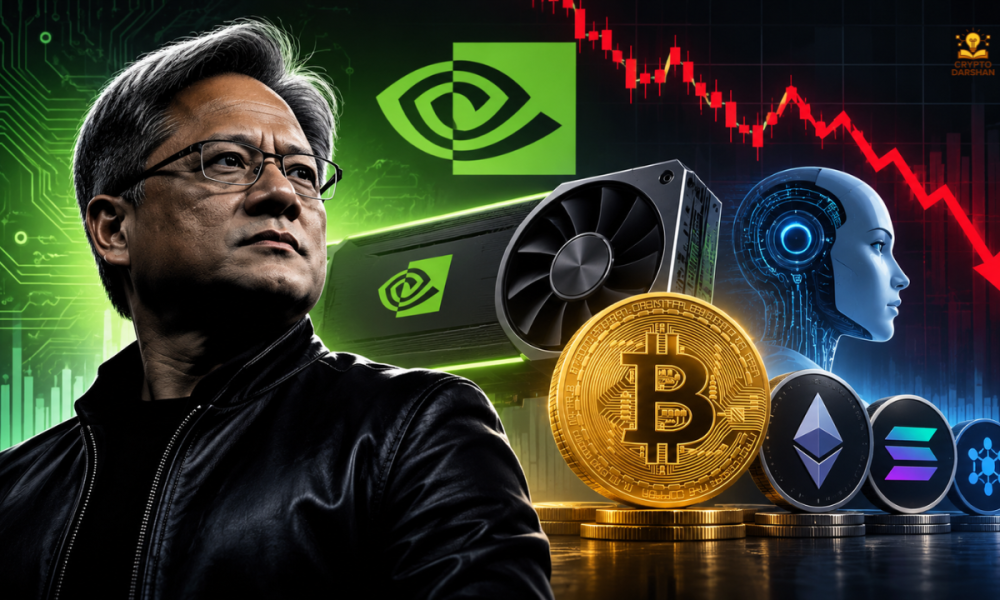
Concerns that Nvidia CEO Jensen Huang could leave the company have spread beyond Wall Street and into crypto markets. Polymarket traders now put the odds of Huang resigning or being removed by the end of 2027 at 89%, while Nvidia-linked crypto products have already recorded sharp losses.
The issue matters for crypto because Nvidia is central to the AI trade. If its leadership uncertainty weakens technology stocks, investors may reduce exposure to Bitcoin, AI tokens, and crypto-linked derivatives.
Polymarket traders expect a departure
Polymarket data from November 12 showed a 60% probability that Huang would leave his role that day. The estimated probability rose to 64% by November 13, 77% by November 30, and 82% by December 31, 2026.
The March 31, 2027 contract showed an 87% chance, while the end-of-2027 market reached 89%. Trading across the contracts had reached about $16.63 million, including $4.67 million in the December 2026 market.
These are prediction-market odds, not confirmed facts. They show what traders expect, but they do not prove that Huang will resign or that Nvidia’s board will remove him.
Nvidia-linked crypto products already fell

Nvidia shares fell about 8% in after-hours trading on November 11 after reports that the board was preparing to discuss Huang’s future. The decline quickly reached decentralized markets.
Nvidia-linked perpetual futures on Hyperliquid dropped as much as 10%. NVDAx, a tokenized version of Nvidia stock issued through xStocks, fell about 9% before recovering part of the loss and trading near $159.51.
The reaction shows how closely crypto markets now track major technology stocks. Tokenized equities and stock-linked derivatives allow crypto traders to gain exposure to companies such as Nvidia without using traditional brokerage accounts.
Decentralized exchanges handling real-world asset perpetual futures recorded $365 billion in trading volume during Q3 2026. Stock-linked contracts made up about $175 billion of that total, or nearly half of quarterly activity.
Uncertainty surrounding major technology companies can also influence cryptocurrency prices, as investor sentiment often shifts across riskier assets. This is one reason crypto markets are highly volatile, especially during periods of economic or market uncertainty.
Bitcoin could face more selling pressure
Bitcoin could come under renewed pressure if Huang’s situation triggers a broader decline in technology stocks. A similar pattern appeared on November 5, when Bitcoin fell more than 6% toward $75,000 as technology shares sold off after the U.S. midterm elections.
During that session, the Nasdaq Composite dropped 5.5%, while Nvidia shares lost more than 9%. More than $1 billion in leveraged cryptocurrency positions were liquidated within 24 hours.
When investors face losses in stocks, some may sell crypto to raise cash or meet margin requirements. That can create a feedback loop: falling stock prices lead to crypto selling, which then triggers more liquidations.
AI tokens may be more exposed
AI-related cryptocurrencies could be especially vulnerable if Nvidia’s leadership uncertainty hurts confidence in the artificial intelligence sector. Bittensor (TAO), Render (RENDER), and Artificial Superintelligence Alliance (FET) are among the tokens that could face selling pressure.
These projects often benefit when investors are optimistic about AI infrastructure, computing demand, and decentralized machine-learning networks. If Nvidia’s outlook weakens, traders may become more cautious about AI-linked crypto assets.
Bitcoin mining companies with AI infrastructure businesses could also be affected. Several publicly traded miners have expanded into AI computing and secured more than $70 billion in infrastructure contracts as they reduce reliance on mining revenue.
Why Nvidia is considering Huang’s future
The uncertainty follows a November 12 New York Times report alleging that Huang had an extramarital relationship with Kimberly Powell, Nvidia’s vice president of health care. Five former employees described the relationship to the publication, while two said the executives were seen being affectionate at a San Jose hotel during Nvidia’s GTC conference in March.
Huang, 63, and Powell, 48, are both married to other people. Nvidia’s code of conduct requires employees to avoid conflicts of interest involving personal relationships.
The allegations follow an earlier controversy involving Alice Huang, a Chinese businesswoman whom U.S. intelligence officials reportedly identified as an intelligence asset working for Beijing. Nvidia’s board opened an investigation led by law firm Wachtell, Lipton, Rosen & Katz.
Republican leaders of three House committees have requested a closed-door briefing with Huang about his interactions with Alice. China has denied the espionage allegations.
What investors should watch next

Nvidia’s next quarterly earnings report is scheduled for November 17. Investors will closely examine the company’s financial outlook, management situation, and any comments about Huang’s future.
For crypto traders, the key signals will be Nvidia’s share price, the Nasdaq’s direction, Bitcoin’s ability to hold support, and liquidation data across leveraged markets. A broad tech selloff could hit crypto harder if traders are already using leverage.
Bitcoin traded near $73,564 at the time of reporting, down 0.52% over 24 hours. Ethereum was near $2,049.60, while XRP traded around $1.04.
Investor confidence in traditional technology markets can influence interest in other digital asset sectors as well. This relationship is also worth exploring through real-world asset (RWA) tokenization, which connects traditional financial assets with blockchain-based markets.
The bottom line

Huang’s potential exit would not directly damage Bitcoin’s network or any blockchain protocol. But it could hurt crypto indirectly by weakening the AI and semiconductor trade, reducing risk appetite, and triggering liquidations in crypto-linked products.
The biggest risk is not the rumor itself, but a repeat of the November 5 pattern: technology stocks fall, Bitcoin follows, and leveraged traders face forced selling. Investors should watch Nvidia’s earnings, Polymarket odds, and broader market liquidity before assuming the crypto market has fully priced in the uncertainty.