

NEAR Protocol fell about 8.75% to $3.75 on November 3, breaking below the $4 level as selling spread through AI-related cryptocurrencies and the wider crypto market. The token has now lost 14.11% over the past week and more than 30% from its October peak near $6.
Why NEAR is under pressure
NEAR’s decline came alongside a broader selloff in AI-linked digital assets. Market analysis cited in the report said investors reduced exposure to the AI crypto sector, which lost 15.9% of its market capitalization during October.
it has attracted attention because of its work on autonomous software agents, cross-chain payments and decentralized computing. But its October rally left the token exposed when buying momentum weakened.
Selling intensified across digital assets after Binance reported a $6.3 billion security breach on October 29. Uncertainty ahead of the November 3 U.S. midterm elections also kept investors cautious.
Bitcoin traded below $77,000 during Tuesday’s session, while Ethereum fell 1.89% to about $2,253.98. NEAR’s 8.75% drop was much larger than Bitcoin’s 2.17% decline, showing weaker demand for the token during the downturn.
The decline in NEAR highlights how quickly market sentiment can shift in the cryptocurrency sector, particularly during periods of widespread selling pressure. Read our guide on why crypto markets are highly volatile to understand the factors that influence sudden price movements.
Token issuance cut approved

The price fall coincided with a governance decision that could change NEAR’s future supply. On November 2, NEAR’s House of Stake approved proposal HSP-029, which would reduce maximum annual token issuance from 2.5% to 1.6%.
The reduction would take place gradually over 24 months, after a 90-day preparation period following ratification. However, the vote does not immediately change the network’s issuance rate.
The proposal still requires Security Council review and adoption by validators through a protocol upgrade. If implemented, daily issuance would eventually fall from about 89,517 NEAR to 57,291 tokens.
The existing allocation structure would remain unchanged: 90% of newly issued tokens would go to staking participants and 10% to the treasury. The proposal estimates that the change could prevent about 11.8 million NEAR from entering circulation over two years.
Lower issuance may reduce staking rewards
The proposal could reduce gross staking yields from 5.27% to 3.37%, assuming staking participation stays at the measured level. Lower issuance means fewer new tokens are distributed to stakers each day.
The proposal also estimates that 24 of 405 validator pools could lose economic self-sufficiency under the lower issuance rate. That means some validators may find it harder to cover their costs from staking rewards alone.
The change is intended to slow inflation and reduce the number of new tokens entering circulation. But it is not yet active, so it has not directly caused the current price decline.
NEAR Protocol is part of the broader Web3 ecosystem, which aims to support decentralized applications and blockchain-based services. Explore our guide to Web3 explained to understand the technology behind this evolving digital landscape.
Key NEAR levels to watch
NEAR traded between $3.75 and $4.15 during the session. Its market capitalization stood near $4.91 billion, while daily trading volume reached $551.02 million.
Crypto analyst Michaël van de Poppe said it failed to hold an important support level after rebounding toward $4.50. He identified the $3.50 to $4.00 area as a possible zone where buyers could return, while warning that another decline toward recent lows could come first.
Trader Altcoin Sherpa also expected a further short-term decline but remained positive about NEAR’s longer-term outlook. He identified the $3.75 region as an area to monitor for potential purchases.
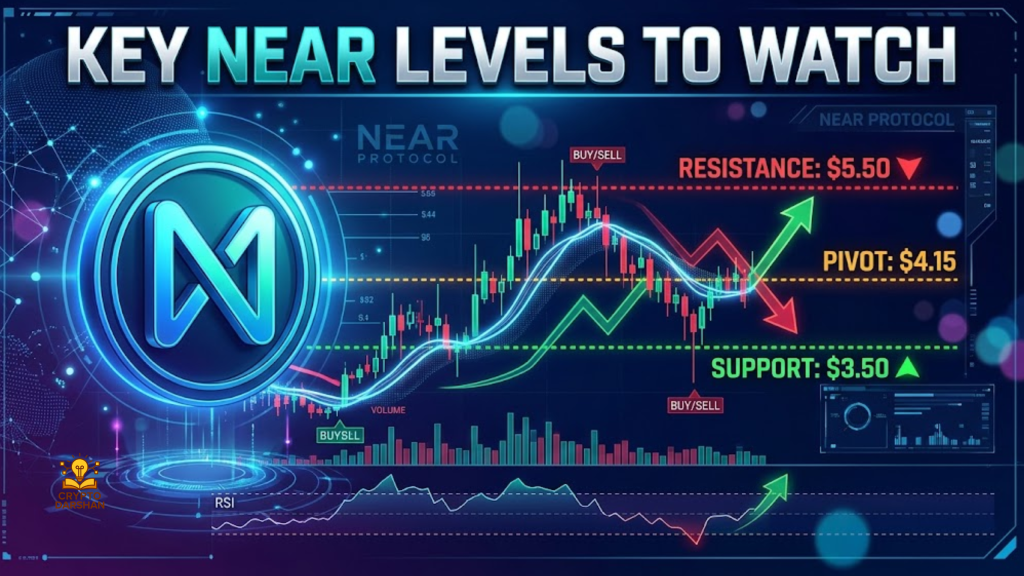
Immediate support sits near $3.70, followed by $3.50. A sustained break below $3.50 could expose the $3.20 area identified in recent market analysis.
Technical indicators remain weak
It traded below its lower Bollinger Band at $3.802. The middle Bollinger Band remained much higher at $4.630, showing how far the token has fallen from its recent average price range.
The Stochastic RSI showed a %K reading of 8.53 and a %D reading of 19.76. Both are below the commonly used oversold threshold of 20, which can signal that a recovery may be possible.
However, oversold readings do not confirm that selling has ended. It would need to reclaim $3.80 first, then move above $4.00 and $4.30 to improve its short-term technical outlook.
NEAR’s ecosystem still has support
It’s earlier rally was supported by growing interest in its ecosystem. In September, Bitwise launched an ETF on NYSE Arca under the ticker NRR, giving traditional brokerage investors exposure .
Bitwise said it planned to stake the fund’s holdings, with staking rewards contributing to the fund’s net asset value. That gives NEAR a link to traditional financial markets, although it does not remove the token’s exposure to crypto-market volatility.
For now, NEAR’s price remains under pressure from weak AI-sector sentiment, broader market selling and a failure to hold key technical support. A recovery above $4 would be the first sign that buyers are regaining control.