
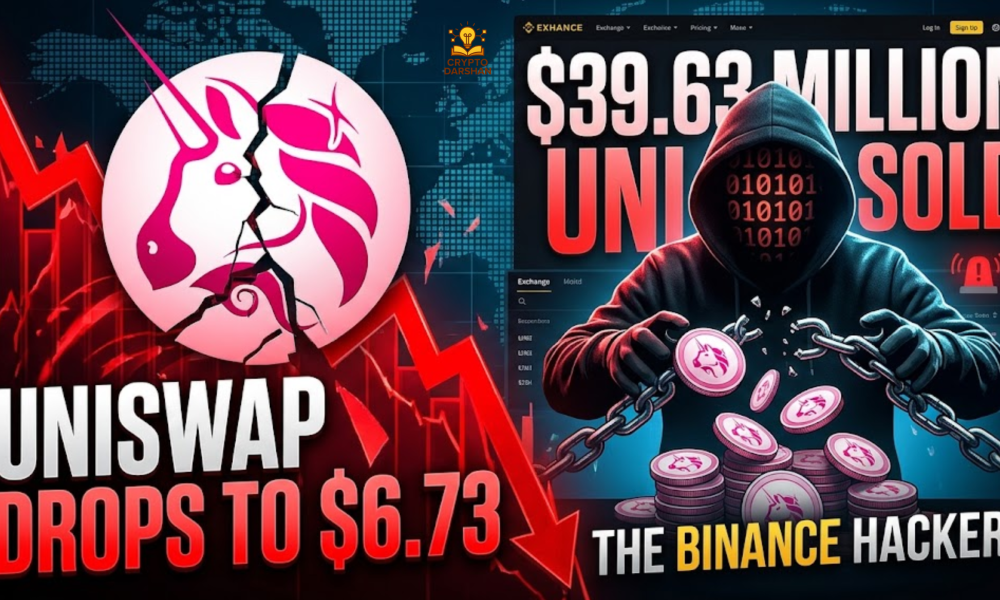
Uniswap fell 3.99% to about $6.73 on October 30 after blockchain analytics firm Lookonchain reported that the attacker behind Binance’s security breach sold 7.02 million UNI tokens for $39.63 million. The sale added pressure to a market already falling alongside Bitcoin, Ethereum and other major cryptocurrencies.
How the UNI sale unfolded
The selling followed unauthorized transfers from Binance-controlled wallets on October 29. On-chain investigators tracked millions of UNI moving from addresses connected to the exchange before the tokens were exchanged for Ethereum.
Lookonchain said the attacker sold the UNI at an average price of $5.65 per token. The sale was part of a larger operation involving seven cryptocurrencies, which generated 70,480 ETH valued at about $158.25 million.
An initial investigation found 3.86 million UNI sold through 23 transactions, with another 3.16 million tokens still held in the receiving wallet. Later monitoring showed the attacker had completed the sale of all 7.02 million uniswap.
UNI was the largest individual asset sold in the group. The attacker also reportedly sold 217.5 million ENA worth $33.93 million, 7.77 trillion PEPE valued at $31.66 million, and 2.57 million LINK worth $26.05 million.
UNI’s price and market activity

UNI recovered from an intraday low of $6.27 but remained below its previous trading range. At the time of reporting, the token was down 7.62% over seven days and 23.48% over the past month.
Daily trading volume reached about $1.32 billion, showing strong market activity during the selloff. However, higher volume during a price decline can reflect selling pressure rather than renewed buying demand.
The broader market added to the pressure. Bitcoin traded near $77,634, down 3.11%, while Ethereum fell 3.95% to about $2,227.05. BNB dropped 6.16%, and Solana declined 3.27%.
Standard Chartered maintains $100 target
Despite the price weakness, Standard Chartered’s global head of digital assets research, Geoffrey Kendrick, said the Binance breach could eventually benefit decentralized exchanges. His argument is that traders may prefer platforms where they retain control of their own assets rather than leaving funds with centralized exchanges.
Kendrick encouraged investors to “re-engage with Uniswap” and maintained a $100 Uniswap price target for 2030. He also expects further market weakness before prices establish a more stable base.
The forecast is long term and does not predict Uniswap’s price for the coming days or weeks. A $100 target would require a substantial increase from the current price near $6.73.
Kendrick’s earlier argument, reported by crypto.news in June, was based partly on expectations that tokenized assets would bring more trading activity into decentralized finance.
Fee burns support the long-term case
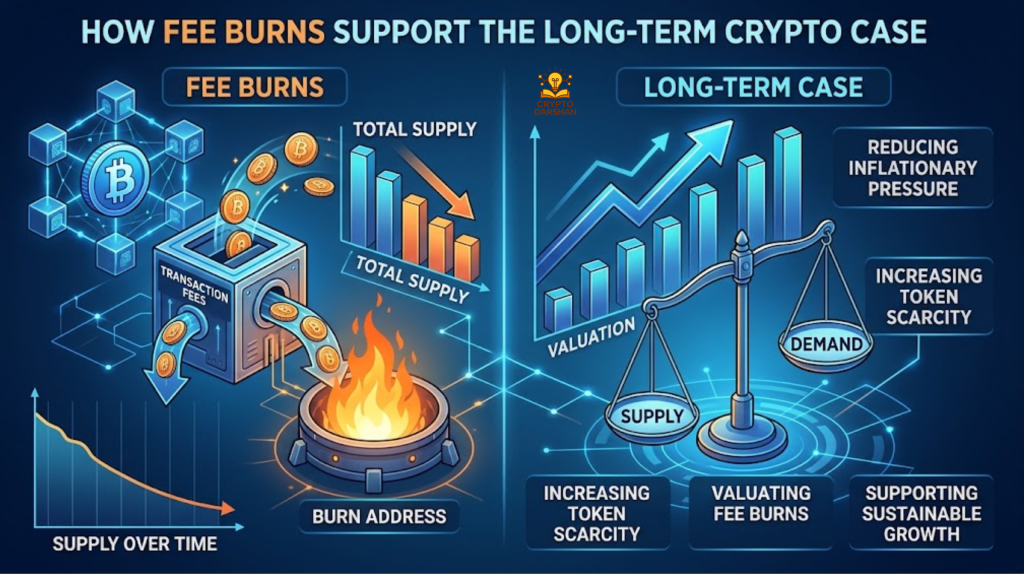
Uniswap’s fee mechanism is another part of the bullish argument. After governance changes introduced in December 2025, the protocol began directing certain trading fees toward UNI purchases and token burns.
A token burn permanently removes tokens from circulation. In Uniswap’s system, the amount burned depends on actual fee collections and the settings applied across liquidity pools.
This mechanism could support UNI over time if trading activity and protocol revenue rise. It does not protect the token from short-term selling pressure, market volatility or changes in trading activity.
Can UNI reclaim $7?
At $6.73, UNI faces immediate resistance around $7.00, followed by $7.50 and $8.00. A sustained move above $7.50 would improve its short-term chart structure after several weeks of decline.
On the downside, the $6.25 to $6.50 area is the immediate support zone. A break below it could expose $6.00, while the 200-day moving average near $5.60 is a lower technical level.
Crypto analyst Crypto With Gopal identified a possible double-top pattern on the five-minute chart, with two rejected attempts near $6.88. He placed the pattern’s neckline around $6.73 and identified $6.55 as a possible downside target if the pattern breaks.
The daily chart showed a rebound from $6.26 toward $6.72, but money-flow indicators offered limited confirmation. The Balance of Power reading of 0.39 suggested buyers gained some ground during the session, while Chaikin Money Flow at -0.01 pointed to nearly balanced flows with a slight selling bias.
New futures market adds exposure

Uniswap gained another trading venue after CME launched UNI futures on October 19. The exchange offers standard and micro contracts, giving traders regulated exposure to UNI’s price.
Futures markets can increase liquidity and make it easier for traders to hedge or speculate on price movements. They can also amplify volatility when leveraged positions are forced to close during sharp market moves.
What to watch next
UNI’s short-term direction will depend on whether it can reclaim $7.00 and whether the $6.25 to $6.50 support zone holds. Traders should also watch whether the broader crypto market stabilizes after the Binance-related selling pressure.
Standard Chartered’s $100 forecast is a long-term view tied to decentralized-exchange adoption, tokenized assets and fee-driven token burns. For now, UNI remains under pressure after a large hacker sale and a broader market decline.