

Solana has fallen about 9.34% over the past seven days to roughly $107, according to CoinGecko data cited in the report. The decline comes just before Solana’s October 21 Alpenglow upgrade, which is designed to reduce transaction finality from about 12.8 seconds to 150 milliseconds.
Price pressure before the upgrade
SOL was trading near $107.06 during the October 14 session, after opening near $106.72. Its intraday range was about $106.68 to $108.20, leaving the token close to immediate support between $104 and $105.
The price has struggled since retreating from late-September highs near $123. SOL had earlier recovered from August lows around $75, but the latest seven-day drop has weakened its short-term technical structure.
SOL remains below its 20-day simple moving average of $115.83. The Bollinger Bands put the upper boundary at $127.20 and the lower boundary at $104.45, with the token trading closer to the lower end of that range.
Key SOL levels to watch
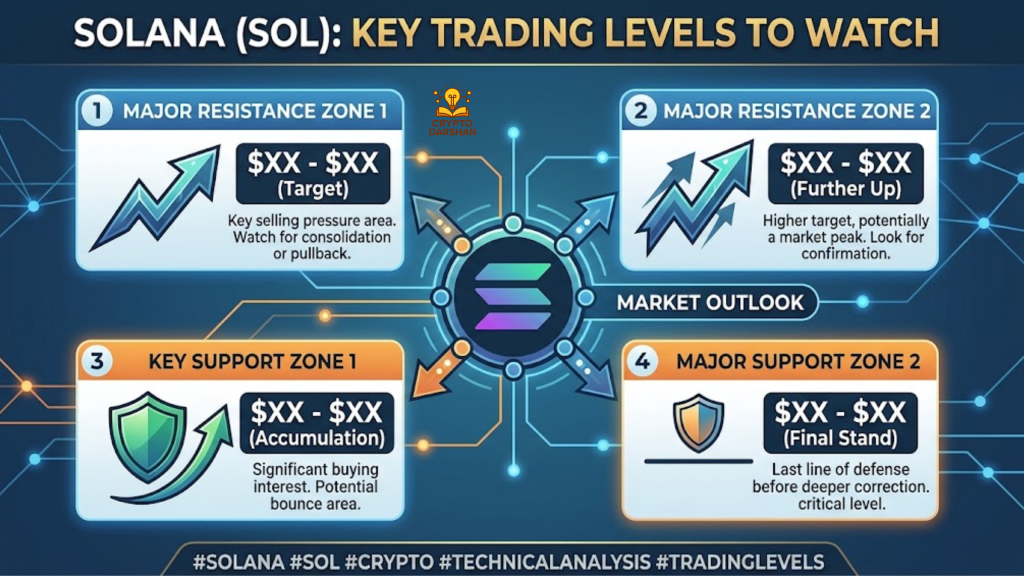
A sustained break below $104.45 could expose the psychological $100 support level. If selling continues below $100, the report identifies $95 to $98 as the next possible support area.
For a recovery, SOL would first need to reclaim $110. A move above $115.83 would put it back above its 20-day moving average, while $120 to $123 remains a larger resistance zone
The Relative Strength Index stood at 41.58, below its moving average of 52.41. A reading below 50 generally suggests that selling pressure is stronger than buying momentum, although Solana had not reached the commonly used oversold threshold of 30.
Analyst Crypto Patel said SOL had broken below its local structure and remained under resistance around $112.39. He identified a potential buying zone between $103 and $96, with possible recovery targets at $125 and $150—but only if Solana forms a higher low and confirms a bullish reversal. He warned that a sustained move below $95.63 would invalidate that setup.
What Alpenglow will change
The Solana Foundation has scheduled Alpenglow to activate during epoch 1064, beginning around 15:00 UTC on October 21. The upgrade will replace TowerBFT, the consensus mechanism Solana has used since 2020.
Alpenglow introduces Votor, a new voting system designed to reach transaction finality in about 150 milliseconds. Transaction finality means the point at which a transaction can no longer be reversed under the network’s consensus rules.
Under the current system, Solana transactions can appear successful quickly, but applications may wait longer for stronger confirmation that settlement is complete. Alpenglow aims to shorten that wait by changing how validators agree on finalized blocks.
Instead of submitting voting transactions to the blockchain, validators will exchange votes directly. When enough approvals are collected, they form certificates that finalize blocks.
What stays the same

The Solana Foundation says Alpenglow will not change how ordinary transactions execute. Wallets and decentralized applications are expected to continue working through the transition
The activation will begin with a temporary period in which Solana continues using TowerBFT for the first 5,000 slots of epoch 1064. Alpenglow is then expected to take over about 18 minutes after the epoch begins.
The upgrade may affect how some network statistics appear. Because voting transactions will no longer be recorded inside blocks, reported transaction counts could fall even if ordinary user activity stays the same.
Validator requirements
Validator operators must prepare before activation by using software built on Agave 4.3.0. The Foundation says Firedancer and Frankendancer will not support the initial migration, so operators using those clients must switch temporarily.
The upgrade also changes validator costs. Existing voting transaction costs of about 1 SOL per epoch will be replaced with a 0.8 SOL Validator Admission Ticket fee, paid from each validator’s vote account.
The Foundation says operators can verify migration through the getAgGenesisCert RPC command. It returns the Alpenglow genesis certificate after migration is complete; before activation, it returns null.
ETF outflows add pressure
Institutional flows have added to the cautious market mood. U.S. spot Solana ETFs recorded about $1.04 million in net outflows on October 13, according to SoSoValue figures cited in the report. That extended a reported streak of seven consecutive trading days of withdrawals.
The daily outflow means investors withdrew more money from the tracked funds than they invested during that session. It does not prove that every individual ETF saw withdrawals.
Despite the recent outflows, cumulative net inflows remained around $1.58 billion, while total net assets stood near $1.71 billion. Trading volume across the tracked products was about $64.26 million on October 13.
The available data does not establish whether ETF redemptions caused SOL’s price weakness. ETF flows and token prices can move together because of broader market conditions, rather than one directly causing the other.
Can SOL recover after October 21?
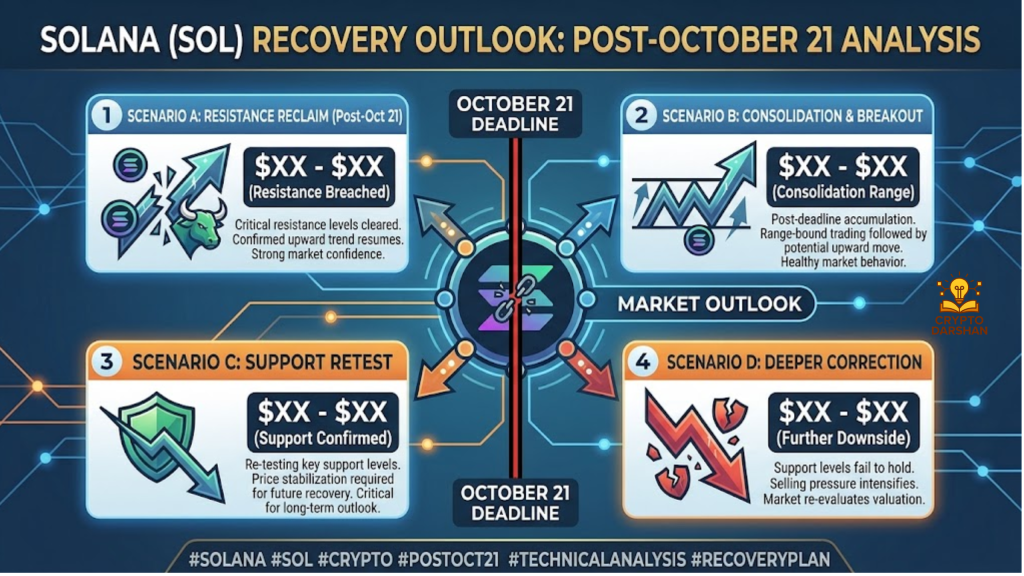
Alpenglow is a major technical milestone, but an upgrade does not guarantee a price recovery. Its 150-millisecond finality target still depends on how the network performs after activation.
Analyst Sweep reported a bullish divergence on SOL’s chart, suggesting that selling momentum may be weakening. He compared the setup with an earlier divergence that preceded a 30% rally, though that comparison does not guarantee a repeat.
For now, the technical picture remains cautious. SOL needs to hold the $104 to $105 support area and reclaim $110 to improve its short-term outlook. If it fails to hold support, $100 and then the $95 to $98 zone could become the next areas traders watch.