
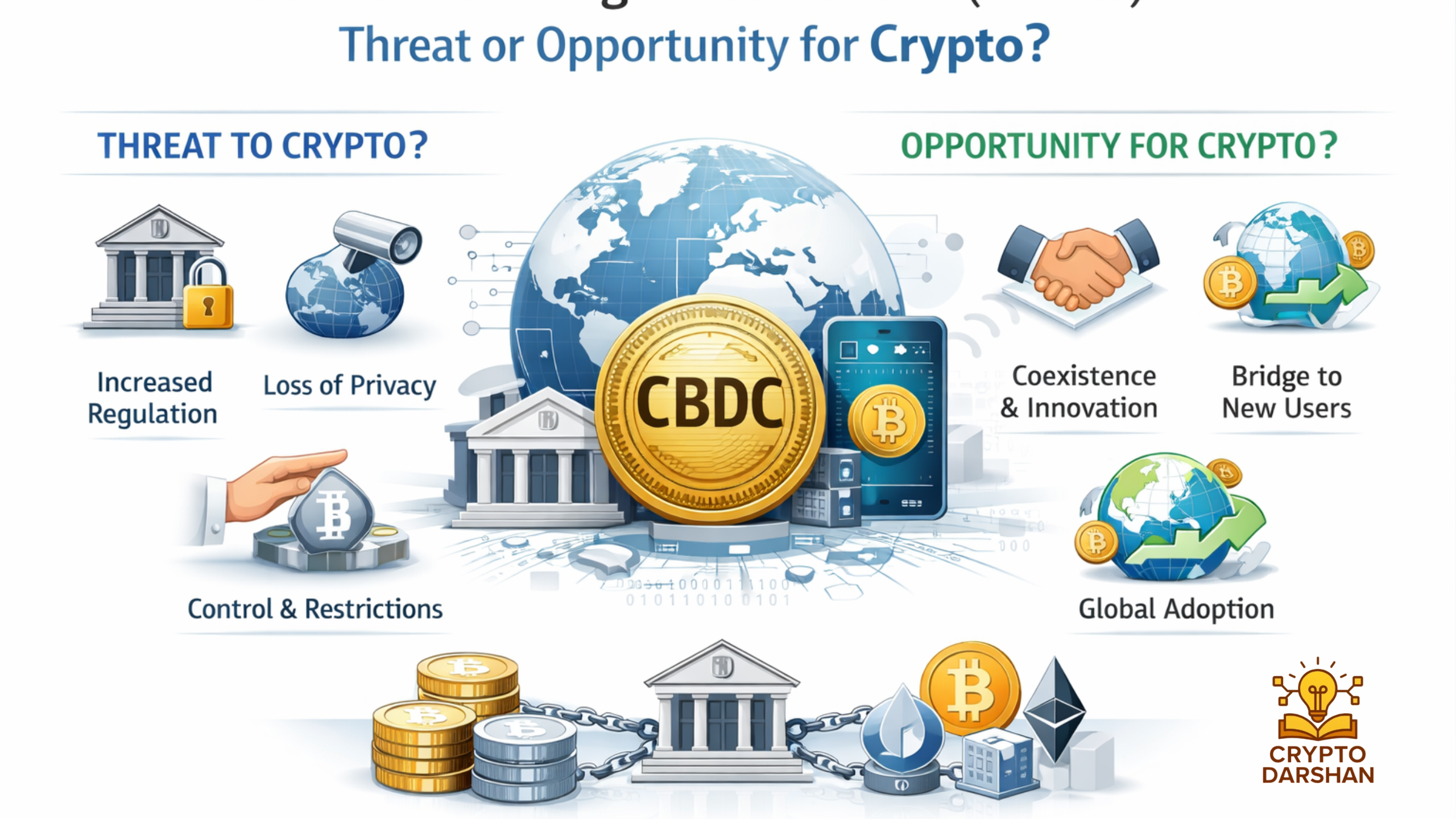
The global financial landscape is undergoing major changes. As digital payments become the standard and blockchain technology advances, central banks throughout the world are looking at the concept of Central Bank Digital Currencies (CBDCs). These digital versions of national currencies aim to modernize payment systems, increase financial inclusion, and preserve monetary sovereignty in an increasingly digital economy. However, their emergence has caused significant controversy among the bitcoin community. Are CBDCs a threat to decentralized cryptocurrencies like Bitcoin and Ethereum, or do they represent an opportunity for broader blockchain adoption?
This article explores the rise of CBDCs, their potential impact on the crypto ecosystem, and whether they can coexist or compete in the future of money.
Understanding CBDCs
What Are Central Bank Digital Currencies?

Central bank digital currencies (CBDCs) are digital forms of a country’s fiat currency issued and regulated by its central bank, and are fixed in value by the government. Unlike cryptocurrencies, which are decentralized and volatile, CBDCs aim to provide stability and are government-backed. With the rise of innovative technologies like cryptocurrency and blockchain, the idea of cashless societies has gained traction.
CBDCs aim to combine the convenience of digital payments with the trust and stability of traditional money. They can be used for everyday transactions, cross-border payments, and even government disbursements.
Types of Central Bank Digital Currencies(CBDCs)
Central Bank Digital Currencies (CBDCs) are generally categorized into two main types: Retail CBDCs and Wholesale CBDCs. Both serve different purposes and target different users within the financial system.
1. Retail Central Bank Digital Currencies (General-Purpose CBDCs)
Definition:
Retail CBDCs are digital currencies issued by a central bank for use by the general public individuals, households, and businesses. They function much like physical cash but in a digital form, allowing people to make everyday payments directly using a central bank–issued currency.
Key Features:
- Accessibility: Anyone can use retail CBDCs, just like cash or bank deposits.
- Direct Central Bank Liability: The money is a direct claim on the central bank, not on a commercial bank.
- Digital Cash Equivalent: It can be used for peer-to-peer transfers, online shopping, or paying bills.
- Financial Inclusion: Helps people without bank accounts access digital financial services.
- Possible Offline Use: Some designs allow transactions even without internet access, similar to handing over physical cash.
Example:
- China’s e-CNY (Digital Yuan): Citizens can use it for daily purchases, public transport, and online payments.
- Bahamas’ Sand Dollar: Enables residents, even in remote islands, to make digital payments easily.
Advantages:
- Promotes financial inclusion.
- Reduces dependency on cash.
- Provides a secure, government-backed digital payment option.
Challenges:
- Privacy concerns, as transactions could be monitored by authorities.
- Potential disruption to commercial banks if people move funds directly into CBDC wallets.
2. Wholesale Central Bank Digital Currencies(CBDCs)
Definition:
Wholesale CBDCs are designed for use by financial institutions, such as banks and payment service providers, rather than the general public. They are primarily used for interbank settlements, large-value transactions, and cross-border payments.
Key Features:
- Restricted Access: Only authorized financial entities can use them.
- Efficiency in Settlements: Enables faster and cheaper clearing and settlement between banks.
- Reduced Counterparty Risk: Transactions are settled instantly in central bank money, minimizing risk.
- Integration with Financial Infrastructure: Can be linked with existing payment systems and securities markets.
Example:
- Project Jasper (Canada): Tested wholesale CBDCs for interbank payments.
- Project Helvetia (Switzerland): Explored using wholesale CBDCs for tokenized asset settlements.
Advantages:
- Improves efficiency and security in interbank transactions.
- Reduces settlement times from days to seconds.
- Enhances transparency and reduces operational costs.
Challenges:
- Complex integration with existing banking systems.
- Requires strong cybersecurity and interoperability standards.
How Central Bank Digital Currencies(CBDCs) Work.
CBDCs operate on a digital ledger, which may or may not use blockchain technology. The central bank maintains control over issuance, distribution, and transaction validation. Depending on the design, CBDCs can be account-based (linked to user identities) or token-based (similar to digital cash, where ownership is determined by possession).
The Rise of CBDCs Around the World

Global Momentum
Over 130 countries are currently exploring or developing CBDCs, representing more than 98% of global GDP. Some nations have already launched pilot programs, while others are in the research or development phase.
| Country | CBDC Name | Status | Type |
| China | e-CNY (Digital Yuan) | Pilot | Retail |
| Bahamas | Sand Dollar | Launched | Retail |
| Nigeria | eNaira | Launched | Retail |
| Sweden | e-Krona | Pilot | Retail |
| India | Digital Rupee | Pilot | Retail & Wholesale |
| European Union | Digital Euro | Development | Retail |
| United States | Digital Dollar | Research | Retail & Wholesale |
Motivations Behind Central Bank Digital Currencies Development
- Financial Inclusion: Providing access to digital financial services for unbanked populations.
- Payment Efficiency: Reducing transaction costs and settlement times.
- Monetary Sovereignty: Countering the influence of private cryptocurrencies and stablecoins.
- Transparency and Security: Enhancing traceability to combat money laundering and fraud.
- Technological Innovation: Modernizing outdated payment infrastructures.
CBDCs vs. Cryptocurrencies: Key Differences
| Aspect | CBDCs | Cryptocurrencies |
| Issuer | Central Bank | Decentralized Network |
| Control | Centralized | Decentralized |
| Backing | Backed by Government | Backed by Market Demand |
| Anonymity | Limited or None | Pseudonymous |
| Technology | May or may not use Blockchain | Always Blockchain-based |
| Volatility | Stable (pegged to fiat) | Market-driven |
| Purpose | National Payment System | Alternative Financial System |
CBDCs are essentially digital versions of fiat currencies, while cryptocurrencies represent a new paradigm of decentralized finance. This fundamental difference shapes their roles and potential interactions in the global economy.
The Case for CBDCs as an Opportunity for Crypto

1. Increased Blockchain Adoption
CBDCs could accelerate mainstream acceptance of blockchain technology. As central banks adopt distributed ledger systems, public awareness and trust in blockchain-based solutions may grow. This could indirectly benefit cryptocurrencies by legitimizing the underlying technology.
2. Improved On-Ramps and Off-Ramps
CBDCs could simplify the process of converting between fiat and crypto. With digital currencies integrated into national payment systems, users might enjoy faster, cheaper, and more secure transactions between traditional and decentralized finance (DeFi) ecosystems.
3. Enhanced Regulatory Clarity
The introduction of CBDCs may push governments to establish clearer regulatory frameworks for digital assets. This could reduce uncertainty for crypto businesses and investors, fostering innovation within a more structured environment.
4. Financial Inclusion Synergies
Both CBDCs and cryptocurrencies aim to enhance financial inclusion. In regions with limited banking infrastructure, CBDCs could provide a gateway to digital finance, while cryptocurrencies could offer additional tools for savings, remittances, and investment.
5. Cross-Border Payment Innovation
CBDCs could revolutionize cross-border payments by reducing intermediaries and settlement times. When combined with blockchain-based crypto solutions, this could lead to a more efficient and interoperable global payment network.
As CBDCs expand, governments are increasing control over digital money, raising concerns about privacy and censorship. This shift highlights the importance of understanding Crypto Regulations 2026: Global Policy Changes, which explains how evolving laws may impact both state-issued digital currencies and decentralized crypto assets.
The Case for Central Bank Digital Currencies(CBDCs) as a Threat to Crypto

1. Centralization vs. Decentralization
CBDCs embody the opposite philosophy of cryptocurrencies. While crypto promotes decentralization and financial autonomy, CBDCs reinforce centralized control. Governments could use CBDCs to monitor transactions, limit privacy, and restrict financial freedom.
2. Competition with Stablecoins
Stablecoins like USDT and USDC currently dominate digital payments and DeFi ecosystems. CBDCs could directly compete with these assets, potentially reducing their market share and utility.
3. Regulatory Pressure on Cryptocurrencies
As CBDCs become mainstream, governments may impose stricter regulations on private cryptocurrencies to maintain control over monetary policy and prevent capital flight. This could stifle innovation and limit crypto adoption.
4. Privacy Concerns
Central Bank Digital Currencies could enable unprecedented levels of financial surveillance. Every transaction could be tracked, raising concerns about data privacy and government overreach. This contrasts sharply with the pseudonymous nature of cryptocurrencies.
5. Reduced Demand for Decentralized Alternatives
If CBDCs offer fast, secure, and low-cost transactions, the general public may see less need for decentralized cryptocurrencies, especially for everyday payments. This could shift crypto’s role toward investment and niche use cases.
The Technological Intersection: CBDCs and Blockchain
The technological intersection between Central Bank Digital Currencies (CBDCs) and blockchain lies at the heart of how digital money is being reimagined. While not all CBDCs are built on blockchain, many central banks are exploring or adopting Distributed Ledger Technology (DLT) the same foundation that powers cryptocurrencies, to enhance transparency, security, and efficiency in their digital currency systems.
1. Blockchain as the Foundation of CBDCs
Blockchain is a type of distributed ledger that records transactions across multiple computers in a secure, tamper-resistant way. This technology ensures that every transaction is transparent, traceable, and verifiable without relying on a single central authority.
CBDCs can use blockchain in two main ways:
- Permissioned (Private) Blockchains:
These are controlled networks where only authorized participants, such as banks or government institutions, can validate transactions. Most Central Bank Digital Currencies (CBDC) projects use this model because it allows the central bank to maintain control while still benefiting from blockchain’s efficiency and security. - Permissionless (Public) Blockchains:
These are open networks like Bitcoin or Ethereum, where anyone can participate. Central banks generally avoid this model due to privacy, scalability, and regulatory concerns.
Example:
The Eastern Caribbean Central Bank’s DCash uses a permissioned blockchain to facilitate digital payments across multiple islands, ensuring both security and regulatory compliance.
2. Transparency and Security
Blockchain provides immutable records, meaning once a transaction is recorded, it cannot be altered or deleted. This feature enhances trust and accountability in the financial system. For CBDCs, this means:
- Reduced Fraud: Every transaction is traceable, making it harder for illicit activities to go unnoticed.
- Enhanced Security: Distributed ledgers reduce the risk of a single point of failure, protecting the system from cyberattacks.
- Auditability: Regulators can easily monitor transactions in real time, improving oversight and compliance.
However, this transparency must be balanced with privacy protections, as excessive visibility could expose sensitive user data.
3. Efficiency and Real-Time Settlements
Traditional payment systems often involve multiple intermediaries, leading to delays and higher costs. Blockchain enables instant settlement of transactions, reducing the need for reconciliation between banks.
For example:
- Wholesale CBDCs can use blockchain to settle interbank transfers in seconds instead of days.
- Retail CBDCs can enable peer-to-peer payments without intermediaries, like how cryptocurrencies operate.
This efficiency can significantly lower transaction costs and improve liquidity management across the financial system.
4. Programmable Money
One of the most transformative aspects of blockchain technology is programmability, the ability to embed rules or conditions directly into digital money through smart contracts.
CBDCs built on blockchain could support programmable features such as:
- Automatic tax collection when a transaction occurs.
- Conditional payments, like releasing funds only when certain criteria are met.
- Targeted subsidies or welfare payments, ensuring funds are used for specific purposes.
This concept of programmable money could revolutionize how governments and businesses manage financial transactions, making them more efficient and transparent.
5. Interoperability with Cryptocurrencies and DeFi
Blockchain-based Central Bank Digital Currencies(CBDCs) could be designed to interact seamlessly with other digital assets, including cryptocurrencies and decentralized finance (DeFi) platforms. This interoperability could enable:
- Cross-border payments between different CBDCs using blockchain bridges.
- Integration with DeFi protocols, allowing CBDCs to be used in lending, staking, or liquidity pools.
- Tokenized asset settlements, where CBDCs serve as the settlement layer for digital securities or real-world assets.
For instance, projects like Project Dunbar (by the Bank for International Settlements) are testing multi-CBDC platforms that allow cross-border transactions between countries using shared blockchain infrastructure.
6. Hybrid Models: The Best of Both Worlds
Many central banks are exploring hybrid architectures that combine blockchain’s benefits with traditional centralized systems. In these models:
- The central bank retains control over issuance and monetary policy.
- Blockchain nodes operated by authorized institutions handle transaction validation and record-keeping.
This approach ensures efficiency, security, and compliance while maintaining the central bank’s authority.
Economic and Geopolitical Implications
The economic and geopolitical implications of Central Bank Digital Currencies (CBDCs) are vast and far-reaching. As nations move toward digitizing their currencies, the global financial system could experience significant shifts in how money is created, distributed, and controlled. CBDCs are not just a technological innovation; they are a strategic tool that can reshape economic policy, international trade, and global power dynamics.
1. Strengthening Monetary Policy
CBDCs give central banks new and more direct tools to manage the economy. Unlike cash or traditional bank deposits, digital currencies can be programmed and distributed instantly, allowing for more precise and efficient policy implementation.
Key Impacts:
- Direct Monetary Transmission: Central banks can inject liquidity directly into citizens’ digital wallets during economic downturns, bypassing commercial banks.
- Negative Interest Rates: CBDCs could make it easier to apply negative interest rates, encouraging spending rather than saving during recessions.
- Real-Time Data: With CBDCs, central banks gain access to real-time economic data, improving their ability to monitor inflation, spending, and money flow.
2. Financial Stability and Banking Sector Impact
CBDCs could alter the structure of the banking system. Since they are direct liabilities of the central bank, people might prefer holding CBDCs over deposits in commercial banks, especially during times of financial uncertainty.
Potential Consequences:
- Bank Disintermediation: If citizens move large amounts of money from banks to Central Bank Digital Currencies wallets, banks could lose deposits, reducing their ability to lend.
- Liquidity Risks: A sudden shift to Central Bank Digital Currencies during crises could trigger bank runs, destabilizing the financial system.
- New Banking Models: To adapt, banks may need to focus more on providing financial services rather than relying on deposit-based funding.
Mitigation Strategies:
Central banks could impose limits on CBDC holdings or design systems where commercial banks still play a role in distribution and customer management.
3. Cross-Border Payments and Global Trade
CBDCs can completely transform cross-border payments, which are now slow, expensive, and reliant on intermediaries such as SWIFT. CBDCs can enable quick, low-cost international transactions through the use of blockchain or interoperable digital platforms.
Economic Benefits:
- Reduced Transaction Costs: Eliminates multiple intermediaries and currency conversion fees.
- Faster Settlements: Cross-border payments could settle in seconds instead of days.
- Financial Inclusion in Trade: Small businesses and developing nations could access global markets more easily.
4. Redefining Global Currency Power
CBDCs could reshape the geopolitical balance of monetary power, especially in how countries use their currencies for international trade and reserves.
Key Dynamics:
- Challenge to the U.S. Dollar Dominance:
The U.S. dollar currently dominates global trade and reserves. However, if countries like China successfully internationalize their CBDCs (e.g., the digital yuan), they could reduce reliance on the dollar-based system. - Regional Currency Alliances:
Groups of countries could create interconnected CBDC systems to strengthen regional trade and reduce dependence on Western financial networks. - Sanctions Resistance:
CBDCs could allow countries to bypass traditional payment systems like SWIFT, making it harder for other nations to enforce economic sanctions.
5. Data Sovereignty and Surveillance Power
CBDCs give governments unprecedented visibility into financial transactions. While this can help combat money laundering and tax evasion, it also raises concerns about financial surveillance and data control.
Economic and Political Implications:
- Enhanced Tax Compliance: Governments can track income and spending more accurately, improving tax collection.
- Reduced Shadow Economy: Illegal or unreported transactions become harder to conceal.
- Surveillance Risks: Excessive monitoring could infringe on privacy and civil liberties, especially in authoritarian regimes.
Geopolitical Angle:
Countries with strong data governance frameworks may gain a competitive advantage by building trust in their digital currencies, while others risk public backlash or international criticism for misuse of financial data.
6. Inclusion and Development Opportunities
CBDCs can promote financial inclusion, especially in developing economies where large portions of the population remain unbanked. By providing access to digital wallets without requiring traditional bank accounts, CBDCs can integrate more people into the formal economy.
Economic Benefits:
- Access to Digital Finance: Enables people in remote areas to receive payments, remittances, and government aid directly.
- Reduced Transaction Costs: Eliminates intermediaries, making small transactions more affordable.
- Empowerment of Small Businesses: Easier access to digital payments and credit history can help small enterprises grow.
7. Cybersecurity and Technological Dependence
As CBDCs rely on digital infrastructure, they introduce new cybersecurity risks and technological dependencies that could have geopolitical consequences.
Risks:
- Cyberattacks: A successful attack on a CBDC system could disrupt an entire national economy.
- Technological Dependence: Countries relying on foreign technology for CBDC infrastructure could face vulnerabilities or external influence.
- Digital Warfare: In extreme cases, cyberattacks on CBDC systems could become tools of economic warfare.
Strategic Response:
Nations are investing heavily in secure, sovereign digital infrastructures to protect their CBDCs from external threats and maintain control over their financial systems.
8. Global Cooperation and Competition
CBDCs could either foster international cooperation or intensify economic competition among nations.
Cooperation Scenario:
- Countries collaborate to create interoperable CBDC systems, improving global trade efficiency.
- International organizations like the IMF and BIS establish standards for cross-border CBDC transactions.
Competition Scenario:
- Nations race to launch their CBDCs first to gain strategic advantages.
- Economic blocs form around dominant digital currencies, leading to new forms of monetary rivalry.
Example:
The European Union’s Digital Euro aims to strengthen Europe’s financial independence and reduce reliance on non-European payment systems.
9. Impact on Global Financial Institutions
CBDCs could change the role of global financial institutions such as the IMF, World Bank, and SWIFT.
- The IMF may need to adapt its reserve frameworks to include digital currencies.
- SWIFT could lose relevance if CBDCs enable direct cross-border settlements.
- The World Bank might use CBDCs to distribute development funds more efficiently and transparently.
10. Long-Term Geopolitical Outlook
The widespread adoption of CBDCs could lead to a multipolar financial world, where multiple digital currencies coexist and compete for influence.
- Digital Currency Diplomacy: Countries may use CBDC infrastructure as a diplomatic tool, offering partnerships or technical support to allies.
- Economic Sovereignty: Nations can strengthen control over their monetary systems, reducing dependence on foreign banks or currencies.
- Shift in Global Power: The countries that lead in CBDC innovation could shape the future rules of global finance.
The Future of Money: Coexistence or Conflict?
Coexistence Scenario
In a balanced future, CBDCs and cryptocurrencies could coexist, serving different purposes. CBDCs might dominate regulated financial systems, while cryptocurrencies thrive in decentralized finance, cross-border trade, and as stores of value.
Conflict Scenario
Alternatively, governments could view cryptocurrencies as threats to monetary sovereignty and impose strict restrictions. This could lead to a bifurcated financial world one centralized and state-controlled, the other decentralized and borderless.
Hybrid Models
Some experts envision hybrid systems where CBDCs integrate with blockchain-based networks. For example, CBDCs could be used as collateral in DeFi protocols or as settlement layers for tokenized assets.
Supporters argue that CBDCs can improve financial inclusion, especially in underbanked regions. However, cryptocurrencies are already filling this gap by providing access to digital finance without requiring traditional banking infrastructure. In many developing countries, crypto is used for everyday transactions, savings, and remittances. A deeper look into this real-world adoption can be found in How Crypto Is Used in Developing Countries (Beyond Trading), showing why crypto remains a strong opportunity despite the rise of CBDCs.
Case Studies: CBDCs in Action
China’s Digital Yuan (e-CNY)
China leads the global CBDC race with its digital yuan. The e-CNY is already used in major cities for retail payments, public transport, and e-commerce. It aims to enhance payment efficiency and reduce reliance on private payment platforms like Alipay and WeChat Pay.
The Bahamas’ Sand Dollar
The Bahamas became the first country to launch a nationwide CBDC in 2020. The Sand Dollar promotes financial inclusion across the archipelago, enabling residents to access digital payments even in remote areas.
Nigeria’s eNaira
Nigeria’s eNaira seeks to modernize the country’s payment system and reduce reliance on cash. However, adoption has been slow due to limited awareness and infrastructure challenges.
The European Union’s Digital Euro
The European Central Bank is developing the digital euro to complement cash and strengthen Europe’s digital economy. It aims to provide a secure, privacy-respecting digital payment option for citizens and businesses.
The Role of Cryptocurrencies in a CBDC World
Store of Value
Cryptocurrencies like Bitcoin may continue to serve as digital gold an alternative store of value independent of government control.
Decentralized Finance (DeFi)
DeFi platforms could integrate CBDCs as stable, government-backed assets, expanding their use cases while maintaining decentralized governance.
Innovation Catalyst
The competition from Central Bank Digital Currencies(CBDCs) could push the crypto industry to innovate further, focusing on privacy, scalability, and interoperability.
Challenges and Considerations
- Privacy vs. Surveillance: Balancing transparency with individual privacy rights.
- Cybersecurity Risks: Protecting digital currencies from hacking and fraud.
- Interoperability: Ensuring seamless integration between CBDCs, cryptocurrencies, and existing financial systems.
- Public Trust: Building confidence in digital currencies through education and transparency.
- Regulatory Coordination: Harmonizing global standards to prevent fragmentation.
Conclusion
Central Bank Digital Currencies represent a pivotal moment in the evolution of money. They offer governments a powerful tool to modernize financial systems, enhance inclusion, and maintain control in a digital economy. Yet, they also challenge the core principles of decentralization and privacy that define cryptocurrencies.
Whether Central Bank Digital Currencies become a threat or an opportunity for crypto depends on how both ecosystems evolve. If designed with openness, interoperability, and respect for privacy, CBDCs could complement the crypto industry and accelerate global digital transformation. However, if used as instruments of control, they could undermine the very freedoms that cryptocurrencies were created to protect.
The future of money may not be a battle between CBDCs and crypto but a convergence where centralized and decentralized systems coexist, each serving distinct yet interconnected roles in the global financial ecosystem.