The digital world is growing faster than ever. Every second, people create and share massive amounts of data—photos, videos, documents, and more. Traditionally, this data is stored on centralized servers owned by large companies. These servers are convenient but come with risks such as data breaches, censorship, and high costs. This is where Decentralized Storage comes in.
Decentralized Storage is a new way to store data across a network of computers instead of relying on a single company or server. It uses blockchain technology and peer-to-peer networks to make data storage more secure, private, and efficient. Two of the most popular technologies leading this revolution are IPFS (InterPlanetary File System) and Filecoin.
This article explains how Decentralized Storage works, how IPFS and Filecoin operate, and why they are changing the future of data storage.
What Is Decentralized Storage?
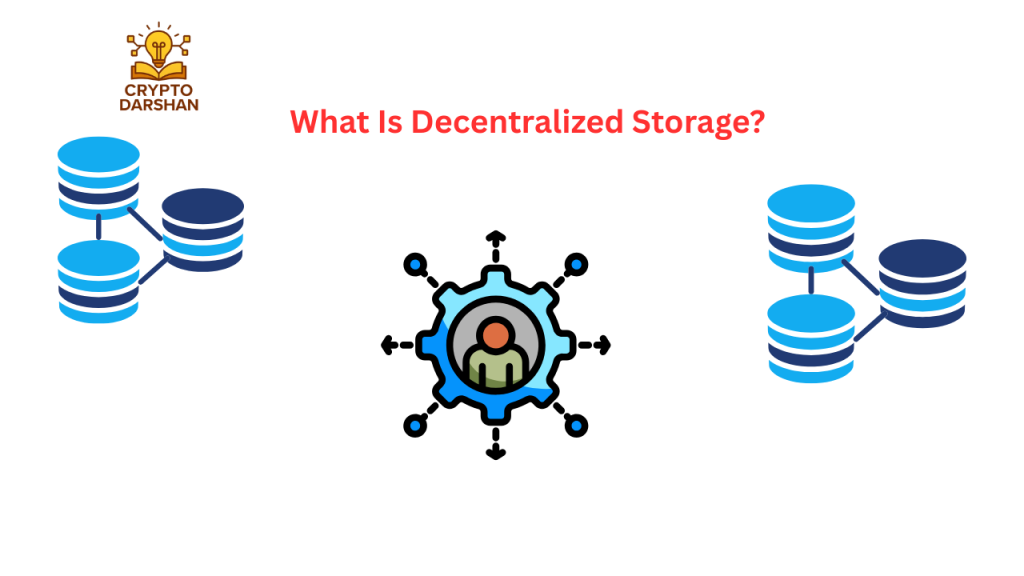
Decentralized Storage is a system where data is stored across multiple computers, also known as nodes, instead of being kept in one central location. Each node in the network contributes storage space and helps maintain the system. This approach removes the need for a central authority and gives users more control over their data.
In traditional storage systems, companies like Google, Amazon, or Dropbox manage servers that store user data. Users must trust these companies to keep their data safe and private. However, centralized systems can fail if servers go down, get hacked, or if the company decides to restrict access.
In contrast, Decentralized Storage distributes data across many independent nodes. Each piece of data is broken into smaller chunks, encrypted, and stored on different nodes. This makes it nearly impossible for hackers to steal or alter the data. It also ensures that the system continues to work even if some nodes go offline.
Why Decentralized Storage Matters
The need for Decentralized Storage is growing because of several key issues with centralized systems:
- Data Privacy – Centralized storage providers can access user data. In a decentralized system, data is encrypted and only accessible to the owner.
- Security – A single point of failure in centralized systems can lead to massive data breaches. Decentralized networks spread data across many nodes, reducing this risk.
- Censorship Resistance – Governments or corporations can censor or remove data from centralized servers. Decentralized networks make censorship much harder.
- Cost Efficiency – Decentralized systems can be cheaper because they use unused storage space from participants around the world.
- Reliability – Even if some nodes fail, the data remains available because it is stored redundantly across the network.
These benefits make Decentralized Storage a powerful alternative to traditional cloud storage.
How Decentralized Storage Works
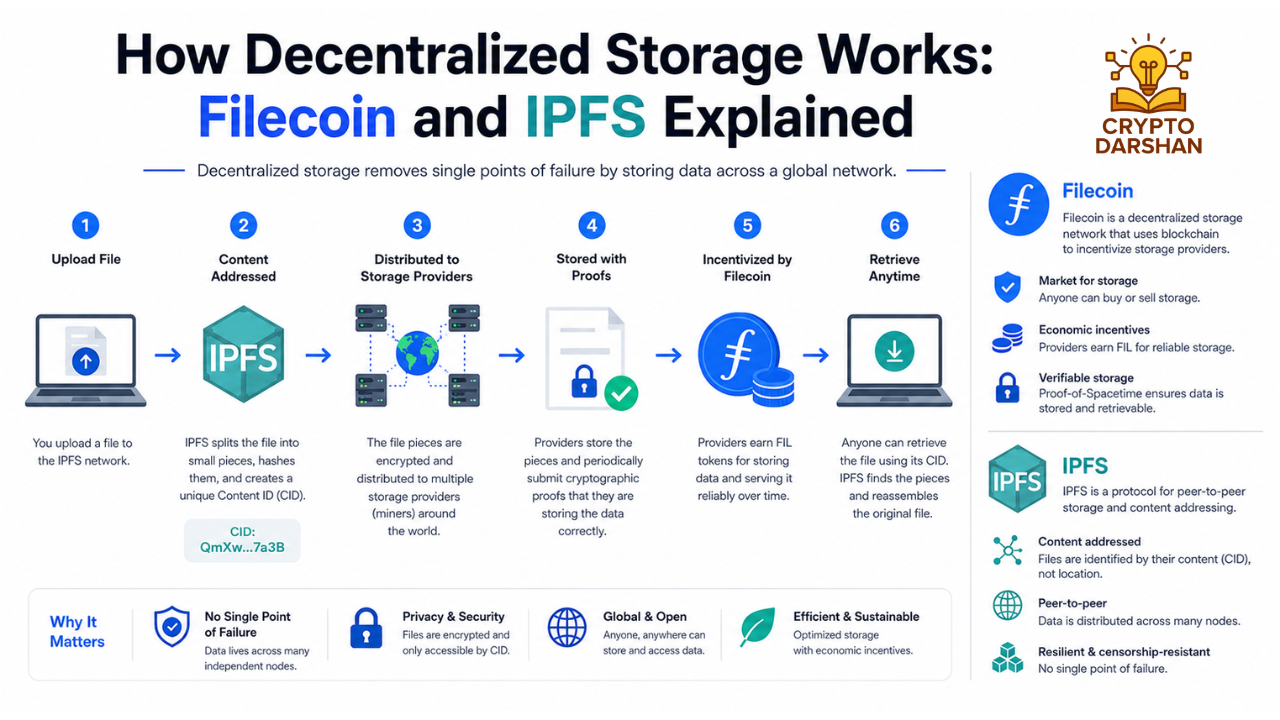
To understand how Decentralized Storage works, it helps to look at the basic process:
- Data Splitting – Files are divided into smaller pieces or chunks.
- Encryption – Each chunk is encrypted to protect privacy.
- Distribution – The encrypted chunks are distributed across multiple nodes in the network.
- Redundancy – Copies of chunks are stored on different nodes to ensure reliability.
- Retrieval – When a user wants to access a file, the system locates and reassembles the chunks from the network.
This process ensures that no single node has access to the entire file, keeping data secure and private. The network uses cryptographic proofs to verify that nodes are storing data correctly.
Decentralized storage works alongside blockchain infrastructure, making it helpful to understand how nodes keep distributed networks running. Learn more in What Is a Blockchain Node? The Simplest Explanation You’ll Ever Read.
The Role of Blockchain in Decentralized Storage
Blockchain technology plays a key role in Decentralized Storage. It provides a transparent and secure way to record transactions and verify data storage. In systems like Filecoin, blockchain is used to track who stores what data and to reward participants who contribute storage space.
Each transaction on the blockchain is recorded in a public ledger that cannot be changed. This ensures trust between users and storage providers without needing a central authority. Smart contracts can also automate payments and enforce agreements between users and nodes.
By combining blockchain with peer-to-peer networks, Decentralized Storage creates a system that is both secure and self-sustaining. Beyond cryptocurrency, decentralized technologies are transforming industries through secure and transparent data management. Learn more in How Blockchain Is Making Global Trade Finance Faster and Cheaper.
Understanding IPFS (InterPlanetary File System)
What Is IPFS?
IPFS (InterPlanetary File System) is a peer-to-peer protocol designed to make the web faster, safer, and more open. It allows users to store and share files in a decentralized way. Instead of using location-based addresses like URLs, IPFS uses content-based addressing.
In traditional web systems, a file is accessed by its location on a server (for example, https://example.com/file.jpg). In IPFS, a file is accessed by its unique cryptographic hash, which represents its content. This means that if the content changes, the hash changes too, ensuring data integrity.
How IPFS Works
- Content Hashing – When a file is added to IPFS, it is broken into smaller chunks. Each chunk is given a unique hash.
- Distributed Storage – These chunks are stored across multiple nodes in the IPFS network.
- Content Addressing – To retrieve a file, the system uses its hash to find and reassemble the chunks.
- Peer-to-Peer Sharing – Nodes share data directly with each other, reducing the need for central servers.
This system makes IPFS highly efficient and resistant to censorship. If one node goes offline, the file can still be retrieved from other nodes that have the same data.
Benefits of IPFS
- Speed – Files can be downloaded from multiple sources at once.
- Integrity – Content hashes ensure that files are not tampered with.
- Decentralization – No single server controls the data.
- Offline Access – Files can be accessed even without an internet connection if cached locally.
IPFS forms the foundation for many Decentralized Storage systems, including Filecoin.
Understanding Filecoin
What Is Filecoin?
Filecoin is a decentralized storage network built on top of IPFS. It adds an economic layer that rewards users for providing storage space and bandwidth. Filecoin uses blockchain technology to manage transactions and ensure that data is stored reliably.
In the Filecoin network, users can pay to store their data, while storage providers (called miners) earn tokens by offering their storage space. This creates a marketplace for storage where prices are determined by supply and demand.
How Filecoin Works
- Storage Deals – Users make deals with storage providers to store their data for a specific time and price.
- Proof of Storage – Providers must regularly prove that they are storing the data correctly using cryptographic proofs.
- Blockchain Ledger – All transactions and proofs are recorded on the Filecoin blockchain.
- Retrieval Market – Users can also pay to retrieve data quickly from providers who specialize in data delivery.
This system ensures that data is stored securely and that providers are rewarded fairly for their services.
Filecoin’s Proof Mechanisms
Filecoin uses two main proof systems:
- Proof of Replication (PoRep) – Verifies that a provider has created a unique copy of the data.
- Proof of Spacetime (PoSt) – Verifies that the provider continues to store the data over time.
These proofs are submitted to the blockchain, ensuring transparency and trust in the network.
The Relationship Between IPFS and Filecoin
IPFS and Filecoin are closely connected but serve different purposes. IPFS focuses on data distribution and retrieval, while Filecoin adds an incentive layer for storage.
- IPFS handles how data is shared and accessed.
- Filecoin handles how data is stored and paid for.
Together, they create a complete Decentralized Storage ecosystem. IPFS ensures that data can be found and shared efficiently, while Filecoin ensures that data is stored securely and economically.
For example, a user can upload a file to IPFS and then use Filecoin to pay for long-term storage of that file. This combination makes the system both functional and sustainable.
Advantages of Decentralized Storage with Filecoin and IPFS

- Enhanced Security – Data is encrypted and distributed, reducing the risk of hacks.
- Data Ownership – Users maintain full control over their data.
- Censorship Resistance – No central authority can remove or block content.
- Cost Efficiency – Storage costs are determined by market competition.
- Scalability – The network can grow as more nodes join.
- Transparency – Blockchain ensures all transactions are verifiable.
- Redundancy – Multiple copies of data ensure reliability.
These advantages make Decentralized Storage a strong alternative to traditional cloud services.
Real-World Use Cases of Decentralized Storage
1. Data Archiving
Organizations can use Decentralized Storage to archive large amounts of data securely. Since data is stored across multiple nodes, it remains safe even if some nodes fail.
2. Content Distribution
Media companies can distribute videos, music, and other content using IPFS. This reduces bandwidth costs and improves delivery speed.
3. Scientific Research
Researchers can store and share large datasets without relying on centralized servers. This promotes collaboration and data integrity.
4. Web3 Applications
Decentralized apps (dApps) use Decentralized Storage to store user data securely. This ensures privacy and prevents data manipulation.
5. Backup Solutions
Individuals and businesses can use Filecoin as a backup system for important files. The decentralized nature ensures that backups are always available.
Challenges of Decentralized Storage

While Decentralized Storage offers many benefits, it also faces challenges:
- Adoption – Many users are still unfamiliar with decentralized systems.
- Performance – Retrieving data from multiple nodes can be slower than centralized systems.
- Complexity – Setting up and managing decentralized storage can be technical.
- Regulation – Legal frameworks for decentralized data storage are still developing.
- Incentive Stability – Token-based systems depend on stable economic models.
Despite these challenges, ongoing development and innovation are improving the usability and performance of Decentralized Storage networks.
The Future of Decentralized Storage

The future of Decentralized Storage looks promising. As more people become aware of data privacy and security issues, demand for decentralized solutions will grow. Technologies like IPFS and Filecoin are leading the way by providing practical, scalable systems for storing and sharing data.
In the coming years, Decentralized Storage could become the backbone of the internet, supporting everything from personal file storage to enterprise-level data management. Integration with Web3, blockchain, and decentralized identity systems will make it even more powerful.
Developers are also working to improve speed, reduce costs, and make decentralized systems easier to use. As these improvements continue, Decentralized Storage will likely become a mainstream technology. Digital credentials and identity systems can benefit from decentralized storage by ensuring records remain accessible and tamper-resistant. Learn more in Soulbound Tokens: Non-Transferable NFTs for Identity and Credentials.
Comparison: Decentralized vs. Centralized Storage
| Feature | Centralized Storage | Decentralized Storage |
| Control | Managed by a single company | Managed by a distributed network |
| Security | Vulnerable to single-point failures | Highly secure through encryption and distribution |
| Cost | Fixed pricing by providers | Market-driven and competitive |
| Censorship | Can be censored or restricted | Resistant to censorship |
| Scalability | Limited by provider capacity | Scales with network growth |
| Transparency | Opaque operations | Transparent blockchain records |
This comparison highlights why Decentralized Storage is becoming a preferred choice for many users and organizations.
How to Get Started with Decentralized Storage

- Install IPFS – Download and install IPFS from its official website.
- Add Files – Use the IPFS command line or desktop app to add files to the network.
- Retrieve Files – Access files using their unique content hash.
- Use Filecoin – Create a Filecoin wallet and connect with storage providers.
- Make Deals – Choose providers based on price and reliability to store data long-term.
These steps allow anyone to start using Decentralized Storage for personal or business needs.
The Economic Model of Filecoin
Filecoin’s economy is based on its native token, FIL. Users pay FIL to store data, and miners earn FIL by providing storage space. The system balances supply and demand through market pricing.
- Storage Miners – Offer storage space and earn FIL.
- Retrieval Miners – Deliver data quickly and earn FIL for their service.
- Clients – Pay FIL to store and retrieve data.
This model ensures that the network remains active and self-sustaining. It also encourages competition, which drives down costs and improves service quality.
Security and Privacy in Decentralized Storage
Security is one of the strongest features of Decentralized Storage. Data is encrypted before being uploaded, and only the owner holds the decryption keys. Even if someone gains access to the network, they cannot read the data without the keys.
Privacy is also enhanced because no central authority can monitor or control user data. Each node only stores encrypted chunks, not entire files. This makes it nearly impossible to reconstruct or misuse the data.
Blockchain adds another layer of security by recording all transactions transparently. This ensures accountability and prevents fraud.
Environmental Impact of Decentralized Storage

Some critics worry about the energy use of blockchain systems. However, Decentralized Storage networks like Filecoin are working to reduce their environmental impact. Filecoin encourages the use of renewable energy and efficient hardware.
Because Decentralized Storage uses existing unused storage space, it can be more sustainable than building new data centers. This approach helps reduce electronic waste and energy consumption.
The Role of Decentralized Storage in Web3
Web3 represents the next generation of the internet—an open, user-controlled web powered by blockchain and decentralized technologies. Decentralized Storage is a key part of this vision.
In Web3, users own their data, identities, and digital assets. Decentralized Storage ensures that this data remains secure, private, and accessible without relying on centralized companies. It supports decentralized applications, NFTs, and smart contracts by providing reliable data storage.
As Web3 continues to grow, Decentralized Storage will become an essential infrastructure layer.
Frequently Asked Questions (FAQs)

1. What is decentralized storage?
Decentralized storage is a method of storing data across multiple independent computers instead of relying on a single centralized server. This improves security, reliability, privacy, and resistance to censorship.
2. What is IPFS?
IPFS (InterPlanetary File System) is a peer-to-peer protocol that stores and shares files using content-based addressing instead of location-based URLs. It makes data retrieval faster and more resilient.
3. How does Filecoin work?
Filecoin is a decentralized storage network that allows users to rent out unused storage space or pay storage providers to securely store their data. It uses blockchain technology to verify storage agreements and rewards providers with FIL tokens.
4. What is the difference between Filecoin and IPFS?
IPFS is a protocol for storing and sharing files, while Filecoin is an incentive layer built on top of IPFS that rewards storage providers and ensures long-term, reliable data storage.
5. Is decentralized storage more secure than cloud storage?
Decentralized storage can offer greater security by distributing encrypted data across multiple nodes, reducing the risk of single points of failure, outages, or centralized data breaches.
6. Can anyone use Filecoin and IPFS?
Yes. Individuals, developers, and businesses can use Filecoin and IPFS to store, retrieve, and share files. Many decentralized applications (dApps), NFT platforms, and Web3 projects rely on these technologies.
7. What types of files can be stored on IPFS?
IPFS can store virtually any type of digital content, including documents, images, videos, websites, software files, NFTs, and application data.
8. What are the benefits of decentralized storage?
Key benefits include improved data availability, censorship resistance, enhanced privacy, lower risk of data loss, and reduced dependence on centralized cloud providers.
9. Are Filecoin and IPFS free to use?
IPFS can be used for free when self-hosting or using public nodes, while Filecoin typically requires payment in FIL tokens to incentivize long-term storage providers.
Conclusion
Decentralized Storage is transforming how data is stored, shared, and managed. Distributing data across a global network of nodes, it eliminates the weaknesses of centralized systems. Technologies like IPFS and Filecoin are leading this change, offering secure, private, and cost-effective solutions for individuals and businesses.
IPFS provides the foundation for decentralized data sharing, while Filecoin adds an economic layer that rewards participants for contributing storage space. Together, they create a powerful ecosystem that supports the future of the internet.
As the world moves toward Web3 and greater digital independence, Decentralized Storage will play a vital role in ensuring that data remains free, secure, and accessible to everyone.