

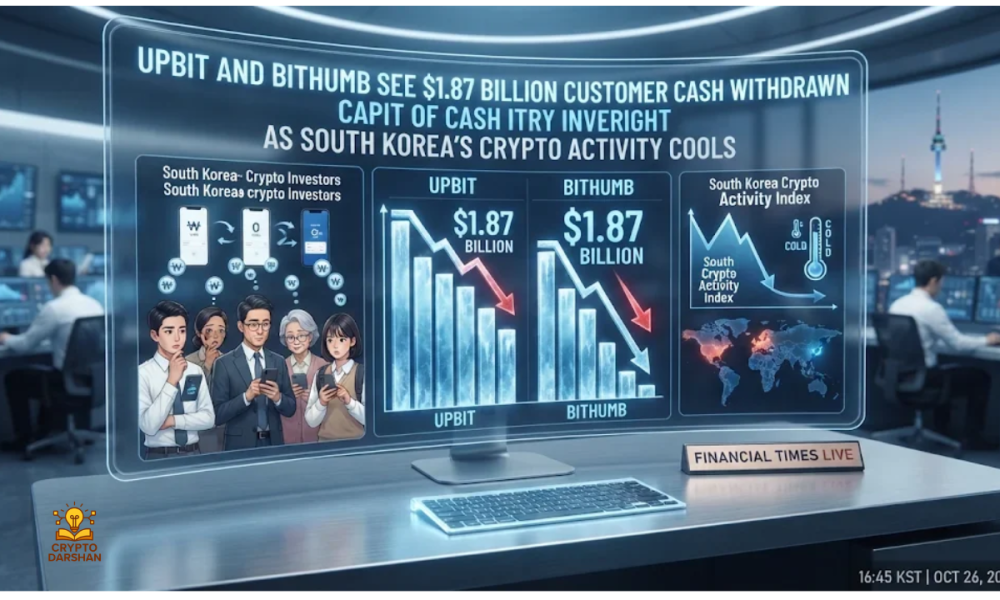
Customer cash deposits at South Korea’s two largest crypto exchanges, Upbit and Bithumb, fell by 2.51 trillion won, or about $1.87 billion, during the first nine months of 2026. The combined decline of 31.9% reflects weaker trading activity, lower crypto valuations, and reduced cash held on the platforms.
The figures come from Financial Supervisory Service filings cited by Yonhap. They measure customer won deposits, not the market value of cryptocurrencies held in user accounts.
Cash balances fall sharply
Upbit operator Dunamu reported 3.9733 trillion won in customer won deposits on September 30, down 31.9% from 5.8327 trillion won at the end of 2025. Bithumb’s customer deposits fell 31.8% to 1.3875 trillion won from 2.0352 trillion won.
Together, the two exchanges lost 2.5071 trillion won in customer cash balances. The decline suggests that many users withdrew Korean won, reduced trading activity, or held less cash on exchanges during the period.
The drop does not automatically mean customers sold all their crypto. In fact, the number of several major tokens held by customers increased, even as the value of those holdings declined.
Crypto holdings rise in volume

Customer crypto holdings at Upbit were valued at 55.4555 trillion won, down 10.9% from the end of 2025. Bithumb’s customer crypto holdings were valued at 15.5597 trillion won, down 13.1%.
Despite the lower valuations, customers collectively held 14,706 more Bitcoin and 421,624 more Ethereum than at the end of December. Upbit users added 13,259 BTC and 337,609 ETH, while Bithumb users increased holdings by 1,447 BTC and 84,015 ETH.
XRP and Solana holdings also rose. Upbit customers held an additional 145 million XRP and 1.22 million SOL, while Bithumb customers added 12.1 million XRP and 392,152 SOL
However, Bithumb’s customer USDT balance fell by 47.3 million tokens. This shows that the deposit decline was not uniform across all digital assets.
Exchanges report operating losses
The slowdown has affected the exchanges’ finances. Dunamu posted 151.7 billion won in consolidated revenue in the third quarter but recorded a 3.5 billion won operating loss. Bithumb reported 59.4 billion won in revenue and an 8.1 billion won operating loss.
Trading fees remain the main source of income for both platforms. Fees accounted for 96.04% of Dunamu’s nine-month revenue and 99.99% of Bithumb’s revenue.
That dependence makes the exchanges vulnerable when trading volume falls. Fewer transactions mean less fee income, even if customer crypto holdings remain relatively stable
Trading activity weakens across Korea
The slowdown extends beyond Upbit and Bithumb. The Financial Services Commission’s October 1 survey found that average daily crypto trading volume fell 44% to 3.1 trillion won in the first half of 2026, down from 5.4 trillion won in the previous six months.
Won deposits across surveyed exchanges fell 35%, while tradable accounts increased slightly by 0.4% to 11.175 million. This indicates that more accounts existed, but users were trading less and keeping less cash on exchanges.
Exchange operating profits fell 78% during the first half. Separate research found that five major Korean platforms processed $366.58 billion in trading volume from January to June, down 54.6% from the same period a year earlier.
KOSPI decline adds pressure

South Korean equities have also weakened. The KOSPI closed at 4,968.48 on November 17, down 2.59% on the day and 45.5% below its June 22 record close of 9,114.55.
That was the first close below 5,000 since February 2. The November decline occurred after the exchanges’ September reporting cutoff, so it is not included in the Q3 deposit figures.
Earlier in the year, crypto trading had already fallen sharply relative to stock market activity. In May, crypto turnover represented just 8% of KOSPI activity, compared with 323% in December 2024.
Stablecoin rules remain unsettled
South Korea is preparing a second-stage digital asset law covering stablecoin issuance and exchange supervision. However, the rules have not yet been enacted.
One proposal discussed in November would require banks to hold at least 50% plus one share of a won-stablecoin issuing consortium. Fintech companies have pushed back, arguing that the rule would limit competition.
At a November 12 National Assembly forum, VIDEX CEO Ryu Hong-ryeol said licensing standards should focus on business capability and risk management rather than restricting issuers to banks.
What comes next for Korean exchanges

Upbit is seeking to expand beyond retail trading. At the D-CON conference on November 10, Dunamu Vice Chairman Kim Hyoung-nyon said the market should open to corporate and institutional crypto investment as soon as possible.
Regulators have not announced a date for the next stage of corporate trading access. Until then, exchanges may continue to face pressure from lower retail activity and weaker trading volumes.
The Q3 data show that South Korean crypto users are holding more major cryptocurrencies but keeping less cash on exchanges. That shift could make it harder for Upbit and Bithumb to generate the trading fees that have historically driven their profits.