Cryptocurrency markets are known for their extreme volatility, rapid price swings, and unpredictable behavior. For traders who thrive on speed and precision, this volatility presents both opportunity and danger. Among the many trading strategies used in crypto, scalping stands out as one of the most aggressive and high‑risk approaches. It involves making dozens or even hundreds of trades in a single day, aiming to profit from small price movements. While the potential for quick gains is appealing, the risks are equally significant.
This comprehensive guide explores the mechanics of crypto scalping, the tools and techniques used by professional scalpers, the psychology behind the strategy, and the risk management principles that can make or break a trader’s success. It also examines how market volatility affects performance and provides practical insights for those considering this fast‑paced trading style.
1. Understanding Scalping in Cryptocurrency Trading

1.1 What Is Scalping?
Scalping is a trading strategy geared toward profiting from minor price changes in an asset’s price. Traders who implement this strategy place anywhere from 10 to a few hundred trades in a single day in the belief that small moves in asset prices are easier to catch than large ones. Instead of holding positions for hours or days, scalpers open and close trades within seconds or minutes. The goal is to accumulate many small wins that add up to a significant profit by the end of the trading session.
In the crypto market, where prices can move several percentage points in seconds, scalping can be highly profitable, but only for those who can execute trades quickly and manage risk effectively.
1.2 How Scalping Differs from Other Trading Styles
| Strategy | Holding Period | Trade Frequency | Profit Target | Risk Level |
| Scalping | Seconds to minutes | Very high | Small (0.1–1%) | Very high |
| Day Trading | Minutes to hours | Moderate | Moderate (1–5%) | High |
| Swing Trading | Days to weeks | Low | Larger (5–20%) | Moderate |
| Position Trading | Weeks to months | Very low | Large (20%+) | Low |
Scalping requires constant attention, lightning‑fast execution, and a deep understanding of market microstructure. Unlike swing or position traders, scalpers rely less on fundamental analysis and more on technical indicators, order flow, and liquidity.
1.3 Why Scalping Appeals to Crypto Traders
- High Volatility: Crypto markets move faster than traditional assets, creating frequent short‑term opportunities.
- 24/7 Market Access: Unlike stock markets, crypto never sleeps, allowing scalpers to trade anytime.
- Leverage Availability: Many exchanges offer high leverage, amplifying both profits and losses.
- Low Entry Barriers: With minimal capital, traders can start scalping using spot or futures markets.
However, these same factors also make it one of the riskiest trading methods.
2. The Mechanics of Crypto Scalping

2.1 How Scalping Works
Scalping relies on exploiting small inefficiencies in price movements. Traders use technical indicators, order book data, and volume analysis to identify micro‑trends. Once a setup appears, they enter a trade, hold it briefly, and exit as soon as a small profit target is reached.
For example, if Bitcoin’s price fluctuates between $65,000 and $65,100, a scalper might buy at $65,000 and sell at $65,050 multiple times throughout the day. Each trade yields a small profit, but the cumulative effect can be substantial.
2.2 Common Scalping Techniques
- Order Book Scalping: Observing bid‑ask spreads and liquidity levels to anticipate short‑term price moves.
- Range Scalping: Trading within tight price ranges, buying at support and selling at resistance.
- Momentum Scalping: Entering trades when strong momentum appears, often confirmed by volume spikes.
- News‑Driven Scalping: Reacting instantly to breaking news or sudden market events.
- Algorithmic Scalping: Using bots to automate high‑frequency trades based on predefined rules.
2.3 Timeframes and Chart Settings
Scalpers typically use ultra‑short timeframes such as:
- 1‑minute (M1) charts
- 5‑minute (M5) charts
- Tick charts (showing each trade rather than time intervals)
These charts reveal micro‑movements that longer timeframes hide. Scalpers often combine multiple timeframes to confirm trends and entry points.
3. Tools and Platforms for Crypto Scalping

3.1 Choosing the Right Exchange
A reliable exchange is critical for scalping. Key factors include:
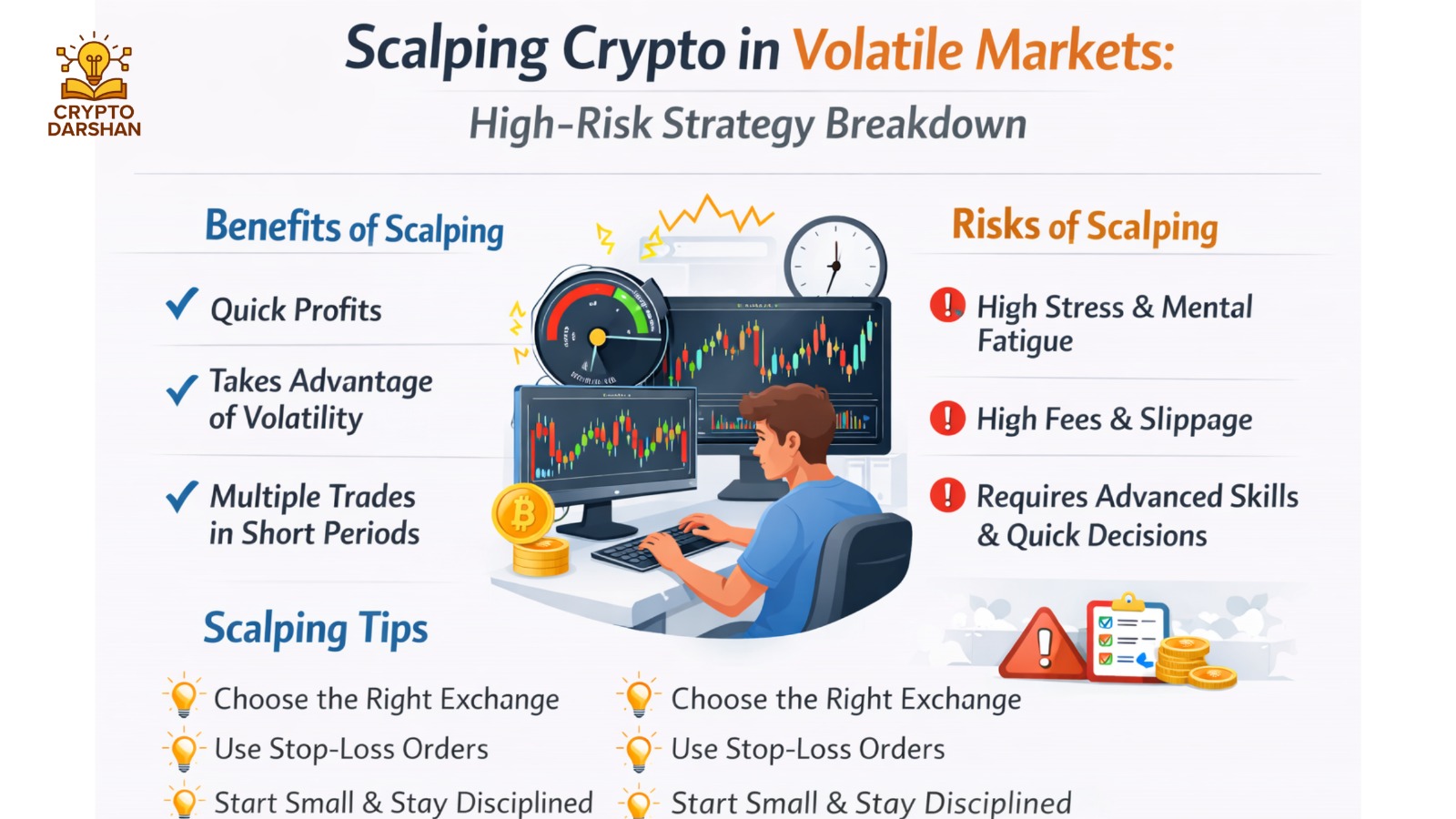
- Low Fees: High trading frequency magnifies the impact of fees.
- Fast Execution: Delays can turn profitable trades into losses.
- Deep Liquidity: Tight spreads and high volume reduce slippage.
- API Access: Enables algorithmic trading and automation.
Popular exchanges for scalping include Binance, Bybit, OKX, and Kraken Pro.
3.2 Essential Scalping Tools
- TradingView: For advanced charting and indicator customization.
- Depth of Market (DOM): Displays real‑time order book data.
- Crypto Screener: Filters assets based on volatility, volume, and price movement.
- Hotkeys and Shortcuts: Speed up order execution.
- Latency‑Optimized VPS: Reduces delay between order placement and execution.
3.3 Indicators Used by Scalpers
| Indicator | Purpose |
| Moving Averages (MA, EMA) | Identify short‑term trends |
| Relative Strength Index (RSI) | Detect overbought/oversold conditions |
| Bollinger Bands | Measure volatility and price deviation |
| Volume Profile | Show where most trading activity occurs |
| VWAP (Volume Weighted Average Price) | Gauge fair value for intraday trading |
| MACD (Moving Average Convergence Divergence) | Confirm momentum shifts |
Scalpers often combine multiple indicators to filter false signals and improve accuracy.
4. Market Volatility and Its Impact

4.1 Understanding Volatility
Volatility measures how much an asset’s price fluctuates over time. In crypto, volatility is influenced by liquidity, market sentiment, macroeconomic events, and whale activity. High volatility creates more trading opportunities but also increases risk.
4.2 Volatility Indicators
- Average True Range (ATR): Measures average price movement over a set period.
- Bollinger Bands Width: Expands during high volatility and contracts during low volatility.
- Historical Volatility (HV): Calculates past price fluctuations.
- Implied Volatility (IV): Derived from options pricing, indicating expected future volatility.
4.3 How Volatility Affects Scalping
- Positive Impact: More price swings mean more chances to profit.
- Negative Impact: Sudden spikes can trigger stop‑losses or cause slippage.
- Execution Risk: Rapid moves may prevent orders from filling at desired prices.
Successful scalpers learn to adapt position size and stop‑loss distance based on volatility levels.
5. Risk Management in Scalping

5.1 The Importance of Risk Control
Because scalping involves frequent trades, even small mistakes can accumulate into large losses. Effective risk management ensures long‑term survival. Strong risk control is essential. The Top 3 Cryptos for a Balanced Portfolio in 2026 shows how diversification can protect your capital.
5.2 Key Risk Management Principles
- Position Sizing: Never risk more than 1–2% of total capital per trade.
- Stop‑Loss Orders: Automatically exit losing trades to prevent large drawdowns.
- Take‑Profit Targets: Lock in small gains consistently.
- Risk‑Reward Ratio: Maintain at least a 1:1 ratio, even for micro‑profits.
- Avoid Overtrading: Quality setups matter more than quantity.
5.3 Managing Leverage
Leverage amplifies both profits and losses. While 10x or 20x leverage may seem attractive, it can quickly wipe out an account during volatile swings. Conservative scalpers often use 2x–5x leverage to balance risk and reward.
5.4 Emotional Discipline
Scalping demands intense focus and emotional control. Fear, greed, and impatience can lead to impulsive decisions. Maintaining a trading journal, setting daily profit/loss limits, and taking breaks can help sustain mental clarity.
6. The Psychology of a Scalper

6.1 Traits of Successful Scalpers
- Patience: Waiting for high‑probability setups.
- Discipline: Following a strict trading plan.
- Adaptability: Adjusting to changing market conditions.
- Focus: Monitoring multiple charts and indicators simultaneously.
- Emotional Control: Staying calm under pressure.
6.2 Common Psychological Pitfalls
- Revenge Trading: Trying to recover losses quickly.
- Overconfidence: Increasing position size after a winning streak.
- Fear of Missing Out (FOMO): Entering trades without confirmation.
- Burnout: Fatigue from constant screen time.
6.3 Building a Scalper’s Mindset
Developing a professional mindset involves consistent practice, realistic expectations, and continuous learning. Scalping is not gambling—it’s a skill that requires precision, patience, and discipline.
7. Developing a Crypto Scalping Strategy

7.1 Step‑by‑Step Strategy Framework
- Select a Market: Choose a liquid pair like BTC/USDT or ETH/USDT.
- Define Timeframe: Use 1‑minute or 5‑minute charts.
- Identify Trend: Use moving averages to determine direction.
- Set Entry Rules: For example, buy when price crosses above EMA and RSI < 70.
- Set Exit Rules: Take profit at 0.3–0.5% gain or stop loss at 0.2–0.3% loss.
- Backtest: Test the strategy on historical data.
- Go Live: Start with small capital and scale gradually.
7.2 Example: EMA + RSI Scalping Strategy
- Indicators: 9‑EMA, 21‑EMA, RSI (14)
- Buy Signal: 9‑EMA crosses above 21‑EMA and RSI < 70
- Sell Signal: 9‑EMA crosses below 21‑EMA or RSI > 70
- Stop‑Loss: 0.25% below entry
- Take‑Profit: 0.5% above entry
This simple setup works best in trending markets with moderate volatility.
7.3 Backtesting and Optimization
Backtesting helps evaluate a strategy’s performance before risking real money. Key metrics include:
- Win rate
- Average profit per trade
- Maximum drawdown
- Profit factor (total profit ÷ total loss)
Optimization involves fine‑tuning parameters like EMA periods or RSI thresholds to improve results.
8. Automation and Algorithmic Scalping

8.1 The Rise of Trading Bots
Algorithmic trading has revolutionized scalping. Bots can execute trades faster than humans, monitor multiple pairs simultaneously, and eliminate emotional bias.
8.2 Types of Scalping Bots
- Grid Bots: Place buy and sell orders at fixed intervals.
- Arbitrage Bots: Exploit price differences across exchanges.
- Momentum Bots: Trade based on volume and trend strength.
- Custom Bots: Built using APIs and custom scripts.
8.3 Advantages and Risks of Automation
Advantages:
- 24/7 operation
- Instant execution
- Consistent strategy application
Risks:
- Technical failures
- Over‑optimization
- Market anomalies causing unexpected losses
Regular monitoring and periodic strategy updates are essential for maintaining performance.
9. Scalping in Different Market Conditions
9.1 Bull Markets
In strong uptrends, scalpers focus on buying dips and riding short bursts of momentum. Volume is high, and liquidity supports quick entries and exits.
9.2 Bear Markets
Downtrends require caution. Scalpers may short rallies or trade stablecoins against volatile assets. Risk management becomes even more critical.
9.3 Sideways Markets
Range‑bound conditions favor range scalping strategies—buying at support and selling at resistance. Tight spreads and low volatility can reduce profitability.
9.4 News and Event‑Driven Volatility
Major announcements, regulatory updates, or exchange hacks can trigger extreme volatility. Scalpers must react quickly but avoid trading during chaotic spikes where spreads widen dramatically.
If scalping feels too intense, EigenLayer Restaking: Double Earnings on Ethereum Staked ETH explores a more passive earning approach.
10. Legal and Ethical Considerations

10.1 Regulatory Environment
Crypto trading regulations vary by country. Some jurisdictions restrict leveraged trading or require licensing for algorithmic strategies. Traders must comply with local laws and exchange policies.
10.2 Market Manipulation Risks
Scalping should not involve unethical practices like spoofing or wash trading. Exchanges monitor suspicious activity, and violations can lead to bans or legal consequences.
10.3 Tax Implications
Frequent trading generates numerous taxable events. Maintaining detailed records of every trade helps ensure accurate tax reporting.
11. Advantages and Disadvantages of Crypto Scalping

11.1 Advantages
- Quick profit potential
- Frequent trading opportunities
- Minimal exposure to overnight risk
- Works in both rising and falling markets
11.2 Disadvantages
- High transaction costs
- Requires constant attention
- Emotionally and mentally exhausting
- High risk of losses due to leverage and slippage
12. Case Studies: Real‑World Scalping Scenarios

12.1 Bitcoin Scalping During High Volatility
During a major Bitcoin rally, price swings of 2–3% per minute created ideal conditions for scalpers. Traders using EMA crossovers captured multiple 0.5% gains within hours. However, those without strict stop‑losses suffered heavy losses when sudden reversals occurred.
12.2 Ethereum Scalping with Bots
An automated bot using a grid strategy on ETH/USDT executed over 500 trades in one day, averaging 0.2% profit per trade. Despite occasional losses, the bot achieved a net daily gain of 3%, demonstrating the power of automation when properly configured.
13. Building a Sustainable Scalping Routine

13.1 Daily Preparation
- Review market news and volatility levels.
- Identify top‑volume pairs.
- Set daily profit and loss limits.
- Prepare charts and indicators.
13.2 During Trading
- Stick to predefined setups.
- Avoid emotional decisions.
- Record every trade for analysis.
13.3 Post‑Trading Review
- Analyze performance metrics.
- Identify mistakes and missed opportunities.
- Adjust strategy parameters if needed.
Consistency and discipline are the foundation of long‑term success.
14. Common Mistakes to Avoid

Ignoring Trading Fees
Many scalpers overlook how quickly fees add up. Since scalping involves frequent trades, even small transaction costs can eat into profits. Always factor in maker and taker fees before entering a trade.
Using Excessive Leverage
High leverage can amplify profits but also magnifies losses. A sudden price swing can liquidate your position instantly. It’s safer to use moderate leverage and focus on consistent, smaller gains.
Chasing Late Entries
Jumping into trades after a move has already started often leads to buying at the top or selling at the bottom. Wait for clear setups and confirmation signals instead of reacting emotionally to price spikes.
Skipping Stop‑Loss Orders
Not setting a stop‑loss is one of the fastest ways to lose money. Scalping requires strict risk control, and every trade should have a predefined exit point to limit potential losses.
Trading Illiquid Pairs
Low‑volume pairs have wider spreads and higher slippage, making it difficult to enter and exit quickly. Always choose pairs with strong liquidity and consistent trading activity.
Overtrading
Taking too many trades in a short period can lead to fatigue and poor decision‑making. Focus on quality setups rather than quantity, and take breaks to maintain mental clarity.
Neglecting Market Conditions
Scalping strategies that work in trending markets may fail in sideways or choppy conditions. Always adapt your approach to current volatility and trend strength.
15. Future of Crypto Scalping

15.1 Technological Advancements
AI‑driven bots, machine learning algorithms, and faster blockchain networks will continue to shape the future. Improved data analytics and predictive modeling may enhance accuracy and reduce risk.
15.2 Regulatory Evolution
As governments refine crypto regulations, exchanges may impose stricter rules on high‑frequency trading. Transparency and compliance will become increasingly important.
15.3 Market Maturity
As liquidity deepens and volatility stabilizes, scalping opportunities may decrease. However, new assets and derivatives will continue to offer fresh possibilities for skilled traders.
FAQ Section

1. What is crypto scalping?
Crypto scalping is a short-term trading strategy where traders aim to make small profits from frequent trades, often within minutes, by taking advantage of tiny price movements.
2. Why is scalping considered high-risk in volatile markets?
Volatile markets can move unpredictably in seconds, increasing the chances of sudden losses, slippage, and failed trades, especially when using high leverage.
3. Is crypto scalping suitable for beginners?
No, scalping is generally not recommended for beginners. It requires fast decision-making, technical analysis skills, and strict risk management.
4. What timeframes are best for scalping crypto?
Scalpers typically use very short timeframes such as 1-minute, 3-minute, or 5-minute charts to identify quick entry and exit opportunities.
5. Which indicators are commonly used in crypto scalping?
Popular indicators include RSI, Moving Averages, Bollinger Bands, and MACD, as they help identify short-term trends and momentum shifts.
6. How much capital do I need to start scalping crypto?
You can start with a small amount, but due to trading fees and tight margins, having sufficient capital helps make scalping more effective.
7. What is the role of leverage in scalping?
Leverage amplifies both profits and losses. While it can increase gains on small price moves, it also raises the risk of liquidation.
8. How do trading fees impact scalping strategies?
Fees can significantly reduce profits since scalping involves frequent trades. Choosing low-fee exchanges is crucial for profitability.
Conclusion
Scalping crypto in volatile markets is a high‑risk, high‑reward strategy that demands precision, discipline, and emotional control. It thrives on volatility but punishes hesitation and poor risk management. While the potential for quick profits is real, so is the danger of rapid losses.
Success in scalping depends on preparation, technology, and mindset. Traders must master technical analysis, manage leverage wisely, and maintain strict discipline. For those who can handle the pressure, scalping offers a thrilling and potentially lucrative way to navigate the ever‑changing world of cryptocurrency trading.