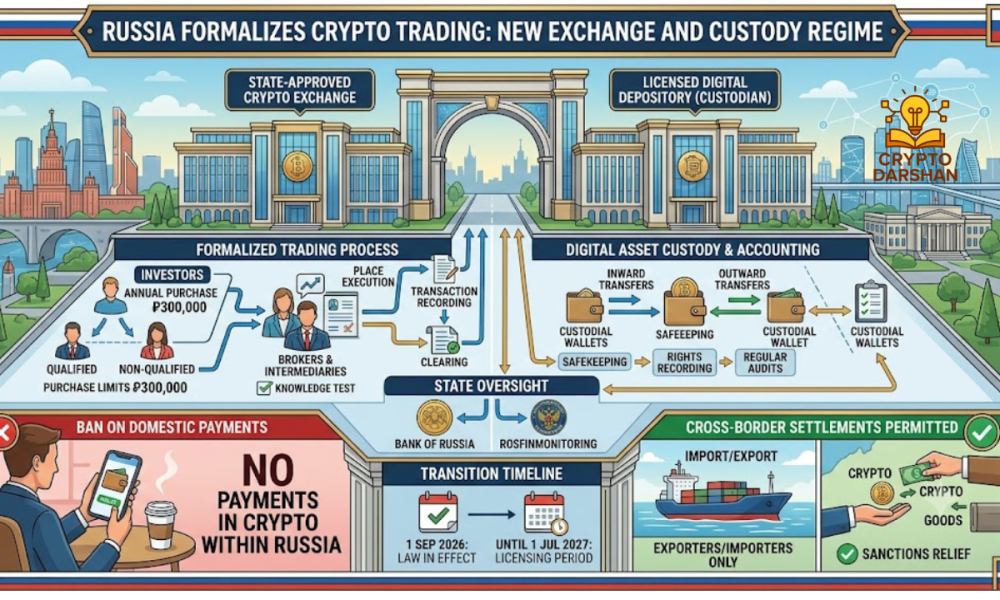
Russia has taken a major step toward building a more formal crypto market, with the Bank of Russia unveiling draft rules for crypto exchanges and digital depositories. The proposal would bring digital asset trading and custody under a more regulated system, with capital rules, oversight standards, and official registries for market participants.
What the draft rules mean

The new draft is designed to create a clearer framework for companies that handle crypto trading and storage. In simple terms, it would set rules for how exchanges operate, how digital assets are recorded, and how custody providers hold crypto on behalf of clients.
The Bank of Russia appears to be borrowing from the structure already used in traditional securities markets. That means crypto firms could soon face requirements similar to those that apply to brokers, depositories, and other regulated financial players.
Digital depositories explained

One of the biggest changes in the proposal is the creation of “digital depositories.” These would be regulated companies responsible for recording crypto holdings and other digital assets, much like securities depositories keep track of financial instruments in traditional markets.
Depending on the type of service they provide, these firms would need between 50 million and 250 million rubles in capital. In dollar terms, that is roughly $570,000 to $2.8 million. The capital must also be held in liquid assets that meet the central bank’s standards.
Capital requirements raise the bar

The draft rules do not treat all crypto firms the same. Companies that settle transactions involving digital financial assets would face the highest capital threshold at 250 million rubles, while firms that only manage certain crypto-related functions would need less.
There is also a middle tier for companies that control crypto addresses or work with foreign custodians. For them, the proposed minimum would be 100 million rubles. This shows that Russia wants to match the level of oversight with the amount of risk each firm takes on.
Exchanges would set their own trading rules

Another important part of the draft is that exchanges would be allowed to define their own trading procedures. They would also be responsible for calculating market prices and weighted average prices for digital assets, which gives them a more active role in how the market runs day to day.
At the same time, this does not mean complete freedom. The exchanges would still operate under central bank supervision and would likely need to follow rules on reporting, disclosure, and compliance.
A wider push for control

This draft is part of a broader Russian effort to regulate digital assets rather than leave them in a gray area. Earlier proposals already suggested that crypto transactions should be handled through legal intermediaries and that banks should not process payments to unofficial or foreign exchanges without approved Russian channels.
The latest move fits that same direction. Russia seems to want crypto activity to continue, but only inside a system it can monitor, license, and tax more easily.
What it means for the market

For crypto users, the new rules could bring more clarity and better protection if they are finalized. A licensed exchange and custody system may reduce the risks of fraud, weak record-keeping, and poorly run platforms.
But there is also a trade-off. Higher capital requirements and tighter oversight may make it harder for smaller firms to enter the market, and some users may see the rules as another sign that Russia wants control first and openness second.
Broader implications
Russia is not just regulating crypto for domestic use. Its policy has also been shaped by foreign trade needs, investor controls, and the country’s wider financial strategy. Earlier drafts allowed some forms of cross-border crypto activity while still banning crypto payments inside Russia
That means the new framework may not be about promoting everyday retail crypto spending. Instead, it looks more like an attempt to build a controlled market that can support business activity while limiting system risk.
Final outlook
Russia’s draft rules for crypto exchanges and digital depositories show that the country is moving closer to a formal digital asset system. If approved, the framework could make the market more organized, more transparent, and easier for regulators to supervise
At the same time, the rules could also make the market tougher for smaller players and less flexible for users who want open access. For now, the proposal is a clear signal that Russia wants crypto to operate inside a regulated financial box, not outside it.