
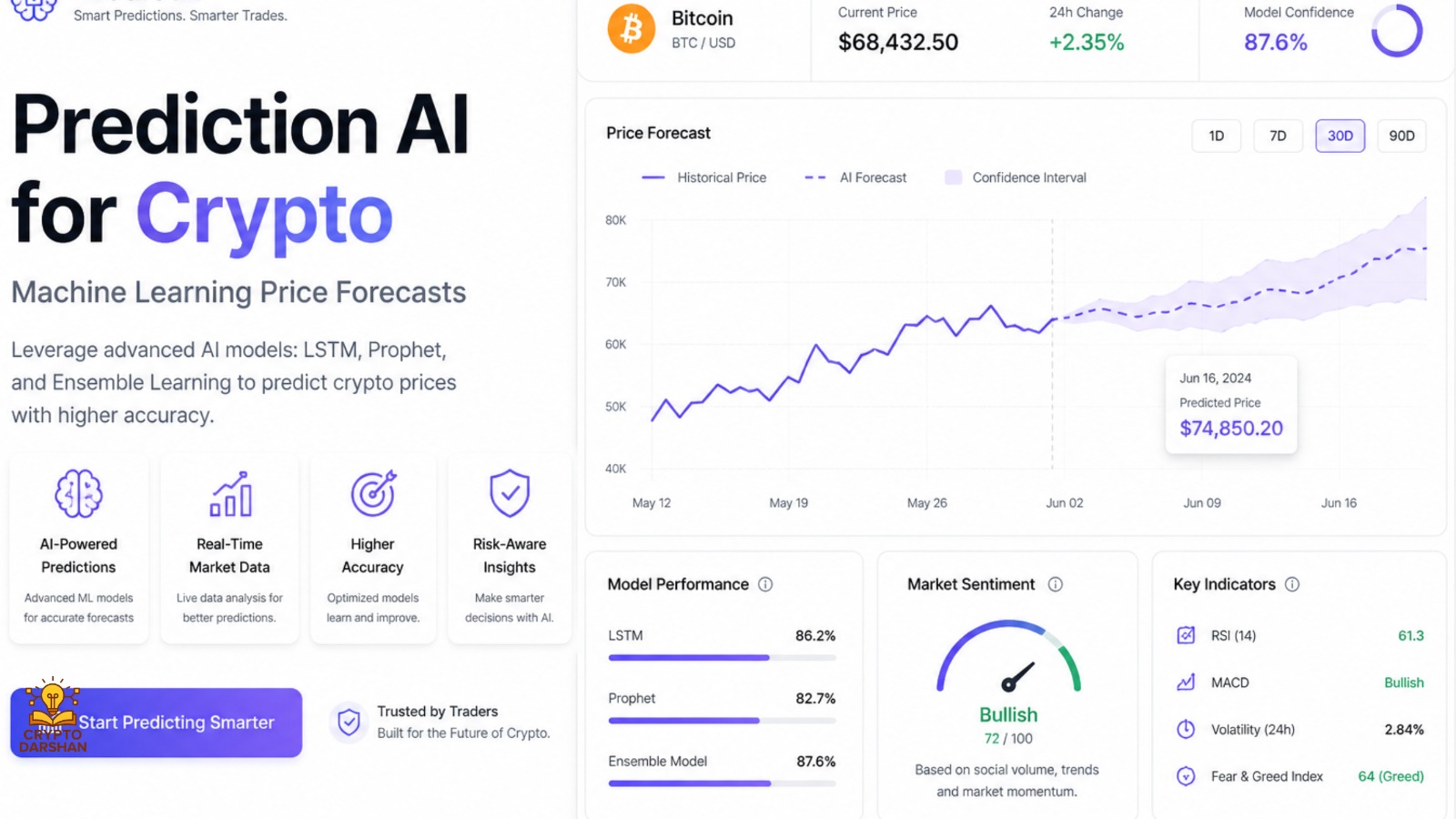
Prediction AI is transforming the way investors, traders, and analysts understand and forecast cryptocurrency prices. In the volatile world of digital assets, where prices can fluctuate dramatically within minutes, AI provides a data-driven approach to anticipate market movements. By leveraging machine learning algorithms, neural networks, and big data analytics, AI for crypt can analyze vast amounts of information to generate accurate and timely forecasts.
The cryptocurrency market operates 24/7, influenced by global events, investor sentiment, and blockchain activity. Traditional financial models often fail to capture the complexity of these factors. However, it uses advanced computational models to identify hidden patterns and correlations that humans might overlook. This technology is not just about predicting prices—it’s about understanding the underlying dynamics that drive market behavior.
Understanding the Basics of Prediction AI

Predictive artificial intelligence (AI) involves using statistical analysis and machine learning (ML) to identify patterns, anticipate behaviors and forecast upcoming events. Organizations use predictive AI to predict potential future outcomes, causation, risk exposure and more. In the context of cryptocurrency, Prediction AI uses machine learning models to analyze past price movements, trading volumes, social media trends, and blockchain metrics. These models learn from data patterns and continuously improve their accuracy over time.
Machine learning, a subset of AI, enables AI to adapt to new information. For example, when a new cryptocurrency enters the market or a major event affects Bitcoin’s price, the AI model updates its parameters to reflect the new reality. This adaptability makes Prediction AI a powerful tool for crypto forecasting.
Key Components of Prediction AI
- Data Collection: Gathering data from multiple sources such as exchanges, news outlets, and social media.
- Data Preprocessing: Cleaning and organizing data to remove noise and inconsistencies.
- Feature Engineering: Selecting relevant variables that influence price movements.
- Model Training: Using algorithms like regression, decision trees, or neural networks to learn from data.
- Prediction and Evaluation: Generating forecasts and comparing them with actual outcomes to measure accuracy.
Each of these components plays a crucial role in ensuring that it delivers reliable and actionable insights.
How Machine Learning Powers Prediction AI

Machine learning is the core technology that drives Prediction AI. It enables systems to learn from data, identify patterns, and make accurate forecasts without being explicitly programmed. In the context of cryptocurrency, machine learning allows AI to analyze massive amounts of market data—such as price movements, trading volumes, and sentiment trends—to predict future price behavior.
Key Points Explaining How Machine Learning Powers Prediction AI
1. Data-Driven Learning
Machine learning relies on large datasets to train models. In crypto forecasting, this includes historical price data, blockchain transactions, and social media sentiment. The more data the model processes, the better it becomes at recognizing patterns and predicting outcomes. Prediction AI uses this continuous flow of data to refine its understanding of market behavior.
2. Pattern Recognition
Machine learning algorithms excel at identifying complex patterns that humans might miss. For example, they can detect subtle correlations between Bitcoin’s trading volume and global economic indicators. Prediction AI uses these patterns to forecast potential price movements, helping traders anticipate market shifts before they happen.
3. Model Training and Optimization
Machine learning models are trained using historical data. During training, the model learns the relationship between input variables (like trading volume or sentiment) and output variables (like price). The model then adjusts its internal parameters to minimize prediction errors. Over time, Prediction AI becomes more accurate as it optimizes its algorithms through repeated training cycles.
4. Adaptability to Market Changes
Cryptocurrency markets are highly volatile and influenced by many unpredictable factors. Machine learning gives the ability to adapt to new data and changing conditions. When new trends or events occur—such as regulatory changes or major news announcements—the AI updates its models to reflect the latest market realities.
5. Types of Machine Learning Used in Prediction AI

Prediction AI uses different types of machine learning techniques to enhance forecasting accuracy:
- Supervised Learning: The model learns from labeled data, where both inputs and outputs are known. It’s commonly used for price prediction.
- Unsupervised Learning: The model identifies hidden structures in unlabeled data, such as grouping similar cryptocurrencies based on performance.
- Reinforcement Learning: The model learns through trial and error, improving its decision-making by receiving feedback from its actions, often used in automated trading systems.
6. Continuous Improvement
Machine learning enables Prediction AI to improve continuously. As new data becomes available, the AI retrains itself, learns from past mistakes, and enhances its predictive accuracy. This ongoing learning process ensures that the system remains effective even as market conditions evolve.
7. Real-Time Analysis
Machine learning allows Prediction AI to process and analyze data in real time. This capability is crucial in the fast-moving crypto market, where prices can change within seconds. Real-time analysis helps traders and investors make timely decisions based on the most current information.
8. Reducing Human Bias
Traditional forecasting methods often rely on human judgment, which can be influenced by emotions or biases. Machine learning eliminates these biases by basing predictions solely on data and statistical relationships. This makes Prediction AI more objective and reliable in its forecasts.
The Role of Big Data in Prediction AI
Big data is essential for the success of Prediction AI in crypto forecasting. The cryptocurrency ecosystem generates massive amounts of data every second—from transaction records and exchange rates to social media discussions and news articles. Prediction uses this data to build comprehensive models that reflect real-time market dynamics.
Sources of Big Data in Crypto Prediction AI
- Blockchain Data: Transaction volumes, wallet addresses, and network activity.
- Market Data: Prices, order books, and trading volumes from exchanges.
- Sentiment Data: Social media posts, news headlines, and community discussions.
- Macroeconomic Data: Global financial indicators and regulatory developments.
By integrating these diverse data sources, Prediction AI can provide a holistic view of the market, improving the accuracy of its forecasts.
Prediction AI vs. Traditional Forecasting Methods

Traditional forecasting methods, such as technical analysis and econometric models, rely heavily on human interpretation and historical trends. While these methods have been useful, they often struggle to adapt to the fast-paced and unpredictable nature of the crypto market.
Prediction AI, on the other hand, uses machine learning to automatically detect patterns and relationships that may not be visible to human analysts. It can process vast datasets in real time, making it more responsive to sudden market changes.
Some AI models even integrate insights from prediction markets to gauge crowd expectations
Advantages of Prediction AI Over Traditional Methods

- Automation: Reduces human bias and manual effort.
- Adaptability: Learns from new data and adjusts predictions accordingly.
- Scalability: Handles large volumes of data efficiently.
- Accuracy: Improves forecasting precision through continuous learning.
These advantages make Prediction AI a superior choice for crypto investors seeking data-driven insights.
Applications of Prediction AI in Cryptocurrency

Prediction AI has numerous applications in the cryptocurrency industry, ranging from price forecasting to risk management and portfolio optimization.
1. Price Prediction
The most common use of Prediction AI is forecasting cryptocurrency prices. By analyzing historical data and market indicators, AI models can predict short-term and long-term price movements. Traders use these predictions to make informed decisions about buying or selling assets.
2. Market Sentiment Analysis
it can analyze social media posts, news articles, and online discussions to gauge market sentiment. Positive or negative sentiment often correlates with price movements, allowing investors to anticipate market trends.
3. Fraud Detection
AI models can detect unusual trading patterns or suspicious transactions that may indicate fraud or market manipulation. This helps exchanges and regulators maintain market integrity.
4. Portfolio Management
Prediction AI assists investors in optimizing their portfolios by predicting asset performance and suggesting diversification strategies. It can balance risk and return based on individual preferences.
5. Automated Trading
Prediction AI powers algorithmic trading systems that execute trades automatically based on predictive signals. These systems can react faster than human traders, capturing opportunities in volatile markets.
How Prediction AI Learns from Data

Prediction AI relies on continuous learning to improve its forecasting accuracy. The process involves feeding the model with new data, evaluating its predictions, and adjusting its parameters accordingly.
The Learning Process
- Data Input: The model receives updated market data.
- Pattern Recognition: It identifies correlations between variables.
- Prediction Generation: The model forecasts future prices.
- Performance Evaluation: Predictions are compared with actual outcomes.
- Model Adjustment: The AI refines its algorithms to reduce errors.
This iterative process ensures that Prediction AI remains accurate and relevant in dynamic market conditions.
Challenges in Using Prediction AI for Crypto Forecasting

While Prediction AI offers significant advantages, it also faces challenges that can affect its performance.
1. Data Quality
Poor-quality data can lead to inaccurate predictions. Inconsistent or incomplete data from exchanges can distort model outputs.
2. Market Volatility
Cryptocurrency markets are highly volatile, making it difficult for models to maintain consistent accuracy.
3. Overfitting
When a model learns too much from historical data, it may fail to generalize to new situations. This is known as overfitting.
4. Regulatory Uncertainty
Changes in regulations can impact market behavior, making it challenging for Prediction AI to adapt quickly.
5. Ethical Concerns
The use of AI in trading raises ethical questions about fairness, transparency, and market manipulation.
Despite these challenges, ongoing research and technological advancements continue to enhance the reliability of Prediction AI.
The Future of Prediction AI in Cryptocurrency

The future of Prediction AI in crypto forecasting looks promising. As machine learning algorithms become more sophisticated and data availability increases, Prediction AI will deliver even more accurate and actionable insights.
Emerging Trends
- Hybrid Models: Combining AI with traditional analysis for improved accuracy.
- Explainable AI: Making AI predictions more transparent and understandable.
- Decentralized AI Systems: Using blockchain to ensure data integrity and privacy.
- Real-Time Forecasting: Providing instant predictions based on live data streams.
These innovations will make Prediction AI an indispensable tool for investors and institutions in the crypto space.
Case Studies: Successful Use of Prediction AI in Crypto

Case Study 1: Bitcoin Price Forecasting
A financial analytics firm used Prediction AI to forecast Bitcoin prices using historical data, trading volumes, and sentiment analysis. The model achieved over 85% accuracy in predicting short-term price movements, helping traders optimize their strategies.
Case Study 2: Ethereum Market Analysis
An AI-driven platform applied Prediction AI to analyze Ethereum’s network activity and market trends. The system identified correlations between gas fees, transaction volumes, and price fluctuations, enabling more precise forecasts.
Case Study 3: Portfolio Optimization
A hedge fund implemented Prediction AI to manage its crypto portfolio. The AI model continuously analyzed market data and adjusted asset allocations, resulting in higher returns and reduced risk exposure. These case studies demonstrate the practical benefits of AI in real-world crypto applications.
Building a Prediction AI Model for Crypto

Creating a Prediction AI model involves several steps, from data collection to model deployment.
Step 1: Data Collection
Gather data from reliable sources, including exchanges, blockchain explorers, and news platforms.
Step 2: Data Preprocessing
Clean and normalize the data to remove errors and inconsistencies.
Step 3: Feature Selection
Identify key variables such as price, volume, sentiment, and network activity.
Step 4: Model Selection
Choose appropriate machine learning algorithms, such as LSTM (Long Short-Term Memory) networks or Random Forests.
Step 5: Training and Testing
Train the model on historical data and test its performance on unseen data.
Step 6: Deployment
Integrate the model into a trading platform or analytics dashboard for real-time predictions.
By following these steps, developers can build robust Prediction AI systems tailored to specific crypto markets.
Ethical and Regulatory Considerations

As Prediction AI becomes more prevalent, ethical and regulatory issues must be addressed to ensure fair and transparent use.
Ethical Issues
- Bias in Data: AI models can inherit biases from training data.
- Transparency: Users should understand how predictions are generated.
- Market Manipulation: Automated trading based on AI predictions could influence prices.
Regulatory Frameworks
Governments and financial authorities are developing regulations to oversee AI-driven trading and data usage. Compliance with these frameworks is essential for maintaining trust and integrity in the market.
Integrating Prediction AI with Blockchain Technology

Blockchain technology can enhance the transparency and security of AI systems. By recording AI model outputs and data sources on a blockchain, stakeholders can verify the authenticity of predictions.
Benefits of Integration
- Data Integrity: Ensures that data used for training is tamper-proof.
- Transparency: Provides an auditable record of AI decisions.
- Decentralization: Reduces reliance on centralized data providers.
This integration creates a more trustworthy environment for AI-driven crypto forecasting.
Tools and Platforms for Prediction AI in Crypto
Several platforms offer tools for building and deploying Prediction AI models in the cryptocurrency domain.
Popular Tools
- TensorFlow: An open-source machine learning framework for building AI models.
- PyTorch: A flexible library for deep learning applications.
- Scikit-learn: A Python library for data analysis and machine learning.
- Keras: A high-level neural network API for rapid model development.
These tools enable developers to create customized Prediction AI solutions for crypto forecasting. Behind the scenes, AI tools rely on crypto infrastructure like indexers and relayers to process real-time data.
The Impact of Prediction AI on Crypto Trading Strategies

Prediction AI is reshaping trading strategies by providing data-driven insights and automation capabilities.
Key Impacts
- Enhanced Decision-Making: Traders can make informed decisions based on predictive analytics.
- Reduced Emotional Bias: AI-driven trading eliminates human emotions from decision-making.
- Increased Efficiency: Automated systems execute trades faster and more accurately.
- Risk Management: AI models assess risk levels and suggest optimal strategies.
These benefits make Prediction AI an asset for both individual traders and institutional investors.
FAQ: Prediction AI for Crypto

1. What is AI-based crypto price prediction?
AI-based crypto prediction uses machine learning algorithms to analyze historical price data, trading volume, sentiment, and on-chain metrics to forecast future price movements.
2. How does machine learning improve crypto forecasting?
Machine learning models can identify complex patterns and correlations in large datasets that humans often miss, improving the accuracy of short-term and long-term predictions.
3. What types of AI models are used in crypto prediction?
Common models include:
- Regression models (for price trends)
- Neural networks (like LSTM for time-series data)
- Reinforcement learning (for trading strategies)
- Natural Language Processing (NLP) for sentiment analysis
4. Is AI crypto prediction 100% accurate?
No. Crypto markets are highly volatile and influenced by unpredictable factors. AI improves probability—not certainty—so predictions should be used alongside risk management.
5. What data does AI use to predict crypto prices?
AI models typically analyze:
- Historical price charts
- Trading volume
- Order book data
- Social media sentiment
- On-chain metrics (wallet activity, inflows/outflows)
6. Can beginners use AI tools for crypto trading?
Yes. Many platforms offer user-friendly dashboards with AI signals, but beginners should still understand basic trading concepts before relying on them.
7. What are the risks of relying on AI predictions?
- Overfitting (model performs well on past data but fails in real markets)
- Sudden market events (news, regulations)
- False signals in low-liquidity markets
8. Are AI trading bots legal?
Yes, in most countries, but regulations vary. Always check local crypto and trading laws before using automated tools.
9. How is sentiment analysis used in AI prediction?
AI scans platforms like Twitter, Reddit, and news articles to gauge market sentiment (bullish or bearish), which can influence price trends.
Conclusion
Prediction AI is revolutionizing the cryptocurrency market by providing accurate, data-driven forecasts powered by machine learning and big data analytics. It enables investors to navigate the complexities of digital assets with greater confidence and precision. From price prediction and sentiment analysis to portfolio optimization and fraud detection, Prediction AI offers a wide range of applications that enhance decision-making and profitability.
As technology continues to evolve, Prediction AI will become even more integral to the crypto ecosystem. Its ability to learn, adapt, and predict with increasing accuracy positions it as a cornerstone of the future of digital finance. By embracing the cryptocurrency industry moves closer to a more intelligent, transparent, and efficient market environment.