Bitcoin has become one of the most talked-about financial assets in the world. Since its creation in 2009, it has evolved from a niche digital experiment into a global financial phenomenon. For many beginners, Bitcoin represents both an exciting opportunity and a confusing challenge. The question that often arises is: Is Bitcoin a good investment for beginners right now?
This comprehensive guide explores Bitcoin’s fundamentals, market trends, risks, and potential rewards. It also provides practical insights for beginners who want to understand whether investing in BTC makes sense in 2026 and beyond.
Understanding Bitcoin(BTC)
What Is Bitcoin?
Bitcoin is a decentralized digital currency that operates without a central authority, such as a bank or government. It was introduced by an anonymous person or group known as Satoshi Nakamoto. Bitcoin transactions are recorded on a public ledger called the blockchain, which ensures transparency and security.
Unlike traditional currencies, BTC is not printed or controlled by any institution. Instead, it is created through a process called mining, where powerful computers solve complex mathematical problems to validate transactions and secure the network.
How Bitcoin Works.
Bitcoin operates on blockchain technology. Each transaction is verified by network participants (miners) and added to a block. Once a block is full, it is linked to the previous one, forming a chain of blocks, hence the term “blockchain.”
Key features of BTC include:
- Decentralization: No single entity controls Bitcoin.
- Limited Supply: Only 21 million Bitcoins will ever exist.
- Transparency: All transactions are publicly recorded.
- Security: Cryptographic algorithms protect the network from fraud.
Why Bitcoin Was Created.
Bitcoin was designed as an alternative to traditional financial systems. After the 2008 financial crisis, trust in banks and centralized institutions declined. BTC aimed to give people control over their money without relying on intermediaries. It also sought to provide a borderless, censorship-resistant form of currency.
The Evolution of Bitcoin
Early Years (2009–2012)
In its early days, Bitcoin was mainly used by tech enthusiasts. The first real-world transaction occurred in 2010 when a programmer paid 10,000 BTC for two pizzas, a purchase now worth millions of dollars. During this period, Bitcoin’s value was negligible, and few people saw its potential.
Growth and Recognition (2013–2017)
Bitcoin began gaining mainstream attention around 2013. Exchanges like Coinbase and Bitstamp made it easier to buy and sell Bitcoin. By 2017, BTC’s price surged to nearly $20,000, driven by growing investor interest and media coverage.
Institutional Adoption (2018–2021)
After a sharp correction in 2018, Bitcoin entered a new phase of maturity. Institutional investors, hedge funds, and corporations began adding Bitcoin to their portfolios. Companies like Tesla and MicroStrategy made headlines by purchasing large amounts of BTC.
The Modern Era (2022–2026)
BTC has continued to evolve, with increasing regulatory clarity and technological improvements such as the Lightning Network, which enables faster and cheaper transactions. As of 2026, Bitcoin remains the largest cryptocurrency by market capitalization and a key player in the digital asset ecosystem.
Why Bitcoin Attracts Beginners.

Bitcoin continues to capture the attention of new investors worldwide. Its unique characteristics, accessibility, and potential for high returns make it especially appealing to beginners who are exploring investment opportunities for the first time. Several key factors explain why BTC attracts a large number of newcomers to the financial market.
1. Accessibility and Ease of Entry
Unlike traditional investments such as real estate or stocks, Bitcoin is easy to access. Anyone with an internet connection and a smartphone can buy BTC through a crypto exchange or mobile app. There are no barriers like minimum investment amounts or complex paperwork. Beginners can start with as little as a few dollars, making it an inclusive investment option.
2. Potential for High Returns
Bitcoin’s price history shows dramatic growth over the years. Early investors who bought BTC when it was worth only a few dollars have seen extraordinary returns. Even though the market is volatile, the potential for significant profit continues to attract beginners who are looking for high-growth opportunities.
3. Decentralization and Financial Freedom
Bitcoin operates without banks or governments controlling it. This decentralization appeals to people who want more control over their money. Beginners often find the idea of owning an asset that isn’t tied to traditional financial systems empowering and modern.
4. Inflation Hedge and Limited Supply
An inflation hedge is an investment that is considered to protect the decreased purchasing power of a currency that results from the loss of its value due to rising prices, either macro-economically or due to inflation. Bitcoin’s supply is capped at 21 million coins, which means it cannot be inflated like fiat currencies. In times of economic uncertainty or rising inflation, many investors see BTC as a store of value, like digital gold.
5. Global Acceptance and Growing Adoption

Bitcoin is now accepted by many businesses, online platforms, and even some governments. This growing acceptance gives beginners confidence that Bitcoin is not just a speculative asset but a legitimate form of money with real-world use cases.
6. Transparency and Security.
All Bitcoin transactions are recorded on a public blockchain, making the system transparent and verifiable. The underlying cryptography ensures that transactions are secure and tamper-proof. For beginners, this transparency builds trust in a system that doesn’t rely on intermediaries.
7. Media Attention and Social Influence.
BTC frequently appears in news headlines, social media discussions, and financial reports. This constant exposure sparks curiosity among beginners. Influencers, celebrities, and financial experts often discuss Bitcoin, further encouraging newcomers to explore it as an investment.
8. Technological Innovation.
BTC represents a revolutionary technology that combines finance and computer science. Beginners who are interested in innovation and digital transformation are naturally drawn to it. The idea of participating in a new financial era powered by blockchain technology is exciting and futuristic.
9. Low Entry Barriers Compared to Traditional Investments.
Traditional investments often require intermediaries, brokers, or large amounts of capital. BTC eliminates these barriers. With user-friendly apps and exchanges, beginners can buy, sell, and store Bitcoin independently, giving them a sense of control and empowerment.
10. Community and Education.
The Bitcoin community is vast and supportive. Online forums, social media groups, and educational platforms provide free resources for beginners to learn about BTC , blockchain, and investing strategies. This accessibility to knowledge helps new investors feel more confident in their decisions.
How to Invest in Bitcoin.

Buying Bitcoin in 2026 is simple, but following the right steps ensures safety and success.
Step 1: Choose a Reliable Bitcoin Exchange
A cryptocurrency exchange is a platform where users can buy, sell, and trade BTC. Choosing a trustworthy exchange is the first and most important step.
Factors to Consider
- Reputation: Choose exchanges with a strong track record and positive reviews.
- Security: Look for platforms with two-factor authentication (2FA), cold storage, and insurance.
- Regulation: Ensure the exchange complies with local laws and regulations.
- Fees: Compare trading and withdrawal fees.
- User Experience: A simple, intuitive interface makes trading easier.
Step 2: Create and Verify an Account
Once an exchange is selected, create an account. Most platforms require identity verification to comply with Know Your Customer (KYC) regulations.
Verification Process
- Provide an email address and create a strong password.
- Verify the email.
- Submit identification documents (passport, driver’s license, or ID card).
- Complete facial verification if required.
Verification ensures account security and prevents fraud.
Step 3: Secure a BTC Wallet
A Bitcoin wallet stores private keys, the codes needed to access and manage Bitcoin. There are two main types of wallets:
1. Hot Wallets (Online)
- Connected to the internet.
- Convenient for frequent transactions.
- Examples: MetaMask, Trust Wallet, Coinbase Wallet.
2. Cold Wallets (Offline)
- Not connected to the internet.
- Best for long-term storage.
- Examples: Ledger Nano X, Trezor Model T.
Tip: For maximum security, store large amounts of Bitcoin in a cold wallet and keep only small amounts in a hot wallet for daily use.
Step 4: Deposit Funds
Before buying Bitcoin, deposit funds into the exchange account. Most exchanges support multiple payment methods:
- Bank Transfer: Secure and suitable for large amounts.
- Credit/Debit Card: Fast but may have higher fees.
- PayPal or E-Wallets: Convenient for small purchases.
- Crypto Deposit: Use other cryptocurrencies to buy Bitcoin.
Always check deposit fees and processing times before transferring funds.
Step 5: Buy Bitcoin
Once the account is funded, it’s time to buy Bitcoin.
Buying Options
- Market Order: Buys Bitcoin instantly at the current market price.
- Limit Order: Sets a specific price to buy Bitcoin when it reaches that level.
- Recurring Purchase: Automatically buys Bitcoin at regular intervals (ideal for dollar-cost averaging).
After purchasing, the Bitcoin will appear in the exchange wallet.
Step 6: Transfer Bitcoin to a Personal Wallet
Leaving Bitcoin on an exchange is risky because exchanges can be hacked. Always transfer Bitcoin to a personal wallet for safety.
How to Transfer
- Copy the wallet’s public address.
- Go to the exchange’s withdrawal section.
- Paste the address and confirm the transaction.
- Wait for blockchain confirmation (usually a few minutes).
Once confirmed, the Bitcoin is safely stored in the personal wallet.
Step 6: Monitor and Manage
Regularly track market trends and adjust investment strategies as needed. Avoid emotional decisions based on short-term price movements.
Investment Strategies for Beginners

Dollar-Cost Averaging (DCA)
Investing a fixed amount regularly, regardless of price, helps reduce the impact of volatility. Over time, this strategy averages out the purchase cost.
Buy and Hold (HODL)
Many investors buy BTC and hold it for years, believing in its long-term potential. This strategy requires patience and confidence in Bitcoin’s future.
Trading
Active traders buy and sell Bitcoin to profit from short-term price movements. This approach requires experience, technical analysis skills, and discipline.
Diversified Crypto Portfolio
Combining Bitcoin with other cryptocurrencies like Ethereum or Solana can balance risk and reward.
The Future of Bitcoin(BTC)
Technological Advancements
Upgrades such as the Lightning Network and Taproot have improved Bitcoin’s scalability and privacy. Future innovations may further enhance its usability.
Institutional Involvement
More financial institutions are offering Bitcoin-related products, including ETFs and custody services. This institutional adoption increases market stability.
Global Economic Trends

As inflation and currency devaluation continue in some regions, Bitcoin’s appeal as a store of value may strengthen.
Regulatory Developments
Clearer regulations could attract more investors by reducing uncertainty. However, overly strict rules might limit growth in some markets.
Environmental Concerns
Bitcoin mining consumes significant energy. The shift toward renewable energy sources and more efficient mining practices aims to address these concerns.
Comparing Bitcoin to Other Investments
| Investment Type | Potential Return | Risk Level | Liquidity | Accessibility |
| BTC | High | High | High | High |
| Stocks | Moderate to High | Moderate | High | High |
| Bonds | Low to Moderate | Low | High | High |
| Real Estate | Moderate | Moderate | Low | Low |
| Gold | Moderate | Low | High | Moderate |
BTC offers higher potential returns but also higher risk compared to traditional assets. Its liquidity and accessibility make it attractive for beginners, but caution is essential.
Common Mistakes Beginners Should Avoid

- Investing Without Research: Understanding Bitcoin’s fundamentals is crucial before investing.
- Falling for Scams: Avoid offers promising guaranteed returns or unrealistic profits.
- Neglecting Security: Always use secure wallets and enable two-factor authentication.
- Emotional Trading: Avoid panic selling during market dips or buying during hype.
- Ignoring Taxes: Cryptocurrency gains may be taxable depending on the jurisdiction.
Expert Opinions on BTC
Financial analysts and crypto experts have mixed views on Bitcoin’s future. Some predict continued growth as adoption increases, while others warn of potential corrections. However, most agree that BTC has established itself as a legitimate asset class that is here to stay.
Is Now the Right Time to Invest?

The question of whether now is the right time to invest in BTC is one that every beginner asks. Bitcoin’s price history is filled with dramatic highs and lows, making timing a difficult but important consideration. However, understanding the current market environment, long-term trends, and investment principles can help investors make informed decisions.
1. Understanding Market Conditions in 2026
As of 2026, Bitcoin remains the largest and most influential cryptocurrency in the world. Its price continues to fluctuate, but the overall trend shows growing maturity and stability compared to its early years. Institutional adoption, technological upgrades, and increasing global awareness have strengthened Bitcoin’s position as a legitimate asset class.
At the same time, macroeconomic factors such as inflation, interest rate changes, and geopolitical tensions influence investor sentiment. Many investors view BTC as a hedge against economic uncertainty, while others see it as a speculative asset.
2. Long-Term Growth Potential
Bitcoin’s long-term potential remains strong. Its limited supply of 21 million coins ensures scarcity, which can drive value over time as demand increases. The growing acceptance of BTC by financial institutions, payment platforms, and even governments adds credibility and stability to its ecosystem.
For beginners, this long-term perspective is crucial. BTC has historically rewarded those who held their investments through market cycles rather than those who tried to time short-term price movements.
3. Volatility and Short-Term Risks
Despite its potential, Bitcoin remains highly volatile. Prices can rise or fall by double-digit percentages within days or even hours. This volatility can be intimidating for beginners and may lead to emotional decision-making.
Short-term traders often struggle to predict market movements accurately. Therefore, beginners should focus on long-term strategies such as dollar-cost averaging (DCA), investing a fixed amount regularly regardless of price. This approach reduces the impact of volatility and helps build a position over time.
4. Institutional and Regulatory Developments
Institutional involvement continues to grow, with more companies offering BTC-related products like ETFs and custody services. This institutional participation adds liquidity and legitimacy to the market.
On the regulatory side, many countries are developing clearer frameworks for cryptocurrency use and taxation. While stricter regulations may temporarily affect prices, they also create a safer environment for investors in the long run.
5. Technological Advancements
Bitcoin’s network continues to evolve. Upgrades such as the Lightning Network and Taproot have improved transaction speed, scalability, and privacy. These innovations make BTC more practical for everyday use and strengthen its long-term value proposition.
As technology advances, Bitcoin’s role as both a store of value and a medium of exchange becomes more viable, attracting more users and investors.
6. Global Economic Climate
The global economy plays a major role in BTC performance. In times of inflation or currency devaluation, BTC often gains attention as a hedge against traditional financial instability. Conversely, during periods of economic stability, investors may shift focus to traditional assets.
In 2026, with many economies still adjusting to post-pandemic realities and digital transformation, Bitcoin continues to serve as an alternative investment that offers diversification and potential protection against inflation.
7. Timing the Market vs. Time in the Market
One of the most important lessons in investing is that timing the market is nearly impossible. Even experienced investors struggle to predict short-term price movements accurately. Instead, focusing on time in the market, holding an investment over the long term has historically produced better results.
Bitcoin’s price history shows that those who held their investments for several years generally saw positive returns, despite temporary downturns. Beginners should adopt a patient, disciplined approach rather than chasing quick profits.
8. Psychological Readiness
Investing in Bitcoin requires emotional discipline. Price swings can trigger fear or greed, leading to impulsive decisions. Beginners should assess their risk tolerance and ensure they are comfortable with potential losses before investing.
A good rule of thumb is to invest only what you can afford to lose. This mindset helps reduce stress and encourages rational decision-making.
9. Diversification Matters
Even if Bitcoin(BTC) seems promising, it should not be the only asset in an investment portfolio. Diversifying across different asset classes such as stocks, bonds, and real estate helps balance risk. Bitcoin can serve as a high-risk, high-reward component within a broader investment strategy.
10. Expert Opinions and Market Sentiment
Financial experts and analysts have mixed views on Bitcoin’s short-term outlook but generally agree on its long-term potential. Some predict continued growth as adoption increases, while others caution about possible corrections.
Market sentiment often shifts quickly, influenced by news, regulations, and global events. Beginners should rely on research and data rather than hype or fear when making investment decisions.
Practical Tips for Beginners
- Start small and increase exposure gradually.
- Use reputable exchanges and wallets.
- Keep private keys secure and never share them.
- Stay updated with credible crypto news sources.
- Avoid making decisions based on social media hype.
Conclusion
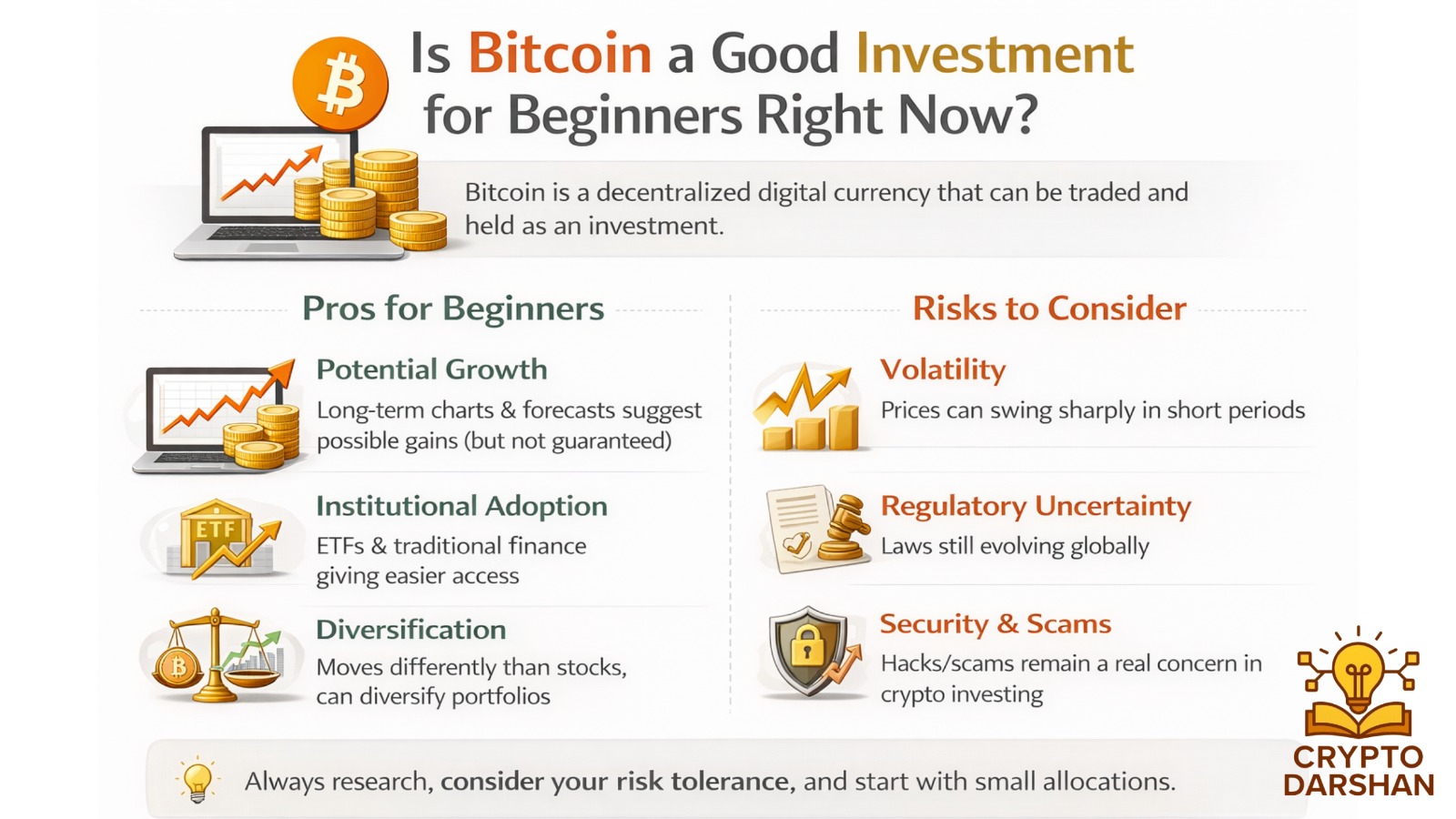
Bitcoin remains one of the most innovative and potentially rewarding investments available today. For beginners, it offers an opportunity to participate in a transformative financial revolution. However, it also carries significant risks due to volatility, regulatory uncertainty, and security challenges.
Whether BTC is a good investment right now depends on individual goals, risk tolerance, and understanding of the market. With proper research, disciplined strategy, and long-term perspective, Bitcoin can be a valuable addition to a diversified investment portfolio.
In 2026, Bitcoin(BTC) continues to stand as a symbol of financial independence and technological progress. For beginners willing to learn and manage risk wisely, it may still be one of the most promising investments of the digital age.