
Bitcoin is often described as digital gold, a decentralized currency, or a revolutionary financial system. But what does that actually mean? Beneath the buzzwords and technical talk lies a simple idea: Bitcoin is a system that allows people to send and receive money without needing a bank. This guide explains how Bitcoin really works under the hood, without the confusing jargon that often surrounds it. By the end, the mystery behind Bitcoin will feel much clearer, even if the word jargon keeps popping up.
1. The Birth of Bitcoin

In 2008, a person or group using the name Satoshi Nakamoto published a paper describing Bitcoin. The goal was to create a digital currency that didn’t rely on banks or governments. Instead, it would use a network of computers to verify and record transactions. This idea was revolutionary because it solved a long-standing problem in digital money: how to prevent people from spending the same coin twice.
Most explanations of Bitcoin are filled with jargon like “cryptographic hash functions” and “distributed consensus.” But at its core, Bitcoin is just a shared record of who owns what. This record is called the blockchain.
2. The Blockchain: Bitcoin’s Public Ledger

Imagine a notebook that everyone can see but no one can erase. Every time someone sends Bitcoin, that transaction is written in the notebook. This notebook is the blockchain. It’s a public ledger that keeps track of all Bitcoin transactions ever made.
Each page in this notebook is called a block. When a block is full of transactions, it’s sealed and linked to the previous block. This creates a chain of blocks , hence the name blockchain. The linking process uses math to make sure no one can change past pages without everyone noticing.
This system removes the need for a central authority. Instead of trusting a bank, users trust the math and the network. The jargon might sound complex, but the idea is simple: everyone agrees on one shared history of transactions.
3. How Transactions Work

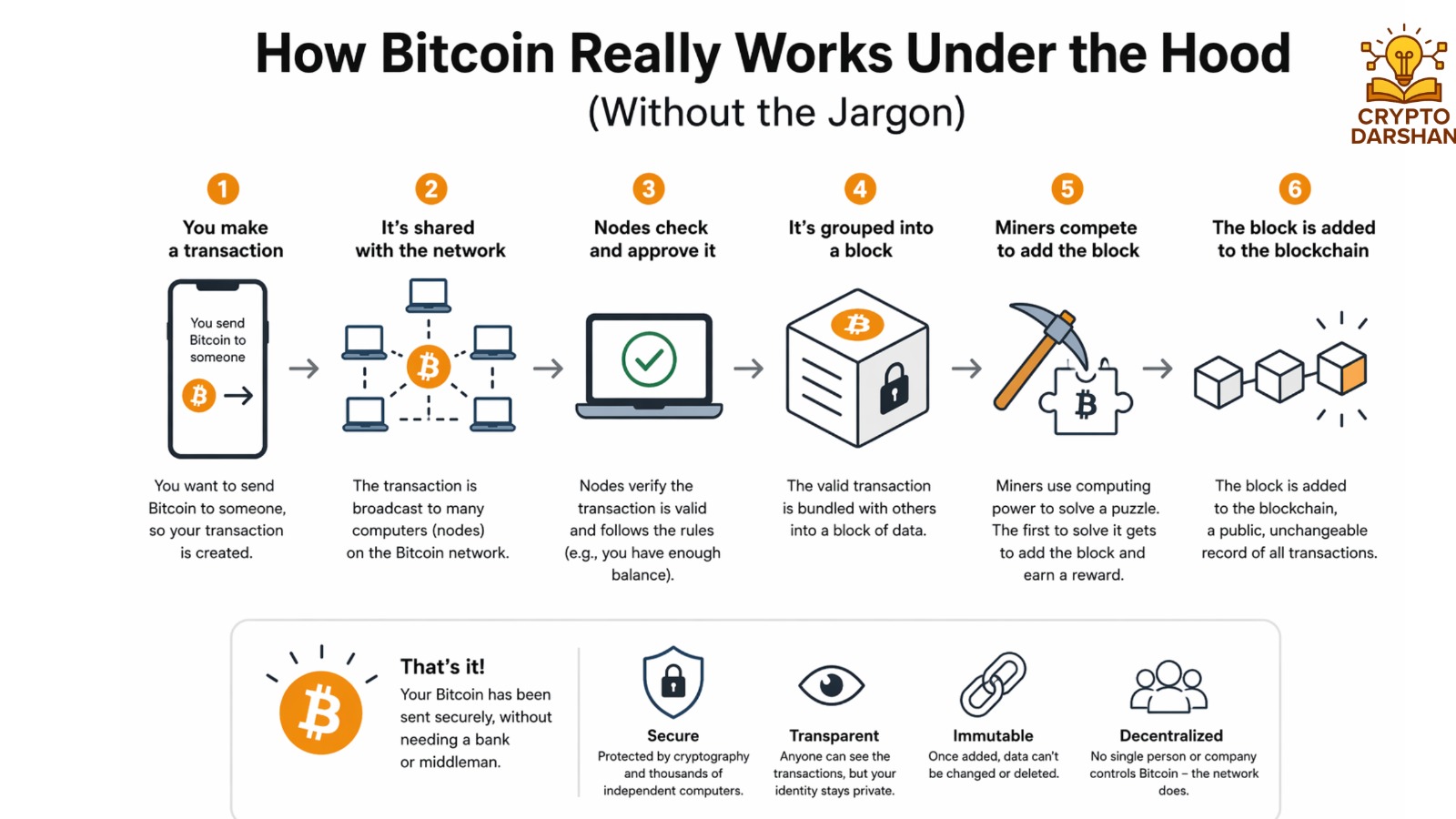
When someone sends Bitcoin, they’re not sending physical coins. They’re sending a message to the network that says, “I give this amount of Bitcoin to this address.” This message is signed with a digital signature, proving that the sender owns the Bitcoin being spent.
Each Bitcoin address is like an account number, but it’s created using cryptography. The sender uses a private key, a secret code, to sign the transaction. The network then checks that the signature matches the sender’s public key. If it does, the transaction is valid.
This process might sound like jargon, but it’s just a secure way to make sure only the rightful owner can spend their Bitcoin.
4. Mining: The Engine Behind Bitcoin

Mining is the process of verifying transactions and adding new blocks to the blockchain network. Miners gather, verify, and record cryptocurrency transactions into the digital ledger, blockchain. Mining is how new blocks are added to the blockchain. Miners are computers that compete to solve a math puzzle. The first miner to solve it gets to add the next block and is rewarded with new Bitcoin.
This process is called proof of work. It ensures that adding blocks requires effort, making it hard for anyone to cheat. The puzzle involves finding a number that, when combined with the block’s data, produces a result that meets certain conditions. It’s like a lottery where the more computing power a miner has, the more chances they get to win.
The jargon around mining can be intimidating, but it’s simply a way to keep the network secure and fair.
5. The Role of Nodes

Nodes are computers that run the Bitcoin software. They store a copy of the blockchain and help verify transactions. When a new transaction is broadcast, nodes check that it follows the rules — for example, that the sender has enough Bitcoin and hasn’t spent it before.
Nodes don’t mine new blocks, but they play a vital role in keeping the network honest. They reject invalid transactions and blocks, ensuring that everyone follows the same rules. This decentralized system means no single person or company controls Bitcoin.
Even though the jargon might sound technical, nodes are simply the guardians of the Bitcoin network.
6. The Importance of Consensus

Consensus means agreement. In Bitcoin, all nodes must agree on the state of the blockchain. When miners add a new block, nodes check it. If most nodes accept it, the block becomes part of the official chain.
This consensus mechanism prevents fraud and ensures that everyone sees the same version of history. If someone tries to cheat by creating a fake block, the network will reject it. The jargon term for this process is “distributed consensus,” but it just means that everyone agrees on what’s true.
7. Bitcoin Supply and Halving

Bitcoin has a limited supply of 21 million coins. This scarcity is built into the system. Every time miners add a block, they receive a reward in new Bitcoin. However, this reward halves every four years in an event called the “halving.”
This design mimics gold mining — it becomes harder to find new coins over time. The halving ensures that Bitcoin remains scarce, which helps maintain its value. The jargon might sound fancy, but it’s just a rule that controls how new Bitcoin enters circulation.
8. Security Through Cryptography

Cryptography is the science of keeping information secure. Bitcoin uses it in two main ways: to create addresses and to sign transactions. Each address is derived from a public key, which comes from a private key. The private key must be kept secret because it’s the only way to spend the Bitcoin associated with that address.
When a transaction is made, the sender uses their private key to create a digital signature. This signature proves ownership without revealing the private key itself. The network can verify the signature using the public key.
This system of keys and signatures might sound like jargon, but it’s what makes Bitcoin secure and trustworthy.
9. The Role of Hashing

Hashing is a process that turns data into a fixed-length string of numbers and letters. Bitcoin uses a hashing algorithm called SHA-256. When a block is created, all its data is hashed. Even a tiny change in the data produces a completely different hash.
This property makes the blockchain tamper-proof. If someone tries to change a transaction in an old block, the hash will change, breaking the chain. The network will immediately notice and reject the altered block.
The jargon term “hash” might sound technical, but it’s just a digital fingerprint that keeps the blockchain secure.
10. Wallets: Where Bitcoin Lives
A Bitcoin wallet doesn’t actually store coins. Instead, it stores private keys — the codes needed to access Bitcoin on the blockchain. There are different types of wallets: software wallets, hardware wallets, and paper wallets.
- Software wallets are apps on phones or computers.
- Hardware wallets are physical devices that store keys offline.
- Paper wallets are printed versions of keys.
The jargon around wallets can be confusing, but they’re simply tools for managing access to Bitcoin.
The importance of wallets and user experience is discussed in Smart Accounts for Normies: How Wallet UX Is Changing in 2026, making crypto more accessible to beginners.
11. How Bitcoin Transactions Are Confirmed

1. Transaction Creation
- Key Point: A Bitcoin transaction begins when a user sends Bitcoin to another address.
- Explanation: The sender uses their private key to sign a digital message that includes the recipient’s address and the amount being sent. This signature proves ownership of the Bitcoin being spent and prevents fraud.
2. Broadcasting to the Network
- Key Point: The signed transaction is broadcast to the Bitcoin network.
- Explanation: Once created, the transaction is sent to all connected nodes. These nodes check that the transaction follows Bitcoin’s rules — for example, that the sender has enough balance and hasn’t spent the same Bitcoin before.
3. Verification by Nodes
- Key Point: Nodes verify the transaction’s validity.
- Explanation: Each node independently checks the digital signature, the transaction format, and the sender’s balance. If everything is correct, the transaction is accepted and stored temporarily in a waiting area called the mempool.
4. The Mempool (Memory Pool)
- Key Point: Unconfirmed transactions wait in the mempool.
- Explanation: The mempool is like a queue where transactions wait to be picked up by miners. Transactions with higher fees are usually prioritized because miners earn these fees as rewards.
5. Selection by Miners

- Key Point: Miners choose transactions to include in the next block.
- Explanation: Miners collect transactions from the mempool and bundle them into a block. They prefer transactions with higher fees since it increases their earnings. This competition ensures that the network remains efficient.
6. Proof of Work
- Key Point: Miners must solve a complex mathematical puzzle to add a block.
- Explanation: This process, called proof of work, requires significant computing power. The first miner to solve the puzzle gets to add the block to the blockchain and receives a reward in newly created Bitcoin plus transaction fees.
7. Block Confirmation
- Key Point: Once a block is added, the transactions inside it are confirmed.
- Explanation: When a miner successfully adds a block, all transactions in that block are considered confirmed. The network recognizes them as valid and permanent.
8. Additional Confirmations
- Key Point: More blocks added after the first one increase confirmation security.
- Explanation: Each new block built on top of the previous one strengthens the transaction’s permanence. For example, one confirmation means the transaction is in one block, while six confirmations mean six blocks have been added after it. The more confirmations, the harder it becomes to reverse the transaction.
9. Final Settlement
- Key Point: After several confirmations, the transaction is final.
- Explanation: Most exchanges and merchants consider a transaction fully settled after six confirmations. At this point, it’s practically impossible to alter or cancel it because changing one block would require rewriting the entire chain.
10. Importance of Confirmations
- Key Point: Confirmations protect against double-spending and fraud.
- Explanation: The confirmation process ensures that each Bitcoin can only be spent once. It also prevents attackers from rewriting history or creating fake transactions, maintaining the integrity of the entire Bitcoin network.
12. The Energy Debate

Bitcoin mining uses a lot of electricity. Critics argue that this makes it wasteful, while supporters say it’s the cost of maintaining a secure, decentralized system. The energy use comes from the proof-of-work process, which requires miners to perform complex calculations.
Some miners use renewable energy to reduce their environmental impact. Others argue that Bitcoin’s energy use is justified because it provides a global, censorship-resistant financial system.
The jargon around energy efficiency can be misleading, but the key idea is that Bitcoin’s security comes from real-world effort.
13. Forks: When the Network Splits

A fork in Bitcoin happens when the network’s participants disagree on the rules that define how the system operates. Since Bitcoin is decentralized, there’s no single authority to make decisions. Instead, changes to the software depend on consensus among users, miners, and developers. When that consensus breaks, the blockchain can split into two separate paths — this event is called a fork.
There are two main types of forks: soft forks and hard forks. A soft fork is a minor update that remains compatible with older versions of the software. It tightens the rules but doesn’t break the existing system. For example, if a new rule says blocks must be smaller, older nodes will still recognize those blocks as valid. Soft forks are often used to introduce upgrades without disrupting the network.
A hard fork, on the other hand, is a major change that isn’t backward compatible. It creates a permanent split in the blockchain because older nodes can’t recognize the new rules. When this happens, two separate blockchains can continue to exist — one following the old rules and one following the new ones. Each chain has its own version of Bitcoin, and users must choose which one to support. A well-known example is the split between Bitcoin (BTC) and Bitcoin Cash (BCH) in 2017, caused by disagreements over how to scale the network for faster transactions.
14. Privacy and Transparency

Bitcoin is both transparent and private. Every transaction is public, but the identities behind addresses are hidden. This means anyone can see how much Bitcoin an address holds, but not who owns it.
Some users value this transparency, while others seek more privacy. Tools like CoinJoin mix transactions to make tracking harder. The jargon around privacy can be complex, but the main idea is that Bitcoin balances openness with anonymity.
15. Bitcoin’s Real-World Uses

Bitcoin is used for many purposes:
- Investment: Many people buy Bitcoin as a store of value.
- Payments: Some businesses accept Bitcoin for goods and services.
- Remittances: It allows fast, low-cost international transfers.
- Hedge against inflation: In countries with unstable currencies, Bitcoin offers an alternative.
Despite the jargon and hype, Bitcoin’s real power lies in giving people financial freedom.
16. The Future of Bitcoin

Bitcoin continues to evolve. Developers are working on improvements like the Lightning Network, which allows faster and cheaper transactions. Governments are exploring regulations, and institutions are investing heavily.
The future may bring more adoption, better technology, and new challenges. But the core idea — a decentralized, borderless currency , remains strong. The jargon may change, but the mission stays the same.
17. Common Myths About Bitcoin

- Bitcoin is anonymous – It’s actually pseudonymous. Transactions are public, but identities are hidden.
- Bitcoin is only for criminals – Most Bitcoin use is legal and transparent.
- Bitcoin has no real value – Its value comes from scarcity, security, and global acceptance.
- Bitcoin can be hacked – The network itself has never been hacked; only exchanges and wallets have.
- Bitcoin is a bubble – While volatile, it has survived multiple market cycles.
These myths often arise from misunderstanding or too much jargon.
18. Why Bitcoin Matters
Bitcoin matters because it challenges the traditional financial system. It gives people control over their money, without needing permission from banks or governments. It’s open to anyone with an internet connection.
In a world where trust in institutions is fading, Bitcoin offers an alternative based on math and transparency. The jargon might make it sound complicated, but the principle is simple: freedom through technology.
19. Breaking Down the Jargon

To truly understand Bitcoin, it helps to decode the most common jargon:
| Jargon | Meaning |
| Blockchain | A public record of all transactions |
| Mining | The process of adding new blocks |
| Hash | A digital fingerprint of data |
| Node | A computer that verifies transactions |
| Wallet | A tool for storing private keys |
| Private Key | A secret code that controls Bitcoin |
| Public Key | A code that others use to send Bitcoin |
| Consensus | Agreement among network participants |
| Halving | A reduction in mining rewards |
| Fork | A split in the blockchain rules |
Understanding this jargon turns Bitcoin from a mystery into a clear, logical system.
20. FAQ: How Bitcoin Really Works Under the Hood (Without the Jargon)

1. What is Bitcoin in simple terms?
Bitcoin is digital money that lives on the internet and isn’t controlled by any bank or government. Instead, it runs on a network of computers that all follow the same rules.
2. What is a blockchain?
A blockchain is like a shared digital notebook where every Bitcoin transaction is recorded. Once something is written, it can’t be changed, making it very secure.
3. Who keeps track of Bitcoin transactions?
Thousands of computers around the world (called nodes) verify and store transactions. No single person or company is in charge.
4. What are miners and what do they do?
Miners are computers that group transactions into blocks and add them to the blockchain. They solve complex puzzles and earn Bitcoin as a reward.
5. What is a Bitcoin wallet?
A wallet is a tool that lets you store, send, and receive Bitcoin. It doesn’t actually hold coins, it stores your access keys.
21. Conclusion
Bitcoin is more than just a digital currency — it’s a new way of thinking about money. It removes the need for middlemen, relies on math instead of trust, and gives people control over their wealth. Beneath the layers of jargon, Bitcoin is simply a shared record that everyone agrees on.
By stripping away the technical terms, the inner workings of Bitcoin become easy to grasp. It’s a network of computers keeping a secure, transparent ledger of transactions. Every piece of jargon — from mining to hashing — describes a part of this elegant system.
Bitcoin’s design is both simple and powerful. It shows that with the right mix of technology and trustless cooperation, money can exist without borders, banks, or bureaucracy. And while the jargon may sound intimidating, the truth is that Bitcoin’s beauty lies in its simplicity.