The competition between Solana and Ethereum has become one of the most discussed topics in the blockchain world. Both networks have established themselves as leaders in decentralized applications (dApps), decentralized finance (DeFi), and non-fungible tokens (NFTs). However, as the crypto industry evolves, the question arises: Is Solana overtaking Ethereum in 2026?
This article provides a data-driven analysis of Solana and Ethereum, comparing their performance, scalability, ecosystem growth, developer activity, and user adoption. It explores whether Solana’s rapid rise and technological advantages are enough to challenge Ethereum’s dominance or if Ethereum’s network effects and upgrades will keep it ahead.
Understanding Ethereum and Solana

Ethereum: The Pioneer of Smart Contracts
Ethereum is a revolutionary global software platform driven by blockchain technology. Known for its native cryptocurrency, ether (ETH), Ethereum is pivotal in the world of blockchain and decentralized finance. Launched in 2015, Ethereum introduced the concept of smart contracts, self-executing programs that run on a decentralized blockchain. It became the foundation for DeFi, NFTs, and countless dApps. Ethereum’s success lies in its developer community, security, and network effects.
However, Ethereum has faced challenges, particularly with scalability and high gas fees. These issues led to the development of Ethereum 2.0, a major upgrade that transitioned the network from Proof of Work (PoW) to Proof of Stake (PoS), improving energy efficiency and paving the way for scalability solutions like sharding and Layer 2 rollups.
Solana: The High-Speed Challenger
Solana, launched in 2020, was designed to solve the scalability problem from the start. It uses a unique consensus mechanism called Proof of History (PoH) combined with Proof of Stake (PoS). This hybrid model allows Solana to process thousands of transactions per second (TPS) with minimal fees.
Solana’s focus on speed, low cost, and developer-friendly tools has made it a popular choice for DeFi, NFTs, and Web3 applications. Its ecosystem has grown rapidly, attracting both developers and users seeking alternatives to Ethereum’s congestion and high fees.
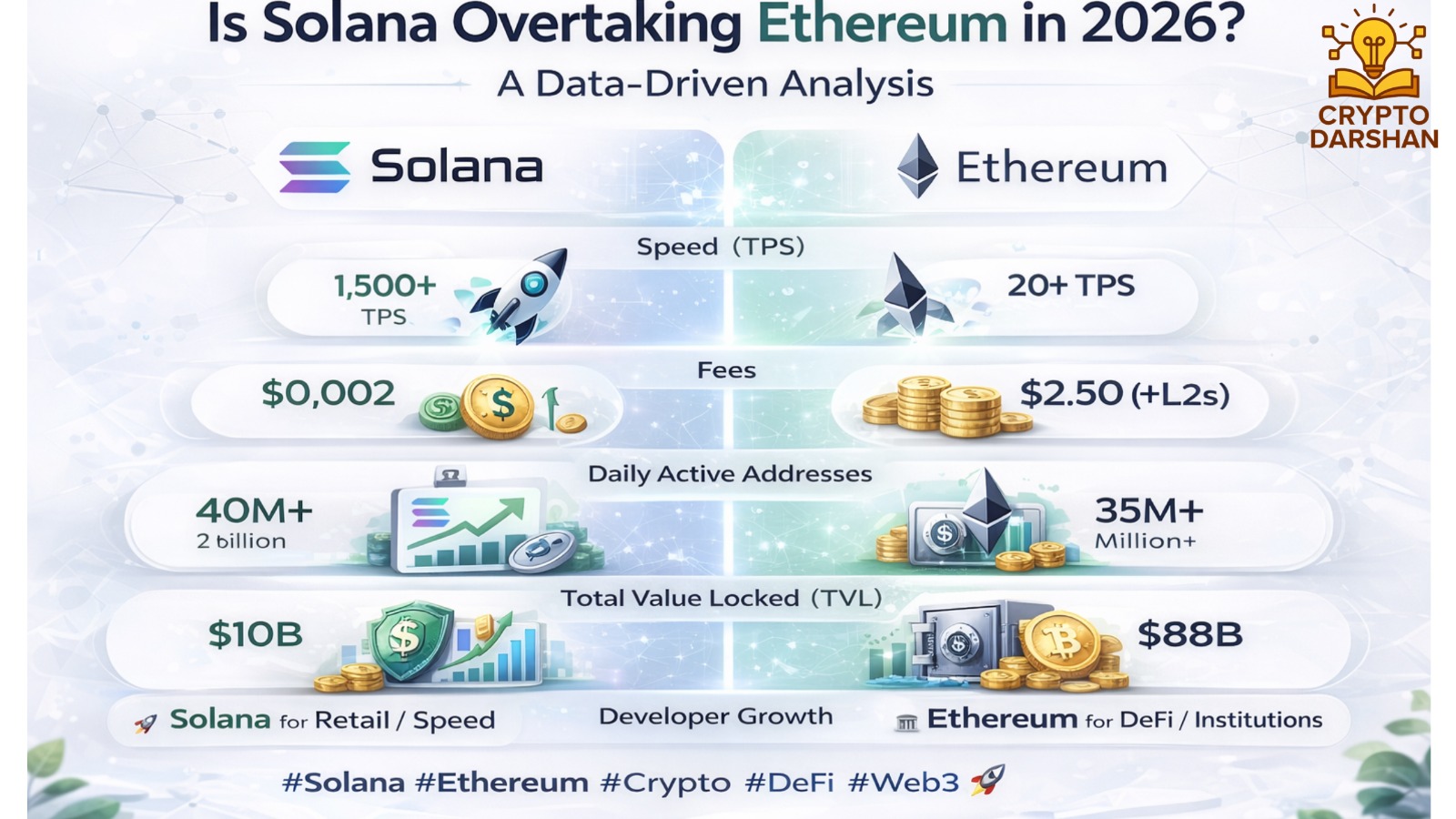
Solana overtaking Ethereum: Key Metrics
| Metric (2026) | Ethereum | Solana |
| Consensus Mechanism | Proof of Stake | Proof of History + Proof of Stake |
| Transactions Per Second (TPS) | ~30–100 (Layer 1), 10,000+ (Layer 2) | 65,000+ (Layer 1) |
| Average Transaction Fee | $0.20–$1.00 (Layer 2) | <$0.01 |
| Block Time | ~12 seconds | ~0.4 seconds |
| Active Developers | 6,000+ | 2,000+ |
| Total Value Locked (TVL) | $45–60 billion | $12–18 billion |
| Ecosystem Projects | 5,000+ | 1,500+ |
| Market Capitalization (2026 est.) | $400–500 billion | $120–180 billion |
These figures highlight the strengths and weaknesses of both networks. Ethereum leads in developer activity, ecosystem size, and security, while Solana dominates in speed, cost efficiency, and user experience.
Transaction Speed and Scalability

Ethereum’s Scalability Journey
Ethereum’s biggest challenge has always been scalability. The network can handle only a limited number of transactions per second on its base layer, leading to congestion and high fees during peak demand. To address this, Ethereum has implemented several upgrades:
- The Merge (2022): Transitioned Ethereum from PoW to PoS, reducing energy consumption by over 99%.
- Sharding (expected by 2026): Divides the network into smaller parts (shards) to process transactions in parallel.
- Layer 2 Solutions: Technologies like Optimism, Arbitrum, and zkSync scale Ethereum by processing transactions off-chain and settling them on the mainnet.
With these improvements, Ethereum’s effective throughput could reach tens of thousands of TPS, making it competitive with Solana.
Solana’s High-Speed Architecture
Solana’s architecture was built for speed from day one. Its Proof of History mechanism timestamps transactions before they are processed, allowing validators to agree on the order of transactions without waiting for network-wide consensus. This innovation enables Solana to achieve 65,000+ TPS with sub-second finality.
However, Solana’s high throughput comes with trade-offs. The network has faced outages and centralization concerns, as running a validator requires powerful hardware. Despite these issues, Solana continues to improve its reliability and scalability through upgrades like Firedancer, a new validator client designed to enhance performance and decentralization.
Network Fees and User Experience
Ethereum’s Fee Evolution
Ethereum’s gas fees have historically been a pain point for users. During bull markets, fees often spiked to tens or even hundreds of dollars per transaction. However, with the rise of Layer 2 networks and EIP-1559, fees have become more predictable and affordable.
By 2026, most Ethereum users interact with the network through Layer 2 solutions, where fees are typically below $1. This makes Ethereum more accessible while maintaining the security of its mainnet.
Much of Ethereum’s recent growth comes from scalability upgrades and rollups, which we explained in detail in Zero-Knowledge Proofs (ZK Rollups) Explained for Beginners.
Solana’s Ultra-Low Fees
Solana’s transaction fees are among the lowest in the industry, often less than $0.01. This affordability has made it a favorite for NFT minting, gaming, and microtransactions. The low fees also encourage experimentation, allowing developers to build applications without worrying about high costs.
However, low fees can also lead to spam attacks, as seen in previous network slowdowns. Solana’s team has implemented mechanisms to mitigate this, ensuring stability while maintaining affordability.
Developer Ecosystem and Innovation

Ethereum’s Developer Dominance
Ethereum remains the most developer-rich blockchain in the world. Its ecosystem includes thousands of developers, extensive documentation, and a wide range of tools like Solidity, Hardhat, and Truffle. The Ethereum Virtual Machine (EVM) has become the industry standard, powering numerous Layer 2s and sidechains.
This developer dominance ensures continuous innovation. From DeFi protocols like Uniswap and Aave to NFT platforms like OpenSea, Ethereum remains the hub of blockchain creativity.
Solana’s Rapid Developer Growth
Solana’s developer community has grown rapidly since 2021. With tools like Anchor Framework and Rust programming language, Solana offers a modern development environment. The Solana Foundation actively supports developers through grants, hackathons, and educational programs.
By 2026, Solana’s developer base has expanded significantly, with thousands of active contributors building DeFi apps, NFT marketplaces, and Web3 games. While still smaller than Ethereum’s, Solana’s community is highly engaged and innovative.
Ecosystem Growth and Adoption

Ethereum’s Expanding Ecosystem
Ethereum’s ecosystem is vast and diverse. It dominates in DeFi, NFTs, and DAOs, hosting major projects such as:
- DeFi: Uniswap, Curve, MakerDAO, Aave
- NFTs: OpenSea, Blur, Foundation
- DAOs: ENS DAO, Gitcoin, Aragon
- Layer 2s: Arbitrum, Optimism, zkSync
Ethereum’s network effects are unmatched. Developers prefer building on Ethereum because of its liquidity, user base, and interoperability. Even competing chains often integrate with Ethereum through bridges and wrapped tokens.Shifting user behavior across chains mirrors broader crypto cycle transitions, similar to what we analyzed in GameFi Is Back in 2026: What Changed Since the Last Cycle?
Solana’s Expanding Ecosystem
Solana’s ecosystem has grown explosively, especially in NFTs and gaming. Projects like Magic Eden, Tensor, and Phantom Wallet have become household names in the crypto community. Solana’s low fees and fast transactions make it ideal for high-frequency applications like gaming and social media.
In DeFi, Solana hosts platforms such as Jupiter, Marinade Finance, and Raydium, which have seen significant growth in total value locked (TVL). The network’s integration with stablecoins like USDC and USDT has further boosted its utility.
Ethereum: Security and Decentralization Strengths

Highly Decentralized Validator Network
Ethereum operates one of the largest validator networks in the blockchain industry, with hundreds of thousands of validators distributed globally. This wide distribution ensures that no single entity can control or manipulate the network, making it resistant to censorship and attacks.
Battle-Tested Infrastructure and Long Track Record
Since its launch in 2015, Ethereum has undergone multiple upgrades and survived numerous market cycles without major security breaches at the protocol level. Its long operational history and extensive audits make it one of the most trusted and secure blockchains in existence.
Robust Proof of Stake (PoS) Mechanism
After transitioning from Proof of Work to Proof of Stake, Ethereum significantly improved its security efficiency. Validators must stake ETH to participate, and any malicious behavior results in penalties or loss of stake. This economic incentive system ensures honest participation and network integrity.
Solana: Security and Decentralization Challenges and Progress

Hybrid Consensus with Security Enhancements
Solana’s combination of Proof of History (PoH) and Proof of Stake (PoS) provides both speed and security. PoH ensures accurate transaction ordering, while PoS secures the network through validator staking. Continuous development and audits are strengthening Solana’s defense against potential vulnerabilities.
High-Performance but Hardware-Intensive Validators
Solana’s architecture requires powerful hardware to maintain its high throughput. While this enables fast transaction speeds, it also limits who can run validators, leading to concerns about centralization. The network is working to reduce these barriers through optimization and new validator clients like Firedancer.
Past Network Outages and Reliability Improvements
Solana has experienced several outages caused by spam attacks and network overloads. These incidents raised questions about its resilience. However, the Solana team has implemented upgrades to improve stability, and by 2026, the network’s uptime and reliability have improved significantly.
DeFi and NFT Market Share

Ethereum’s DeFi Dominance
Ethereum remains the DeFi leader, with over 60% of total value locked across all blockchains. Its mature ecosystem, deep liquidity, and integration with Layer 2s make it the preferred platform for institutional DeFi.
Ethereum also leads in NFT trading volume, hosting the largest marketplaces and most valuable collections. Despite competition, Ethereum’s brand and liquidity continue to attract creators and investors.
Solana’s DeFi and NFT Growth
Solana has carved out a strong position in both DeFi and NFTs. Its low fees and fast transactions make it ideal for retail users and developers seeking scalability. Solana’s NFT ecosystem, led by Magic Eden, has become a major competitor to Ethereum’s OpenSea.
In DeFi, Solana’s TVL has grown steadily, supported by innovative protocols and cross-chain integrations. While still smaller than Ethereum’s, Solana’s DeFi ecosystem is expanding rapidly, especially in 2025–2026.
Institutional and Enterprise Adoption
Ethereum’s Institutional Edge
Ethereum’s long track record and regulatory clarity make it the preferred choice for institutions. Many enterprises use Ethereum or its Layer 2s for tokenization, supply chain management, and decentralized identity solutions. The Enterprise Ethereum Alliance (EEA) continues to drive corporate adoption.
Ethereum’s compatibility with stablecoins, CBDCs, and tokenized assets positions it as a key player in the future of digital finance.
Solana’s Emerging Institutional Interest
Solana is gaining attention from institutions due to its performance and cost efficiency. Partnerships with payment providers, fintech companies, and Web3 startups have expanded its reach. Solana Pay, for example, enables instant, low-cost crypto payments, appealing to merchants and consumers alike.
By 2026, Solana’s growing reliability and developer ecosystem have made it a viable option for enterprise applications, though Ethereum still leads in institutional trust.
Community and Brand Power

Ethereum’s Community Strength
Ethereum’s community is one of its greatest assets. It includes developers, investors, researchers, and users who actively contribute to its growth. The Ethereum Foundation and independent teams worldwide collaborate on upgrades and research.
This decentralized, open-source culture fosters innovation and resilience. Ethereum’s brand is synonymous with decentralization, security, and innovation.
Solana’s Vibrant Community
Solana’s community is younger and more experimental. It thrives on social media, hackathons, and NFT culture. The Solana Foundation and Solana Labs play active roles in supporting developers and promoting adoption.
Solana’s community-driven events, such as Breakpoint, showcase its energy and creativity. This grassroots enthusiasm has helped Solana build a strong identity in the crypto space.
Environmental Impact

Ethereum’s Green Transition
After The Merge, Ethereum reduced its energy consumption by over 99.9%, making it one of the most eco-friendly blockchains. Its PoS model eliminates the need for energy-intensive mining, aligning with global sustainability goals.
Solana’s Energy Efficiency
Solana is also energy-efficient, thanks to its PoS-based consensus. The network’s carbon footprint is minimal, and it has partnered with organizations to offset emissions. Both Ethereum and Solana are now considered environmentally sustainable, removing a major barrier to mainstream adoption.
Market Performance and Token Economics

Ethereum (ETH)
Ethereum’s token, ETH, serves multiple purposes gas fees, staking, and collateral in DeFi. With the introduction of EIP-1559, a portion of transaction fees is burned, reducing supply over time. This deflationary mechanism supports long-term value growth.
By 2026, ETH will remain one of the most valuable digital assets, supported by strong demand from DeFi, NFTs, and institutional investors.
Solana (SOL)
Solana’s native token, SOL, is used for transaction fees, staking, and governance. Its low fees and high throughput make it ideal for everyday transactions. SOL’s value is driven by network usage, staking rewards, and ecosystem growth.
Despite volatility, SOL has shown strong performance, often ranking among the top five cryptocurrencies by market capitalization.
Challenges Ahead
Ethereum’s Challenges
- Scalability: Despite improvements, Ethereum still relies heavily on Layer 2s for scaling.
- Competition: New blockchains and rollups continue to challenge its dominance.
- Complexity: Layer 2 fragmentation can confuse users and developers.
Solana’s Challenges
- Network Stability: Past outages have raised reliability concerns.
- Centralization: High hardware requirements limit validator participation.
- Ecosystem Maturity: Still smaller and less liquid than Ethereum’s.
Both networks must continue innovating to maintain growth and user trust.
Data-Driven Outlook for 2026
Based on current trends and projections:
- Ethereum will likely maintain its lead in total value locked, developer activity, and institutional adoption.
- Solana will continue to grow rapidly, capturing market share in NFTs, gaming, and consumer applications.
- Layer 2 solutions will make Ethereum more scalable, while Firedancer will make Solana more reliable.
- Both ecosystems will coexist, serving different user needs, Ethereum for security and liquidity, Solana for speed and affordability.
Frequently Asked Questions (FAQ)

1. What does “overtaking” mean in the context of Solana overtaking Ethereum?
“Overtaking” refers to Solana surpassing Ethereum in key metrics such as daily active users, transaction volume, total value locked (TVL), developer activity, or market capitalization not just price.
2. Is Solana currently ahead of Ethereum in total value locked (TVL)?
At times, Solana has seen rapid TVL growth due to its low fees and high throughput, but Ethereum has historically maintained a larger overall TVL owing to its deep liquidity and broader DeFi ecosystem.
3. Does Solana have more daily transactions than Ethereum?
Yes, Solana often processes more daily transactions than Ethereum, thanks to its high throughput design, though higher transaction counts don’t automatically translate to stronger network usage or economic activity.
4. Is Solana gaining more users than Ethereum?
Solana has attracted significant new users, especially in gaming, NFTs, and social apps. However, Ethereum’s user base remains larger and more diverse, especially among DeFi and institutional participants.
5. Can Solana’s technology outperform Ethereum’s scalability?
Technically, Solana’s architecture allows higher theoretical throughput and lower fees. Meanwhile, Ethereum’s Layer 2 ecosystem (rollups) has closed much of the performance gap with strong security and decentralization.
6. What role do transaction fees play in comparing Solana and Ethereum?
Lower fees on Solana make it appealing for micro-transactions, gaming, and NFTs. Ethereum’s base fees are higher but are mitigated by Layer 2 solutions that significantly reduce costs for users.
7. Does Solana have more developers building on it than Ethereum?
Ethereum continues to lead in developer activity and tooling maturity. Solana’s developer ecosystem is growing, but it’s still smaller in absolute terms.
8. How do NFTs on Solana compare with Ethereum?
Solana has become a popular chain for NFTs due to low minting costs and fast transactions. Ethereum NFTs retain higher liquidity and broader marketplace support.
Conclusion
The question of whether Solana is overtaking Ethereum in 2026 doesn’t have a simple yes or no answer. Instead, it reflects a diversifying blockchain landscape where multiple networks thrive based on their strengths.
Ethereum remains the foundation of decentralized finance, with unmatched security, developer support, and institutional trust. Solana, on the other hand, is emerging as the fast, user-friendly alternative, driving innovation in NFTs, gaming, and real-time applications.
Rather than one overtaking the other, the future of blockchain likely involves coexistence and interoperability. Ethereum and Solana will continue to push each other forward, shaping a more scalable, efficient, and inclusive decentralized world.