
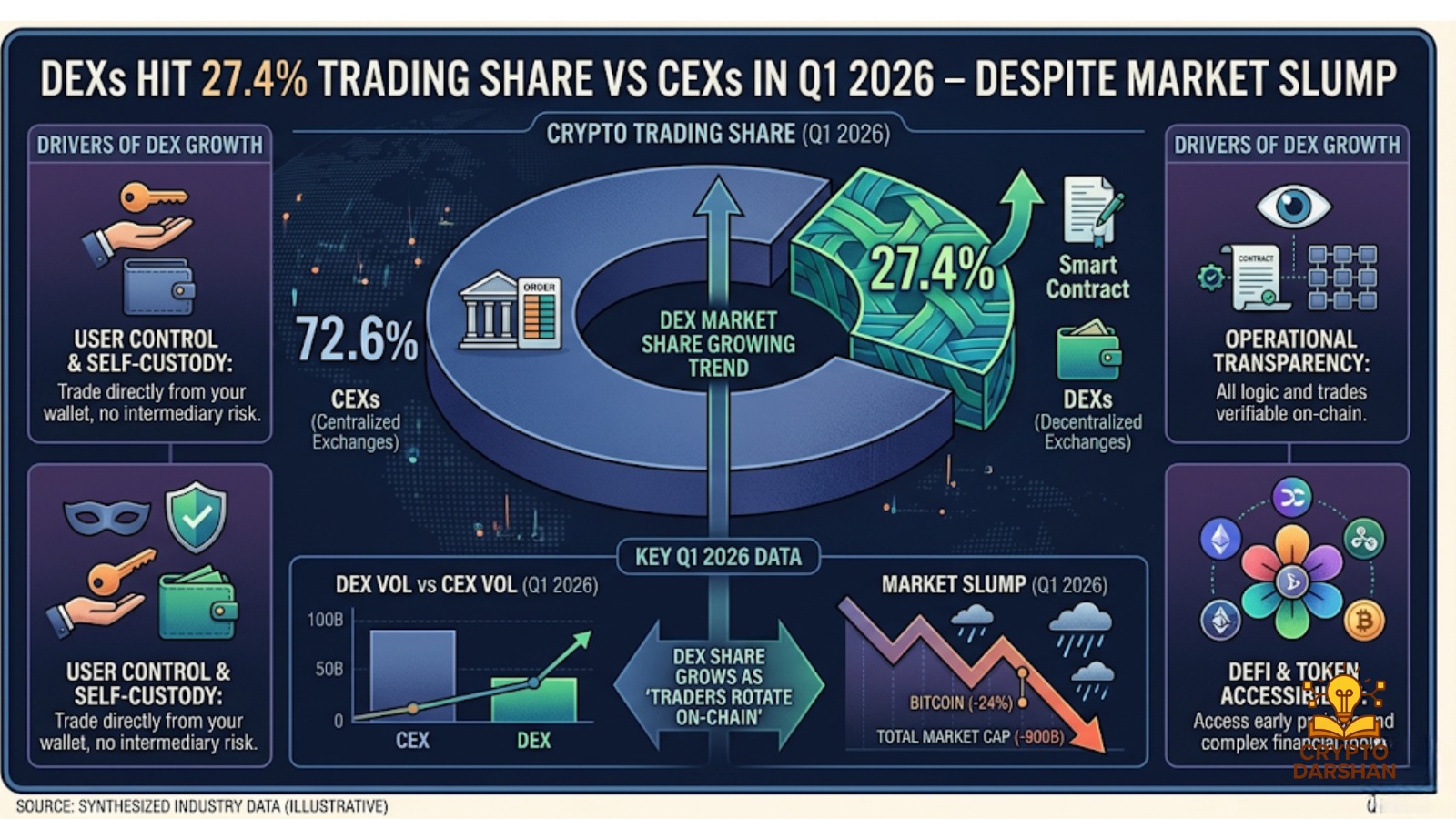
Decentralized exchanges, or DEXs, made big gains against big centralized players in early 2026. They hit a 27.4% share of spot trading, up from before, even when overall crypto volume dropped.
What the Numbers Show

In Q1 2026, total spot trading volume fell 26% to $832 billion across all exchanges. DEXs took a larger slice of that pie, jumping 270 basis points to 27.4% of the market. This means folks traded about $228 billion on DEXs alone, pulling business from centralized exchanges (CEXs) like Binance or Coinbase.
CEXs still rule with over 72%, but their grip is slipping. Spot volume on these platforms dropped too, as traders sought out Decentralized exchanges perks like no-KYC swaps and self-custody. ARK Invest’s report flags this shift as a sign of maturing crypto users who want control over their funds.
Why Volumes Dropped Overall

Crypto markets cooled off after 2025’s wild runs. Bearish vibes, regulatory news, and less hype cut daily trades. Decentralized exchanges’ volumes ended a five-quarter growth streak, down 26% quarter-over-quarter.
Yet DEXs grew their share because CEX volumes shrank faster. Think of it like this: if the whole cake shrinks but your piece stays the same size, you look bigger. Solana-based DEXs led the pack, grabbing 30.6% of all Decentralized exchanges spot volume – ahead of Ethereum at 23.7% and BNB Chain at 24.5%.
Solana’s Big Win in DEX Land

Solana stole the show among DEX networks. Platforms like Jupiter and Raydium on Solana handled over 30% of DEX trades in Q1, despite a 26.5% volume dip network-wide. Fast, cheap transactions draw users tired of Ethereum gas fees.
Ethereum DEXs like Uniswap still matter but have lost ground. BSC held steady, but Solana’s speed won traders in memecoins and quick swaps. This chain battle shows that Decentralized exchanges aren’t one-size-fits-all – pick your network wisely.
DEXs vs CEXs: The Real Fight

CEXs shine in deep liquidity and easy fiat ramps. They processed trillions in 2025, holding 87%+ market share back then. But hacks, outages, and rules like MiCA in Europe push users away.
Decentralized exchanges fix that with smart contracts – no middleman, your keys, your coins. Tools like 1inch aggregators now match CEX prices on many pairs. Perpetual futures on DEXs exploded too, hitting 11.7% of CEX perps by late 2025.
What’s Driving the DEX Boom

Users want freedom. After FTX’s crash, “not your keys, not your crypto” rings true. DEX volume grew 37% yearly into 2025, with weekly highs near $86 billion early 2026.
DeFi innovations help: intent-based trading, better UI, and Layer-2s cut friction. Solana’s rise ties to this – cheap trades mean more volume per user. Regs favor Decentralized exchanges too; CEXs face audits while DEXs skirt borders.
Risks remain: smart contract bugs and low liquidity on niche pairs. But aggregators bridge gaps, making DEX viable for most.
Future Outlook for Traders

Right now, the data suggests DEXs (decentralized exchanges) still have room to grow. If trading volumes pick up again, they could capture over 30% of the total market by the end of the year. Keep an eye on ecosystems like Solana and newer Layer 2 networks like Base, as they’re likely to lead this growth.
For everyday traders, it’s not about choosing one over the other. A balanced approach works best. Use centralized exchanges (CEXs) when you need easy fiat access or leverage trading, and use Decentralized exchanges when you want more privacy or to earn through DeFi opportunities. Platforms like Dune Analytics can help you track market trends in real time so you can make smarter decisions.
Overall, this shift is a positive sign. Relying less on big exchanges means the crypto space can become safer and more fair. As Decentralized exchanges technology keeps improving, the dominance of centralized exchanges may continue to shrink.