Day Trading Crypto is one of the most exciting ways to make money in the digital asset market. It involves buying and selling cryptocurrencies on the same day to profit from short-term price movements. Unlike long-term investing, where traders hold assets for months or years, day traders focus on quick trades that can yield fast returns. With the right strategy, even a small amount like $100 can be enough to start Day Trading Crypto.
The crypto market operates 24/7, offering endless opportunities for traders around the world. This constant activity makes it ideal for those who want to take advantage of price volatility. However, it also means that Day Trading Crypto requires discipline, knowledge, and a clear plan to avoid losses.
This guide explains everything beginners need to know about Day Trading Crypto, including how to start with just $100, the best strategies, tools, and risk management techniques to succeed.
What Is Day Trading Crypto?

Crypto day trading involves opening and closing digital currency trades within the same day, otherwise known as ‘intraday’ trading. Day Trading Crypto means buying and selling cryptocurrencies within a single day to profit from price fluctuations. Traders use technical analysis, charts, and indicators to identify entry and exit points. The goal is to make small profits on multiple trades that add up over time.
Unlike traditional stock markets, the crypto market never closes. This allows traders to operate at any time, but it also increases the risk of missing opportunities or facing sudden price changes. Successful Day Trading Crypto requires constant attention and quick decision-making.
Key Features of Day Trading Crypto
- Short-term focus: Trades are opened and closed within the same day.
- High volatility: Crypto prices can change rapidly, creating profit opportunities.
- Leverage options: Some exchanges allow traders to use leverage to increase potential gains.
- 24/7 market: Crypto trading never stops, offering flexibility for traders worldwide.
- Technical analysis: Charts and indicators are essential tools for decision-making.
Why Start Day Trading Crypto With $100?

Starting Day Trading Crypto with $100 is a smart way to learn without risking too much capital. Many beginners think they need thousands of dollars to start trading, but that’s not true. With proper risk management and the right exchange, $100 is enough to begin. Before trading, learn how to build a balanced crypto portfolio in 2026.
Benefits of Starting Small
- Low Risk Exposure: Losing $100 is manageable while learning.
- Hands-On Experience: Real trading experience teaches more than theory.
- Scalable Strategy: Once profitable, the same strategy can be applied to larger amounts.
- Emotional Control: Smaller amounts reduce stress and help build discipline.
How to Grow $100 in Day Trading Crypto
- Focus on small, consistent profits.
- Reinvest earnings to compound growth.
- Avoid overtrading or chasing losses.
- Use stop-loss orders to protect capital.
Understanding the Crypto Market

Before starting Day Trading Crypto, it’s essential to understand how the market works. Cryptocurrencies are digital assets that operate on blockchain technology. Their prices are influenced by supply, demand, news, and investor sentiment. You can also learn about EigenLayer restaking and double earning opportunities.
Major Cryptocurrencies for Day Trading
- Bitcoin (BTC): The most traded and stable crypto asset.
- Ethereum (ETH): Known for its smart contract platform and high liquidity.
- Binance Coin (BNB): Popular for trading fee discounts on Binance.
- Solana (SOL): Fast transactions and growing ecosystem.
- Ripple (XRP): Used for cross-border payments.
These coins have high trading volumes, making them ideal for Day Trading Crypto. High liquidity ensures that trades can be executed quickly without large price slippage.
Setting Up for Day Trading Crypto

Step 1: Choose a Reliable Exchange
Select a crypto exchange that supports low fees, fast execution, and strong security. Popular options include Binance, Coinbase, Kraken, and Bybit. Ensure the platform allows small trades and offers advanced charting tools.
Step 2: Create and Verify an Account
Sign up with your email, verify your identity, and enable two-factor authentication for security. Deposit your $100 using a bank transfer, credit card, or crypto wallet.
Step 3: Choose a Trading Pair
Pick a trading pair like BTC/USDT or ETH/USDT. Stablecoins like USDT make it easier to measure profits and losses in dollar terms.
Step 4: Learn the Trading Interface
Familiarize yourself with the order book, charts, and trading options. Practice using limit orders, market orders, and stop-loss orders before trading real money.
Essential Tools for Day Trading Crypto

Day Trading Crypto requires more than just intuition; it demands the right set of tools to analyze markets, execute trades efficiently, and manage risks. These tools help traders make informed decisions, track performance, and stay updated with market trends. Whether you’re starting with $100 or managing a larger portfolio, using the right tools can significantly improve your trading results.
Below is a detailed explanation of the most essential tools for Day Trading Crypto:
1. Crypto Exchanges
A crypto exchange is the platform where you buy and sell cryptocurrencies. It’s the foundation of all trading activity. The best exchanges for Day Trading Crypto offer low fees, high liquidity, fast order execution, and advanced charting features.
Key features to look for:
- Low trading fees (important for frequent trades)
- High liquidity to avoid slippage.
- Advanced order types (limit, stop-loss, take-profit)
- Strong security measures (2FA, cold storage)
- User-friendly interface
Popular exchanges: Binance, Kraken, Coinbase, Bybit, and KuCoin.
2. Charting and Technical Analysis Tools
Charts are the backbone of Day Trading Crypto. They help traders visualize price movements, identify trends, and spot entry or exit points.
Best charting tool: TradingView, which offers real-time data, customizable charts, and hundreds of technical indicators.
Common indicators used:
- Moving Averages (MA): Show trend direction.
- Relative Strength Index (RSI): Measures overbought or oversold conditions.
- MACD: Identifies momentum changes.
- Bollinger Bands: Indicate volatility and potential breakouts.
These tools help traders make data-driven decisions instead of emotional ones.
3. Crypto News and Market Updates
The crypto market reacts instantly to news, exchange hacks, government regulations, or major partnerships, which can cause sudden price swings. Staying informed is crucial for Day Trading Crypto.
Reliable news sources:
- CoinDesk
- CoinTelegraph
- Decrypt
- The Block
Tip: Use news aggregators or alerts to get updates in real time. Quick reactions to news can mean the difference between profit and loss.
4. Portfolio and Trade Tracking Tools
Tracking your trades helps you understand what’s working and what’s not. A portfolio tracker records all your trades, profits, and losses, giving you a clear picture of your performance.
Popular tools:
- CoinStats
- CoinMarketCap Portfolio
- Delta
- CoinTracking
These tools also help with tax reporting and performance analysis, which are essential for serious traders.
5. Risk Management Tools
Risk management is the key to surviving in Day Trading Crypto. Tools that calculate position size, stop-loss levels, and risk-to-reward ratios help traders protect their capital.
Useful tools:
- Position Size Calculators: Determine how much to invest per trade.
- Stop-Loss and Take-Profit Orders: Automatically close trades to limit losses or lock in profits.
- Volatility Indicators: Measure how much a coin’s price fluctuates to adjust trade size accordingly.
These tools ensure that no single trade can wipe out your account.
Key Strategies for Day Trading Crypto

1. Scalping
Scalping involves making dozens of small trades throughout the day to capture tiny price movements. It requires quick execution and low trading fees. Scalpers often use 1-minute or 5-minute charts.
2. Momentum Trading
Momentum traders buy assets showing strong upward trends and sell when momentum slows. This strategy relies on indicators like RSI and MACD to identify overbought or oversold conditions.
3. Breakout Trading
Breakout traders look for price levels where the market breaks through resistance or support zones. Once a breakout occurs, they enter trades expecting strong price movement in that direction.
4. Range Trading
Range traders buy at support and sell at resistance when prices move within a defined range. This strategy works best in sideways markets.
5. News-Based Trading
Crypto prices often react to news events such as exchange listings, partnerships, or regulatory updates. Traders monitor news feeds to capitalize on sudden price movements.
Technical Analysis for Day Trading Crypto

Technical analysis is the backbone of Day Trading Crypto. It’s the process of studying price charts, patterns, and indicators to predict future price movements. Instead of focusing on a coin’s technology or long-term potential, technical analysis looks purely at market behavior, how prices move, how traders react, and where opportunities lie.
1. What Is Technical Analysis in Crypto Trading?
Technical analysis (TA) is based on the idea that all market information, including news, sentiment, and fundamentals, is already reflected in the price. Therefore, by analyzing price charts and trading volume, traders can forecast future movements.
In Day Trading Crypto, TA helps traders:
- Identify short-term trends.
- Spot potential reversals.
- Determine entry and exit points.
- Manage risk effectively.
2. Core Principles of Technical Analysis
There are three main principles behind technical analysis:
- Market action discounts everything:
Every factor that can influence price — news, demand, supply, and trader psychology — is already included in the current price. - Prices move in trends:
Markets don’t move randomly. They move in trends — upward (bullish), downward (bearish), or sideways (consolidation). Recognizing these trends helps traders align their trades with the market direction. - History tends to repeat itself:
Human behavior in markets is consistent. Patterns that worked in the past often repeat, allowing traders to use historical data to predict future moves.
3. Types of Charts Used in Day Trading Crypto
Charts are the foundation of technical analysis. They visually represent price movements over time.
Common chart types:
- Line Chart: Simplest form, showing closing prices over time.
- Bar Chart: Displays open, high, low, and close prices for each period.
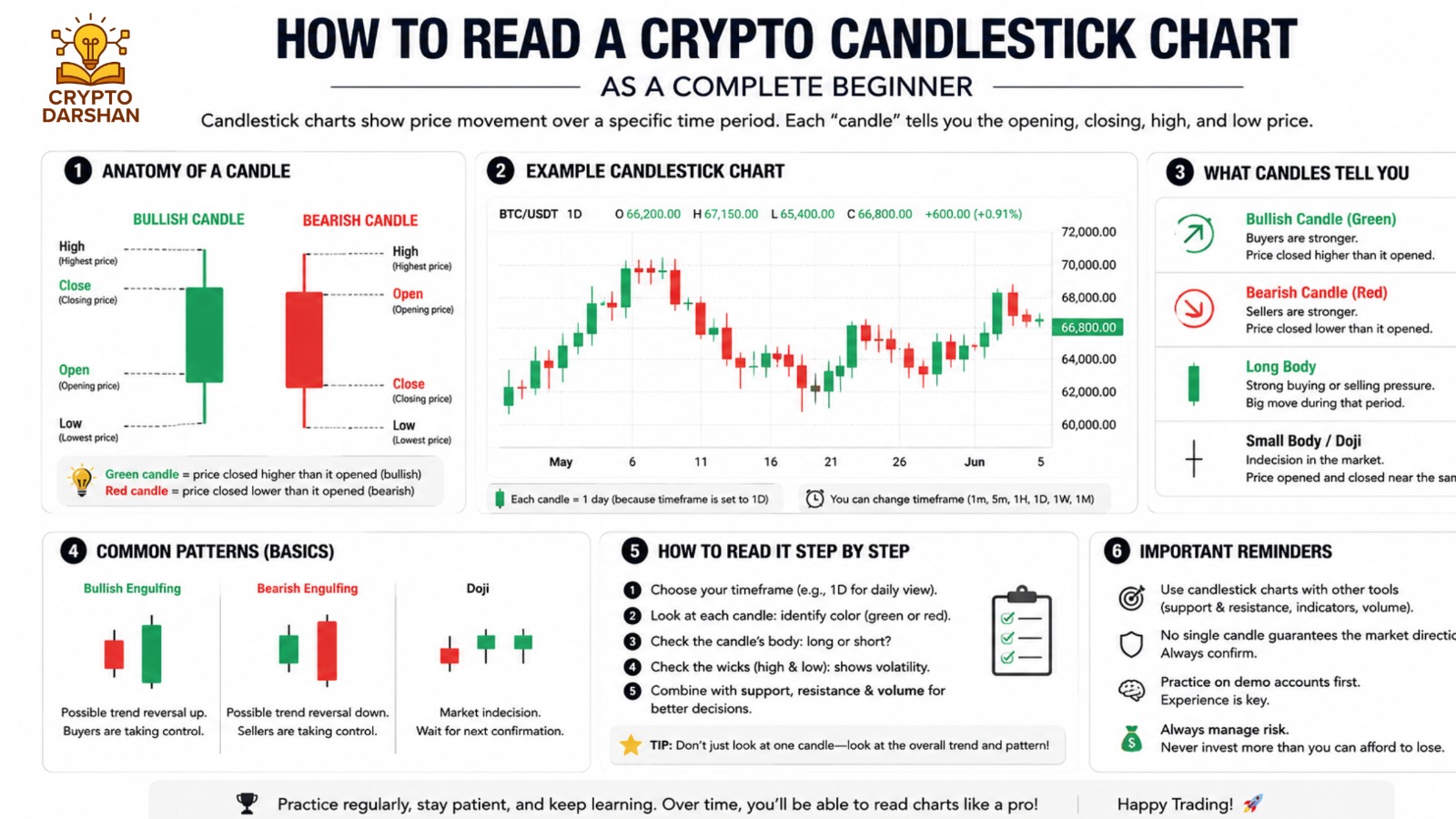
- Candlestick Chart: The most popular among crypto traders. Each candle shows the open, close, high, and low prices for a specific time frame.
Candlestick charts are preferred because they clearly show market sentiment — whether buyers (bulls) or sellers (bears) are in control.
4. Understanding Trends in Day Trading Crypto
A trend is the general direction in which the market is moving.
- Uptrend: Higher highs and higher lows — signals buying opportunities.
- Downtrend: Lower highs and lower lows — signals selling or shorting opportunities.
- Sideways Trend: Price moves within a range — ideal for range trading strategies.
Trendlines are drawn on charts to connect highs or lows, helping traders visualize the direction of the market.
5. Support and Resistance Levels
Support and resistance are key concepts in technical analysis.
- Support: A price level where demand is strong enough to prevent further decline. Traders often buy near support.
- Resistance: A price level where selling pressure prevents further rise. Traders often sell near resistance.
Risk Management in Day Trading Crypto

Risk management is crucial for long-term success. Even the best traders face losses, but proper risk control ensures survival in the market.
Key Risk Management Rules
- Never risk more than 1–2% of capital per trade.
- Always use stop-loss orders.
- Avoid emotional trading after losses.
- Diversify across multiple coins.
- Keep a trading journal to track performance.
Example of Risk Calculation
If trading with $100, risking 2% means risking only $2 per trade. This approach protects capital and allows multiple trades without significant losses.
Psychology of Day Trading Crypto

Emotions play a major role in trading success. Fear, greed, and impatience can lead to poor decisions. Developing the right mindset is as important as mastering technical skills.
Tips for a Strong Trading Mindset
- Stick to a trading plan.
- Accept losses as part of the process.
- Avoid revenge trading.
- Take breaks to prevent burnout.
- Focus on consistency, not perfection.
A disciplined mindset helps maintain control and improves long-term profitability in Day Trading Crypto.
Common Mistakes to Avoid in Day Trading Crypto
- Overtrading: Making too many trades without clear signals.
- Ignoring Stop-Losses: Leads to large, avoidable losses.
- Trading Without a Plan: Results in emotional decisions.
- Using Too Much Leverage: Increases risk of liquidation.
- Following Hype: Buying coins based on social media trends.
Avoiding these mistakes can significantly improve success rates.
How to Analyze the Market for Day Trading Crypto

Fundamental Analysis
While day traders focus on short-term moves, understanding fundamentals helps identify strong assets. Factors include project updates, partnerships, and overall market sentiment.
Sentiment Analysis
Monitoring social media, news, and community discussions can reveal market mood. Positive sentiment often leads to price increases, while negative sentiment can trigger sell-offs.
Technical Analysis Integration
Combining technical and sentiment analysis provides a balanced view of the market, improving trade accuracy.
Building a Day Trading Crypto Plan

A trading plan defines goals, strategies, and risk limits. It acts as a roadmap for consistent decision-making.
Components of a Trading Plan
- Trading Goals: Define profit targets and acceptable losses.
- Strategy: Choose one or two proven methods.
- Risk Rules: Set maximum daily loss limits.
- Review Process: Analyze trades weekly to improve performance.
A solid plan helps maintain discipline and reduces emotional trading.
Using Leverage in Day Trading Crypto

Leverage allows traders to control larger positions with smaller capital. For example, 10x leverage means controlling $1,000 with $100. While leverage can amplify profits, it also increases risk.
Safe Leverage Practices
- Start with low leverage (2x–3x).
- Always use stop-loss orders.
- Avoid holding leveraged positions overnight.
- Understand liquidation risks before trading.
Leverage should be used carefully, especially when starting Day Trading Crypto with $100.
Tax Considerations for Day Trading Crypto
Profits from Day Trading Crypto are often subject to taxation under local laws. Traders should keep detailed records of all transactions, including dates, amounts, and profits.
Tips for Managing Taxes
- Use crypto tax software to track trades.
- Separate trading and investment accounts.
- Consult a tax professional for accurate reporting.
Proper tax management ensures compliance and avoids legal issues.
Best Times to Trade Crypto
Crypto markets are active 24/7, but certain times offer higher volatility and liquidity.
Peak Trading Hours
- During U.S. and European market overlap: High volume and volatility.
- When major news is released: Sudden price movements.
- Early week (Monday–Wednesday): Strong market activity.
Timing trades during these periods can increase profit potential.
Practicing Before Trading Real Money

Before risking real funds, beginners should practice Day Trading Crypto using demo accounts. Many exchanges offer paper trading features that simulate real market conditions.
Benefits of Demo Trading
- Learn platform features safely.
- Test strategies without risk.
- Build confidence before trading live.
Once consistent results are achieved in demo mode, transition to real trading with small amounts.
Tracking and Improving Performance

Keeping a trading journal is essential for growth. Record every trade, including entry, exit, profit, and reasoning. Reviewing past trades helps identify strengths and weaknesses.
What to Track
- Date and time of trade
- Entry and exit prices
- Profit or loss
- Strategy used
- Emotional state during trade
Regular analysis leads to continuous improvement in Day Trading Crypto.
Advanced Tips for Day Trading Crypto
- Use multiple timeframes: Confirm signals across charts.
- Follow market leaders: Watch Bitcoin’s movement before trading altcoins.
- Stay updated: News can instantly change market direction.
- Automate trades: Use bots for consistent execution.
- Join trading communities: Learn from experienced traders.
These advanced techniques can enhance performance and efficiency.
Long-Term Success in Day Trading Crypto

Success in Day Trading Crypto doesn’t happen overnight. It requires patience, discipline, and continuous learning. Traders who focus on risk management, consistent strategies, and emotional control can achieve steady growth over time.
Key Principles for Long-Term Success
- Focus on process, not profits.
- Keep learning and adapting.
- Protect capital above all else.
- Review and refine strategies regularly.
With dedication and smart planning, even a $100 starting balance can grow into a significant trading portfolio.
Frequently Asked Questions (FAQ)
1. Can you really start crypto day trading with just $100?
Yes, many exchanges allow you to start with as little as $100. While profits will be smaller, it’s a great way to learn strategies and manage risk without large losses.
2. Is crypto day trading profitable for beginners?
It can be, but most beginners lose money initially due to lack of strategy and emotional trading. Consistent profits come with practice, discipline, and proper risk management.
3. What is the best strategy for beginner crypto day traders?
Simple strategies work best, such as:
- Scalping (small quick trades)
- Trend following
- Support and resistance trading
4. How much can I realistically make with $100?
A realistic goal is 1–3% daily gains, meaning $1–$3 per day. Over time, compounding can grow your capital significantly.
5. What are the best indicators for crypto day trading?
Popular indicators include:
- RSI (Relative Strength Index)
- MACD (Moving Average Convergence Divergence)
- Moving Averages
- Volume analysis
6.Which crypto exchange is best for beginners?
Beginner-friendly exchanges usually offer:
- Easy UI
- Low fees
- Good liquidity
Examples include Binance, Coinbase, and Bybit.
Conclusion
Day Trading Crypto offers endless opportunities for those willing to learn and practice. Starting with just $100 is possible with the right mindset, strategy, and risk management. The key is to focus on small, consistent gains, protect capital, and continuously improve trading skills.
By mastering technical analysis, understanding market psychology, and following a disciplined plan, beginners can turn Day Trading Crypto into a profitable venture. The journey may be challenging, but with persistence and smart decision-making, success is within reach.