
The rapid expansion of digital assets has transformed how institutions and individuals manage their wealth. As cryptocurrencies become mainstream, the need for secure storage and management has never been more critical. This is where Crypto Custody plays a central role. It defines how digital assets are stored, accessed, and protected from theft, loss, or unauthorized use. The debate between institutional solutions like Fireblocks and self-custody methods continues to shape the future of digital asset management. Understanding both approaches is essential for investors, businesses, and financial institutions seeking to balance security, control, and convenience.
This comprehensive guide explores Crypto Custody in depth, comparing institutional-grade solutions such as Fireblocks with self-custody options. It examines their security models, operational frameworks, regulatory implications, and suitability for different types of users. The goal is to provide a clear understanding of how each approach works and which might be best suited for specific needs in the evolving digital asset ecosystem.
Understanding Crypto Custody

Definition and Importance
Crypto custody is the storage and management of private keys that prove ownership of digital assets (e.g., crypto) and enable access to them. Unlike traditional finance, where banks or brokers hold assets on behalf of clients, digital assets rely on cryptographic keys. Losing these keys means losing access to the funds permanently. Therefore, Crypto Custody solutions are designed to protect these keys from theft, hacking, or accidental loss.
The importance of Crypto Custody extends beyond security, as effective Crypto Custody also involves compliance with regulations, operational efficiency, and scalability for institutions managing large portfolios. It also involves compliance with regulations, operational efficiency, and scalability for institutions managing large portfolios. As the digital asset market matures, custody solutions have evolved from simple hardware wallets to complex institutional-grade infrastructures capable of handling billions in assets.
Types of Crypto Custody
There are two main categories of Crypto Custody:
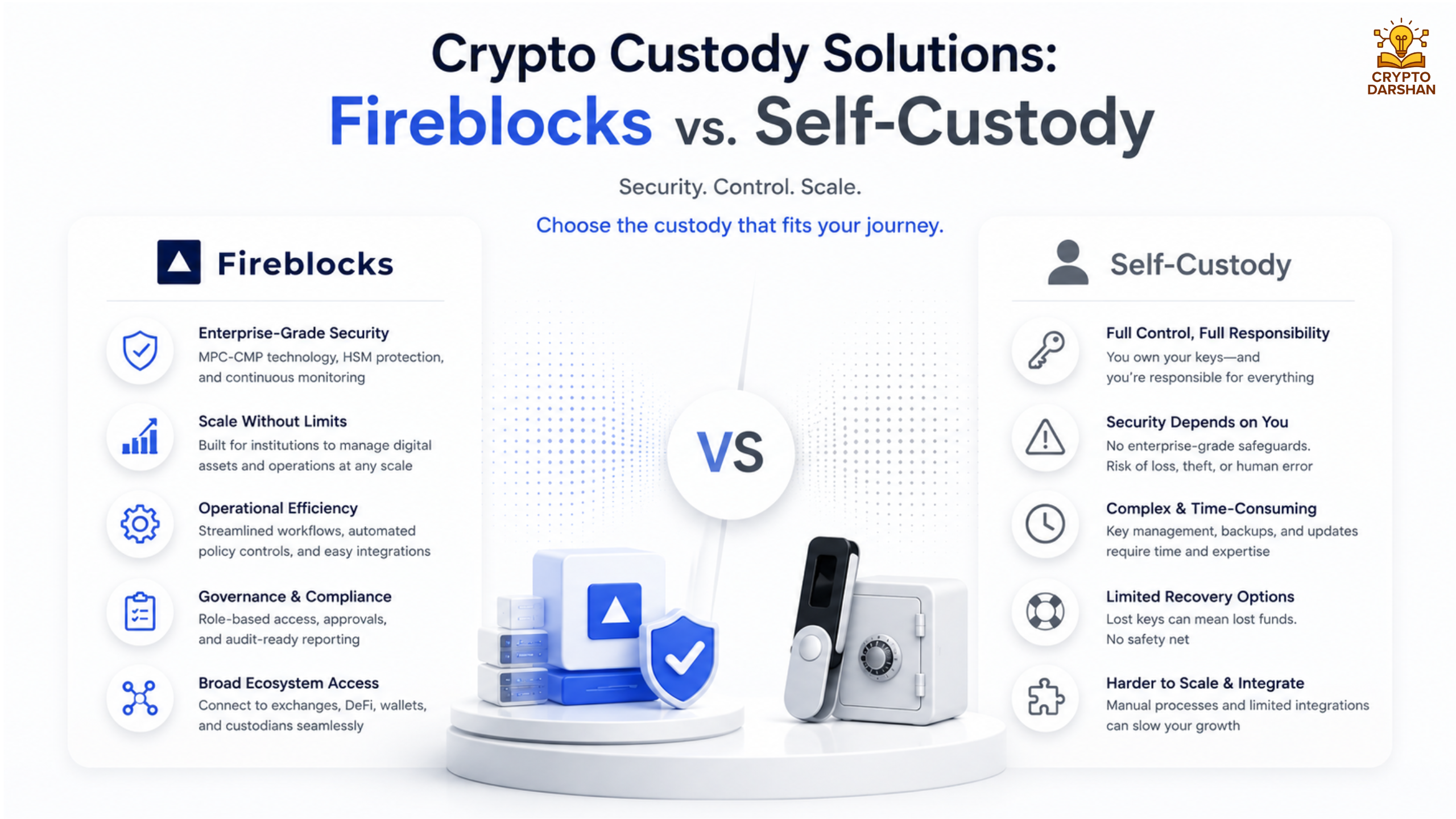
- Institutional Custody – Managed by third-party providers like Fireblocks, Coinbase Custody, or BitGo. These services offer enterprise-level security, insurance coverage, and regulatory compliance.
- Self-Custody – Managed directly by the asset owner using hardware wallets, software wallets, or multi-signature setups. This approach gives full control but also full responsibility for security.
Each model has distinct advantages and trade-offs, which will be explored in detail throughout this article.
Institutional Crypto Custody: The Fireblocks Model

Overview of Fireblocks
Fireblocks is a leading institutional Crypto Custody platform designed for enterprises, financial institutions, and asset managers. It provides a secure infrastructure for storing, transferring, and managing digital assets. Fireblocks uses advanced cryptographic techniques and multi-party computation (MPC) to eliminate single points of failure.
The platform supports a wide range of digital assets and integrates with exchanges, liquidity providers, and decentralized finance (DeFi) protocols. Understanding the technology and security infrastructure behind digital assets is essential before investing. Similar to analyzing project documentation through a Crypto Whitepaper 2026: How to Read Project Docs Like a Pro approach, institutions must evaluate custody architecture, transparency, and risk management frameworks. Its goal is to simplify digital asset operations while maintaining the highest security standards.
Security Architecture
Fireblocks’ security model is built around three core components:
- Multi-Party Computation (MPC): Instead of storing private keys in one location, MPC divides them into multiple encrypted shares distributed across different servers. No single entity ever has access to the complete key, reducing the risk of theft or compromise.
- Hardware Isolation: Fireblocks uses secure hardware enclaves to protect key fragments during computation. This ensures that even if one device is compromised, the attacker cannot reconstruct the full key.
- Policy Engine and Governance: Institutions can define custom approval workflows, transaction limits, and access controls. This governance layer ensures compliance and prevents unauthorized transactions.
These features make Fireblocks one of the most trusted names in Crypto Custody for institutions.
Operational Efficiency
Institutional investors require more than just security; they need operational efficiency. Fireblocks provides automated transaction workflows, API integrations, and real-time monitoring. This allows institutions to move assets quickly between exchanges, wallets, and counterparties without compromising security.
The platform also supports instant settlement and connectivity with major trading venues. This reduces friction in trading operations and enhances liquidity management. For institutions managing multiple portfolios, Fireblocks offers consolidated reporting and auditing tools, simplifying compliance and accounting.
Compliance and Regulation
Regulatory compliance is a major concern in Crypto Custody. Fireblocks operates under strict regulatory frameworks and partners with licensed custodians in various jurisdictions. It adheres to anti-money laundering (AML) and know-your-customer (KYC) standards, ensuring that institutional clients meet legal obligations.
Fireblocks also provides insurance coverage for digital assets held within its infrastructure. This gives institutions additional peace of mind, knowing that their assets are protected against potential losses due to security breaches.
Advantages of Institutional Custody
- High Security: Advanced cryptography and hardware isolation protect against hacks.
- Regulatory Compliance: Meets institutional standards for AML, KYC, and reporting.
- Operational Efficiency: Streamlined workflows and integrations with trading platforms.
- Insurance Coverage: Protection against potential losses.
- Scalability: Suitable for large organizations managing multiple assets.
Limitations of Institutional Custody
- Reduced Control: Clients rely on third-party providers to manage their assets.
- Cost: Institutional-grade services often come with high fees.
- Dependence on Provider: Service disruptions or regulatory changes can affect access.
Despite these limitations, institutional Crypto Custody remains the preferred choice for enterprises seeking security and compliance.
Self-Custody: Full Control Over Digital Assets

What Is Self-Custody?
Self-custody means holding and managing private keys independently without relying on third-party custodians. In this model, the user has complete control over their digital assets. This approach aligns with the original philosophy of cryptocurrencies—decentralization and personal sovereignty.
Self-custody can be achieved through hardware wallets, software wallets, or multi-signature setups. Each method offers different levels of security and convenience.
Types of Self-Custody Solutions
- Hardware Wallets: Physical devices like Ledger or Trezor that store private keys offline. They are resistant to online attacks and considered one of the safest self-custody options.
- Software Wallets: Applications installed on computers or mobile devices. They offer convenience but are more vulnerable to malware and phishing attacks.
- Multi-Signature Wallets: Require multiple approvals to authorize a transaction. This adds an extra layer of security, especially for organizations or joint accounts.
Security Considerations
Self-custody provides maximum control but also maximum responsibility. Losing access to private keys means losing access to funds permanently. Therefore, users must implement strong security practices, such as:
- Using hardware wallets for offline storage.
- Keeping backup seed phrases in secure, offline locations.
- Avoiding sharing private keys or recovery phrases.
- Regularly updating firmware and software.
Advantages of Self-Custody
- Full Control: Users have complete ownership of their assets.
- Privacy: No third-party involvement in transactions.
- No Custodial Fees: Eliminates costs associated with institutional services.
- Decentralization: Aligns with the core principles of blockchain technology.
Limitations of Self-Custody
- High Responsibility: Users must manage their own security and backups.
- Risk of Loss: Losing keys or seed phrases results in permanent loss.
- Limited Support: No customer service or recovery options.
- Complexity: Managing multiple wallets and assets can be challenging.
Self-custody is ideal for experienced users who value independence and are confident in managing their own security.
Comparing Institutional Fireblocks vs. Self-Custody
Security Comparison
Both institutional and self-custody models prioritize security but in different ways. Fireblocks uses MPC and hardware isolation to eliminate single points of failure, while self-custody relies on the user’s ability to protect private keys.
| Aspect | Fireblocks (Institutional Custody) | Self-Custody |
| Key Management | Distributed via MPC | Managed by user |
| Risk of Theft | Low (multi-layer protection) | Depends on user security |
| Recovery Options | Available through provider | User-dependent |
| Attack Surface | Centralized infrastructure | Individual devices |
In terms of Crypto Custody, Fireblocks offers institutional-grade protection, while self-custody offers personal sovereignty.
Control and Ownership
Control is the defining difference between the two models. In Fireblocks, the institution delegates control to a trusted provider. In self-custody, the user retains full ownership and control. Maintaining control over digital assets is a key part of effective risk management. As explained in our Bitcoin Strategy 2026: Professional Trading Plans for the Modern Investor guide, investors must balance security, accessibility, and ownership when building a long-term crypto strategy.
| Aspect | Fireblocks | Self-Custody |
| Ownership | Custodian-managed | User-owned |
| Access | Through platform policies | Direct via private keys |
| Flexibility | Limited by provider rules | Unlimited |
For institutions, delegating control ensures compliance and operational efficiency. For individuals, self-custody ensures independence.
Cost and Accessibility
Institutional Crypto Custody solutions like Fireblocks charge fees for storage, transactions, and insurance. These costs are justified by the level of security and compliance offered. Self-custody, on the other hand, has minimal costs but requires technical knowledge.
| Aspect | Fireblocks | Self-Custody |
| Cost | High (service and insurance fees) | Low (hardware or software cost) |
| Accessibility | Enterprise-level | Individual-level |
| Maintenance | Managed by provider | User-managed |
Regulatory Compliance
Fireblocks operates under strict regulatory frameworks, making it suitable for institutions that must comply with financial laws. Self-custody does not inherently meet regulatory requirements, which can be a challenge for businesses.
| Aspect | Fireblocks | Self-Custody |
| Compliance | Regulated and insured | Unregulated |
| AML/KYC | Integrated | User responsibility |
| Auditability | Comprehensive | Limited |
Use Cases
- Fireblocks: Ideal for hedge funds, exchanges, and financial institutions managing large portfolios.
- Self-Custody: Suitable for individual investors, crypto enthusiasts, and decentralized organizations.
The Role of Crypto Custody in Institutional Adoption

Institutional adoption of digital assets depends heavily on secure and compliant Crypto Custody solutions. Without reliable custody, institutions cannot safely manage client funds or meet regulatory standards. Platforms like Fireblocks have bridged this gap by offering enterprise-grade infrastructure that integrates with existing financial systems.
Institutional Needs
Institutions require:
- Security: Protection against cyber threats and internal fraud.
- Compliance: Adherence to global financial regulations.
- Scalability: Ability to manage large volumes of transactions.
- Integration: Seamless connectivity with trading and settlement systems.
Fireblocks addresses these needs through its MPC technology, governance tools, and regulatory partnerships.
Impact on Market Growth
The availability of institutional Crypto Custody has accelerated market growth. It has enabled traditional financial players to enter the crypto space confidently. Custody solutions have also paved the way for new financial products such as crypto ETFs, lending platforms, and tokenized securities.
As more institutions adopt digital assets, the demand for secure custody will continue to rise. This will drive innovation in both institutional and self-custody technologies.
The Future of Crypto Custody

Technological Advancements
The future of Crypto Custody will be shaped by emerging technologies such as:
- Multi-Party Computation (MPC): Enhancing distributed key management.
- Decentralized Custody Networks: Combining institutional security with decentralized control.
- Smart Contract Automation: Enabling programmable custody for DeFi and tokenized assets.
- Quantum-Resistant Cryptography: Preparing for future security threats.
These innovations will make custody solutions more secure, efficient, and adaptable to evolving market needs.
Regulatory Evolution
As governments develop clearer frameworks for digital assets, Crypto Custody providers will need to adapt. Regulations will likely focus on transparency, insurance, and operational standards. Institutional providers like Fireblocks are already aligning with these requirements, while self-custody users must stay informed about legal obligations in their jurisdictions.
Hybrid Custody Models
A growing trend is the emergence of hybrid custody models that combine the best of both worlds. These systems allow users to retain partial control while leveraging institutional-grade security. For example, shared custody arrangements use MPC to distribute control between the user and the custodian, reducing risk while maintaining flexibility. The growing adoption of alternative custody approaches reflects a broader shift toward long-term asset ownership, a trend also highlighted in our analysis of Bitcoin Supply Shock: Are Exchanges Running Out of BTC?, which explores how investors are changing their approach to holding digital assets.
Education and Awareness
As digital assets become mainstream, education about Crypto Custody will be crucial. Users must understand the risks and responsibilities associated with managing private keys. Institutions must train staff to handle digital assets securely and comply with regulations.
Choosing the Right Crypto Custody Solution
Selecting the right Crypto Custody solution depends on several factors:
- Type of User: Institutions may prefer Fireblocks for compliance and scalability, while individuals may choose self-custody for independence.
- Security Requirements: Evaluate the level of protection needed based on asset value and risk tolerance.
- Regulatory Obligations: Ensure the chosen solution meets legal and compliance standards.
- Operational Needs: Consider integration with trading platforms, reporting tools, and liquidity providers.
- Cost Considerations: Balance between service fees and security benefits.
A thorough assessment of these factors will help determine the most suitable custody approach.
Case Study: Fireblocks in Institutional Operations
A global asset management firm adopted Fireblocks to manage its digital asset portfolio. Before implementation, the firm faced challenges with fragmented wallets, manual approvals, and compliance risks. By integrating Fireblocks, the firm achieved:
- Centralized Control: Unified management of multiple wallets and assets.
- Enhanced Security: MPC-based key management eliminated single points of failure.
- Regulatory Compliance: Automated reporting and audit trails.
- Operational Efficiency: Reduced transaction times and improved liquidity management.
This case demonstrates how institutional Crypto Custody solutions can transform digital asset operations.
Case Study: Self-Custody for Individual Investors
An independent investor managing a diversified crypto portfolio opted for self-custody using hardware wallets and multi-signature setups. The investor prioritized privacy and control over convenience. Key outcomes included:
- Full Ownership: Complete control over private keys.
- Enhanced Security: Offline storage minimized exposure to online threats.
- Cost Efficiency: No recurring custodial fees.
- Learning Curve: Required technical knowledge and disciplined key management.
This example highlights the empowerment and responsibility that come with self-custody.
Emerging Trends in Crypto Custody
The Crypto Custody landscape is evolving rapidly. Several emerging trends are shaping the next generation of custody solutions:
- Tokenization of Real-World Assets: As more assets like real estate and equities are tokenized, custody solutions must adapt to handle diverse asset types securely.
- Integration with DeFi: Institutional custody providers are exploring ways to connect securely with decentralized finance platforms, enabling clients to earn yield while maintaining compliance. The growth of institutional participation across blockchain networks is increasing demand for secure infrastructure and regulated investment solutions. This trend is also reflected in our analysis of Solana ETF Approval: Could Institutional Demand Trigger a New Rally?, which explores how institutional adoption is influencing the future of digital assets.
- Interoperability: Future custody systems will need to support cross-chain transactions, allowing seamless movement of assets across different blockchains.
- AI and Automation: Artificial intelligence will enhance risk detection, transaction monitoring, and compliance automation in Crypto Custody systems.
- Sustainability: As environmental concerns grow, custody providers are optimizing infrastructure to reduce energy consumption while maintaining security.
These trends indicate that Crypto Custody will continue to evolve as a cornerstone of the digital economy.
Balancing Security and Control
The choice between institutional and self-custody ultimately depends on balancing security and control. Institutional Crypto Custody offers robust protection and compliance but requires trust in a third party. Self-custody offers autonomy but demands personal responsibility.
A hybrid approach may provide the best balance. For example, institutions can use Fireblocks for operational assets while maintaining self-custody for long-term holdings. Similarly, individuals can use custodial services for trading while keeping savings in hardware wallets.
Crypto Custody Solutions: Institutional Fireblocks vs. Self-Custody – FAQ

1. What are crypto custody solutions?
Crypto custody solutions are methods and technologies used to securely store, manage, and protect cryptocurrency assets. They help prevent unauthorized access, theft, and loss of digital assets.
2. What is institutional crypto custody?
Institutional crypto custody refers to professional-grade asset storage services designed for businesses, funds, exchanges, and large investors. These solutions often include multi-signature security, insurance coverage, compliance tools, and governance controls.
3. What is Fireblocks?
Fireblocks is a digital asset infrastructure platform that provides secure custody, transfer, and settlement solutions for institutions. It uses Multi-Party Computation (MPC) technology to protect private keys and facilitate secure transactions.
4. What is self-custody in crypto?
Self-custody means individuals or organizations maintain direct control of their private keys without relying on a third-party custodian. Hardware wallets, software wallets, and paper wallets are common self-custody methods.
5. What are the advantages of Fireblocks for institutions?
Key benefits include:
- Advanced MPC security architecture
- Institutional-grade governance controls
- Compliance and audit tools
- Secure asset transfers
- Team-based approval workflows
- Integration with exchanges and DeFi platforms
6. What are the benefits of self-custody?
Self-custody offers:
- Full ownership and control of assets
- No dependence on third parties
- Enhanced privacy
- Reduced custodial fees
- Direct access to blockchain networks
7. Which option is more secure: Fireblocks or self-custody?
Security depends on implementation. Fireblocks provides enterprise-grade protection and operational controls, while self-custody eliminates third-party risk but requires users to securely manage private keys. Poor key management can make self-custody riskier.
8. Is Fireblocks suitable for retail investors?
Fireblocks is primarily designed for institutions, including hedge funds, exchanges, asset managers, and financial organizations. Most retail investors typically use hardware wallets or other self-custody solutions.
Conclusion
Crypto Custody is the cornerstone of digital asset management. As cryptocurrencies continue to reshape global finance, secure and reliable custody solutions are essential for both institutions and individuals. Fireblocks represents the pinnacle of institutional-grade custody, offering advanced security, compliance, and operational efficiency. Self-custody, on the other hand, embodies the spirit of decentralization, giving users full control over their assets.
The future of Crypto Custody lies in innovation, regulation, and education. As technology evolves, new models will emerge that combine the strengths of both institutional and self-custody approaches. Whether through Fireblocks or personal wallets, the ultimate goal remains the same: safeguarding digital assets in an increasingly interconnected world.
In this evolving landscape, understanding the nuances of Crypto Custody empowers investors and institutions to make informed decisions, ensuring that their digital wealth remains secure, accessible, and compliant with the demands of the modern financial ecosystem.