The cryptocurrency market in 2026 is witnessing one of the most significant developments since Bitcoin’s creation a potential Bitcoin Supply shock. As Bitcoin continues to mature as a global financial asset, the amount of BTC available on exchanges is shrinking rapidly. This phenomenon, known as a supply shock, could have far-reaching implications for prices, investor behavior, and the broader financial system.
The concept of Bitcoin Supply refers to the total number of Bitcoins in circulation and how they are distributed among holders, exchanges, and institutions. With a fixed maximum of 21 million coins, Bitcoin’s scarcity is one of its defining features. However, as more investors move their BTC into long-term storage or institutional custody, the available Bitcoin Supply for trading is decreasing.
This article explores the mechanics behind the Bitcoin Supply shock, the reasons exchanges are running out of BTC, and what this means for the future of Bitcoin’s price, adoption, and market structure.
Understanding Bitcoin Supply
What Is Bitcoin Supply?
Bitcoin Supply represents the total number of Bitcoins that exist at any given time. Unlike traditional currencies, Bitcoin has a fixed cap of 21 million coins, making it a deflationary asset. One of the chief characteristics of Bitcoin (BTC) is its limited coin supply. Bitcoin inventor Satoshi Nakamoto, the anonymous name used by the creator(s) of the Bitcoin cryptocurrency, designed the cryptocurrency with a cap to limit the supply. This increases its scarcity over time, which tends to increase demand and price. New Bitcoins are introduced into circulation through mining, where miners validate transactions and receive BTC as a reward.
Over time, the rate of new Bitcoin creation decreases due to halving events, which occur approximately every four years. This predictable reduction in new supply ensures that Bitcoin remains scarce, a key factor driving its value.
The Bitcoin Supply can be divided into several categories:
- Circulating Supply: The total number of Bitcoins currently available in the market.
- Exchange Supply: The amount of BTC held on trading platforms.
- Long-Term Holder Supply: Bitcoins stored in wallets that have not moved for extended periods.
- Lost Supply: Coins that are permanently inaccessible due to lost keys or forgotten wallets.
Understanding these categories helps explain how Bitcoin Supply dynamics influence price and market behavior.
The Role of Scarcity
Scarcity is central to Bitcoin’s design. With a limited Bitcoin Supply, demand plays a crucial role in determining price. When demand increases but supply remains fixed or decreases, prices tend to rise. This fundamental economic principle is what makes Bitcoin a hedge against inflation and a store of value.
As more investors recognize Bitcoin’s scarcity, they are choosing to hold rather than trade, leading to a tightening of the available Bitcoin Supply on exchanges. This shift is creating the conditions for a new supply shock one that could redefine the market in 2026 and beyond.
The Mechanics of a Bitcoin Supply Shock

Declining Exchange Balances
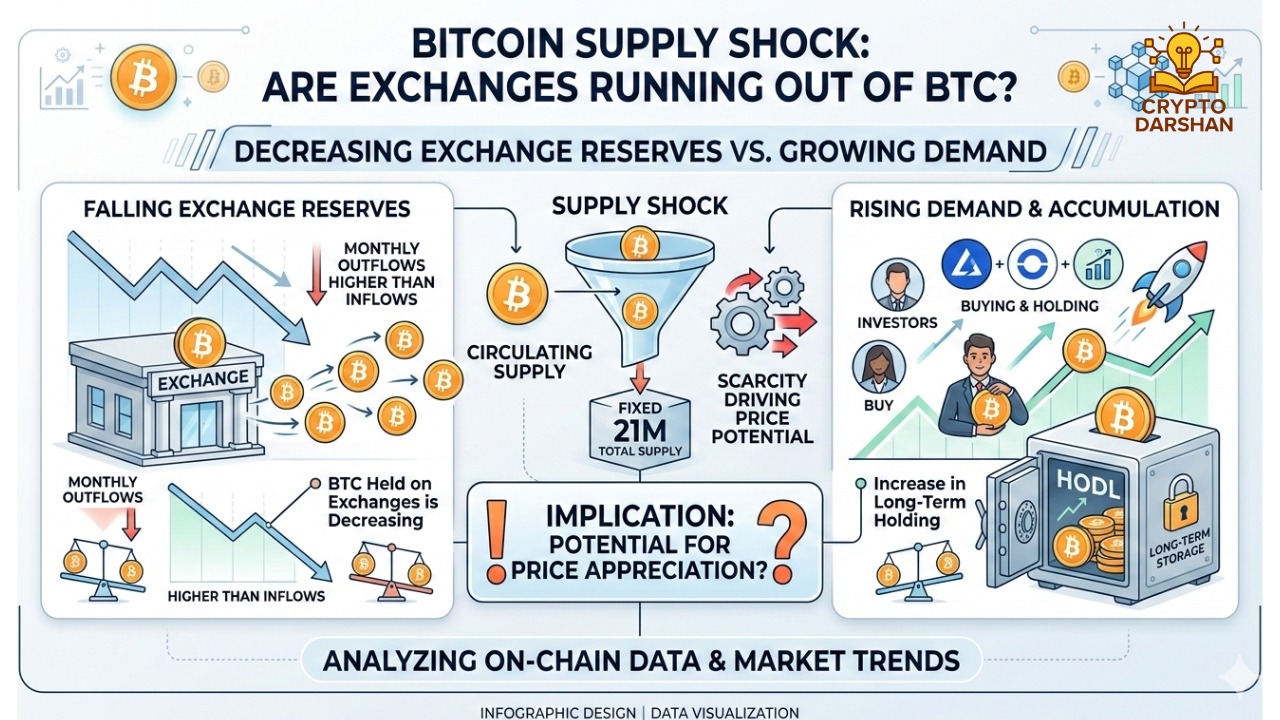
One of the clearest indicators of a Bitcoin Supply shock is the steady decline in exchange balances. Data from blockchain analytics firms shows that the amount of BTC held on major exchanges has dropped to its lowest level in years.
This trend suggests that investors are withdrawing their coins to private wallets, signaling a preference for long-term holding rather than active trading. As exchange reserves shrink, liquidity decreases, making it harder for large buyers to acquire BTC without driving up prices.
The reduction in exchange-held Bitcoin Supply is a key factor behind the current market dynamics. With fewer coins available for sale, even modest increases in demand can lead to significant price movements.
Institutional Accumulation
Institutional investors have played a major role in accelerating the Bitcoin Supply shock. Companies, hedge funds, and family offices are increasingly viewing Bitcoin as a strategic reserve asset. Many institutions purchase BTC through over-the-counter (OTC) desks and store it in cold custody solutions, effectively removing it from circulation.
This institutional accumulation reduces the available Bitcoin Supply on exchanges and contributes to tightening liquidity. As institutions continue to buy and hold, the balance between supply and demand becomes increasingly skewed.
Self-Custody Movement
The rise of self-custody has also fueled the Bitcoin Supply shock. Following several high-profile exchange collapses and security breaches, more investors are choosing to hold their BTC in hardware wallets or decentralized custody solutions.
This shift toward self-custody not only enhances security but also removes coins from the exchange ecosystem. As a result, fewer Bitcoins are available for trading, reinforcing the scarcity that defines the Bitcoin Supply shock. While Bitcoin supply tightens, innovation across the broader crypto ecosystem continues to grow, especially with infrastructure solutions discussed in Rollup-as-a-Service (RaaS): The Shopify Moment for Blockchains.
Factors Driving the Bitcoin Supply Shock in 2026

1. The 2024 Halving Effect
The 2024 Bitcoin halving reduced the block reward from 6.25 BTC to 3.125 BTC per block. This event cut the rate of new Bitcoin entering circulation by half, intensifying the scarcity effect. By 2026, the impact of this halving is fully visible, with miners producing fewer coins and selling less to cover operational costs.
This reduction in new supply has strengthened the Bitcoin Supply shock, as demand continues to outpace the limited issuance of new BTC.
2. Institutional Adoption and ETFs
The approval of multiple Bitcoin exchange-traded funds (ETFs) in major markets has accelerated institutional adoption. These ETFs hold large amounts of BTC in custody to back their shares, effectively locking up millions of coins.
As institutional demand grows, the available Bitcoin Supply on exchanges continues to shrink. This institutional hoarding is a key driver of the ongoing Bitcoin Supply shock.
3. Global Economic Uncertainty
Economic instability, inflation, and currency devaluation have pushed more investors toward Bitcoin as a hedge against traditional financial risks. In countries experiencing high inflation, Bitcoin is increasingly used as a store of value.
This global demand surge has intensified the Bitcoin Supply shock, as more individuals and institutions accumulate BTC for long-term preservation rather than short-term speculation.
4. Technological Advancements in Custody
Advancements in custody technology have made it easier and safer for investors to hold Bitcoin outside exchanges. Multi-signature wallets, decentralized custody platforms, and institutional-grade vaults have all contributed to the rise of Bitcoin Supply scarcity by encouraging secure, long-term storage.
5. Cultural Shift Toward HODLing
The “HODL” culture holding Bitcoin regardless of market volatility has become a defining feature of the crypto community. This mindset has strengthened over time, especially as Bitcoin’s long-term performance continues to outperform traditional assets.
As more investors adopt a long-term perspective, fewer coins are available for trading, reinforcing the Bitcoin Supply shock across the market.
The Impact of Bitcoin Supply on Exchanges

Liquidity Crunch
As the Bitcoin Supply on exchanges decreases, liquidity becomes a growing concern. With fewer coins available for trading, order books become thinner, and price volatility can increase. Large buy or sell orders can move the market significantly, leading to sharper price swings.
Rising Premiums
In some regions, the scarcity of BTC on exchanges has led to price premiums. Buyers are willing to pay more to acquire Bitcoin quickly, especially during periods of high demand. These premiums are a direct reflection of the tightening Bitcoin Supply and the imbalance between supply and demand.
Shift Toward OTC Markets
With limited liquidity on exchanges, institutional investors are turning to over-the-counter (OTC) markets to execute large trades without impacting prices. OTC desks facilitate private transactions between buyers and sellers, often involving significant amounts of BTC.
This shift further reduces exchange liquidity, amplifying the Bitcoin Supply shock as more coins move off public trading platforms.
Increased Price Volatility
A shrinking Bitcoin Supply on exchanges often results in greater price swings. When demand rises but supply remains limited, prices can spike rapidly. Conversely, during sell-offs, the lack of liquidity can cause sharp declines. This volatility attracts traders seeking profit opportunities but also increases risk for retail investors who may not be prepared for sudden market changes.
Encouragement of Long-Term Holding Behavior
The decreasing Bitcoin Supply on exchanges encourages a culture of holding rather than trading. Investors withdraw their BTC to private wallets for long-term storage, reducing the number of coins available for daily trading. This behavior strengthens Bitcoin’s position as a store of value and contributes to the broader narrative of digital scarcity that underpins its market appeal.Top of FormBottom of Form.
On-Chain Indicators of Bitcoin Supply Trends

Exchange Reserve Ratio
The exchange reserve ratio measures the amount of BTC held on exchanges relative to the total circulating supply. A declining ratio indicates that more Bitcoin is being withdrawn from exchanges, signaling a tightening Bitcoin Supply.
HODL Waves
HODL waves track the age distribution of Bitcoin holdings. When a larger percentage of BTC remains unmoved for extended periods, it suggests that long-term holders are accumulating. This trend is a hallmark of a constrained Bitcoin Supply, as it reflects reduced selling pressure.
Realized Cap and Dormancy Metrics
Realized cap measures the total value of Bitcoin based on the price at which each coin last moved. Dormancy metrics track how long coins remain inactive. Rising dormancy and a growing realized cap indicate that holders are not selling, reinforcing the Bitcoin Supply shortage.
Active Addresses and Transaction Volume
Monitoring the number of active Bitcoin addresses and transaction volume provides insight into network activity. A steady or rising number of active addresses alongside declining exchange balances indicates that users are holding BTC rather than trading it. This behavior supports the narrative of a tightening Bitcoin Supply, as more coins are being stored long-term.
Long-Term Holder vs. Short-Term Holder Supply
On-chain data distinguishes between long-term holders (LTHs) and short-term holders (STHs). When the proportion of BTC held by LTHs increases, it signals that more coins are locked away for extended periods. This shift reduces the liquid Bitcoin Supply available for trading, contributing to market scarcity and potential upward price pressure.Top of FormBottom of Form
The Economic Implications of Bitcoin Supply Scarcity

Price Appreciation Potential
The most immediate consequence of a tightening Bitcoin Supply is upward pressure on price. When supply tightens and demand remains strong, basic economic principles dictate that prices will rise.
Historical data shows that previous supply shocks have preceded major bull runs. If the current trend continues, the Bitcoin Supply shock could set the stage for another significant price rally.
Market Stability and Volatility
While scarcity can drive prices higher, it can also increase volatility. With fewer coins available for trading, even small market movements can cause large price fluctuations. Exchanges may struggle to maintain stable order books, leading to short-term instability despite long-term bullish trends.
Institutional Leverage
As institutions accumulate more BTC, they gain greater influence over market dynamics. This concentration of ownership could lead to a new phase of Bitcoin Supply control, where large holders have significant power over liquidity and price movements.
The Role of Miners in Bitcoin Supply Dynamics

Reduced Selling Pressure
After the 2024 halving, miners receive fewer BTC rewards, reducing the amount they need to sell to cover expenses. This decline in miner selling contributes to the tightening of the Bitcoin Supply, as fewer new coins enter the market.
Strategic Holding
Many mining companies are now adopting treasury strategies similar to corporations, holding a portion of their mined BTC as a long-term asset. This behavior further limits the available supply and strengthens the Bitcoin Supply shortage.
Energy Efficiency and Profitability
Advancements in mining technology have improved energy efficiency, allowing miners to operate profitably even with lower rewards. This stability enables them to hold more BTC, reinforcing the long-term scarcity that defines the Bitcoin Supply shock.
The Future of Bitcoin Supply

The Next Halving Cycle
The next Bitcoin halving, expected in 2028, will reduce block rewards even further. This event will likely intensify the Bitcoin Supply shortage, as new supply becomes scarcer and long-term holders continue to accumulate.
Integration with Traditional Finance
As Bitcoin becomes more integrated into traditional financial systems, demand from institutions, pension funds, and sovereign wealth funds will grow. This influx of capital will accelerate the tightening Bitcoin Supply, as more BTC is locked in long-term investment vehicles.
The Rise of Layer 2 Solutions
Layer 2 technologies like the Lightning Network are making Bitcoin more practical for everyday transactions. As these solutions gain adoption, users can transact without moving coins off-chain, further reducing exchange liquidity and supporting the constrained Bitcoin Supply.
Global Adoption and Regulation
Regulatory clarity in major markets is encouraging broader adoption of Bitcoin. As more countries recognize Bitcoin as a legitimate asset class, demand will rise, amplifying the Bitcoin Supply shortage on a global scale.
Case Studies: Evidence of Bitcoin Supply Tightening

MicroStrategy’s Accumulation Strategy
MicroStrategy continues to be a leading example of Bitcoin Supply concentration. The company’s strategy of accumulating and holding BTC as a treasury reserve has removed hundreds of thousands of coins from circulation, contributing to the overall scarcity.
El Salvador’s National Bitcoin Reserves
El Salvador’s decision to adopt Bitcoin as legal tender and accumulate reserves has also played a role in the Bitcoin Supply shortage. By holding BTC in national reserves, the country has effectively reduced the global liquid supply.
ETF Custody Holdings
Bitcoin ETFs in the United States and Europe collectively hold millions of BTC in cold storage. These holdings are not actively traded, further tightening the Bitcoin Supply across institutional markets.
Challenges and Risks of a Tight Bitcoin Supply

Market Manipulation Concerns
As ownership becomes concentrated among large holders, concerns about market manipulation grow. A few entities controlling a significant portion of the Bitcoin Supply could influence prices, posing a risk to market fairness.
Reduced Liquidity for Traders
While a constrained Bitcoin Supply benefits long-term holders, it can create challenges for traders who rely on liquidity. Thin order books can lead to slippage and increased trading costs.
Potential for Overvaluation
If demand surges too quickly amid limited supply, Bitcoin could experience short-term overvaluation. This could lead to corrections as the market adjusts to new equilibrium levels.
FAQ

What is a Bitcoin supply shock?
A Bitcoin supply shock happens when the available BTC on exchanges drops significantly while demand keeps rising. When fewer coins are available for sale, buyers compete for limited supply, which can push prices higher.
Why are Bitcoin reserves on exchanges decreasing?
Exchange reserves are falling mainly because investors are moving their Bitcoin to private wallets for long-term holding. Institutions, ETFs, and long-term holders often withdraw BTC from exchanges, reducing the amount available for trading.
How does a supply shock affect Bitcoin’s price?
When supply becomes scarce and demand stays strong, prices often rise. This basic supply-and-demand dynamic is why many analysts see falling exchange reserves as a bullish signal for Bitcoin.
What role do Bitcoin ETFs play in the supply shock?
Spot Bitcoin ETFs buy large amounts of BTC and store them in custody rather than leaving them on exchanges. This removes more coins from the liquid supply, tightening the market even further.
Are exchanges really running out of Bitcoin?
Exchanges are not completely running out of BTC, but the amount available for immediate trading has been steadily decreasing. This trend can increase volatility and lead to faster price movements when demand spikes.
How can investors prepare for a Bitcoin supply shock?
Investors often focus on long-term strategies such as dollar-cost averaging and secure self-custody. Monitoring exchange reserves, ETF inflows, and long-term holder activity can also help identify supply trends.
Could another supply shock trigger a major Bitcoin rally?
Historically, large drops in exchange supply have preceded strong price rallies. While nothing is guaranteed, tightening supply combined with growing demand could create conditions for another bullish cycle.
Conclusion
The era of the Bitcoin Supply shock marks a new chapter in the evolution of the cryptocurrency market. As more Bitcoin moves into long-term storage and institutional custody, the available supply on exchanges continues to shrink. This tightening liquidity is reshaping market dynamics, driving scarcity, and setting the stage for potential price appreciation.
While challenges such as volatility and concentration of ownership remain, the underlying trend of a constrained Bitcoin Supply reflects growing confidence in Bitcoin’s role as a global store of value. With each halving, technological advancement, and wave of adoption, Bitcoin’s scarcity becomes more pronounced.
In 2026, the question is no longer whether exchanges are running out of BTC — it’s how the world will adapt to the new reality of a limited Bitcoin Supply, where scarcity defines value, and long-term holders shape the future of digital finance.