Bitcoin has become one of the most popular investment assets in the world. Its decentralized nature, high potential returns, and global accessibility have attracted millions of new investors. However, this popularity has also made Bitcoin a prime target for scammers. Every year, thousands of people lose money to fraudulent schemes that exploit the excitement and lack of knowledge among beginners.
Understanding how these scams work the first step is toward protecting digital assets. This guide explains the most common Bitcoin scams, how they operate, and how to avoid them. It also provides practical safety tips for beginners to navigate the crypto world confidently and securely.
1. Understanding Bitcoin and Its Appeal.
1.1 What Is Bitcoin?
Bitcoin is a decentralized digital currency that allows peer-to-peer transactions without intermediaries like banks. It operates on blockchain technology, which records all transactions on a public ledger. This transparency and independence from central authorities make Bitcoin attractive to investors and users worldwide. This removes the need for trusted third-party involvement (e.g., a mint or bank) in financial transactions.
1.2 Why Bitcoin Attracts Scammers.
Bitcoin’s popularity and anonymity make it appealing not only to investors but also to criminals. Transactions are irreversible, meaning once Bitcoin is sent, it cannot be recovered unless the recipient returns it. This feature, combined with the lack of centralized oversight, creates opportunities for scammers to exploit inexperienced users.
1.3 The Importance of Awareness.
Many Bitcoin scams succeed because victims are unaware of how Bitcoin works. Scammers often use social engineering, fake websites, and emotional manipulation to trick people into sending their coins. Awareness and education are the best defenses against these tactics. Bitcoin scams are most common these days due to the rise of Bitcoin in today’s market.
2. The Psychology Behind Bitcoin Scams.
2.1 Greed and Fear of Missing Out (FOMO).
Scammers often exploit human emotions. The promise of quick profits triggers greed, while the fear of missing out pushes people to act without thinking. Fake investment schemes and giveaway scams rely heavily on these psychological triggers.
2.2 Trust in Authority.
Fraudsters frequently impersonate trusted figures, such as celebrities, influencers, or company executives. By mimicking authority, they gain credibility and convince victims to send money or share sensitive information.
2.3 Lack of Technical Knowledge.
Beginners often lack a deep understanding of how Bitcoin transactions and wallets work. Scammers take advantage of this by creating fake platforms or misleading instructions that trick users into giving away their private keys and becoming easy targets of bitcoin scams.
Many Bitcoin scams lure beginners into fake DeFi platforms that promise high and guaranteed returns. These platforms often disappear once funds are deposited, leaving victims with no recovery options. Our article on Hidden Risks in DeFi Platforms Most Investors Ignore explains how such platforms operate and why beginners should stay cautious.
3. Common Bitcoin Scams and How They Work.
3.1 Phishing Scams.
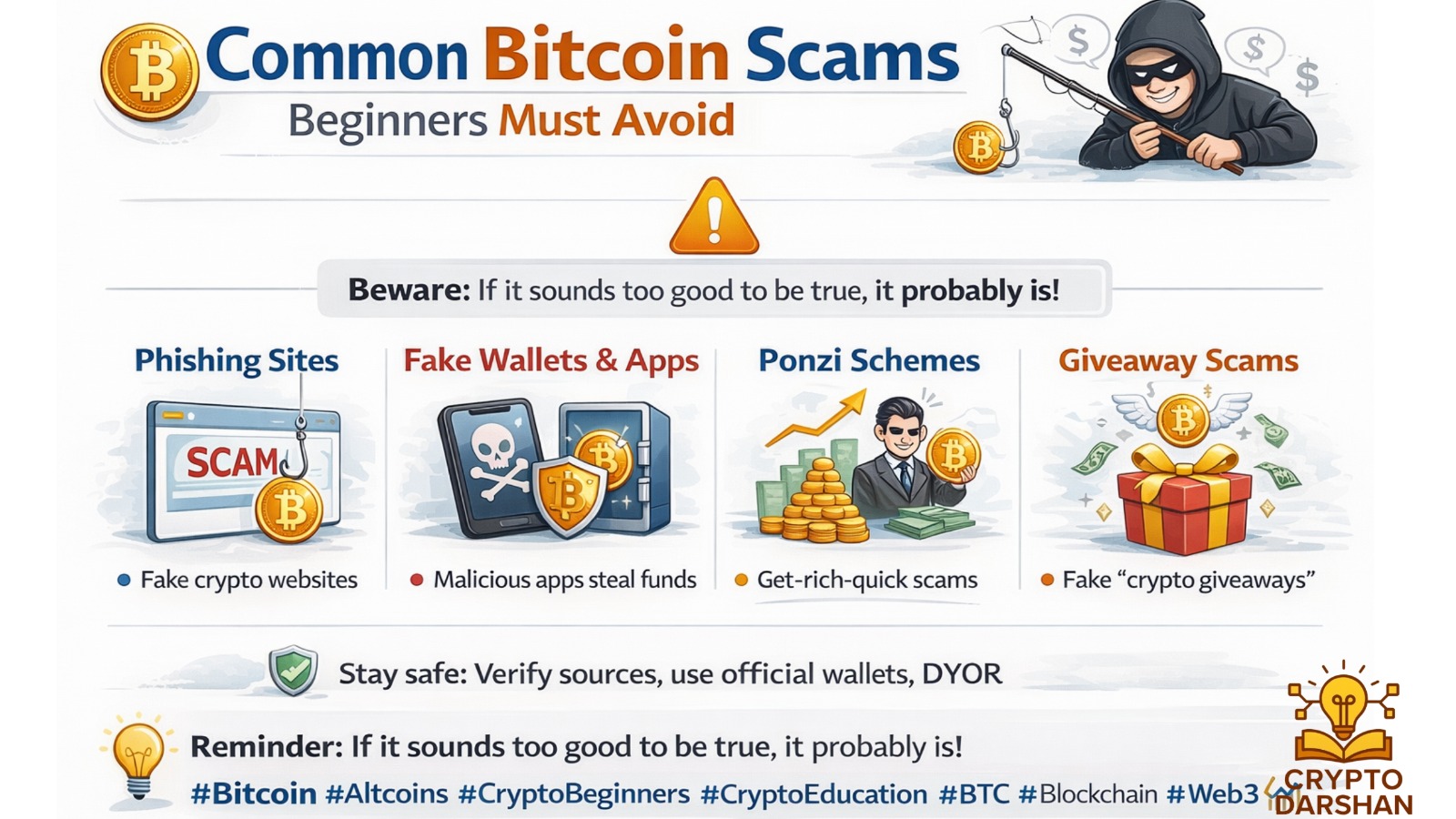
Phishing scams are among the most common Bitcoin scams in the crypto world. They involve fake websites, emails, or messages designed to steal login credentials or private keys.
How it works:
- Scammers send emails or messages that look like they come from legitimate exchanges or wallet providers.
- The message contains a link to a fake website that looks identical to the real one.
- When users enter their credentials, scammers capture the information and use it to steal funds.
How to avoid it:
- Always check the website URL carefully.
- Never click on links from unsolicited emails or messages.
- Enable two-factor authentication (2FA) on all crypto accounts.
3.2 Fake Exchanges and Wallets.
Fraudsters create fake cryptocurrency exchanges or wallet apps that look professional and legitimate. These platforms promise low fees or special bonuses to attract users.
How it works:
- Users deposit Bitcoin into the fake exchange or wallet.
- The scammers disappear with the funds, leaving users unable to withdraw or recover their coins.
How to avoid it:
- Use only well-known and reputable exchanges.
- Check reviews and verify the platform’s registration details.
- Download wallet apps only from official app stores or verified websites.
3.3 Ponzi and Pyramid Schemes.
Ponzi schemes are bitcoin scams that promise high returns with little or no risk. They pay early investors using funds from new participants rather than actual profits.
How it works:
- Scammers advertise guaranteed returns, often claiming to use advanced trading bots or secret investment strategies.
- As more people invest, the scheme appears successful.
- Eventually, when new investments slow down, the scam collapses, and most investors lose their money.
How to avoid it:
- Be skeptical of any investment promising fixed or unrealistic returns.
- Research the company’s background and verify its operations.
- Remember: if it sounds too good to be true, it probably is.
3.4 Giveaway Bitcoin Scams.
Giveaway bitcoin scams are common on social media platforms like Twitter, YouTube, and Telegram. Scammers impersonate celebrities or crypto influencers, claiming to give away free Bitcoin.
How it works:
- Victims are told to send a small amount of Bitcoin to a wallet address to “verify” their participation.
- The scammer promises to send back double or triple the amount.
- Once the Bitcoin is sent, the scammer disappears.
How to avoid it:
- Never send Bitcoin to participate in giveaways.
- Verify official social media accounts before engaging.
- Remember that legitimate giveaways never require payment.
3.5 Fake ICOs (Initial Coin Offerings).
An ICO is a fundraising method where new crypto projects sell tokens to investors. Scammers exploit this concept by creating fake ICOs to steal funds. A fake initial coin offering (ICO) has all the trappings of a legitimate ICO but with none of the supporting technology or infrastructure. In other words, it’s like launching a coin that exists in name only.
How it works:
- Fraudsters build a professional-looking website and publish a whitepaper.
- They promote the ICO through social media and influencers.
- Once investors send Bitcoin or Ethereum, the scammers vanish.
How to avoid it:
- Research the project’s team, technology, and roadmap.
- Check if the ICO is registered with relevant authorities.
- Avoid projects that lack transparency or verifiable information.
3.6 Malware and Ransomware Attacks.
Malware can infect computers or mobile devices to steal private keys or redirect transactions.
How it works:
- Scammers trick users into downloading malicious software disguised as wallet apps or trading tools.
- The malware records keystrokes or accesses wallet files.
- In ransomware attacks, hackers lock files and demand Bitcoin payments for decryption.
How to avoid it:
- Install antivirus software and keep it updated.
- Avoid downloading files or apps from unknown sources.
- Backup important data regularly.
3.7 Cloud Mining Scams.
Cloud mining allows users to rent mining power from remote data centers. Scammers exploit this by creating fake cloud mining companies.
How it works:
- Victims pay for mining contracts that promise daily or monthly returns.
- The company either doesn’t mine at all or shuts down after collecting enough money.
How to avoid it:
- Research the company’s mining facilities and verify proof of operations.
- Be cautious of guaranteed profits or unrealistic returns.
- Prefer reputable mining services with transparent records.
3.8 Pump-and-Dump Schemes.
Pump-and-dump scams manipulate the price of low-value cryptocurrencies. A scammer using a pump-and-dump scheme leverages various tactics to artificially inflate (or “pump”) the price of a digital asset. With the price inflated, the scammer immediately sells (“dumps”) their tokens into the open market.
How it works:
- Scammers buy large amounts of a cheap coin and promote it heavily on social media.
- As more people buy in, the price rises (“pump”).
- The scammers then sell their holdings at the peak, causing the price to crash (“dump”).
How to avoid it:
- Avoid investing based on hype or social media trends.
- Research the project’s fundamentals before buying.
- Be cautious of sudden price spikes in unknown coins.
3.9 Impersonation Scams.
Scammers often impersonate well-known figures or companies to gain trust.
How it works:
- They create fake social media profiles or websites that look identical to legitimate ones.
- Victims are asked to send Bitcoin or share personal information.
How to avoid it:
- Verify official accounts through blue checkmarks or official links.
- Contact the company directly through verified channels.
- Never trust unsolicited messages asking for money.
3.10 Investment Management Scams.
Some scammers pose as professional traders or investment managers who promise to grow your Bitcoin holdings.
How it works:
- They ask victims to transfer Bitcoin to their wallets for “trading.”
- Initially, they may show fake profits to build trust.
- Eventually, they disappear with all the funds.
How to avoid it:
- Never give control of your funds to strangers.
- Avoid anyone promising guaranteed profits.
- Use regulated investment platforms only.
3.11 Romance Bitcoin Scams.
Romance scams in Bitcoin occur when scammers build emotional relationships online and then persuade victims to send Bitcoin or other cryptocurrencies. Because Bitcoin transactions are irreversible and pseudonymous, scammers prefer crypto over traditional bank transfers.
How it works:
- Scammers build relationships with victims through dating apps or social media.
- Once trust is established, they ask for Bitcoin to solve a “crisis” or invest together.
- After receiving the funds, they vanish.
How to avoid it:
- Be cautious of online relationships that involve money.
- Never send Bitcoin to someone you haven’t met in person.
- Watch for inconsistencies in stories or profiles.
3.12 Fake Customer Support Scams.
Scammers pose as customer support agents from exchanges or wallet providers.
How it works:
- Victims contact fake support pages or receive unsolicited help offers.
- Scammers ask for login details or remote access to “fix” issues.
- They then steal funds from the victim’s account.
How to avoid it:
- Contact support only through official websites.
- Never share passwords or private keys.
- Be wary of anyone offering unsolicited help.
4. How to Identify Bitcoin Scams.
The cryptocurrency market is full of opportunities, but it also attracts scammers who prey on beginners. Identifying Bitcoin scams early can save you from losing your hard-earned money. Scammers often use similar tactics, promising unrealistic profits, creating fake websites, or impersonating trusted figures. By learning to recognize the warning signs, you can protect yourself and your investments.
4.1 Promises of Guaranteed or Unrealistic Returns.
One of the biggest red flags in any Bitcoin-related offer is the promise of guaranteed profits. No legitimate investment can guarantee returns, especially in the volatile crypto market.
Common signs:
- Claims like “Earn 10% daily” or “Double your Bitcoin in 24 hours.”
- Websites or individuals showing fake testimonials or profit charts.
- Phrases such as “risk-free investment” or “guaranteed income.”
Reality check:
Bitcoin’s price fluctuates constantly, and no one can predict or guarantee profits. If an offer sounds too good to be true, it almost always is.
4.2 Pressure to Act Quickly.
Scammers often create a sense of urgency to push victims into making hasty decisions. They use time-limited offers or countdown timers to make you feel like you’ll miss out if you don’t act fast.
Examples:
- “Only 10 spots left, invest now!”
- “Offer expires in 2 hours!”
- “Send Bitcoin immediately to secure your bonus.”
How to respond:
Take your time to research before sending any money. Legitimate opportunities will never pressure you to act instantly.
4.3 Lack of Transparency.
Legitimate crypto projects and businesses are transparent about their team, goals, and operations. Scammers, on the other hand, hide behind anonymity or fake identities.
Warning signs:
- No clear information about the company or founders.
- Fake or stolen profile pictures on websites and social media.
- No verifiable business address or registration details.
What to do:
Always research the project’s background. Look for official documentation, team profiles on LinkedIn, and credible partnerships.
4.4 Requests for Private Keys or Wallet Access.
Your private key is the most important piece of information in cryptocurrency ownership. Anyone who has it can access and transfer your Bitcoin. No legitimate company or support agent will ever ask for it.
Scam examples:
- Fake customer support asking for your private key to “verify your account.”
- Websites requesting you to “import your wallet” to claim rewards.
Rule:
Never share your private keys, seed phrases, or passwords with anyone, no matter how convincing they sound.
4.5 Poorly Designed or Suspicious Websites.
Scammers often create fake websites that look similar to legitimate ones. These sites may have small spelling errors, unusual domain names, or low-quality design.
How to spot them:
- Check the URL carefully, scammers often use slight variations (e.g., “binancee.com” instead of “binance.com”).
- Look for HTTPS encryption (a padlock symbol in the address bar).
- Avoid websites that ask for personal details before providing information.
Tip:
Bookmark official exchange and wallet websites to avoid phishing traps.
4.6 Unverified Social Media Accounts.
Social media is a common tool for scammers. They impersonate celebrities, influencers, or crypto companies to promote fake giveaways or investment schemes.
Warning signs:
- Accounts with few followers but claiming to be official.
- Posts promising free Bitcoin or “limited time offers.”
- Direct messages asking for money or wallet addresses.
How to verify:
Check for verified badges (blue checkmarks) and cross-check announcements on official websites.
4.7 Fake Testimonials and Reviews.
Scammers often use fake reviews or testimonials to appear trustworthy. These can be found on websites, YouTube videos, or social media posts.
How to identify them:
- Overly positive reviews with no specific details.
- Repeated phrases or identical comments across multiple platforms.
- Stock photos or fake names used for “happy investors.”
What to do:
Search for independent reviews on trusted crypto forums or news sites.
4.8 Unregistered or Unregulated Platforms.
Legitimate exchanges and investment platforms are usually registered with financial authorities. Scammers operate unregulated platforms that disappear once they collect enough funds.
How to check:
- Verify if the platform is registered with your country’s financial regulator.
- Look for licensing information on the website.
- Avoid platforms that hide their legal or contact details.
4.9 Suspicious Communication Channels.
Scammers often contact victims through unofficial channels like WhatsApp, Telegram, or direct messages. They may pretend to be support agents or investment advisors.
Red flags:
- Unsolicited messages offering investment opportunities.
- Poor grammar or spelling in messages.
- Requests for personal or financial information.
Safe practice:
Only communicate through official support channels listed on verified websites.
4.10 Unrealistic Whitepapers or Roadmaps.
For new crypto projects, the whitepaper is a key document explaining the project’s purpose and technology. Scammers often copy or fabricate whitepapers to appear legitimate.
How to identify fake ones:
- Vague or overly technical language with no real explanation.
- Missing details about the team or technology.
- Promises of massive returns without clear business models.
What to do:
Compare the whitepaper with those of established projects. If it lacks clarity or originality, it’s likely a scam.
4.11 No Community or Online Presence.

Legitimate crypto projects usually have active communities on platforms like Reddit, Discord, or Twitter. Scams often lack genuine engagement.
Signs of a fake project:
- Inactive or newly created social media accounts.
- Few followers or fake engagement (bots).
- No discussions or updates from the development team.
Check:
Join the project’s community channels and observe interactions before investing.
4.12 Overuse of Buzzwords.
Scammers often use trendy crypto terms to sound legitimate, like “AI-powered trading,” “blockchain revolution,” or “next-generation DeFi.”
Why it’s a red flag:
These terms are used to impress beginners without explaining how the technology actually works.
How to respond:
Ask for clear explanations. If the promoters can’t explain the project in simple terms, it’s likely a scam.
4.13 Fake Apps and Downloads.
Some scammers create fake mobile apps that mimic real crypto wallets or exchanges. Once installed, these apps steal login credentials or private keys.
How to avoid them:
- Download apps only from official app stores.
- Check developer information and user reviews.
- Avoid downloading apps from links shared on social media or emails.
4.14 Unrealistic Affiliate or Referral Programs.
Some scams lure users with high referral bonuses or commissions for bringing in new investors. These are often disguised pyramid schemes.
Warning signs:
- High rewards for recruiting others.
- No real product or service behind the program.
- Payments depend solely on new sign-ups.
Rule:
Avoid programs that focus more on recruitment than actual value creation.
4.15 Lack of Customer Support.
Legitimate platforms provide responsive customer support through official channels. Scams often have no real support or use fake contact details.
How to test:
- Send a query before investing and see if you get a professional response.
- Check if the support email domain matches the official website.
- Avoid platforms that only offer chatbots or social media DMs for support.
5. How to Protect Bitcoin Investments.
5.1 Use Secure Wallets.
Choose reputable wallets with strong security features. Hardware wallets like Ledger or Trezor offer the best protection by keeping private keys offline.
5.2 Enable Two-Factor Authentication.
2FA adds an extra layer of security by requiring a second verification step during login or transactions.
5.3 Keep Software Updated.
Regular updates fix security vulnerabilities and protect against new threats.
5.4 Avoid Public Wi-Fi for Transactions.
Public networks are vulnerable to hackers. Always use a secure, private connection when accessing crypto accounts.
5.5 Verify Before Sending.
Double-check wallet addresses and transaction details before sending Bitcoin. Scammers often use similar-looking addresses to trick users.
5.6 Educate Yourself Continuously.
Stay informed about new scams and security practices. The crypto landscape evolves rapidly, and awareness is the best defense.
6. What to Do If Scammed?

Falling victim to a Bitcoin scam can be devastating, both financially and emotionally. Because cryptocurrency transactions are irreversible, recovering lost funds is extremely difficult but not always impossible. Acting quickly, documenting evidence, and reporting the incident can help minimize damage and increase the chances of tracing the scammer.
This section outlines the essential steps to take immediately after realizing you’ve been scammed.
6.1 Stay Calm and Act Quickly.
The first and most important step is to stay calm. Panic can lead to poor decisions, such as sending more money in desperation or trusting another scam promising recovery. Take a deep breath, assess the situation, and move forward methodically.
Immediate actions:
- Stop all communication with the scammer.
- Do not send additional funds, even if they claim it’s needed for “verification” or “refund.”
- Secure your remaining assets as soon as possible.
6.2 Secure Your Accounts and Wallets.
If you suspect your wallet or exchange account has been compromised, act immediately to protect what’s left.
Steps to secure your accounts:
- Change passwords on all crypto-related accounts and emails.
- Enable two-factor authentication (2FA) if it’s not already active.
- Transfer remaining funds to a new, secure wallet, preferably a hardware wallet.
- Revoke access to any suspicious apps or browser extensions connected to your wallet.
If you used a custodial exchange (like Binance or Coinbase), contact their support team immediately to freeze your account or flag suspicious activity.
6.3 Gather and Preserve Evidence.
Documentation is crucial for reporting and investigation. Collect as much information as possible about the scam.
What to collect:
- Transaction IDs (TXIDs) from your wallet or exchange.
- Screenshots of messages, emails, or websites used by the scammer.
- Wallet addresses, usernames, and social media profiles involved.
- Dates, times, and amounts of all transactions.
Keep this information organized, as it will help authorities or blockchain investigators trace the Bitcoin scams.
6.4 Report the Scam.
Reporting the scam increases the chances of catching the fraudsters and helps protect others from falling victim.
Where to report:
- Local law enforcement: File a police report with all evidence.
- National cybercrime agencies: Many countries have dedicated cybercrime units.
- Crypto exchanges: If the scammer’s wallet is linked to an exchange, report it immediately. Exchanges can sometimes freeze funds or flag suspicious accounts.
- Blockchain analysis firms: Some private companies specialize in tracing stolen crypto.
- Consumer protection agencies: Report to organizations like the Federal Trade Commission (FTC) or your country’s equivalent.
Examples:
- In the U.S., report to the FTC (reportfraud.ftc.gov) or IC3 (ic3.gov).
- In the U.K., contact Action Fraud (actionfraud.police.uk).
- In India, report to the National Cyber Crime Reporting Portal (cybercrime.gov.in).
6.5 Notify Your Exchange or Wallet Provider.
If the scam involved a transaction through a crypto exchange or wallet service, contact their support team immediately. Provide all relevant details, including transaction IDs and wallet addresses.
While exchanges can’t reverse blockchain transactions, they can:
- Flag the scammer’s wallet address.
- Freeze funds if they reach the exchange.
- Assist law enforcement with investigations.
6.6 Use Blockchain Tracking Tools.
Blockchain transactions are public and traceable. You can use blockchain explorers or professional tracking services to follow where your Bitcoin went.
Tools to use:
- Blockchain.com Explorer
- Blockchair
- Chainalysis (for professionals)
If the scammer transfers your Bitcoin to an exchange, there’s a small chance authorities can intervene before it’s withdrawn.
6.7 Warn Others.
Sharing your experience can prevent others from falling into the same trap. Post about the scam on crypto forums, social media, or community groups.
What to include:
- The scam’s name or website.
- The wallet address used.
- A brief description of how it happened.
This helps raise awareness and allows others to identify similar scams early.
6.8 Avoid “Recovery” Scams.
After being scammed, victims often become targets again. Fraudsters posing as “recovery experts” or “blockchain investigators” may contact you, promising to retrieve your lost Bitcoin for a fee.
Warning signs of recovery scams:
- Requests for upfront payment.
- Claims of guaranteed recovery.
- Unsolicited contact through email or social media.
Rule:
No legitimate service can guarantee the recovery of stolen Bitcoin. Always verify the credibility of any recovery company before engaging.
6.9 Seek Legal and Professional Help.
If the amount lost is significant, consider consulting a lawyer specializing in cryptocurrency or cybercrime. They can guide you through legal procedures and coordinate with authorities.
You can also hire blockchain forensic experts who specialize in tracing stolen funds. While expensive, they can sometimes identify the scammer’s exchange or wallet, aiding law enforcement.
6.10 Learn from the Experience.
Being scammed is painful, but it can also be a valuable lesson. Use the experience to strengthen your security habits and help others avoid similar mistakes.
Steps to take moving forward:
- Educate yourself about common scams and security practices.
- Use hardware wallets for long-term storage.
- Verify all platforms and offers before investing.
- Stay updated on new scam tactics in the crypto community.
7. Legal and Regulatory Protection.

Governments and regulators are increasingly addressing crypto fraud. Many countries now require exchanges to follow Know Your Customer (KYC) and Anti-Money Laundering (AML) rules. These measures help track suspicious activities and protect users.
However, because Bitcoin operates globally, enforcement remains challenging. Investors must take personal responsibility for their security.
8. The Role of Education in Preventing Bitcoin Scams.

Education is the strongest defense against scams. Beginners should learn:
- How Bitcoin transactions work.
- How to use wallets safely.
- How to verify legitimate platforms.
Crypto communities, online courses, and trusted news sources can help build knowledge and confidence.
9. The Future of Bitcoin Security.
As the crypto industry matures, security measures are improving. Exchanges are adopting stronger authentication systems, and blockchain analytics tools help trace stolen funds. Governments are also developing clearer regulations to protect investors.
However, scammers continue to evolve. Staying alert and informed will always be essential for safe participation in the Bitcoin ecosystem.
10. Conclusion.
Bitcoin offers incredible opportunities for financial freedom and innovation, but it also attracts scammers who prey on beginners. Understanding how these scams work and how to avoid them is crucial for anyone entering the crypto space.
By recognizing red flags, using secure tools, and staying informed, investors can protect their assets and enjoy the benefits of Bitcoin safely. The key to avoiding Bitcoin scams is simple: research, verify, and never trust promises that sound too good to be true.