Coinbase crypto adoption is accelerating mainstream use, boasting over 120 million monthly users and dominating 65% of US exchange volume amid 2026’s regulatory thaw. The rise of cryptocurrency has transformed the global financial landscape, introducing a new era of decentralized finance and digital assets. Among the many platforms that have contributed to this transformation, Coinbase stands out as one of the most influential. Founded in 2012, Coinbase has played a pivotal role in bridging the gap between traditional finance and the emerging world of cryptocurrencies.
This article explores Coinbase’s role in mainstream crypto adoption, examining its history, business model, technological innovations, regulatory approach, and impact on the broader financial ecosystem. It also discusses how Coinbase has influenced public perception, institutional participation, and the global acceptance of digital currencies.
The Origins of Coinbase

Coinbase was founded by Brian Armstrong and Fred Ehrsam in 2012 with a simple mission: to make buying and selling Bitcoin easy and accessible. At the time, cryptocurrency was still a niche concept, often associated with tech enthusiasts and early adopters. The process of acquiring Bitcoin was complex, involving peer-to-peer transactions or unregulated exchanges that lacked transparency and security.
Armstrong, a former Airbnb engineer, recognized the need for a secure and user-friendly platform that could simplify crypto transactions. Together with Ehrsam, a former Goldman Sachs trader, they launched Coinbase as a digital wallet and exchange service. The platform allowed users to buy Bitcoin using traditional payment methods such as bank transfers and credit cards, marking a significant step toward mainstream accessibility.
By focusing on simplicity, security, and compliance, Coinbase quickly gained traction. Within a few years, it became one of the most trusted names in the crypto industry, attracting both retail investors and institutional clients.
Coinbase’s Mission and Vision

Coinbase’s mission is to “increase economic freedom in the world.” This vision is rooted in the belief that cryptocurrencies can democratize access to financial services, reduce barriers to entry, and empower individuals globally. The company envisions a future where digital assets are integrated into everyday financial systems, enabling faster, cheaper, and more transparent transactions.
To achieve this, Coinbase has focused on three core principles:
- Accessibility: Making crypto easy to buy, sell, and store for everyone, regardless of technical expertise.
- Trust: Building a secure and compliant platform that users can rely on.
- Innovation: Continuously developing new products and services that expand the use cases of digital assets.
These principles have guided Coinbase’s growth and shaped its role as a leader in mainstream crypto adoption.
Simplifying Crypto for the Masses

One of Coinbase’s most significant contributions to mainstream adoption is its focus on user experience. Early crypto exchanges were often intimidating, requiring users to understand complex trading interfaces and blockchain technology. Coinbase changed this by designing a clean, intuitive platform that resembled traditional financial apps.
Key Features That Simplified Crypto
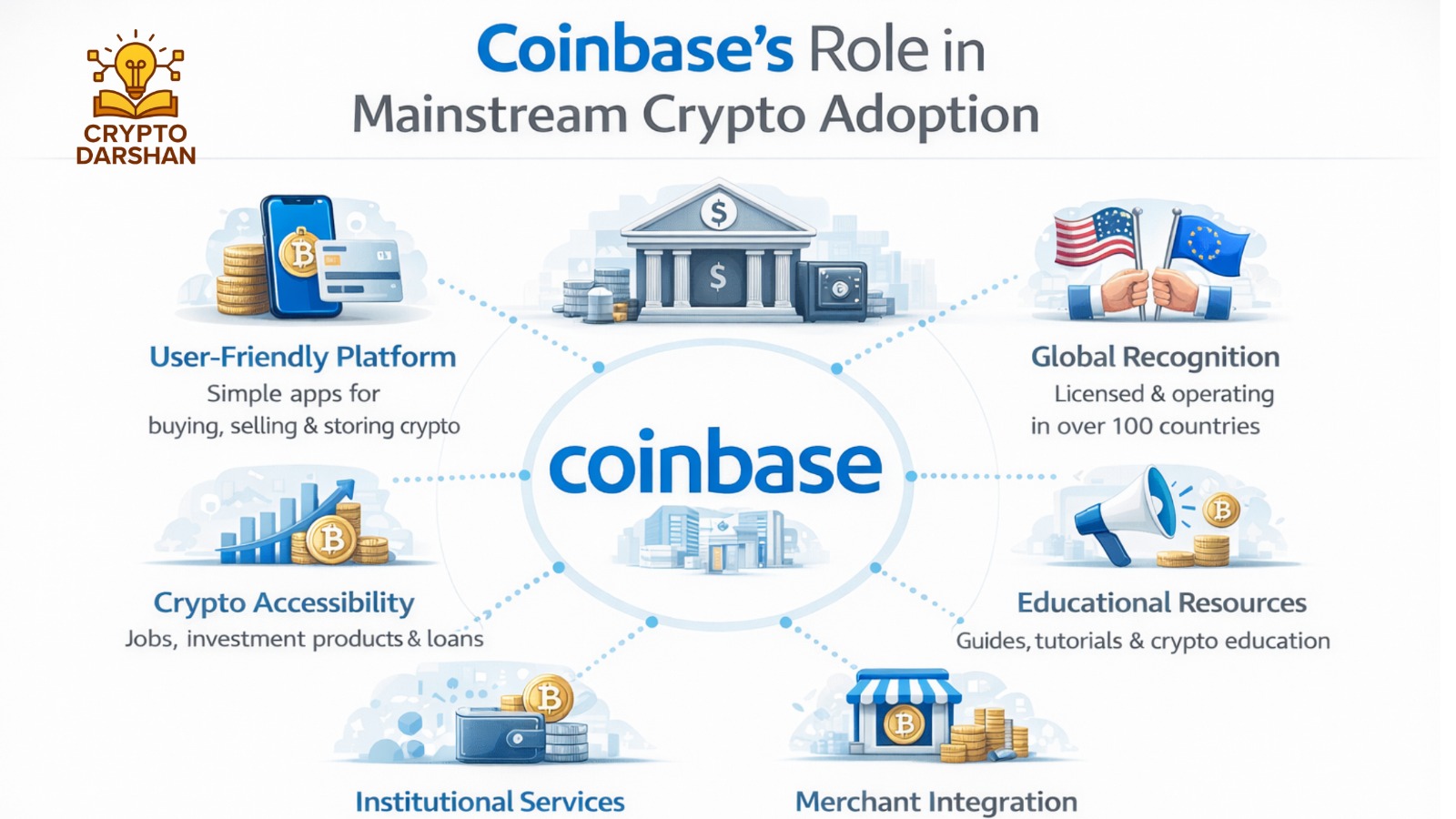
- User-Friendly Interface: Coinbase’s app and website are designed for ease of use, allowing users to buy, sell, and manage cryptocurrencies with just a few clicks.
- Educational Resources: The platform offers tutorials, articles, and videos that explain crypto concepts in simple terms. The “Coinbase Earn” program even rewards users with crypto for learning about different projects.
- Mobile Accessibility: With a robust mobile app, Coinbase made it possible for users to manage their crypto portfolios on the go.
- Instant Purchases: Integration with bank accounts and credit cards enabled instant purchases, reducing friction for new users.
By removing technical barriers, Coinbase made cryptocurrency accessible to millions of people who might otherwise have been hesitant to participate.
Building Trust Through Regulation and Security

Trust has been a major challenge in the crypto industry, especially in its early years when scams, hacks, and unregulated exchanges were common. Coinbase recognized that mainstream adoption would require a strong foundation of trust and compliance.
Regulatory Compliance
Coinbase has consistently prioritized working within regulatory frameworks. It is registered as a Money Services Business with the U.S. Financial Crimes Enforcement Network (FinCEN) and complies with Know Your Customer (KYC) and Anti-Money Laundering (AML) regulations. This commitment to compliance has helped legitimize the platform in the eyes of regulators, investors, and the public.
The company’s proactive approach to regulation has also influenced the broader industry, setting standards for transparency and accountability. By cooperating with regulators, Coinbase has helped shape policies that support responsible innovation in the crypto space.
Security Measures
Security is another cornerstone of Coinbase’s success. The platform employs advanced security protocols to protect user funds and data, including:
- Cold Storage: The majority of customer funds are stored offline in secure vaults, minimizing the risk of hacking.
- Two-Factor Authentication (2FA): Users are required to verify their identity through multiple authentication steps.
- Insurance Coverage: Coinbase provides insurance for digital assets held on its platform, offering additional peace of mind.
- Regular Audits: Independent security audits ensure that Coinbase maintains the highest standards of protection.
These measures have made Coinbase one of the most secure exchanges in the world, reinforcing its reputation as a trusted gateway to crypto.
Expanding the Coinbase Crypto Adoption Ecosystem

Coinbase’s influence extends beyond its exchange platform. Over the years, the company has launched a range of products and services that support the broader crypto ecosystem.
Coinbase Pro
Coinbase Pro (formerly GDAX) caters to advanced traders, offering lower fees, detailed charts, and more sophisticated trading tools. This platform attracts professional investors and institutions, bridging the gap between retail and institutional markets.
Coinbase Wallet
The Coinbase Wallet is a self-custody wallet that gives users full control over their private keys and digital assets. Coinbase also has a wallet that is an ideal alternative for users who prefer a more interactive, on-the-go platform. Unlike the website, the wallet is non-custodial, so you have to keep your login details safe, or else you could permanently lose your assets.
As users become more comfortable with wallets and self-custody, many eventually graduate beyond centralized platforms. Our guide on Best Decentralized Exchange(DEX) 2026 : Decentralized Trading Platforms explores where these users are going once they move past custodial exchanges like Coinbase.
Coinbase Custody
Launched in 2018, Coinbase Custody provides secure storage solutions for institutional investors. It meets the stringent requirements of hedge funds, family offices, and corporations seeking to invest in digital assets safely.
Coinbase Commerce
Coinbase Commerce allows merchants to accept cryptocurrency payments directly. This service has helped expand the use of crypto in e-commerce, making it easier for businesses to integrate digital currencies into their payment systems.
Coinbase Cloud
Coinbase Cloud offers infrastructure and developer tools for building blockchain applications. By providing APIs and node services, it supports developers in creating decentralized apps and services, further driving innovation in the crypto space.
The Coinbase IPO: A Milestone for Crypto

In April 2021, Coinbase made history by becoming the first major cryptocurrency exchange to go public on the Nasdaq under the ticker symbol COIN. The direct listing was a landmark event, signaling the growing acceptance of crypto in mainstream finance.
The IPO not only validated Coinbase’s business model but also represented a broader shift in how traditional markets view digital assets. It demonstrated that crypto companies could operate transparently, comply with regulations, and achieve profitability.
The listing also brought increased visibility to the crypto industry, attracting new investors and sparking discussions about the future of digital finance. For many, Coinbase’s public debut marked the moment when cryptocurrency officially entered the mainstream.
Institutional Adoption and Coinbase’s Role

While Coinbase initially focused on retail users, it has increasingly become a key player in institutional crypto adoption. The launch of Coinbase Prime and Coinbase Custody has made it easier for large investors to enter the market.
Institutional Services
Coinbase Prime offers a suite of services tailored to institutional clients, including:
- Advanced Trading Tools: Access to deep liquidity and algorithmic trading options.
- Secure Custody: Institutional-grade storage solutions with insurance coverage.
- Analytics and Reporting: Tools for portfolio management and compliance tracking.
These services have attracted major financial institutions, hedge funds, and corporations. Companies like Tesla, MicroStrategy, and Square have used Coinbase to manage their crypto holdings, further legitimizing digital assets as an investment class.
Impact on Institutional Confidence
By providing a regulated and secure platform, Coinbase has helped reduce the perceived risks associated with crypto investments. Its partnerships with established financial institutions have also bridged the gap between traditional finance and the digital economy.
Educating the Public About Crypto

Education has been central to Coinbase’s strategy for driving adoption. The company recognizes that understanding is key to participation, especially in a field as complex as cryptocurrency.
Coinbase Learn and Earn
The “Learn and Earn” program rewards users with small amounts of crypto for completing educational modules about different projects. This approach not only incentivizes learning but also introduces users to new digital assets in a practical way.
Blog and Research Reports
Coinbase regularly publishes research reports, market analyses, and educational content that help users stay informed about trends and developments in the crypto space. These resources contribute to a more knowledgeable and confident user base.
Advocacy and Public Engagement
Coinbase also engages in public advocacy, promoting policies that support innovation and consumer protection. Through partnerships, conferences, and media outreach, the company plays an active role in shaping the conversation around crypto regulation and adoption.
Global Expansion and Accessibility

Coinbase’s mission to “increase economic freedom in the world” has always extended beyond the borders of the United States. From its early days, the company recognized that cryptocurrency is a global phenomenon with the potential to empower individuals in every corner of the world. To fulfill this vision, Coinbase has pursued an ambitious strategy of international expansion, focusing on accessibility, localization, and partnerships that make crypto adoption easier for users worldwide.
Expanding Beyond the U.S. Market
Initially, Coinbase operated primarily in the United States, where it built a strong foundation of trust and compliance. Once established as a reliable and secure exchange, the company began expanding into international markets. Today, Coinbase operates in over 100 countries, offering services that allow users to buy, sell, and store cryptocurrencies in their local currencies.
This expansion has been driven by a combination of strategic partnerships, regulatory engagement, and technological innovation. By adapting its platform to meet the needs of different regions, Coinbase has positioned itself as a global leader in digital finance.
Localization and Regional Adaptation
Localization has been a key factor in Coinbase’s global success. The company understands that each market has unique cultural, regulatory, and financial characteristics. To address these differences, Coinbase has localized its platform in several ways:
- Language Support: Coinbase offers its platform in multiple languages, ensuring that users can navigate and understand the interface easily.
- Local Payment Methods: The company integrates region-specific payment options, such as bank transfers, credit cards, and mobile payment systems, to make transactions seamless.
- Regulatory Compliance: Coinbase works closely with local regulators to ensure compliance with national laws, building trust and legitimacy in each market.
- Customer Support: Regional support teams provide assistance tailored to local languages and time zones, improving the overall user experience.
By focusing on localization, Coinbase has made cryptocurrency more accessible to users who might otherwise face barriers due to language, regulation, or payment infrastructure.
Partnerships with Local Institutions
To strengthen its presence in international markets, Coinbase has formed partnerships with local financial institutions, payment processors, and fintech companies. These collaborations help bridge the gap between traditional finance and the crypto economy.
For example, in Europe, Coinbase has partnered with banks to enable faster deposits and withdrawals through the Single Euro Payments Area (SEPA) network. In Asia and Latin America, the company has worked with regional payment providers to facilitate local currency transactions.
Such partnerships not only enhance accessibility but also foster trust among users who are new to cryptocurrency. By aligning with established financial entities, Coinbase demonstrates its commitment to operating within regulated frameworks while promoting innovation.
Accessibility in Emerging Markets

One of the most profound impacts of Coinbase’s global expansion has been in emerging markets. In many developing countries, access to traditional banking services is limited, and local currencies can be unstable. Cryptocurrency offers an alternative means of storing and transferring value, providing financial inclusion to millions of people who are underserved by conventional systems.
Coinbase’s presence in these regions allows users to:
- Store Value Securely: Cryptocurrencies can act as a hedge against inflation and currency devaluation.
- Send and Receive Money Globally: Cross-border transactions become faster and cheaper compared to traditional remittance services.
- Access Global Markets: Users can participate in the global digital economy, investing, trading, and earning in ways previously unavailable to them.
By offering a secure and user-friendly platform, Coinbase empowers individuals in emerging markets to take control of their financial futures.
Technological Infrastructure for Global Reach
To support its international operations, Coinbase has invested heavily in scalable and secure infrastructure. Its cloud-based systems ensure that users around the world can access the platform reliably, regardless of location. The company also employs advanced encryption and security protocols to protect user data and assets globally.
Additionally, Coinbase’s mobile app plays a crucial role in accessibility. In many regions, mobile devices are the primary means of accessing the internet. By offering a fully functional mobile platform, Coinbase ensures that users can buy, sell, and manage their crypto assets anytime, anywhere.
Promoting Financial Inclusion
Coinbase’s global expansion aligns with its broader mission of promoting financial inclusion. By providing access to digital assets, the company helps reduce barriers to entry for individuals who lack access to traditional banking systems. This is particularly impactful in regions where economic instability, inflation, or limited infrastructure restrict financial opportunities.
Through education initiatives, localized content, and partnerships with local organizations, Coinbase also works to raise awareness about the benefits and risks of cryptocurrency. This educational approach empowers users to make informed decisions and fosters responsible adoption.
The Impact of Global Accessibility
Coinbase’s global reach has had a ripple effect across the crypto industry. By setting high standards for compliance, security, and user experience, it has encouraged other exchanges to follow suit. Its presence in multiple markets has also contributed to the normalization of cryptocurrency as a legitimate financial asset.
Moreover, global accessibility has accelerated the integration of crypto into everyday life. From remittances and online shopping to investment and savings, Coinbase’s expansion has made it easier for people worldwide to engage with digital assets in meaningful ways.
Coinbase’s Role in Shaping Regulation

As one of the most visible players in the crypto industry, Coinbase has had a significant influence on regulatory discussions. The company advocates for clear, fair, and innovation-friendly regulations that protect consumers without stifling growth.
Policy Engagement
Coinbase actively engages with policymakers and regulators to promote understanding of blockchain technology. It has proposed frameworks for crypto regulation that emphasize transparency, security, and consumer protection.
Compliance as a Competitive Advantage
While some crypto companies have resisted regulation, Coinbase has embraced it as a competitive advantage. By operating within legal frameworks, it has built credibility with both users and institutions, setting a standard for responsible innovation.
Challenges and Criticisms

Despite its success, Coinbase has faced challenges and criticisms. These include concerns about high fees, customer support issues, and occasional service outages during periods of high demand. Additionally, some critics argue that Coinbase’s centralized model contradicts the decentralized ethos of cryptocurrency.
However, the company has taken steps to address these concerns by improving infrastructure, expanding support channels, and exploring decentralized solutions through its wallet and developer tools.
The Future of Coinbase and Crypto Adoption

As the crypto industry continues to evolve, Coinbase remains at the forefront of innovation. The company is expanding into new areas such as decentralized finance (DeFi), non-fungible tokens (NFTs), and blockchain infrastructure.
Coinbase isn’t just an exchange; it’s part of a broader shift toward crypto as digital infrastructure. Acting as a regulated on-ramp, it helps transition users from traditional finance into a more open, blockchain-based system.
Key Future Initiatives
- Integration with Web3: Coinbase aims to make Web3 accessible to mainstream users through its wallet and developer tools.
- Stablecoins and Payments: The company is exploring stablecoin-based payment systems that could revolutionize global transactions.
- Institutional Growth: Continued expansion of institutional services will attract more traditional investors to the crypto market.
- Global Inclusion: Coinbase plans to deepen its presence in emerging markets, promoting financial inclusion through digital assets.
Long-Term Vision
Coinbase envisions a world where crypto is seamlessly integrated into everyday life—where people use digital assets for payments, savings, and investments as easily as they use traditional money. By continuing to innovate and advocate for responsible regulation, Coinbase is helping turn that vision into reality.
FAQ: Coinbase’s Role in Mainstream Crypto Adoption

1. What is Coinbase?
Coinbase is a U.S.-based cryptocurrency exchange and financial services company that allows individuals and institutions to buy, sell, store, and use digital assets such as Bitcoin and Ethereum.
2. Why is Coinbase important to mainstream crypto adoption?
Coinbase lowers barriers to entry by offering a user-friendly interface, strong security practices, and regulatory compliance, making crypto more accessible to non-technical users and traditional investors.
3. How does Coinbase make crypto easier for beginners?
Coinbase provides simple onboarding, fiat-to-crypto purchases, educational resources, intuitive mobile apps, and customer support, reducing the complexity often associated with cryptocurrency.
4. What role does regulation play in Coinbase’s adoption impact?
Coinbase operates with a strong focus on regulatory compliance, particularly in the United States. This builds trust with users, institutions, and regulators, helping legitimize crypto in traditional finance.
5. How has Coinbase influenced institutional adoption?
Coinbase offers services such as Coinbase Prime and custody solutions for institutions, enabling hedge funds, asset managers, and corporations to safely enter the crypto market.
6. Does Coinbase contribute to crypto education?
Yes. Coinbase offers educational content and incentive-based learning programs that teach users about blockchain technology and specific cryptocurrencies.
7. How does Coinbase affect public trust in cryptocurrency?
As a publicly traded company with transparent reporting and compliance standards, Coinbase increases credibility and public confidence in the crypto ecosystem.
8. What products beyond trading support adoption?
Coinbase supports wallets, staking, blockchain developer tools, merchant payment integrations, and on-chain applications, expanding real-world crypto use cases.
Conclusion
Coinbase has played a transformative role in bringing cryptocurrency into the mainstream. From simplifying crypto transactions for beginners to providing institutional-grade services for large investors, the company has built a bridge between traditional finance and the digital economy. Its commitment to security, compliance, and education has earned it the trust of millions of users worldwide.
As the crypto industry matures, Coinbase’s influence will continue to shape its direction. By promoting accessibility, transparency, and innovation, Coinbase is not only driving mainstream adoption but also redefining the future of global finance.