
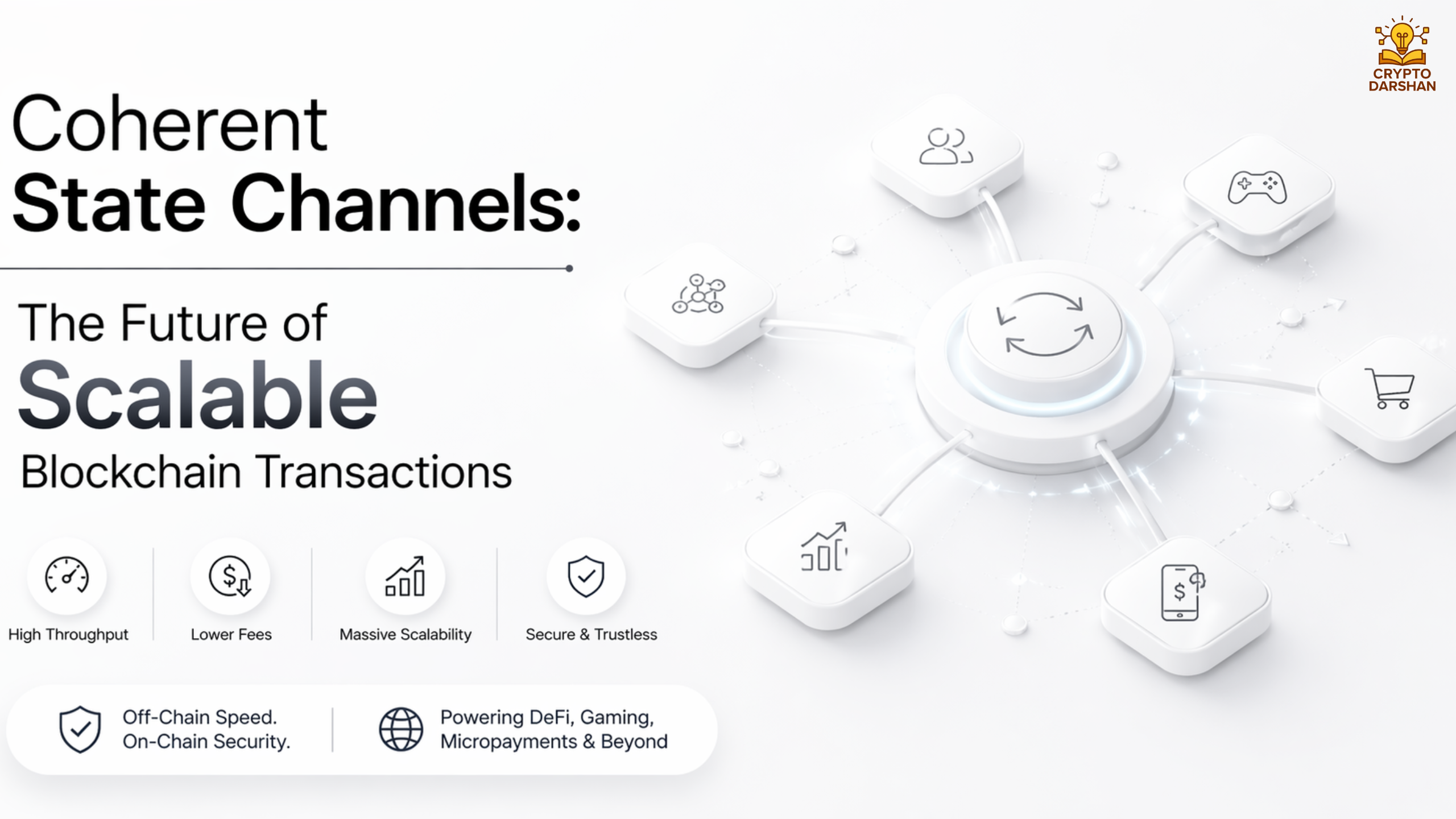
Blockchain technology has transformed digital transactions by introducing transparency, decentralization, and security. Yet, as adoption grows, scalability remains a persistent challenge. High transaction fees, network congestion, and slow confirmation times limit blockchain’s potential for mass use. To overcome these issues, developers have turned to state channels, a Layer-2 scaling solution that allows off-chain transactions while maintaining blockchain-level security. Among these, coherent state channels stand out as a refined and efficient evolution, ensuring consistency, synchronization, and reliability across participants.
This comprehensive guide explores coherent state channels in depth—covering their architecture, functionality, advantages, use cases, and future potential. It also examines how they differ from traditional state channels and why they are critical for the next generation of decentralized applications (dApps).
Understanding Blockchain Scalability

The Scalability Trilemma
The blockchain scalability trilemma, introduced by Ethereum co-founder Vitalik Buterin, highlights the trade-off between three essential properties:
- Decentralization – No single entity controls the network.
- Security – The network remains resistant to attacks and fraud.
- Scalability – The system can handle a large number of transactions per second (TPS).
Most blockchains can only optimize two of these at once. Bitcoin, for example, prioritizes decentralization and security but sacrifices scalability. Coherent state channels aim to balance all three by enabling secure, decentralized, and scalable off-chain interactions.
On-Chain vs. Off-Chain Transactions
- On-chain transactions occur directly on the blockchain and require network consensus. They are secure but slow and costly.
- Off-chain transactions happen outside the blockchain, reducing congestion and fees. Only the final state is recorded on-chain, improving efficiency.
State channels are a form of off-chain transaction mechanism that allows participants to interact privately and efficiently without burdening the main blockchain.
What Are State Channels?

Definition
A state channel is a blockchain second-layer solution. It allows a group of participants to perform unlimited private transactions off-chain. The channel participants can only observe these transactions and are not public. Only the opening and closing of the channel are recorded on the blockchain. This drastically reduces the number of on-chain transactions, improving speed and scalability.
How State Channels Work
- Channel Opening – Participants lock a certain amount of cryptocurrency in a smart contract.
- Off-Chain Transactions – They exchange signed messages representing state updates (e.g., payments, game moves, or data exchanges).
- Channel Closing – When the interaction ends, the final state is submitted to the blockchain for settlement.
This process ensures that all off-chain interactions are cryptographically secure and verifiable.
Example
Consider two users, Alice and Bob, who frequently transact. Instead of recording every transaction on the blockchain, they open a state channel by locking funds in a smart contract. They can then exchange hundreds of transactions off-chain. When they finish, they close the channel, and the blockchain records only the final balance.
The Evolution Toward Coherent State Channels

Traditional state channels have proven effective but face challenges related to synchronization, dispute resolution, and multi-party coordination. Coherent state channels were developed to overcome these limitations by introducing a more structured and consistent framework for managing off-chain states.
Definition of Coherent State Channels
A coherent state channel is an advanced form of state channel that ensures all participants maintain a consistent and synchronized view of the off-chain state throughout the interaction. It introduces coherence protocols that prevent discrepancies, double-spending, or conflicting updates.
Key Principles
- Consistency – All participants share the same version of the state at any given time.
- Atomicity – State transitions occur as indivisible operations, ensuring no partial updates.
- Finality – Once a state is agreed upon, it cannot be reversed or disputed.
- Security – Cryptographic proofs guarantee that off-chain states are valid and enforceable on-chain.
Architecture of Coherent State Channels

Core Components
- Smart Contract Layer – Manages channel creation, fund locking, and dispute resolution.
- Off-Chain Communication Layer – Handles message exchange and state synchronization between participants.
- Coherence Protocol – Ensures all participants maintain a consistent view of the state.
- Settlement Mechanism – Finalizes the channel by submitting the agreed-upon state to the blockchain.
Workflow
- Initialization – Participants agree on channel parameters and deposit funds into a smart contract.
- State Updates – Each transaction updates the off-chain state, signed by all participants.
- Coherence Verification – The coherence protocol checks that all participants have identical state versions.
- Dispute Handling – If a disagreement arises, the smart contract enforces the last valid state.
- Closure – The final state is submitted to the blockchain for settlement.
Example of Coherence Protocol
In a coherent state channel, every state update must be acknowledged by all participants before it becomes valid. This ensures that no participant can unilaterally alter the state or broadcast an outdated version to the blockchain.
Advantages of Coherent State Channels

1. Enhanced Scalability
By moving most transactions off-chain, coherent state channels significantly increase throughput. Networks can handle thousands of transactions per second without congesting the main blockchain.
This approach builds on advanced scalability techniques similar to those discussed in our guide on Multi-Party Computation (MPC) for Secure Off-Chain Collaboration, where computation is distributed while maintaining strong security guarantees.
2. Reduced Transaction Costs
Since only the opening and closing transactions are recorded on-chain, users save on gas fees. This makes microtransactions and frequent interactions economically viable.
3. Improved Privacy
Off-chain transactions are not publicly visible on the blockchain, protecting user data and transaction details from exposure.
4. Faster Transaction Speed
Transactions within a coherent state channel are nearly instantaneous, as they do not require network-wide consensus.
5. Stronger Security Guarantees
The coherence protocol ensures that all participants share the same state, preventing fraud, double-spending, or conflicting updates.
6. Seamless User Experience
Users can interact with dApps or payment systems smoothly without waiting for block confirmations.
Comparison: Coherent vs. Traditional State Channels

| Feature | Traditional State Channels | Coherent State Channels |
| State Synchronization | Manual or ad hoc | Automated and enforced by coherence protocol |
| Dispute Resolution | Reactive | Proactive and consistent |
| Scalability | High | Very high |
| Security | Strong | Enhanced with coherence checks |
| Multi-Party Support | Limited | Optimized for multiple participants |
| Transaction Speed | Fast | Instantaneous |
| Implementation Complexity | Moderate | Higher but more robust |
Use Cases of Coherent State Channels

1. Micropayments
Coherent state channels enable instant, low-cost micropayments for services like streaming, gaming, or IoT devices. Users can pay per second or per action without incurring high fees.
2. Decentralized Exchanges (DEXs)
DEXs can use coherent state channels to execute trades off-chain, reducing latency and improving liquidity. Only final trade settlements are recorded on-chain.
3. Gaming and Virtual Worlds
In blockchain-based games, coherent state channels allow players to exchange assets, make moves, or interact in real time without blockchain delays.
4. Internet of Things (IoT)
IoT devices can use coherent state channels to exchange data and payments efficiently, supporting machine-to-machine (M2M) economies.
5. Supply Chain Management
Coherent state channels can streamline supply chain transactions by enabling real-time updates and verifiable off-chain interactions between stakeholders.
6. Cross-Chain Interactions
They can facilitate communication between different blockchains, allowing assets and data to move seamlessly across networks.
Technical Deep Dive: How Coherence Is Maintained

State Representation
Each state in a coherent channel is represented as a tuple containing:
- Channel ID
- Participant balances
- Nonce (to track version order)
- Signatures from all participants
Coherence Enforcement
- State Validation – Each new state must have a higher nonce than the previous one.
- Signature Verification – All participants must sign the new state.
- Conflict Prevention – The coherence protocol rejects any state that conflicts with the latest agreed version.
- Timeout Mechanism – If a participant becomes unresponsive, the channel can be closed using the last valid state.
Dispute Resolution
If a dispute arises, the smart contract acts as an impartial judge. It verifies the submitted state’s signatures and nonces to determine the valid final state. This ensures fairness and prevents malicious behavior.
Implementation Challenges

1. Complexity of Coherence Protocols
Designing and implementing coherence protocols that scale efficiently across multiple participants is technically challenging.
2. Onboarding and User Experience
Users must understand how to open, manage, and close channels. Simplified interfaces and automated tools are essential for mainstream adoption.
3. Interoperability
Integrating coherent state channels with existing blockchain networks and dApps requires standardized frameworks.
4. Security Risks
While coherent state channels enhance security, vulnerabilities in smart contracts or signature schemes can still pose risks.
5. Resource Management
Maintaining off-chain communication and synchronization requires computational and network resources, especially in multi-party setups.
Solutions and Optimizations

1. Layer-2 Integration
Coherent state channels can be integrated with other Layer-2 solutions like rollups or sidechains to further enhance scalability.
2. Automated Channel Management
Smart contracts can automate channel creation, monitoring, and closure, reducing user complexity.
3. Multi-Hop Channels
Multi-hop routing allows participants to transact even without a direct channel, improving network connectivity.
4. Watchtowers
Third-party services called watchtowers can monitor the blockchain for disputes and act on behalf of users to ensure fairness.
5. Standardization Efforts
Developers are working on open standards for coherent state channels to ensure interoperability across platforms.
Real-World Projects and Research

1. Lightning Network (Bitcoin)
While not fully coherent, the Lightning Network laid the foundation for off-chain payment channels, inspiring coherent channel research.
2. Raiden Network (Ethereum)
Raiden extends Ethereum’s scalability through state channels, with ongoing research into coherence mechanisms.
3. Perun Framework
The Perun project focuses on generalized state channels with strong coherence guarantees, supporting complex multi-party interactions.
4. Celer Network
Celer introduces a coherent off-chain scaling architecture that supports fast, secure, and low-cost transactions for dApps.
5. Counterfactual Framework
Counterfactual provides a generalized framework for building state channels with coherent state management.
As blockchain adoption expands into traditional finance and public infrastructure, scalable transaction layers become increasingly important. For example, governments exploring blockchain-based financial instruments such as tokenized bonds require high-throughput systems. In this context, coherent state channels can support efficient and scalable settlement mechanisms, similar to those discussed in On-Chain Government Bonds Guide.
Economic and Environmental Impact

Lower Transaction Costs
By reducing on-chain activity, coherent state channels minimize gas fees, making blockchain applications more affordable.
Energy Efficiency
Fewer on-chain transactions mean less computational work for miners or validators, reducing energy consumption.
Economic Inclusion
Low-cost, high-speed transactions enable broader participation in decentralized finance (DeFi) and digital economies.
Sustainable Blockchain Growth
Coherent state channels contribute to a more sustainable blockchain ecosystem by reducing the environmental footprint of transaction processing.
Security Considerations

Cryptographic Integrity
All off-chain states are signed by participants, ensuring authenticity and non-repudiation.
Fraud Prevention
The coherence protocol prevents outdated or conflicting states from being broadcast to the blockchain.
Timeout and Recovery
Timeout mechanisms protect participants from unresponsive or malicious peers by allowing safe channel closure.
Smart Contract Auditing
Regular audits of the underlying smart contracts are essential to prevent vulnerabilities.
Multi-Layer Security
Combining coherent state channels with other security layers, such as zero-knowledge proofs or multi-signature wallets, can further enhance protection.
Future of Coherent State Channels

Integration with Layer-3 Solutions
As blockchain ecosystems evolve, coherent state channels may integrate with Layer-3 protocols to enable even more complex off-chain computations.
AI and Automation
Artificial intelligence could optimize channel routing, dispute resolution, and resource allocation in coherent networks.
Cross-Industry Adoption
From finance to gaming and IoT, coherent state channels will underpin scalable, real-time digital interactions.
Regulatory Compliance
Future implementations may include compliance features such as identity verification and transaction monitoring to align with global regulations.
Quantum-Resistant Cryptography
As quantum computing advances, coherent state channels may adopt quantum-resistant algorithms to maintain long-term security.
Integration with Decentralized Identity (DID)
Coherent state channels could integrate with decentralized identity systems to enable secure, verifiable, and privacy-preserving user authentication. This would allow seamless participation in off-chain ecosystems without compromising personal data.
Expansion into Enterprise Solutions
Enterprises exploring blockchain for supply chain, logistics, and finance can leverage coherent state channels to process large volumes of internal transactions efficiently. This approach reduces operational costs and enhances transparency across departments and partners.
Case Study: Coherent Channels in Decentralized Gaming

In decentralized gaming, latency and transaction costs are major barriers. Coherent state channels solve these by enabling real-time gameplay and asset exchanges off-chain. Players can trade items, make moves, and interact instantly. Only the final game results are recorded on-chain, ensuring fairness and transparency.
This approach enhances user experience, reduces costs, and supports complex multiplayer interactions without compromising decentralization. Developers can also integrate reward systems, tournaments, and NFT-based assets seamlessly within coherent channels.
Best Practices for Developers

Design for Coherence
Every state transition within a coherent state channel must be atomic, meaning it either happens completely or not at all. Each update should be signed by all participants to ensure mutual agreement and prevent inconsistencies. This guarantees that all parties share the same version of the state at any given time.
Implement Robust Dispute Mechanisms
Smart contracts should include clear and efficient dispute resolution processes. If a participant tries to cheat or becomes unresponsive, the contract must automatically enforce the last valid state. This ensures fairness and protects honest participants from malicious actions.
Optimize Communication Protocols
Efficient message-passing systems are essential for maintaining synchronization between participants. Developers should minimize latency and ensure that messages are delivered reliably and in the correct order. This helps maintain coherence and prevents state mismatches.
Prioritize Security Audits
Regular security audits of smart contracts and cryptographic components are critical. Audits help identify vulnerabilities before deployment, reducing the risk of exploits or data breaches. Using well-tested libraries and following secure coding practices strengthens the overall system.
Enhance User Interfaces
User experience plays a major role in adoption. Interfaces should simplify complex processes like opening, managing, and closing channels. Clear visual feedback, automation, and intuitive design make coherent state channels accessible to non-technical users.
Plan for Scalability
Systems should be designed to handle multiple participants and large transaction volumes. Developers must ensure that performance remains stable as the network grows. Scalable architecture supports enterprise-level applications and future expansion.
Integrate Monitoring Tools
Watchtowers or automated bots can monitor the blockchain for disputes or irregular activities. These tools act on behalf of users to enforce valid states and prevent fraud. Continuous monitoring enhances reliability and user trust.
Coherent State Channels – FAQ

1. What are Coherent State Channels?
Coherent State Channels are communication channels that transmit information using coherent states of light, typically produced by lasers. In quantum optics, a coherent state is a special quantum state that behaves most like classical electromagnetic waves. These channels are widely used in quantum communication and optical fiber communication systems.
2. Why are coherent states important in quantum communication?
Coherent states are important because they:
- Are stable and easy to generate using lasers.
- Maintain their properties during propagation through optical fibers.
- Allow efficient encoding of information in phase and amplitude.
- Enable high-speed optical communication systems.
Because of these advantages, coherent states are often used in quantum key distribution (QKD) and modern optical networks.
3. How does a coherent state channel work?
A coherent state channel works through the following steps:
- Preparation: A laser generates coherent states of light.
- Encoding: Information is encoded in the phase, amplitude, or polarization of the light.
- Transmission: The optical signal travels through a medium such as optical fiber or free space.
- Detection: A receiver measures the signal using detectors such as homodyne or heterodyne detectors.
- Decoding: The received signal is converted back into classical data.
4. What are the main applications of coherent state channels?
Coherent state channels are used in several advanced technologies:
- Optical fiber communication systems
- Quantum key distribution (QKD)
- Deep-space optical communication
- Quantum sensing and metrology
- Secure communication networks
5. What are homodyne and heterodyne detection in coherent channels?
Homodyne Detection
- Measures a single quadrature (phase or amplitude) of the optical field.
- Uses a reference laser called a local oscillator.
- Provides high measurement precision.
Heterodyne Detection
- Measures both quadratures simultaneously.
- Uses two slightly different frequencies between signal and local oscillator.
- Enables full reconstruction of the optical signal.
6. What are the advantages of coherent state channels?
- High data transmission rates
- Compatible with existing optical communication infrastructure
- Efficient detection techniques
- Better noise tolerance compared to many quantum states
- Practical implementation using laser technology
7. What are the limitations of coherent state channels?
- Quantum noise limits measurement accuracy.
- Photon loss in optical fibers reduces signal strength.
- Security challenges in certain quantum cryptography protocols.
- Requires precise phase synchronization between sender and receiver.
8. How do coherent state channels differ from single-photon channels?
| Feature | Coherent State Channels | Single-Photon Channels |
| Signal Type | Laser-based coherent light | Individual photons |
| Implementation | Easier and practical | Technically complex |
| Data Rate | High | Lower |
| Noise Sensitivity | Moderate | High |
| Typical Use | Optical communication | Quantum cryptography |
Conclusion
Coherent state channels represent a major advancement in blockchain scalability. By ensuring consistent, secure, and synchronized off-chain interactions, they enable high-speed, low-cost transactions suitable for a wide range of applications. From micropayments and gaming to IoT and DeFi, coherent state channels pave the way for a more efficient and accessible decentralized future.
As blockchain technology continues to evolve, coherent state channels will play a central role in bridging the gap between scalability and decentralization—unlocking the full potential of distributed systems for global adoption. Their combination of speed, security, and coherence positions them as a cornerstone of the next generation of blockchain infrastructure.