The rise of blockchain technology has transformed how societies think about trust, value exchange, and digital coordination. Yet, beneath the cryptographic algorithms and decentralized networks lies a deeper truth: blockchains are not just technological systems, they are Coordination Games. Understanding blockchains through the lens of game theory reveals that their success depends less on technical sophistication and more on how well they align human incentives. This perspective shifts the focus from code to cooperation, from cryptography to coordination.
This article explores how Coordination Games shape blockchain ecosystems, why incentives are the foundation of decentralized systems, and how game theory explains both the triumphs and failures of blockchain projects. It also examines how incentive design, governance, and social consensus determine the long-term sustainability of blockchain networks.
Understanding Coordination Games

What Are Coordination Games?
In game theory, Coordination Games are scenarios where participants achieve the best outcomes by aligning their actions with those of others. Coordination games are a class of games in game theory where players benefit from making the same choices or coordinating their strategies. The goal is to achieve a common outcome, and players typically have multiple strategies that can lead to mutually beneficial results. The key feature is mutual benefit; players succeed when they coordinate on shared strategies. Classic examples include driving on the same side of the road or adopting a common language. The challenge lies not in competition but in achieving harmony.
In the context of blockchains, Coordination Games describe how participants, miners, validators, developers, and users must align their behaviors to maintain network security, consensus, and trust. Every blockchain is a living coordination mechanism where incentives guide participants toward cooperative equilibrium.
The Role of Equilibrium in Coordination Games

An equilibrium in Coordination Games occurs when no participant benefits from changing their strategy unilaterally. In blockchain systems, this equilibrium represents a stable state where all actors follow the protocol rules because doing so maximizes their rewards. For example, Bitcoin miners follow the proof-of-work consensus because deviating would reduce their profits and undermine the network’s value.
The equilibrium is fragile, however. If incentives shift or trust erodes, participants may defect, leading to forks, attacks, or network collapse. Thus, designing robust incentive structures is essential for maintaining equilibrium in blockchain Coordination Games.
Blockchains as Coordination Mechanisms

The Blockchain as a Social Contract
A blockchain can be viewed as a digital social contract enforced by code. Participants agree to follow specific rules, such as validating transactions, producing blocks, or staking tokens, in exchange for rewards. This agreement is sustained not by legal enforcement but by economic incentives and shared belief in the system’s value.
In this sense, blockchains are Coordination Games where the payoff depends on collective adherence to the protocol. The technology provides the framework, but human coordination gives it life. Without aligned incentives, even the most advanced blockchain will fail to achieve consensus.
Consensus Protocols as Coordination Games
Consensus protocols like Proof of Work (PoW) and Proof of Stake (PoS) are prime examples of Coordination Games in action. In PoW, miners coordinate by solving cryptographic puzzles to secure the network. In PoS, validators coordinate by staking tokens and validating blocks. In both cases, participants must trust that others will act honestly, as the system’s security depends on collective cooperation.
The success of these protocols relies on incentive alignment. If rewards are too low or penalties too weak, participants may act selfishly, leading to instability. Thus, consensus mechanisms are not just technical algorithms, they are carefully designed Coordination Games that balance risk, reward, and trust.
Incentives: The Heart of Blockchain Coordination

Economic Incentives and Game Theory
Game theory teaches that rational players act in their self-interest. Therefore, blockchain designers must create incentive structures that make cooperation the most rational choice. This involves balancing rewards (such as block rewards or transaction fees) with penalties (such as slashing or loss of stake).
For example, in Ethereum’s Proof of Stake system, validators earn rewards for proposing and attesting to blocks but risk losing their stake if they act maliciously. This dual mechanism ensures that the equilibrium of the Coordination Game favors honest participation.
Social Incentives and Reputation
Beyond economic rewards, social incentives play a crucial role in blockchain Coordination Games. Participants often value reputation, community trust, and ideological alignment. Developers contribute to open-source projects not just for profit but for recognition and shared purpose. Communities coordinate around values like decentralization, transparency, and fairness.
These social incentives reinforce cooperation, creating a culture of trust that strengthens the network. When social and economic incentives align, blockchains achieve resilient coordination.
To understand why incentives drive participation, it’s important to first explore how consensus mechanisms work in practice.
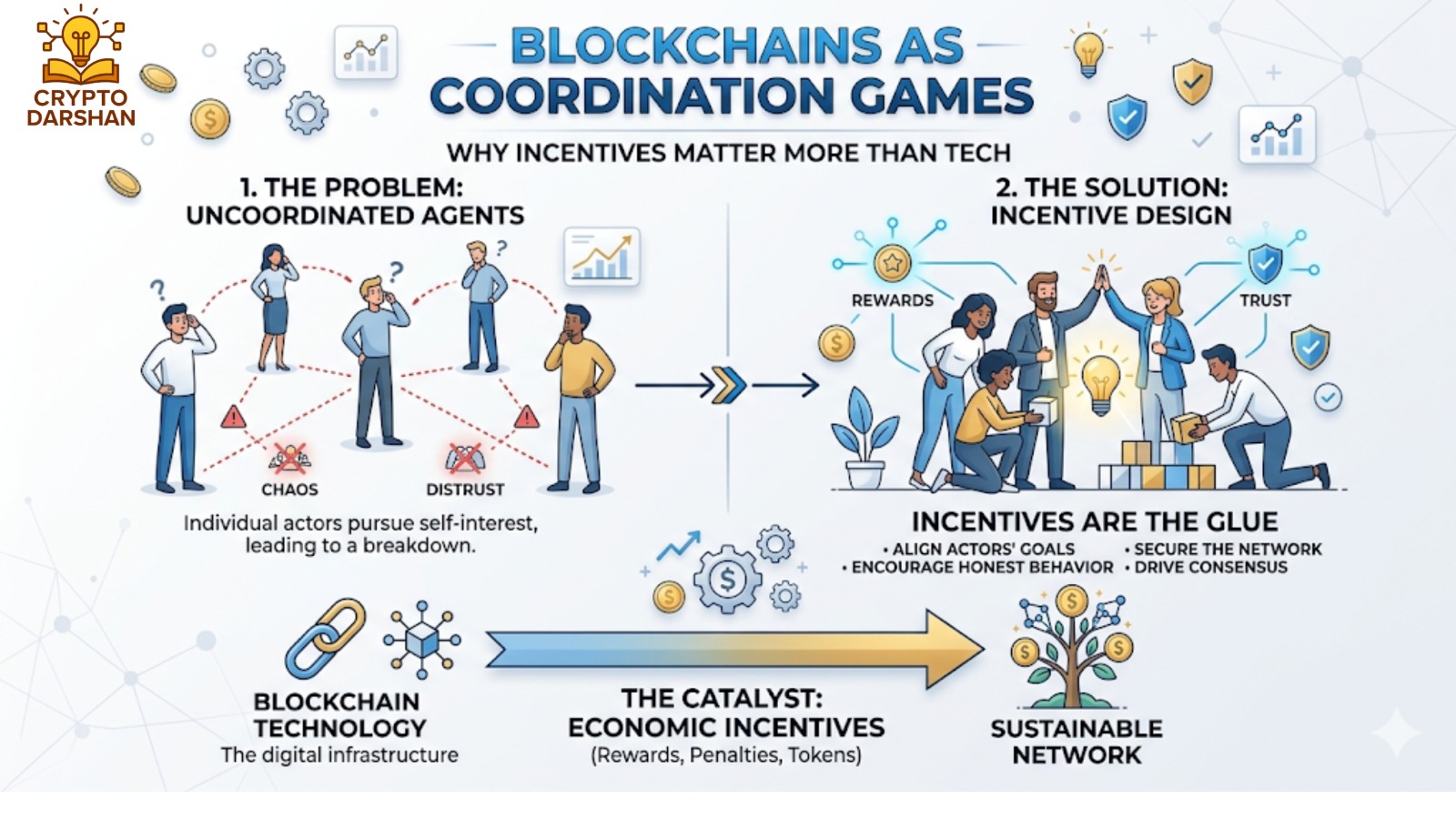
Why Incentives Matter More Than Tech

Technology Alone Doesn’t Ensure Participation
Even the most advanced blockchain technology cannot function without active participants. Incentives motivate people to validate transactions, secure the network, and contribute resources. Without rewards or benefits, users have no reason to engage, making the system ineffective regardless of its technical design.
Incentives Align Individual and Collective Goals
Incentives ensure that what benefits one participant also benefits the entire network. When miners, validators, and users act in their own interest, they simultaneously strengthen the system. This alignment transforms self-interest into collective cooperation, which technology alone cannot achieve.
They Maintain Network Security and Honesty
Incentives discourage malicious behavior by making attacks costly and cooperation profitable. For example, in Proof of Stake systems, validators risk losing their staked tokens if they cheat. This economic pressure keeps participants honest, something pure technology cannot enforce on its own.
They Drive Long-Term Sustainability

Incentives encourage participants to think beyond short-term gains. Properly designed reward systems promote consistent engagement, governance participation, and ecosystem growth. Without sustainable incentives, even technically strong blockchains can lose momentum over time.
They Enable Decentralized Governance
In decentralized systems, there’s no central authority to enforce rules. Incentives act as the invisible hand that guides decision-making and cooperation. Token-based voting, staking rewards, and community grants all rely on incentives to maintain fair and active governance.
They Foster Innovation and Ecosystem Growth
Incentives attract developers, entrepreneurs, and users to build and expand blockchain ecosystems. By rewarding innovation and contribution, blockchains evolve organically. Technology provides the foundation, but incentives fuel the creativity and expansion that keep systems alive.
They Build Trust and Social Coordination
Incentives create predictable outcomes that build trust among participants. When everyone knows that cooperation leads to rewards and dishonesty leads to loss, confidence in the system grows. This trust forms the social glue that technology alone cannot replicate.
The Dynamics of Blockchain Coordination Games

The Role of Network Effects
Network effects amplify the power of Coordination Games in blockchain ecosystems. As more participants join a network, its value increases, attracting even more users. This positive feedback loop strengthens coordination and makes defection less attractive.
Bitcoin’s success illustrates this dynamic. Its large user base, mining community, and liquidity create a powerful coordination equilibrium. Competing blockchains struggle to replicate this because breaking an established coordination equilibrium requires overwhelming incentives or innovation.
Forks as Failed Coordination
Forks occur when participants in a blockchain Coordination Game fail to maintain consensus. Disagreements over protocol changes, governance, or ideology can lead to splits, creating new chains. Each fork represents a breakdown in coordination, where players choose different equilibria.
For example, the Bitcoin Cash fork emerged from disagreements about block size. Both sides believed their version better served the network’s goals, but the split diluted coordination and fragmented the community. Forks highlight the delicate balance of incentives and beliefs in blockchain Coordination Games.
Governance and Decision-Making
Blockchain governance is itself a Coordination Game. Decisions about upgrades, parameter changes, or funding require collective agreement. On-chain governance systems like those in Tezos or Polkadot formalize this process, allowing token holders to vote on proposals. Off-chain governance, as seen in Bitcoin or Ethereum, relies on social consensus and community debate.
Effective governance depends on aligning incentives among stakeholders. If governance mechanisms reward participation and transparency, coordination improves. Poorly designed governance, however, can lead to apathy, manipulation, or centralization.
Case Studies: Coordination Games in Action

Bitcoin: The Original Coordination Game
Bitcoin exemplifies how Coordination Games underpin blockchain success. Its design aligns incentives among miners, users, and developers. Miners secure the network for rewards, users trust the system for its stability, and developers maintain the code for ideological and reputational reasons. The equilibrium is sustained by shared belief in Bitcoin’s value and scarcity.
Despite technological limitations, Bitcoin’s incentive structure has maintained coordination for over a decade. Its resilience demonstrates that incentives, not technology, are the foundation of blockchain stability.
Ethereum: Evolving Coordination Through Innovation
Ethereum extends the concept of Coordination Games by enabling programmable incentives through smart contracts. Its transition from Proof of Work to Proof of Stake represents a shift in coordination dynamics. Validators now stake tokens instead of expending energy, aligning incentives around sustainability and security.
Ethereum’s ecosystem of decentralized applications (dApps) also functions as a network of interconnected Coordination Games. Each dApp relies on users, developers, and liquidity providers coordinating through token incentives and governance mechanisms.
DAOs: Decentralized Coordination in Practice
Decentralized Autonomous Organizations (DAOs) are pure expressions of Coordination Games. They enable groups to coordinate resources, make decisions, and execute actions without centralized control. Token holders vote on proposals, and smart contracts enforce outcomes automatically.
The success of a DAO depends on incentive alignment. If token holders act in self-interest without considering collective welfare, coordination breaks down. Effective DAOs design mechanisms that reward participation, transparency, and long-term commitment.
Designing Effective Blockchain Coordination Games
Principles of Incentive Design
Designing successful blockchain Coordination Games requires balancing multiple factors:
- Alignment – Incentives must align individual goals with collective outcomes.
- Fairness – Rewards should reflect contribution and risk.
- Transparency – Rules must be clear and predictable.
- Adaptability – Systems should evolve as conditions change.
- Security – Penalties must deter malicious behavior.
These principles ensure that participants find cooperation rational and sustainable.
Mechanism Design and Game Theory
Mechanism design, a branch of game theory, provides tools for creating systems where desired outcomes emerge from individual self-interest. In blockchain Coordination Games, mechanism design helps structure rewards, penalties, and governance to achieve equilibrium.
For instance, staking mechanisms use deposits as collateral to ensure honest behavior. Voting systems use token-weighted decisions to reflect stakeholder influence. Each mechanism transforms potential conflict into coordinated action.
Tokenomics as Coordination Architecture
Tokenomics, the economic design of tokens, serves as the architecture of blockchain Coordination Games. Tokens represent both value and participation rights. Their distribution, utility, and scarcity influence how participants coordinate.
Well-designed tokenomics encourage long-term engagement and discourage speculation. Poorly designed systems, however, can lead to short-term manipulation and collapse. Thus, tokenomics is not just economics—it is the language of coordination.
Challenges in Blockchain Coordination Games

The Problem of Free Riders
In many Coordination Games, some participants benefit from others’ efforts without contributing themselves. In blockchains, free riders may use the network without paying fees or participate in governance without voting. This weakens coordination and undermines sustainability.
Solutions include introducing participation rewards, reputation systems, or penalties for inactivity. By internalizing the cost of free riding, blockchains can maintain stronger coordination.
Information Asymmetry and Trust
Coordination requires shared information and trust. In decentralized systems, participants may lack full visibility into others’ actions or intentions. This information asymmetry can lead to mistrust and inefficiency.
Transparency mechanisms—such as open-source code, public ledgers, and verifiable smart contracts—reduce asymmetry. By making actions observable, blockchains strengthen the equilibrium of Coordination Games.
Governance Capture and Centralization
As blockchain networks grow, power can concentrate among large stakeholders or developers. This centralization threatens the decentralized equilibrium of Coordination Games. Governance capture occurs when a small group controls decisions, undermining collective coordination.
Mitigating this requires designing governance systems that balance influence, encourage participation, and prevent dominance. Quadratic voting, reputation-based systems, and rotating leadership are potential solutions.
The Future of Coordination Games in Blockchain

Beyond Finance: Coordination in Society
The concept of Coordination Games extends beyond cryptocurrencies. Blockchains can coordinate supply chains, energy grids, identity systems, and even social movements. By aligning incentives across diverse actors, they enable collective action without centralized control.
For example, decentralized energy markets allow producers and consumers to coordinate directly. In digital identity systems, users and institutions coordinate trust through verifiable credentials. Each application represents a new frontier in coordination.
AI and Automated Coordination
The integration of artificial intelligence with blockchain could create autonomous Coordination Games where algorithms negotiate, trade, and cooperate without human intervention. Smart contracts could dynamically adjust incentives based on real-time data, optimizing coordination efficiency.
This convergence of AI and blockchain may redefine how societies organize resources, governance, and trust.
The Human Element
Despite technological advances, human behavior remains central to blockchain Coordination Games. Trust, belief, and social norms shape how participants interpret incentives. Technology can facilitate coordination, but it cannot replace the human capacity for cooperation and meaning.
Future blockchain systems must therefore blend technical precision with social understanding, designing incentives that resonate with human values.
FAQ

1. What does it mean to view blockchains as coordination games?
It means blockchains work because participants (users, validators, developers) align their actions around shared rules and incentives. Instead of just relying on technology, success depends on people cooperating within the system.
2. Why are incentives more important than technology in blockchains?
Even the best technology fails if participants aren’t motivated to use it honestly. Incentives—like rewards, fees, and penalties—ensure that users act in ways that keep the network secure and functional.
3. How do incentives keep blockchain networks secure?
Incentives reward honest behavior (like validating transactions correctly) and punish dishonest actions (like attempting fraud). This makes attacking the network costly and unprofitable.
4. What role do tokens play in coordination?
Tokens act as economic signals. They reward contributors, align stakeholders, and create a shared interest in the network’s success, making coordination easier.
5. What happens when incentives are poorly designed?
Poor incentives can lead to issues like:
- Network congestion
- Exploits or hacks
- Validator centralization
- Lack of user participation
Ultimately, the system may fail even if the underlying tech is strong.
6. How do consensus mechanisms relate to coordination games?
Consensus mechanisms (like Proof of Work or Proof of Stake) are structured incentive systems. They define how participants agree on the state of the blockchain while rewarding honest participation.
7. Can a blockchain succeed without strong incentives?
No. Without proper incentives, participants have no reason to act in the network’s best interest, leading to instability or collapse.
8. What is an example of coordination failure in blockchain?
Examples include network forks, low validator participation, or exploit-driven crashes—situations where participants fail to align due to conflicting incentives.
9. How do transaction fees influence coordination?
Transaction fees prioritize which transactions get processed and compensate validators. Proper fee design ensures efficient network usage and prevents spam.
Conclusion
Blockchains are not merely databases or financial tools, they are living Coordination Games that align human behavior through incentives. Their success depends less on cryptographic innovation and more on the careful design of economic, social, and governance mechanisms that sustain cooperation.
Understanding blockchains as Coordination Games reveals that technology alone cannot guarantee decentralization or trust. Incentives are the true engine of coordination, transforming individual self-interest into collective order. As blockchain ecosystems evolve, the mastery of incentive design will determine which networks thrive and which fade into history.
In the end, the future of blockchain is not a technological race but a coordination challenge. Those who understand and design for the dynamics of Coordination Games will shape the next era of decentralized civilization.