
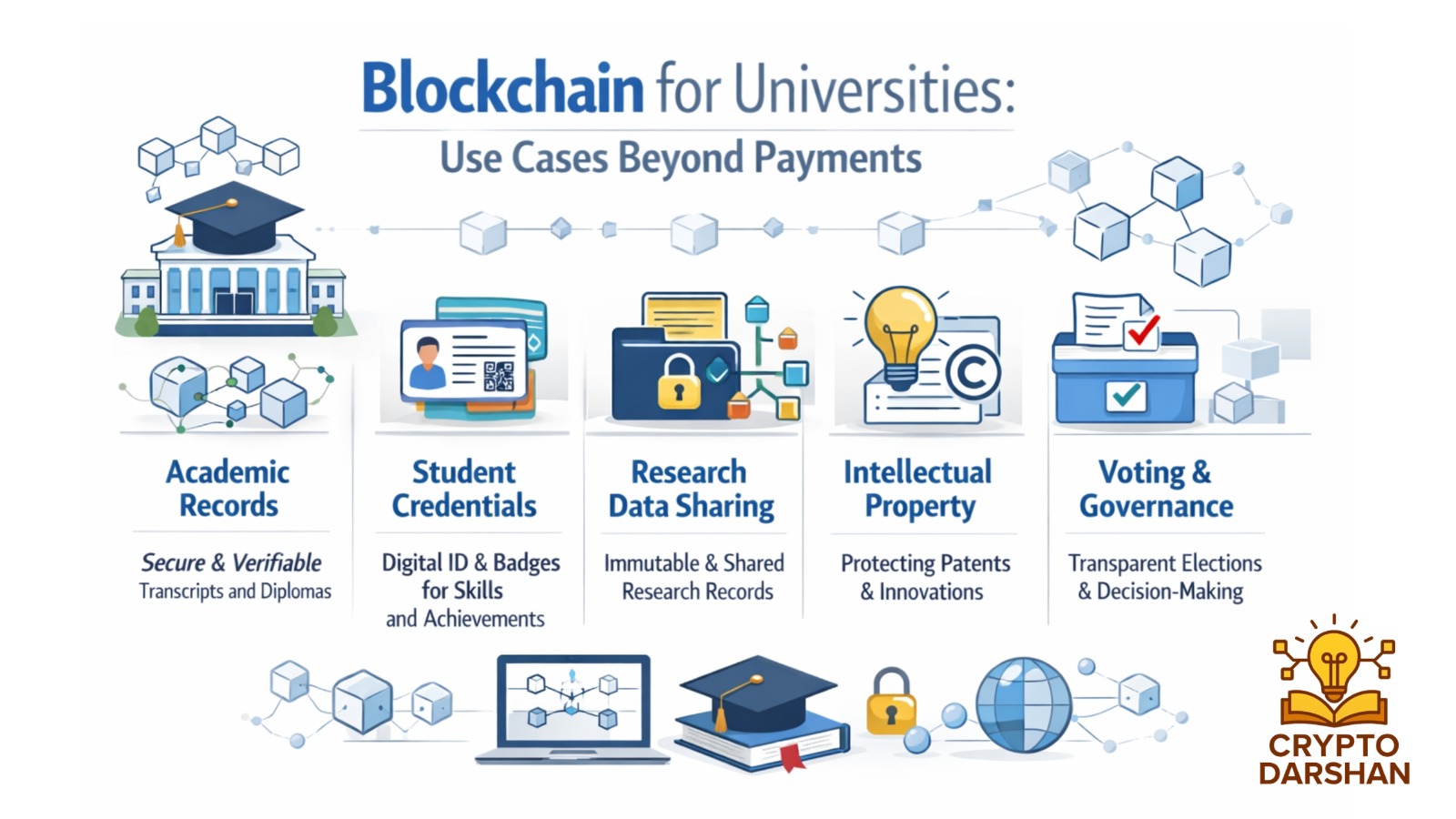
Blockchain university use cases go far beyond payments, enabling secure academic records, intellectual property management, and decentralized learning ecosystems. Blockchain technology, once synonymous with cryptocurrencies and digital payments, has evolved into a transformative force across multiple industries. In higher education, universities are beginning to explore blockchain’s potential beyond financial transactions. From academic credentialing to research integrity, blockchain offers a decentralized, transparent, and secure framework that can redefine how institutions manage data, verify achievements, and foster collaboration.
This article explores the diverse use cases of blockchain in universities beyond payments, examining how it can enhance trust, efficiency, and innovation in academia. It also discusses the challenges, implementation strategies, and future outlook of blockchain adoption in higher education.
Understanding Blockchain Technology
Blockchain is a distributed ledger system that records transactions across multiple computers in a network. Each record, or “block,” contains data that is cryptographically linked to the previous block, forming a secure and immutable chain. This decentralized structure eliminates the need for intermediaries, ensuring transparency and trust among participants.
Key Features of Blockchain
- Decentralization – Data is stored across a network of nodes rather than a central server, reducing the risk of single-point failures.
- Immutability – Once recorded, data cannot be altered or deleted, ensuring integrity and authenticity.
- Transparency – All participants can view and verify transactions, promoting accountability.
- Security – Cryptographic algorithms protect data from unauthorized access or tampering.
- Smart Contracts – Self-executing contracts automate processes based on predefined conditions.
These features make blockchain particularly suitable for universities, where data integrity, verification, and collaboration are critical.
Why Universities Need Blockchain Beyond Payments
Universities handle vast amounts of sensitive data, including academic records, research outputs, intellectual property, and administrative information. Traditional systems often rely on centralized databases that are vulnerable to breaches, manipulation, and inefficiencies. Blockchain offers a solution by providing a secure, transparent, and tamper-proof infrastructure.
Key Drivers for Blockchain Adoption in Universities
- Data Security and Privacy: Protecting student and faculty data from cyber threats.
- Verification and Trust: Ensuring authenticity of academic credentials and research outputs.
- Operational Efficiency: Reducing administrative overhead through automation.
- Global Collaboration: Enabling seamless data sharing across institutions and borders.
- Innovation and Competitiveness: Staying ahead in the digital transformation of education.
Use Cases of Blockchain in Universities Beyond Payments
1. Academic Credential Verification
One of the most promising applications of blockchain in higher education is the issuance and verification of academic credentials. Traditional paper-based certificates are prone to forgery and loss, while digital copies can be easily manipulated. Blockchain-based credentials solve these issues by providing verifiable, tamper-proof records. Similar to how assets are digitized in Real-World Assets (RWA) on Blockchain, universities can tokenize academic certificates and research ownership securely.
How It Works
Universities issue digital diplomas or transcripts as blockchain tokens. Each credential is recorded on the blockchain with a unique cryptographic signature. Employers or other institutions can verify the authenticity of these credentials instantly without contacting the issuing university.
Benefits
- Eliminates credential fraud.
- Simplifies verification for employers and institutions.
- Reduces administrative workload.
- Enhances student mobility across borders.
Real-World Example
The Massachusetts Institute of Technology (MIT) launched the Blockcerts project, allowing graduates to receive blockchain-based diplomas that can be independently verified anywhere in the world.
2. Student Identity Management
Managing student identities across multiple systems admissions, learning management, libraries, and alumni networks can be complex. Blockchain enables a unified, self-sovereign identity (SSI) system where students control their digital identities.
How It Works
Each student is assigned a blockchain-based digital identity containing verified credentials, achievements, and personal data. Students can grant or revoke access to specific information as needed.
Benefits
- Enhances privacy and data ownership.
- Simplifies access to university services.
- Reduces identity theft and data breaches.
- Facilitates lifelong learning records.
Example
The European Blockchain Services Infrastructure (EBSI) initiative supports cross-border student identity verification across European universities, enabling seamless academic mobility.
3. Research Data Management and Integrity
Research integrity is a cornerstone of academic credibility. Blockchain can ensure that research data, methodologies, and results are securely recorded and timestamped, preventing manipulation or plagiarism.
How It Works
Researchers upload data and findings to a blockchain ledger, creating immutable timestamps. Any updates or revisions are recorded as new blocks, maintaining a transparent audit trail.
Benefits
- Ensures authenticity and reproducibility of research.
- Prevents data tampering and plagiarism.
- Facilitates collaboration and data sharing.
- Enhances trust in published results.
Example
The University of Cambridge has explored blockchain for managing research data provenance, ensuring transparency in collaborative projects.
4. Intellectual Property (IP) Protection
Universities are hubs of innovation, producing patents, inventions, and creative works. Blockchain can streamline IP management by providing verifiable proof of ownership and creation.
How It Works
When a researcher or student creates an invention, the details are recorded on the blockchain with a timestamp. This record serves as immutable proof of authorship and ownership.
Benefits
- Protects intellectual property rights.
- Simplifies patent filing and licensing.
- Encourages innovation and collaboration.
- Reduces legal disputes over ownership.
Example
The University of New South Wales has piloted blockchain-based IP registries to protect academic innovations and streamline commercialization.
5. Transparent Academic Publishing
Academic publishing often faces challenges such as plagiarism, peer-review manipulation, and lack of transparency. Blockchain can bring accountability and openness to the publishing process.
How It Works
Each stage of the publication process submission, peer review, revision, and acceptance is recorded on the blockchain. Reviewers’ contributions can be verified, and the publication’s history remains transparent.
Benefits
- Promotes transparency in peer review.
- Reduces plagiarism and duplicate submissions.
- Recognizes reviewer contributions.
- Builds trust in academic publishing.
Example
Platforms like ARTiFACTS use blockchain to record and verify research outputs, ensuring transparency and credit for all contributors.
6. Supply Chain Management for Campus Operations
Universities manage extensive supply chains for equipment, food services, and construction. Blockchain can enhance transparency and efficiency in procurement and logistics.
How It Works
Each transaction in the supply chain from supplier to delivery is recorded on the blockchain. Stakeholders can track the origin, movement, and authenticity of goods.
Benefits
- Increases transparency in procurement.
- Reduces fraud and corruption.
- Ensures ethical sourcing and sustainability.
- Improves inventory management.
Example
Some universities have begun exploring blockchain-based supply chain systems to track sustainable food sourcing and campus construction materials.
7. Decentralized Learning Platforms
Blockchain can support decentralized education models where learners earn micro-credentials or badges for completing specific modules or skills. These credentials are stored on the blockchain, forming a lifelong learning record.
How It Works
Students complete online courses or skill modules. Each achievement is recorded as a verifiable blockchain credential that can be shared with employers or other institutions.
Benefits
- Encourages continuous learning.
- Provides verifiable skill records.
- Supports personalized education pathways.
- Enables interoperability across platforms.
Example
The Open University’s Knowledge Media Institute has explored blockchain for open learning credentials, allowing learners to build portable, verifiable skill portfolios.
8. Alumni Engagement and Fundraising

Blockchain can transform alumni relations by enabling transparent donation tracking and engagement programs.
How It Works
Donations are recorded on a blockchain ledger, allowing donors to see how their contributions are used. Smart contracts can automate scholarship disbursements or project funding.
Benefits
- Increases transparency in fundraising.
- Builds trust with donors.
- Simplifies scholarship management.
- Strengthens alumni engagement.
Example
Some universities are experimenting with blockchain-based donation platforms that allow alumni to fund specific projects and track their impact in real time.
9. Administrative Process Automation
University administration involves numerous repetitive tasks such as admissions, course registration, and record management. Blockchain and smart contracts can automate these processes, reducing errors and delays.
How It Works
Smart contracts execute predefined actions when conditions are met for example, automatically enrolling a student once payment and prerequisites are verified.
Benefits
- Reduces administrative workload.
- Minimizes human error.
- Enhances transparency and accountability.
- Improves student experience.
Example
Pilot projects in Asia and Europe have demonstrated blockchain’s potential to streamline admissions and course registration processes.
10. Cross-Institutional Collaboration
Blockchain enables secure data sharing among universities, research institutions, and industry partners. This fosters collaboration while maintaining data integrity and privacy.
How It Works
Institutions join a shared blockchain network where research data, credentials, and resources can be exchanged securely. Access permissions are managed through smart contracts.
Benefits
- Facilitates global academic collaboration.
- Protects sensitive data.
- Enhances interoperability between systems.
- Accelerates innovation.
Example
The Blockchain in Education Network (B.CERT) connects universities worldwide to share verified credentials and research data securely.
Implementation Strategies for Universities

Adopting blockchain in universities requires a structured and thoughtful approach. Institutions must ensure that the technology aligns with their academic, administrative, and research goals. Below are key strategies explained briefly:
1. Define Clear Objectives
Universities should start by identifying specific problems blockchain can solve, such as verifying credentials, securing research data, or improving administrative efficiency. Having clear goals prevents unnecessary investment in technology that doesn’t address real needs.
2. Build Strategic Partnerships
Collaboration is essential. Universities can partner with technology providers, government agencies, and other educational institutions to share expertise, reduce costs, and develop interoperable systems.
3. Start with Pilot Projects
Instead of implementing blockchain across all departments at once, universities should begin with small pilot programs. For example, a pilot for issuing digital diplomas can help test the system’s reliability before scaling it campus-wide.
4. Ensure Legal and Regulatory Compliance
Blockchain systems must comply with data protection laws such as GDPR or FERPA. Universities should establish policies for data privacy, consent, and access control to protect student and faculty information.
5. Invest in Training and Awareness
Faculty, staff, and students need to understand how blockchain works and how it benefits them. Training programs and workshops can build confidence and encourage adoption across the institution.
6. Integrate with Existing Systems
Blockchain should complement not replace existing university systems like student information systems or learning management platforms. Seamless integration ensures smooth operations and data consistency.
7. Monitor and Evaluate Progress
After implementation, universities should continuously assess performance, gather feedback, and make improvements. Regular evaluation ensures that blockchain initiatives remain effective and aligned with institutional goals.
Challenges of Blockchain Adoption in Universities
While blockchain offers many advantages, universities face several challenges when trying to implement it effectively. These challenges must be addressed to ensure successful adoption.
1. Technical Complexity
Blockchain technology requires specialized knowledge in cryptography, distributed systems, and smart contracts. Many universities may lack the technical expertise or infrastructure needed to develop and maintain such systems.
2. Scalability Issues
Public blockchains can become slow and expensive as the number of transactions increases. Universities handling large volumes of student records or research data may face performance limitations.
3. Regulatory and Legal Concerns
Data privacy laws like GDPR and FERPA impose strict rules on how personal data is stored and shared. Since blockchain data is immutable, ensuring compliance with these regulations can be challenging.
4. High Implementation Costs
Developing, testing, and maintaining blockchain systems can be costly. Smaller universities may struggle to allocate sufficient budgets for technology, training, and infrastructure.
5. Resistance to Change
Faculty and administrative staff may be hesitant to adopt new technologies due to unfamiliarity or fear of disruption. Overcoming this resistance requires strong leadership and clear communication about blockchain’s benefits.
6. Interoperability Problems
Different blockchain platforms may not easily communicate with each other. This lack of standardization can create data silos and limit collaboration between institutions.
Future Outlook: The Role of Blockchain in Higher Education

The future of blockchain in universities extends far beyond payments. As technology matures, it will become a foundational layer for digital transformation in education. Key trends shaping the future include:
1. Global Credential Networks
Universities worldwide will join interoperable blockchain networks, allowing seamless verification of academic records across borders.
2. Integration with Artificial Intelligence
Blockchain and AI will combine to enhance data analytics, personalized learning, and predictive modeling in education.
3. Smart Campus Ecosystems
Blockchain will underpin smart campus operations, integrating IoT devices, energy management, and student services.
4. Decentralized Autonomous Universities (DAUs)
Decentralized Autonomous Universities represent a paradigm shift in academic governance. Future universities may operate as decentralized organizations governed by smart contracts, enabling transparent decision-making and resource allocation.
5. Lifelong Learning Passports
Blockchain will enable individuals to maintain lifelong learning records, integrating formal education, professional training, and personal achievements.
Blockchain University Use Cases: Real-World Case Studies

MIT Media Lab – Digital Diplomas
MIT’s Blockcerts initiative allows graduates to receive blockchain-based diplomas that can be verified instantly by employers, reducing credential fraud.
University of Nicosia – Blockchain Education
The University of Nicosia in Cyprus became the first to offer a master’s degree in blockchain and accept tuition payments in cryptocurrency. It also issues blockchain-based certificates.
Sony Global Education – Academic Data Sharing
Sony developed a blockchain platform for sharing academic records securely among institutions, promoting global student mobility.
Holberton School – Transparent Credentialing
Holberton School uses blockchain to issue verifiable certificates, ensuring employers can trust the authenticity of graduates’ qualifications.
Blockchain University Use Cases: Ethical Challenges and Social Considerations

Blockchain adoption in universities raises ethical considerations that must be addressed to ensure equitable and responsible use.
1. Data Privacy
While blockchain enhances transparency, it must also protect sensitive student and research data through encryption and access controls. Technologies like Zero-Knowledge Proofs (ZK Rollups) allow universities to verify student credentials without exposing sensitive personal data.
2. Digital Divide
Not all institutions or students have equal access to advanced technologies, potentially widening educational inequalities.
3. Governance and Accountability
Universities must establish clear governance frameworks for blockchain networks to prevent misuse or centralization of control.
4. Environmental Impact
Some blockchain systems consume significant energy. Universities should prioritize energy-efficient or proof-of-stake models.
Steps Toward a Blockchain-Enabled University
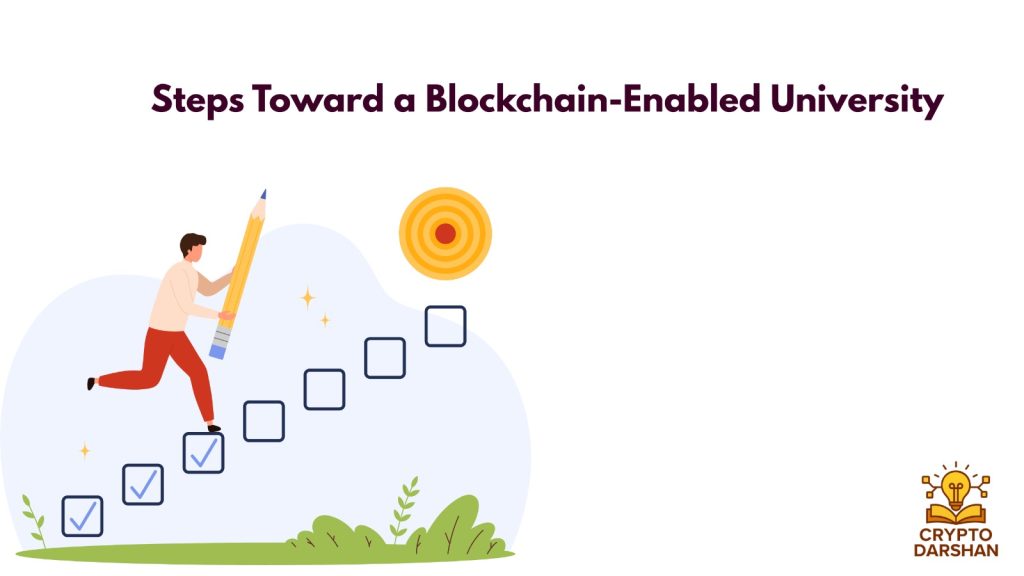
- Assessment: Evaluate institutional readiness and identify key areas for blockchain integration.
- Strategy Development: Create a roadmap aligning blockchain initiatives with academic and administrative goals.
- Pilot Implementation: Launch small-scale projects to test functionality and gather feedback.
- Evaluation: Measure outcomes in terms of efficiency, transparency, and user satisfaction.
- Scaling: Expand successful pilots across departments or campuses.
- Continuous Improvement: Update systems based on technological advancements and regulatory changes.
Blockchain University Use Cases in Education – Frequently Asked Questions
1. What does “blockchain for universities” mean beyond payments?
Blockchain for universities goes far beyond tuition payments or crypto transactions. It includes secure digital certificates, student identity management, academic record storage, research verification, and transparent administrative processes.
2. How can blockchain improve student record management?
Universities can store academic transcripts and certificates on a blockchain network. This ensures records are tamper-proof, instantly verifiable, and accessible globally without relying on manual paperwork.
For example, institutions could use platforms built on Ethereum or Hyperledger to create secure credential systems.
3. Can blockchain prevent fake degrees and certificate fraud?
Yes. Blockchain creates immutable digital credentials. Once a certificate is recorded on the blockchain, it cannot be altered. Employers can verify authenticity directly without contacting the university, reducing fraud significantly.
4. How does blockchain support digital identity for students?
Blockchain enables decentralized identity (DID). Students control their digital IDs and share verified information when needed. This reduces dependency on centralized databases and increases privacy and security.
Projects under IBM and Microsoft have explored blockchain-based identity solutions.
5. Can blockchain improve research transparency in universities?
Yes. Research data, publications, and intellectual property rights can be timestamped and stored on blockchain. This proves originality, protects authorship, and increases transparency in academic research.
6. Is blockchain useful for university voting systems?
Absolutely. Student elections and governance voting can be conducted on blockchain to ensure transparency, prevent manipulation, and build trust in the process.
7. How can smart contracts benefit universities?
Smart contracts automatically execute agreements when conditions are met. Universities can use them for scholarship disbursement, grant releases, faculty contracts, and attendance-based incentives.
8. Is blockchain implementation expensive for universities?
Initial setup costs can be significant. However, over time, blockchain reduces administrative costs, fraud losses, paperwork, and manual verification expenses.
Conclusion
Blockchain technology holds transformative potential for universities far beyond financial transactions. By enabling secure credential verification, transparent research management, decentralized learning, and efficient administration, blockchain can redefine how higher education operates in the digital age.
While challenges such as technical complexity and regulatory uncertainty remain, the benefits of trust, transparency, and efficiency make blockchain a powerful tool for academic innovation. As universities continue to explore and adopt blockchain solutions, they will not only enhance institutional credibility but also empower students, researchers, and educators to thrive in a decentralized, data-driven world.