Bitcoin’s huge rise over the past two years was largely driven by spot ETFs, which brought in billions of dollars and helped push the price above $100,000. But in 2026, those strong inflows are slowing, leading investors to wonder whether ETFs have shifted from driving the rally to holding it back.
ETF Inflows: From Record Smashes to Sudden Stops
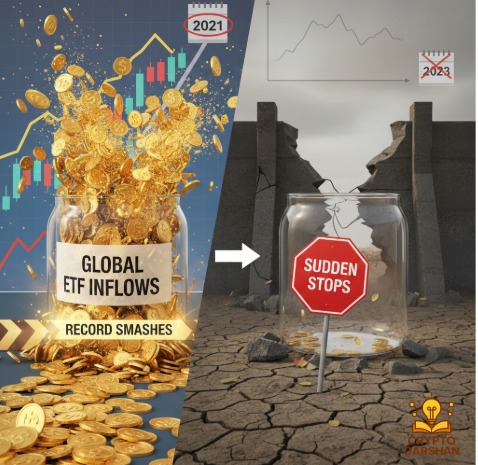
Spot Bitcoin ETFs launched in early 2024 with huge excitement, attracting over $12.5 billion in just their first three months the strongest ETF debut ever. BlackRock’s iShares Bitcoin Trust (IBIT) and Fidelity Investments’s Fidelity Wise Origin Bitcoin Fund (FBTC) led the inflows, which climbed to nearly $27 billion by late 2025. By making Bitcoin easy to buy through retirement accounts and traditional brokerage platforms, these ETFs helped push Bitcoin to a record high of around $126,000 in October 2025.
Fast-forward to early 2026: the momentum has reversed sharply. U.S. spot Bitcoin and Ether ETFs shed over $1 billion in outflows between January 6-8, erasing brief year-start gains. By mid-February, cumulative Bitcoin ETFs inflows had dipped to about $20 billion, signaling a clear deceleration. Ether ETFs mirrored the trend, with $258 million exiting after modest inflows. This isn’t isolated November 2025 saw $3.48 billion in BTC outflows, the second-worst month post-launch.
Why the chill? Analysts point to fading novelty. Initial FOMO drew retail and institutional buyers, but as BTC matures, enthusiasm wanes without fresh catalysts like rate cuts or halvings. Broader market pressures, including a strong U.S. dollar and Fed hawkishness, have sidelined risk assets.
Why This Shift Hurts Bitcoin More Than Helps

ETFs were Bitcoin’s “huge tailwind” by expanding liquidity and bridging TradFi to crypto. They absorbed selling pressure from long-term holders and miners, stabilizing prices during volatility. Without them, spot markets feel every sell-off more acutely, amplifying short-term swings. To understand how ETFs reshaped Bitcoin’s market structure, see our analysis in BlackRock, ETFs, and the Institutionalization of Bitcoin.
In 2026, the headwind is palpable. ETF outflows coincide with BTC trading around $68,000-$95,000, down from peaks amid macro squeezes like rising real yields. Geopolitical boosts think U.S.-China tensions favoring “digital gold”offer counterbalance, but can’t fully offset liquidity droughts. Corporate treasuries like MicroStrategy continue stacking sats, yet their impact pales against Bitcoin ETFs-scale flows.
Experts like those at Delphi Digital note policy turning neutral at best, with QT ending but no aggressive easing. Fundstrat’s Tom Lee argues BTC’s sensitivity to liquidity means ETF pullbacks could prolong consolidation unless risk appetite rebounds.
| Factor | Tailwind Phase (2024-2025) | Headwind Phase (2026) |
|---|---|---|
| Inflows | $27B peak; record launches | $1B+ outflows early year; down to $20B cumulative |
| Price Impact | Drove $126K ATH | Contributes to $68K-$95K range-bound trading |
| Market Liquidity | Buffered volatility | Heightens spot sensitivity to sells |
| Investor Base | Fresh TradFi money | Fading hype; profit-taking dominant |
Broader Market Ripples and Investor Strategies

The ETF slowdown ripples beyond BTC. Altcoins feel the pinch as BTC dominance holds firm, squeezing liquidity in DeFi and memes. Yet, on-chain innovation like Layer-2 scaling and RWAs could spark organic demand. Trump’s pro-crypto stance, including pardons and lighter regs, adds tailwinds elsewhere.
For traders, this headwind screams caution. Dip-buying near $60,000 support makes sense if Fed pivots dovish, but prolonged outflows risk testing $50,000 lows. Long-term holders should eye dollar-cost averaging, betting on halvings and adoption over ETF flows. Kraken’s outlook flags a “macro-driven BTC cycle” in 2026, with liquidity shifts dictating direction.
MicroStrategy’s playbook holding through volatility remains gold. Governments and firms adding BTC to balance sheets could quietly rebuild momentum. Still, until Bitcoin ETFs reignite, expect choppier waters.
Looking Ahead: Reversal or New Normal?

Bitcoin ETFs era transformed it from niche to mainstream, but maturity brings maturity pains. The “huge tailwind” of endless inflows was never sustainable; now, as a headwind, it forces BTC to stand on fundamentals like scarcity and network effects.
If history repeats itself, Bitcoin often dips after a halving before starting a new rally. Bitcoin ETFs could see renewed demand if yields fall. Global events and policy changes like a drop in reverse repo balances might also shift momentum by mid-year. For now, though, the slowdown in Bitcoin ETFs cools bullish excitement and reminds investors that crypto rewards patience, not hype.