
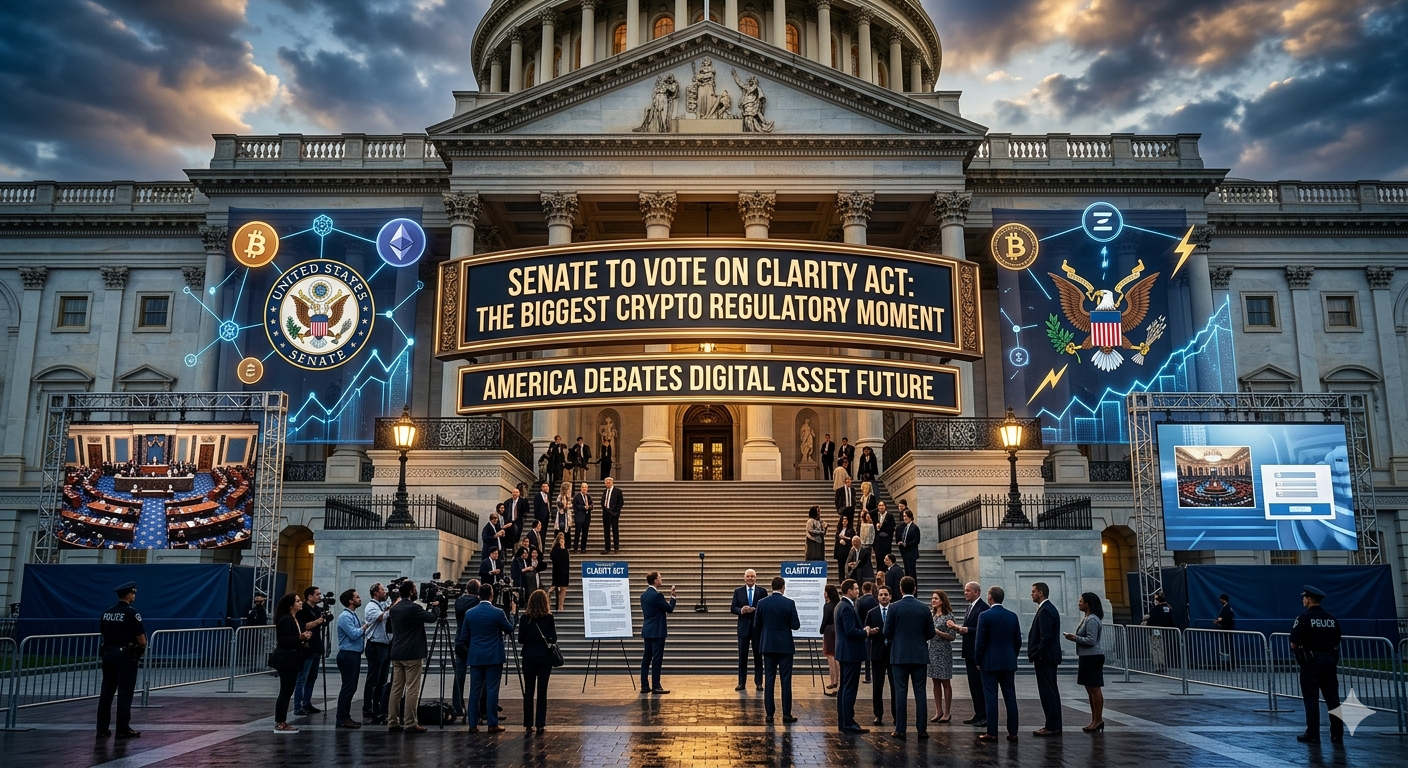
The United States Senate Banking Committee is preparing to move forward on the Digital Asset Market CLARITY Act — the most comprehensive crypto regulation bill ever to clear one chamber of Congress — with a committee markup expected as early as next week.
The development marks a major turning point for legislation that has been stalled in the Senate for nearly a year after sailing through the House with a commanding 294–134 bipartisan vote back in July 2025.
The Stablecoin Standoff Is Over — For Now
The biggest obstacle blocking the bill has been a fierce battle between the banking industry and crypto firms over stablecoin yield. That fight appears to have reached a workable resolution.
Senators Thom Tillis (R-NC) and Angela Alsobrooks (D-MD) released compromise language that bans crypto companies from paying interest or yield simply for holding stablecoins — a concession to banks worried about deposit flight — but permits activity-based rewards when users actually spend or use stablecoins. In short: “buy and use” is allowed; “buy and hold” yield is not.
The crypto industry responded immediately. Coinbase CEO Brian Armstrong posted “mark it up” on X, signaling his company’s go-ahead after months of withheld support. Circle’s Chief Strategy Officer Dante Disparte called the deal “meaningful progress.” Senator Cynthia Lummis declared, “We are closer than ever to getting the CLARITY Act across the finish line.”
What the CLARITY Act Does
At its core, the bill draws a clear regulatory map for digital assets in the United States — something the industry has been demanding for years:
- SEC vs. CFTC split: The SEC retains authority over digital assets that behave like securities, while the CFTC gets exclusive jurisdiction over digital commodities traded on decentralized networks.
- DeFi protections: Decentralized finance developers and validators get safe harbor provisions shielding them from traditional financial regulations.
- Exchange registration: A new Digital Commodity Exchange (DCE) registration framework is introduced under the CFTC.
- Federal stablecoin rules: Replaces a fragmented state-by-state licensing patchwork with a unified national standard.
- Anti-CBDC measures: The bill also bans the Federal Reserve from developing a central bank digital currency without explicit congressional approval.
The Clock Is Ticking
At the Consensus 2026 conference in Miami, Coinbase’s VP of U.S. Policy Kara Calvert said she expects the Senate Banking Committee markup to happen as soon as next week, adding that the bill will need at least 60 votes on the full Senate floor — meaning bipartisan support is not optional.
The White House is pushing hard. Patrick Witt, executive director of the President’s Council of Advisors for Digital Assets, has set an ambitious July 4 target for full passage, warning that American inaction could cede global rule-making authority to other nations, including China.
Senator Bernie Moreno (R-OH) has issued a firmer deadline, saying that if the bill doesn’t pass by end of May, crypto market structure legislation could be shelved “for the foreseeable future.”
Who’s Still Unsatisfied?
Not everyone is fully on board. Banking groups, led by the American Bankers Association, say the stablecoin yield compromise still doesn’t go far enough to protect deposit-taking institutions. Some Democrats, including Senator Alsobrooks, say additional compromises are needed before they can support the full bill. The Crypto Council for Innovation praised the deal but warned that the new yield restrictions go “very far beyond” what was required under last year’s GENIUS Act, which only barred stablecoin issuers — not all market participants — from paying rewards.
What Comes Next
If the Senate Banking Committee approves the bill, it still must clear the full Senate, be reconciled with the Senate Agriculture Committee’s version, and then align with the House-passed text before reaching President Trump’s desk for signature. Prediction markets currently place the odds of the CLARITY Act becoming law in 2026 at around 55%.
For global’s growing crypto community and global investors watching U.S. regulatory developments, the coming weeks in Washington could be among the most consequential in the history of digital asset regulation.