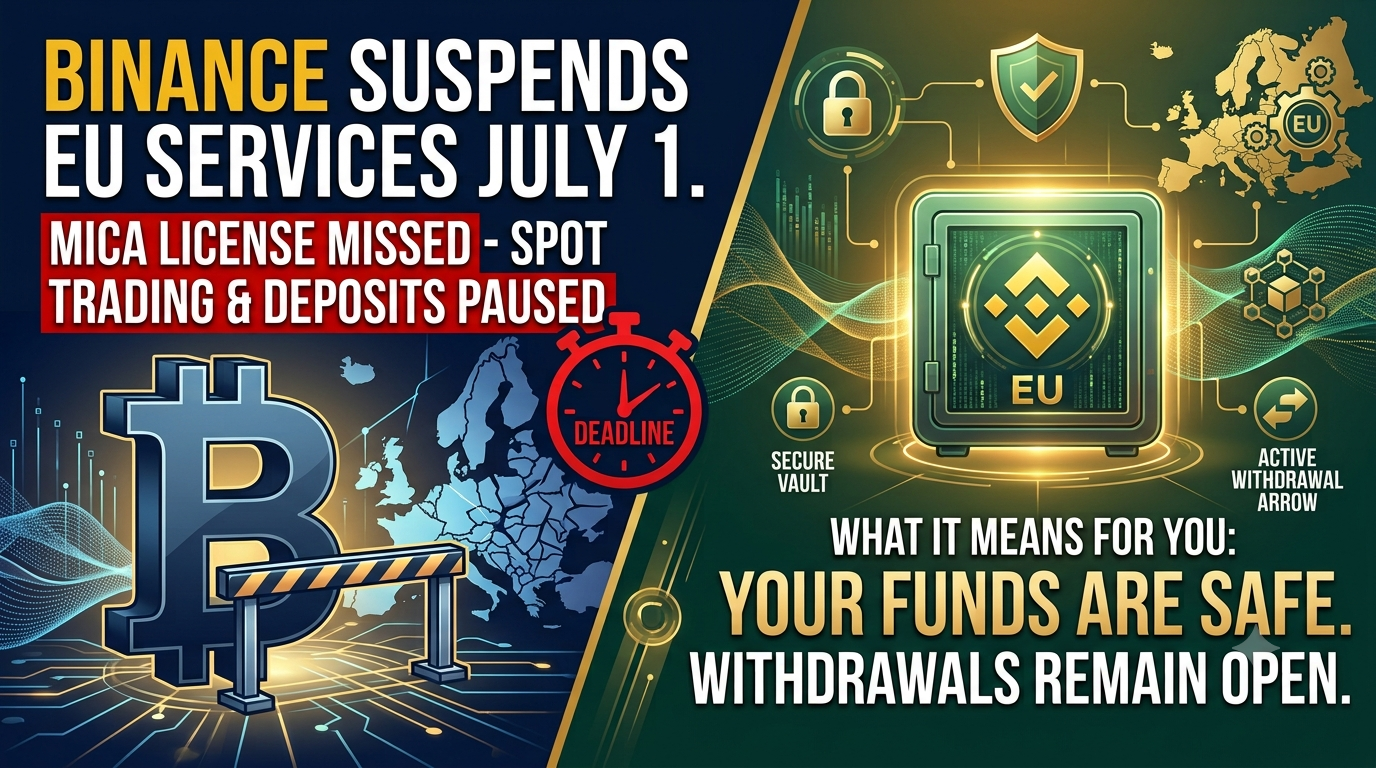
Binance, the world’s largest cryptocurrency exchange, is officially suspending a wide range of services for European Union users starting tomorrow, July 1, 2026. The drastic move comes after the exchange failed to secure a vital regulatory license under the EU’s strict Markets in Crypto-Assets (MiCA) framework before today’s hard deadline.
If you are an EU resident using Binance, here is the immediate bottom line: This is a suspension, not an exit. Your funds remain safe, and withdrawals will continue to function normally.
Here is everything Cryptodarshan readers in Europe—and anyone tracking the shifting sands of global crypto regulation—need to know right now.
What Changes on July 1 (And What Doesn’t)
Starting tomorrow, EU-based Binance users will experience a major freeze on active account features.
What is Paused:
• Trading & Capital: No new spot trading orders can be placed, and new deposits are completely disabled.
• New Users: New account sign-ups for EU residents are temporarily frozen.
• Passive Income: Access to Earn and staking products is paused.
What Stays Unaffected:
• Fund Safety: Existing funds remain entirely accessible. Nothing is frozen, locked, or seized.
• Withdrawals: Withdrawals stay wide open. You can freely move your assets to another platform or into self-custody.
• No Rush: Binance has explicitly stated it is not forcing users to rush withdrawals by a specific date.
In short: If you have funds on Binance, your money isn’t going anywhere—but your ability to actively trade, deposit, or earn yield on the platform is completely paused until further notice.
Why This Is Happening: The Unforgiving MiCA Deadline
The EU’s Markets in Crypto-Assets regulation (MiCA) is the bloc’s unified licensing framework designed to replace a chaotic patchwork of individual national rules. Under MiCA, any exchange wanting to operate across the EU’s 27 member states needs a single license—called a Crypto-Asset Service Provider (CASP) authorization. Once secured from one national regulator, it can be “passported” across the entire union.
MiCA’s generous transition period officially closes today, June 30, 2026. From July 1 onward, any firm without a CASP license is operating illegally in the EU—with zero exceptions made for size or market share.
The compliance gap is staggering. Of the more than 3,000 crypto firms previously operating across Europe, only around 210 secured full MiCA authorization. Crucially, Binance’s major global rivals—including Coinbase, Kraken, OKX, and Crypto.com—all successfully passed the bar. Binance did not.
What Went Wrong: The Greek Application Collapse
Binance initially pursued its EU compliance strategy through Greece, filing an application with the Hellenic Capital Market Commission back in January 2026. Greece was viewed as a strategic, faster route because its regulators had processed fewer applications than heavyweights like Germany.
That plan unraveled rapidly. By mid-June, reports surfaced that Greek regulators were preparing a formal rejection. On June 24, Binance abruptly withdrew its application rather than face a formal refusal, framing the move as a strategic decision to look elsewhere.
According to multiple industry reports, the core roadblock wasn’t administrative paperwork—it was Binance’s turbulent regulatory history. MiCA enforces a strict “fit and proper” test on a firm’s owners and management. Regulators heavily scrutinized whether co-founder and 90% owner Changpeng Zhao (CZ) could meet that standard, pointing to:
- The 2023 US Guilty Plea: Binance’s $4.3 billion settlement over anti-money-laundering and sanctions violations.
- CZ’s Legal Standing: CZ’s criminal plea and subsequent prison sentence (despite a late-2025 pardon by the US President).
- Ongoing Probes: An active French investigation into alleged money laundering links and a UK operating ban active since 2021.
Binance disputes that it was formally rejected, maintaining it received no official negative decision before the deadline and that withdrawing the Greek application was simply a prudent choice.
What Happens Next: Binance’s Plan B
Binance insists it remains fully committed to the European market and intends to pivot to a different member state—reportedly France—to secure its CASP license.
However, any approval there is highly unlikely to arrive overnight. EU users face a regulatory “gap period” of unknown length during which Binance cannot legally offer services. Furthermore, the France route is complicated by the fact that French authorities already have an open investigation into the exchange. If France grants a license that Greece was prepared to deny, it will raise serious questions about consistency in how MiCA is applied across the continent.
CryptoDarshan Action Plan: What EU Users Should Do
If you are an EU resident holding a Binance account, stay calm and take these practical steps
- Don’t Panic: Your capital is secure, and withdrawal gates are open. There is no need to make panic trades or bad market moves.
- Execute an Orderly Transfer: Plan a calm, calculated migration of your funds. You can move them to fully MiCA-compliant competitors like Coinbase, Kraken, OKX, or Crypto.com, or choose to withdraw to a private self-custody wallet (like Ledger or MetaMask).
- Guard Against Phishing Scams: Times of regulatory confusion are prime hunting grounds for scammers. Binance will never call you on the phone, send text messages demanding immediate action, or ask for your passwords and 2FA codes.
- Trust Official Channels Only: Check the official Binance dashboard and look for direct, account-specific communications from the exchange
This is a historic watershed moment for crypto. For the first time, a premier global framework has effectively locked out the largest exchange on earth. MiCA is functioning exactly as it was designed to—filtering out firms that cannot meet its rigid institutional standards, proving that market dominance offers no immunity from compliance.
However, the aggressive enforcement comes with friction. The EU faces immediate liquidity migration, lost tax revenues, and the very real risk of users turning to riskier, unregulated workarounds like VPNs to bypass the ban. Whether Binance successfully returns to the EU in weeks or months now rests entirely on French regulators.
Stay tuned to CryptoDarshan.com as we update this story with breaking regulatory developments.