


CoinShares has spent more than a decade building its name as a leading crypto asset manager in Europe, serving both institutional and retail investors. The firm has managed several billion dollars in digital assets, offering products such as exchange-traded funds (ETFs), structured products, and active strategies that give investors regulated exposure to crypto. It was already listed on Nasdaq Stockholm, but leadership has long seen the United States as the key market for its next phase of growth.
To reach that goal, CoinShares chose to go public in the U.S. via a merger with Vine Hill Capital, a special purpose acquisition company (SPAC) listed on Nasdaq. Through the deal, a new holding company, CoinShares PLC, has been created, which will now trade on Nasdaq under the ticker symbol CSHR.
This route allows CoinShares to combine with an already listed vehicle and uplist more quickly compared to a traditional initial public offering.
Inside the $1.2 billion SPAC merger

The merger values CoinShares at around 1.2 billion dollars, reflecting the market’s confidence in crypto asset management even after years of volatility in digital assets. As part of the transaction, the deal also includes a 50 million dollar investment from institutional backers, providing fresh capital to support expansion.
This combination of valuation and new funding puts CoinShares in a stronger position to compete globally with other digital asset companies that have gone public in recent years.
Before this step, CoinShares’ shares traded in Sweden, and the company saw growing demand from investors who wanted more liquid access in the U.S. market. Moving its primary listing to Nasdaq helps the firm reach a wider pool of investors, including large institutions that focus on U.S. exchanges. After the U.S. listing, trading on the Swedish exchange is set to wind down, with CoinShares concentrating its equity story around the Nasdaq listing.
What CoinShares offers investors
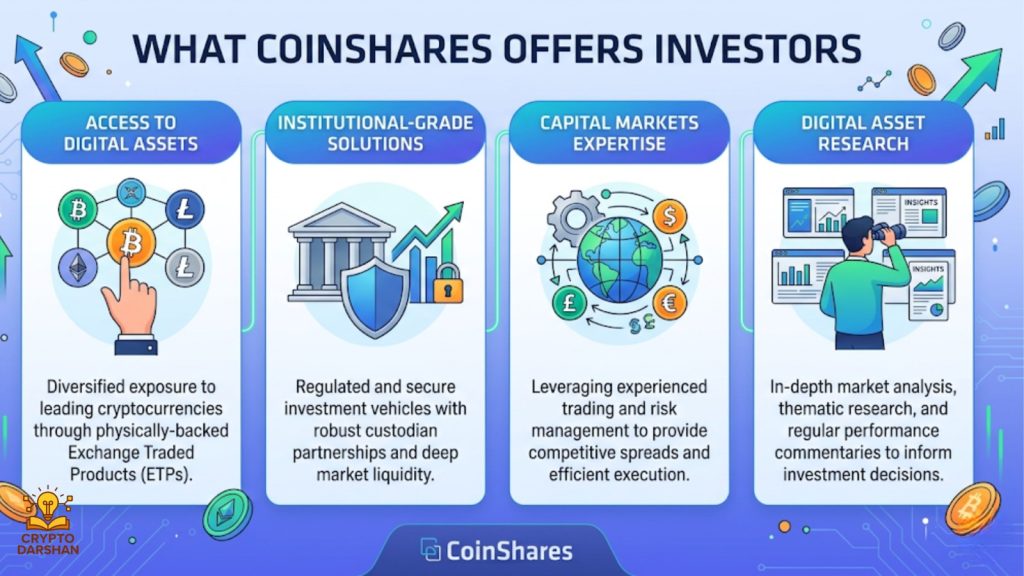
CoinShares manages a diverse lineup of investment products built around digital assets, designed to make crypto exposure simpler and more regulated. Its range includes a U.S.-listed Bitcoin ETF, structured notes, and other funds that track or actively allocate across leading cryptocurrencies.
The firm also works on on-chain and active strategies, aiming to capture yield and market opportunities in the broader crypto ecosystem while maintaining institutional-grade risk controls.
Assets under management sit around the multi‑billion dollar mark, underscoring the scale CoinShares has built up through different market cycles. By listing on Nasdaq, CoinShares is offering public market investors a direct way to invest not in individual tokens, but in a business whose revenues come from fees on crypto products and services.
For some investors, this can be a more familiar and regulated way to play the growth of digital assets. While institutional players are gaining structured access through platforms like Nasdaq, retail traders still face significant challenges in navigating the market.
Lack of strategy and emotional trading often lead to losses. If you want to avoid common pitfalls, read our guide on why most retail traders lose money in crypto.
Strategic reasons behind the U.S. listing

CoinShares’ leadership has framed the Nasdaq debut as more than just a change of venue; it is a strategic evolution for the company. The move is expected to unlock better access to equity capital markets, allowing the firm to raise funds more efficiently for expansion, acquisitions, and new product launches. In statements around the deal, management highlighted that the U.S. continues to be the largest and most influential capital market, particularly for financial and technology firms.
At the same time, the listing signals growing mainstream acceptance of crypto infrastructure companies, even as regulation remains a moving target in many regions. CoinShares is positioning itself to benefit from rising institutional adoption of digital assets, banking on its experience navigating European rules and translating that into a competitive advantage in the U.S.
The company aims to deepen relationships with American investors and partners who want exposure to crypto while working within clearer regulatory frameworks.
What this means for the crypto market

CoinShares’ Nasdaq listing through a 1.2 billion dollar SPAC merger marks another milestone in the steady integration of digital asset firms into traditional finance. It suggests that investors still see long‑term value in the infrastructure behind crypto – from asset managers and exchanges to custody providers – even when token prices can swing sharply. The debut of CSHR on Nasdaq will be closely watched to see how public markets price a pure‑play crypto asset manager in the current environment.
For other crypto companies, CoinShares’ successful path to a U.S. listing via SPAC could serve as a roadmap or at least a case study in accessing American capital markets.
If trading in CSHR proves strong and investor demand holds up, it may encourage more digital asset managers to explore public offerings, further tightening the links between the crypto industry and Wall Street