
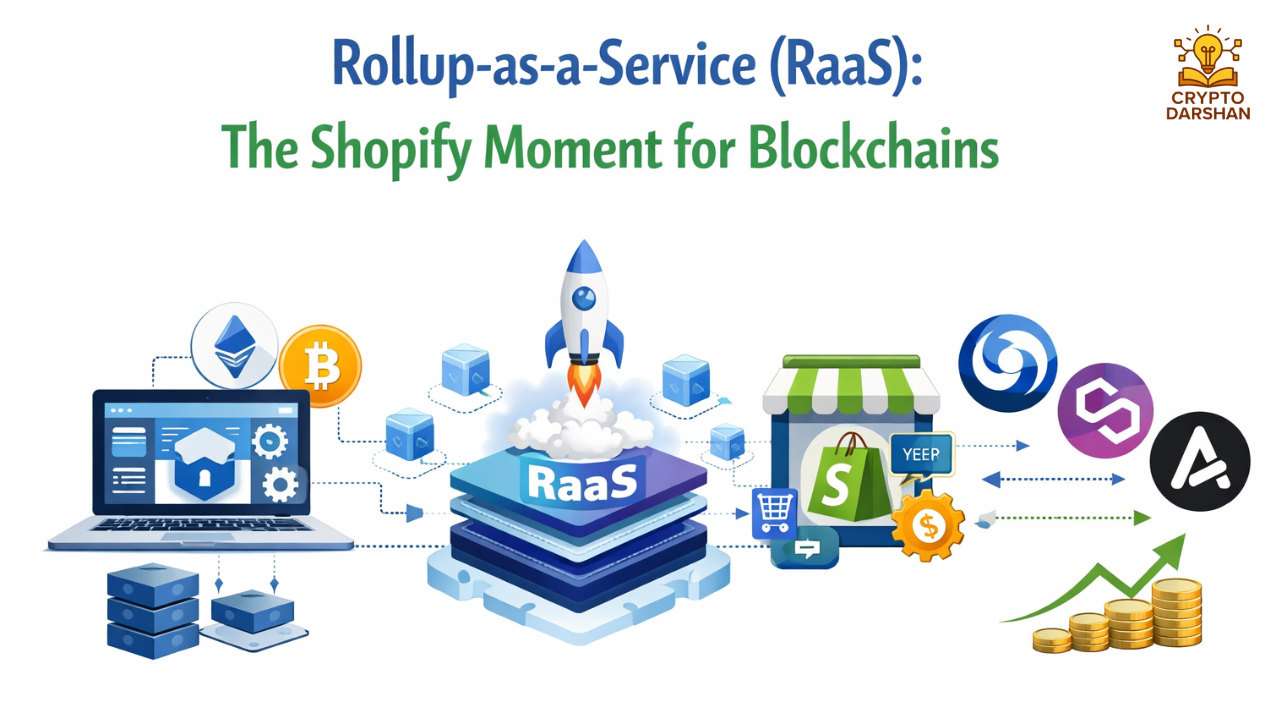
The blockchain industry is evolving at a rapid pace, moving from experimental technology to a foundational layer of the digital economy. As adoption grows, scalability, interoperability, and usability have become the most pressing challenges. Rollup-as-a-Service (RaaS) has emerged as a transformative solution, enabling developers, enterprises, and innovators to deploy scalable, customizable blockchains without the complexity of building from scratch. Much like Shopify revolutionized e-commerce by allowing anyone to launch an online store effortlessly, RaaS platforms are democratizing blockchain deployment. This shift represents what many call the “Shopify moment” for blockchains — a turning point where accessibility meets innovation.
This article explores the concept of Rollup-as-a-Service, its technical foundations, market impact, and why it’s poised to redefine the blockchain landscape. It also examines leading RaaS providers, use cases, and the broader implications for Web3 adoption.
Understanding Rollups: The Foundation of RaaS
What Are Rollups?
Rollups are a Level 2 solution designed to load off computational and storage burden from the main blockchain protocol in an effective way that doesn’t compromise security. This is a necessary tool at this point of blockchain development, which improves throughput and the overall scalability in a protocol. This approach reduces congestion, lowers fees, and improves transaction speed.
There are two main types of rollups:
- Optimistic Rollups – Assume transactions are valid by default and rely on fraud proofs to detect invalid ones. Examples include Optimism and Arbitrum.
- Zero-Knowledge (ZK) Rollups – Use cryptographic proofs to verify transactions instantly, offering faster finality and stronger security guarantees. Examples include zkSync and StarkNet.
Both types of rollups enhance scalability but differ in performance, cost, and complexity. RaaS platforms often support multiple rollup frameworks, allowing developers to choose the best fit for their use case.
Why Rollups Matter
Rollups are critical to blockchain scalability. They enable thousands of transactions per second (TPS) compared to the limited capacity of base layers like Ethereum. By offloading computation and storage, rollups make decentralized applications (dApps) more efficient and affordable. This scalability unlocks new possibilities for gaming, decentralized finance (DeFi), supply chain management, and enterprise blockchain solutions.
The Rise of Rollup-as-a-Service (RaaS)
What Is Rollup-as-a-Service?
Rollup-as-a-Service (RaaS) is a cloud-based infrastructure model that allows developers to deploy and manage rollups easily. Instead of building a rollup from scratch — which requires deep technical expertise in cryptography, consensus mechanisms, and smart contract design — RaaS platforms provide pre-built frameworks, automation tools, and hosting environments.
In essence, RaaS abstracts away the complexity of blockchain infrastructure, enabling teams to focus on product development and user experience. It’s similar to how Shopify simplified e-commerce by handling hosting, payments, and logistics, allowing merchants to focus on their brand and customers.
The Shopify Analogy
Before Shopify, launching an online store required technical knowledge of web development, payment integration, and server management. Shopify changed that by offering a plug-and-play platform where anyone could create a store in minutes. RaaS is doing the same for blockchain networks.
With RaaS, developers can:
- Launch custom rollups with minimal coding.
- Choose between Optimistic or ZK rollup frameworks.
- Integrate with existing Layer 1 ecosystems like Ethereum, Polygon, or Avalanche.
- Access built-in tools for monitoring, analytics, and governance.
- Scale applications seamlessly as user demand grows.
This democratization of blockchain infrastructure is accelerating innovation across industries.
How RaaS Works
Core Components
A typical RaaS platform includes several key components:
- Rollup Frameworks – Pre-configured templates for Optimistic or ZK rollups.
- Node Infrastructure – Managed nodes for data availability, sequencing, and validation.
- Bridging Tools – Secure bridges for asset transfers between Layer 1 and Layer 2.
- Developer SDKs – Software development kits for integrating smart contracts and APIs.
- Monitoring Dashboards – Real-time analytics for performance, fees, and network health.
- Security Modules – Fraud-proof systems, cryptographic verification, and auditing tools.
Not all RaaS platforms are built the same. While some rely on optimistic rollups, others use Zero-Knowledge (ZK) rollups, which generate cryptographic proofs to validate transactions instantly.
Deployment Process
The deployment process typically involves:
- Configuration – Selecting the rollup type, base chain, and parameters.
- Customization – Adding governance rules, tokenomics, and application logic.
- Deployment – Launching the rollup on a managed infrastructure.
- Integration – Connecting wallets, dApps, and external services.
- Maintenance – Continuous updates, monitoring, and scaling.
This streamlined process reduces deployment time from months to hours, making blockchain development accessible to startups, enterprises, and even individual developers.
Benefits of Rollup-as-a-Service
1. Simplified Deployment
RaaS eliminates the need for deep blockchain expertise. Developers can deploy scalable networks using intuitive interfaces and pre-built templates.
2. Cost Efficiency
Building a rollup from scratch can cost millions in development and maintenance. RaaS platforms offer subscription-based or usage-based pricing, significantly reducing upfront costs.
3. Scalability
RaaS solutions are designed to handle high transaction volumes, enabling applications to scale without compromising performance.
4. Interoperability
Most RaaS providers support cross-chain communication, allowing assets and data to move seamlessly between ecosystems.
5. Security
By leveraging proven rollup frameworks and audited smart contracts, RaaS platforms ensure robust security and reliability.
6. Customization
Developers can tailor rollups to specific use cases — from DeFi protocols to gaming ecosystems — with custom governance, tokenomics, and consensus rules.
7. Time-to-Market
RaaS drastically reduces development cycles, enabling faster product launches and quicker iteration.
The Market Landscape
1. Rapid Growth of the RaaS Ecosystem
The Rollup-as-a-Service (RaaS) market is expanding quickly as blockchain adoption accelerates. With the growing demand for scalable and customizable blockchain solutions, RaaS has become a vital part of the Web3 infrastructure stack. Analysts predict that the blockchain infrastructure market could surpass hundreds of billions of dollars by 2030, with RaaS capturing a significant portion due to its accessibility and efficiency.
2. Leading RaaS Providers
Several innovative companies are shaping the RaaS landscape:
Caldera – Offers modular rollup deployment supporting both Optimistic and ZK rollups.
Conduit – Focuses on developer-friendly rollup infrastructure with seamless Ethereum integration.
AltLayer – Provides decentralized rollup orchestration and elastic scaling for high-performance applications.
Eclipse – Combines Solana’s speed with Ethereum compatibility for hybrid rollups.
Gelato Rollups – Automates rollup deployment with built-in smart contract execution.
Saga – Specializes in app-specific rollups optimized for gaming and DeFi.
Each provider differentiates itself through performance, customization, and ecosystem integration, giving developers a wide range of options to suit their needs.
3. Competitive Differentiation
Competition in the RaaS market centers around three main factors: scalability, interoperability, and developer experience. Platforms that offer faster deployment, better cross-chain communication, and robust developer tools are gaining traction. The ability to integrate with major Layer 1 networks like Ethereum, Polygon, and Avalanche also plays a key role in attracting users.
4. Enterprise and Institutional Interest
Enterprises and governments are beginning to explore RaaS for private and consortium blockchains. These organizations value RaaS for its compliance features, scalability, and ease of integration with existing systems. As regulatory clarity improves, enterprise adoption is expected to accelerate, driving further growth in the RaaS sector.
Use Cases of Rollup-as-a-Service
1. Decentralized Finance (DeFi)
DeFi platforms require high throughput and low fees. RaaS enables DeFi projects to launch dedicated rollups optimized for trading, lending, and yield farming, reducing congestion on main networks.
2. Gaming and Metaverse
Blockchain games and metaverse platforms need fast, low-cost transactions for in-game assets. RaaS allows developers to create custom rollups that handle millions of microtransactions efficiently.
3. Enterprise Solutions
Corporations can deploy private or consortium rollups for supply chain management, identity verification, and data sharing, ensuring privacy and compliance.
4. NFTs and Digital Collectibles
RaaS supports NFT marketplaces with scalable infrastructure, enabling instant minting, trading, and cross-chain transfers.
5. DAOs and Governance
Decentralized Autonomous Organizations (DAOs) can use RaaS to build governance-specific rollups, improving voting efficiency and transparency.
6. Cross-Chain Applications
RaaS facilitates interoperability between ecosystems, allowing developers to build applications that operate across multiple blockchains.
Technical Deep Dive: The Architecture of RaaS
Layered Design
RaaS platforms typically follow a modular architecture:
- Execution Layer – Processes transactions and smart contracts.
- Settlement Layer – Anchors rollup data to the base chain for security.
- Data Availability Layer – Ensures transaction data is accessible and verifiable.
- Bridging Layer – Manages cross-chain communication and asset transfers.
- Governance Layer – Handles upgrades, validators, and community decisions.
Data Availability Solutions
Data availability is a critical component of rollup security. RaaS providers often integrate with decentralized data availability networks like Celestia or EigenDA to ensure transparency and resilience.
Sequencers and Validators
Sequencers order transactions within the rollup, while validators verify their correctness. Some RaaS platforms offer decentralized sequencer networks to prevent centralization risks.
Security and Auditing
RaaS providers implement multiple layers of security, including:
- Fraud proofs for Optimistic rollups.
- Validity proofs for ZK rollups.
- Smart contract audits.
- Continuous monitoring and threat detection.
The Economic Model of RaaS
Pricing Structures
RaaS platforms typically offer flexible pricing models:
- Subscription-Based – Fixed monthly or annual fees for managed services.
- Usage-Based – Pay-per-transaction or per-block fees.
- Revenue Sharing – Percentage of network fees or token issuance.
Tokenomics Integration
Many RaaS platforms allow developers to integrate native tokens for governance, staking, and transaction fees. This flexibility supports diverse economic models and incentivizes community participation.
Challenges and Limitations
1. Security Risks
While RaaS simplifies deployment, it introduces dependency on third-party infrastructure. Ensuring trust and transparency in service providers is essential.
2. Interoperability Complexity
Cross-chain communication remains a technical challenge, requiring robust bridging mechanisms to prevent exploits.
3. Regulatory Uncertainty
As blockchain adoption grows, regulatory frameworks are still evolving. RaaS providers must navigate compliance requirements across jurisdictions.
4. Centralization Concerns
Some RaaS platforms rely on centralized sequencers or validators, which can undermine decentralization principles.
5. Market Fragmentation
With multiple RaaS providers and rollup frameworks, standardization is still lacking, potentially leading to ecosystem fragmentation.
The Future of RaaS
The Path Toward Mass Adoption
RaaS is paving the way for mainstream blockchain adoption by lowering technical barriers. As more developers and enterprises embrace this model, the blockchain ecosystem will become more diverse and interconnected.
Integration with AI and IoT
Future RaaS platforms may integrate with artificial intelligence (AI) and Internet of Things (IoT) systems, enabling autonomous, data-driven blockchain applications.
Decentralized RaaS Networks
The next evolution of RaaS could involve decentralized orchestration, where multiple providers collaborate through shared protocols, enhancing resilience and interoperability.
Enterprise and Government Adoption
Governments and large corporations are exploring blockchain for identity, supply chain, and finance. RaaS offers a scalable, compliant pathway for these institutions to deploy blockchain solutions.
The Shopify Moment for Blockchains
1. Democratization of Blockchain Deployment
Just as Shopify made it easy for anyone to launch an online store without coding skills, Rollup-as-a-Service (RaaS) platforms make blockchain creation accessible to all. Developers, startups, and enterprises can now deploy their own scalable blockchains without needing deep technical expertise. This democratization lowers entry barriers and accelerates innovation across industries.
2. Simplified Infrastructure Management
Before Shopify, businesses had to manage servers, payment gateways, and logistics manually. Similarly, before RaaS, launching a blockchain required managing nodes, consensus mechanisms, and security layers. RaaS automates these processes, providing ready-to-use infrastructure so teams can focus on building products rather than maintaining complex systems.
3. Customization and Flexibility
Shopify allows merchants to customize their stores with themes and plugins. In the same way, RaaS enables developers to tailor their rollups — choosing between Optimistic or ZK rollups, defining governance models, and integrating specific tokenomics. This flexibility ensures that each blockchain can be optimized for its unique use case, from gaming to finance.
4. Scalability and Cost Efficiency
Shopify reduced the cost and time of launching an online business. RaaS does the same for blockchain projects by offering scalable, cost-effective solutions. Instead of spending millions on custom infrastructure, developers can deploy rollups quickly and pay only for what they use, making blockchain adoption financially viable for more organizations.
5. Accelerating Web3 Adoption
Shopify’s ease of use led to an explosion of e-commerce businesses worldwide. RaaS is expected to have a similar effect on Web3, enabling thousands of new decentralized applications to emerge.
Before investing in rollup tokens or RaaS ecosystems, understanding token supply metrics is critical read our guide on What Is Fully Diluted Valuation (FDV) and Why It Matters to evaluate long-term dilution risks.
Case Studies
Case Study 1: Gaming Studio Launches Custom Rollup
A gaming company used a RaaS platform to deploy a dedicated rollup for its metaverse. The result was a 90% reduction in transaction fees and a 10x increase in user engagement. The rollup handled millions of in-game asset transfers seamlessly.
Case Study 2: DeFi Protocol Scales with RaaS
A DeFi startup leveraged RaaS to launch a high-performance rollup optimized for trading. The platform achieved sub-second transaction finality and attracted over $100 million in total value locked (TVL) within months.
Case Study 3: Enterprise Supply Chain Rollup
A logistics company deployed a private rollup using RaaS to track shipments across multiple regions. The system improved transparency, reduced fraud, and streamlined compliance reporting.
Key Metrics for Evaluating RaaS Platforms
When choosing a RaaS provider, organizations should consider:
- Transaction Throughput (TPS)
- Latency and Finality Time
- Security Audits and Certifications
- Interoperability Support
- Customization Options
- Developer Tools and Documentation
- Pricing and Scalability
These metrics help ensure that the chosen platform aligns with technical and business requirements.
The Broader Impact on Web3
RaaS is not just a technical innovation; it’s a catalyst for the next phase of Web3 growth. Simplifying blockchain deployment enables a new generation of decentralized applications that are faster, cheaper, and more user-friendly. This accessibility will attract traditional developers, enterprises, and institutions, bridging the gap between Web2 and Web3.
As RaaS matures, it will foster a more inclusive digital economy where innovation is no longer limited by technical barriers. The result will be a vibrant ecosystem of interconnected blockchains, each serving specialized purposes but united by shared infrastructure.
Frequently Asked Questions (FAQs)
1. What is Rollup-as-a-Service (RaaS)?
Rollup-as-a-Service (RaaS) is a platform that allows developers and businesses to launch their own Layer 2 rollups without building blockchain infrastructure from scratch. It simplifies deployment, maintenance, sequencing, and security management similar to how Shopify made it easy to launch an e-commerce store.
2. How does RaaS work?
RaaS providers handle the technical backend of a rollup, including data availability, node infrastructure, and integration with Layer 1 blockchains like Ethereum. Developers can customize execution environments, gas tokens, and governance rules while relying on shared security from the base layer.
3. Why is RaaS called the “Shopify moment” for blockchains?
Just as Shopify enabled anyone to create an online store without coding expertise, RaaS enables projects to launch their own blockchain rollups quickly and cost-effectively. It removes technical barriers and accelerates Web3 adoption.
4. What are the benefits of using RaaS?
- Faster time-to-market
- Lower infrastructure costs
- Customizable blockchain environments
- Access to Ethereum security
- Easier scalability
5. What is the difference between RaaS and appchains?
RaaS rollups typically settle on Layer 1 networks like Ethereum, inheriting their security. Appchains, on the other hand, often rely on their own validator sets. Projects using frameworks like Cosmos SDK or ecosystems like Polkadot may choose appchains for greater sovereignty.
6. Who are the leading RaaS providers in 2026?
Major RaaS platforms include:
- Optimism (OP Stack ecosystem)
- Arbitrum (Orbit chains)
- Polygon (CDK rollups)
These platforms allow teams to deploy custom rollups with varying degrees of decentralization and modularity.
7. Is RaaS only for large crypto projects?
No. RaaS is designed to support startups, enterprises, gaming platforms, DeFi protocols, and even traditional businesses entering the Web3 space. It lowers the technical and financial barriers to launching a blockchain.
8. How does RaaS impact Ethereum scalability?
By moving transactions off the main chain and settling them in batches, rollups reduce congestion and fees on Ethereum. As more projects adopt RaaS, the Ethereum ecosystem becomes more modular and scalable.
Conclusion
Rollup-as-a-Service represents a pivotal moment in blockchain evolution — the “Shopify moment” that transforms blockchain deployment from a complex engineering challenge into a streamlined, accessible process. By abstracting away technical complexity, RaaS empowers developers, startups, and enterprises to build scalable, secure, and customizable blockchains with ease.
As the blockchain industry continues to mature, RaaS will play a central role in driving mass adoption, interoperability, and innovation. Just as Shopify democratized e-commerce, RaaS is democratizing blockchain infrastructure — unlocking the full potential of decentralized technology for the world.