The internet has evolved through several major phases. The first era, Web1, was static and read-only. Web2 introduced interactivity, social media, and user-generated content, giving rise to platforms like Facebook, Twitter, and YouTube. However, these platforms’ centralized control, monetizing user data and content, while offering little ownership to the creators who fueled their growth. Now, a new paradigm is emerging SocialFi, short for Social Finance, which merges social networking with decentralized finance (DeFi) principles.
SocialFi represents the next evolution of online communities, where users, creators, and influencers can own, monetize, and govern their digital presence through blockchain technology. It introduces tokenized social interactions, decentralized governance, and new economic models that reward participation and creativity.
This article explores what SocialFi is, how it works, its key components, leading platforms, challenges, and the future of tokenized communities. It also examines how SocialFi could redefine the relationship between users, content, and value in the digital age.
1. Understanding SocialFi
1.1 Definition of SocialFi
SocialFi, short for Social Finance, integrates the principles of blockchain and decentralised finance into social networking platforms. The idea is to create a fairer, more participatory ecosystem where users, rather than corporations, control their data and earn value for their contributions. It also enables users to interact socially while earning, trading, and owning digital assets. In SocialFi platforms, every social action, such as posting, liking, sharing, or following, can have financial value.
Unlike traditional social media, where platforms profit from user engagement, SocialFi redistributes value to the community through tokenized incentives and decentralized ownership. Users can earn tokens for their contributions, creators can issue their own tokens, and communities can govern themselves through decentralized autonomous organizations (DAOs).
1.2 The Philosophy Behind Social Finance
SocialFi is built on three core principles:
- Ownership: Users own their data, content, and digital identity.
- Monetization: Engagement and creativity are rewarded through tokens or NFTs.
- Decentralization: Governance and decision-making are distributed among users, not controlled by a central authority.
This model challenges the Web2 paradigm, where corporations control user data and advertising revenue. SocialFi aims to create a fairer, user-driven internet economy.
1.3 The Evolution from Web2 to Web3
The transition from Web2 to Web3 marks one of the most significant shifts in the history of the internet. Web2, often referred to as the “social web,” introduced interactivity, user-generated content, and social networking. It gave rise to platforms like Facebook, Twitter, and YouTube, where users could share their thoughts, photos, and videos with the world. However, while Web2 empowered users to create content, it also centralized control in the hands of a few large corporations.
Web3, on the other hand, represents a decentralized evolution of the internet, one that prioritizes ownership, transparency, and user sovereignty. The growth of SocialFi is part of the broader Web3 ownership movement, explained in Real-World Assets (RWA) on Blockchain Explained. web3 are Built on blockchain technology. Web3 enables users to truly own their data, digital assets, and online identities. Instead of relying on centralized intermediaries, interactions occur peer-to-peer through smart contracts and decentralized applications (dApps).
2. How SocialFi Works
2.1 Tokenization of Social Interactions
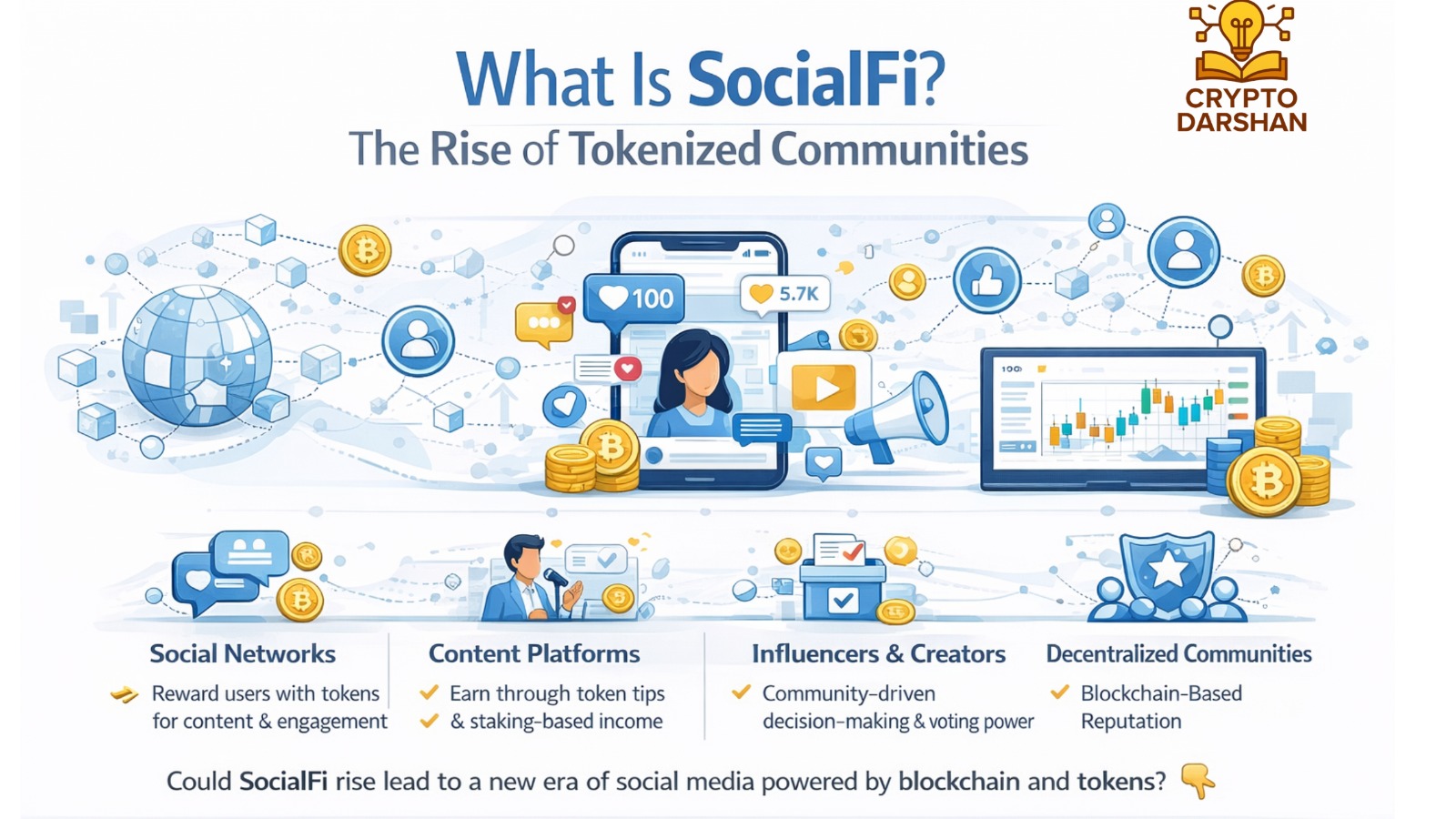
At the heart of SocialFi lies tokenization the process of converting social value into digital assets. Every interaction on a SocialFi platform can be represented by tokens. For example:
- Creator Tokens: Influencers can issue personal tokens that represent their brand value.
- Engagement Tokens: Users earn tokens for participating, commenting, or sharing content.
- Governance Tokens: Holders can vote on platform decisions or community rules.
This token economy transforms social engagement into a financial ecosystem where attention, reputation, and influence have measurable value.
2.2 Decentralized Identity (DID)
Social Finance platforms use Decentralized Identity (DID) systems to give users control over their online presence. Instead of logging in with centralized credentials, users authenticate through blockchain wallets. Their identity, reputation, and achievements are stored securely on-chain, portable across multiple platforms.
2.3 Smart Contracts and DAOs
Smart contracts automate transactions and governance in SocialFi ecosystems. Communities can form DAOs (Decentralized Autonomous Organizations) to manage funds, approve proposals, and enforce rules transparently. This ensures that no single entity can manipulate the system.
2.4 NFTs and Digital Ownership
Non-Fungible Tokens (NFTs) play a major role in SocialFi. Creators can mint NFTs representing exclusive content, memberships, or experiences. Fans can buy, trade, or hold these NFTs, creating a direct economic relationship between creators and their audiences.
2.5 Revenue Models in SocialFi
SocialFi introduces multiple revenue streams:
- Token Rewards: Users earn tokens for engagement and contributions.
- Creator Tokens: Influencers issue tokens that appreciate with popularity.
- NFT Sales: Creators sell digital collectibles or access passes.
- Staking and Yield Farming: Users can stake tokens to earn passive income.
- Advertising in Web3: Brands can advertise directly to token holders, sharing revenue with the community.
3. Key Components of SocialFi Ecosystems
3.1 Social Tokens
Social tokens are the backbone of SocialFi. They represent ownership, reputation, or influence within a community. There are three main types:
- Personal Tokens: Issued by individuals (e.g., creators, influencers).
- Community Tokens: Represent collective ownership in a group or DAO.
- Platform Tokens: Native tokens used for transactions and governance.
3.2 Decentralized Social Networks
Unlike centralized platforms, decentralized social networks run on blockchain infrastructure. They allow users to post, share, and interact without intermediaries. Examples include Lens Protocol, Farcaster, and DeSo.
3.3 Creator Economy Integration
SocialFi empowers creators to monetize directly without relying on advertisers or intermediaries. Through tokenized fan engagement, creators can build sustainable income streams while maintaining creative freedom.
3.4 Governance and DAOs
DAOs enable community-driven decision-making. Token holders can propose and vote on changes, ensuring transparency and fairness. This governance model aligns incentives between users, creators, and developers.
3.5 Interoperability and Cross-Platform Identity
SocialFi platforms aim for interoperability, allowing users to carry their identity, tokens, and reputation across multiple ecosystems. This breaks the silos of Web2 platforms and fosters a unified digital identity.
4. Leading SocialFi Platforms
4.1 Lens Protocol
Built on the Polygon blockchain, Lens Protocol is a decentralized social graph that allows developers to build social apps where users own their content and connections. Each user’s profile is an NFT, enabling full control over data and monetization.
4.2 Friend.tech
Friend.tech popularized the concept of tokenized social relationships. Users can buy and sell “shares” of influencers, granting access to private chats and exclusive content. The platform runs on Base, an Ethereum Layer 2 network.
4.3 DeSo (Decentralized Social)
DeSo is a blockchain designed specifically for social applications. It supports features like posts, profiles, and NFTs natively on-chain, enabling scalable and censorship-resistant social networks.
4.4 Rally
Rally allows creators to launch their own branded tokens and build communities around them. Fans can support creators by purchasing tokens, which can be used for exclusive content or experiences.
4.5 Minds
Minds is an open-source social network that rewards users with tokens for engagement. It combines free speech principles with blockchain-based monetization.
4.6 Other Emerging Platforms
- Farcaster: A decentralized social protocol emphasizing user sovereignty.
- Chingari: A short-video platform integrating crypto rewards.
- Audius: A decentralized music streaming platform rewarding artists directly.
- Mirror: A Web3 publishing platform where writers can tokenize their content.
5. The Economic Model of SocialFi
5.1 The Creator Economy 2.0
Social finance represents the next phase of the creator economy. Instead of relying on ad revenue or brand deals, creators can issue tokens, sell NFTs, and engage directly with their audience. This model fosters community ownership and shared success.
5.2 Tokenomics and Value Creation
SocialFi platforms design token economies that balance supply, demand, and utility. Tokens can be used for:
- Access to exclusive content
- Voting in community decisions
- Staking for rewards
- Trading on decentralized exchanges
The value of tokens depends on community engagement, scarcity, and perceived influence.
5.3 Network Effects and Virality
SocialFi thrives on network effects. As more users join and interact, token demand increases, driving value. Viral growth is incentivized through referral rewards and token airdrops.
5.4 Monetization for Users and Creators
Both users and creators benefit financially:
- Creators: Earn from token sales, NFT drops, and community growth.
- Users: Earn from engagement, staking, and early participation in creator tokens.
5.5 The Role of AI in SocialFi
Artificial intelligence enhances SocialFi by curating content, detecting fraud, and personalizing user experiences. AI-driven analytics can also help creators optimize engagement and token performance.
6. Benefits of Social finance
6.1 True Ownership
Users own their data, content, and digital identity. This ownership is verifiable on the blockchain and transferable across platforms.
6.2 Fair Monetization
SocialFi ensures that value flows directly to those who create and engage, not to centralized intermediaries.
6.3 Transparency and Trust
Blockchain technology ensures transparency in transactions, governance, and content moderation.
6.4 Community Empowerment
DAOs and tokenized governance empower communities to make collective decisions, fostering inclusivity and accountability.
6.5 Censorship Resistance
Decentralized infrastructure prevents censorship and ensures freedom of expression. SocialFi’s decentralized infrastructure shares similarities with the physical-digital integration explored in DePIN: The Next Big Crypto Trend?
7. Challenges Facing SocialFi

7.1 Scalability
Running social interactions on-chain can be resource-intensive. Layer 2 solutions and sidechains are being developed to address scalability.
7.2 Regulation and Compliance
SocialFi blurs the line between social media and finance, raising regulatory concerns about securities laws, data privacy, and taxation.
7.3 Token Volatility
The value of social tokens can fluctuate dramatically, creating risks for users and creators.
7.4 User Experience
Blockchain-based platforms can be complex for mainstream users. Simplified interfaces and wallet integrations are essential for mass adoption.
7.5 Security Risks
Smart contract vulnerabilities and phishing attacks pose threats to user funds and data.
8. The Future of SocialFi
8.1 Integration with the Metaverse
SocialFi will play a central role in the metaverse, enabling tokenized social interactions, virtual economies, and digital ownership across immersive environments.
8.2 Cross-Platform Interoperability
Future SocialFi ecosystems will allow seamless movement of tokens, NFTs, and identities across multiple platforms, creating a unified digital experience.
8.3 Institutional Adoption
Brands, influencers, and even governments may adopt SocialFi models for community engagement, loyalty programs, and digital governance.
8.4 AI and Personalization
AI will enhance SocialFi by enabling personalized token economies, predictive engagement models, and automated moderation.
8.5 Sustainable Token Economies
To ensure long-term viability, SocialFi platforms will focus on sustainable tokenomics, balancing incentives with real-world utility.
9. Case Studies: Successful SocialFi Models

9.1 Friend.tech’s Tokenized Relationships
Friend.tech demonstrated how social tokens could represent personal influence. By allowing users to buy and sell “shares” of creators, it introduced a new form of social capital.
9.2 Lens Protocol’s Decentralized Social Graph
Lens Protocol’s NFT-based profiles and modular architecture showcase how decentralized social networks can empower users with full ownership and portability.
9.3 Audius and the Music Revolution
Audius disrupted the music industry by enabling artists to earn directly from fans without intermediaries, proving the potential of SocialFi in creative industries.
9.4 Mirror and Web3 Publishing
Mirror allows writers to tokenize their work, crowdfund projects, and share ownership with readers, redefining digital publishing.
10. Predictions for the Next Decade

1. Mainstream Adoption of SocialFi Platforms
Over the next decade, SocialFi platforms are expected to move from early adopters to mainstream audiences. Just as social media became a daily habit in the Web2 era, it will become a natural part of online life. As user interfaces become more intuitive and blockchain technology becomes invisible to the average user, millions will join tokenized social networks without even realizing they are using Web3 infrastructure.
2. Creator-Led Economies and Personal Tokens
Creators will become the driving force of the SocialFi revolution. Instead of relying on brand sponsorships or ad revenue, influencers, artists, and thought leaders will issue their own personal tokens that represent their brand value and community influence. Fans will be able to invest in their favorite creators, earning rewards as their popularity grows.
3. Regulatory Frameworks and Legal Clarity
As SocialFi grows, governments and regulators will inevitably step in to establish clearer rules. The line between social tokens, securities, and digital collectibles will need to be defined to protect investors and ensure compliance. Over the next decade, we can expect the emergence of global regulatory frameworks that balance innovation with consumer protection.
4. AI-Driven SocialFi Ecosystems
Artificial intelligence will play a major role in shaping the future of SocialFi. AI algorithms will help personalize user experiences, recommend content, and optimize token economies. For creators, AI tools will automate community management, analyze engagement data, and even assist in content creation. On the financial side, AI will help detect fraudulent activities, prevent scams, and maintain fair token valuations.
5. Global Inclusion and Financial Empowerment
One of the most powerful aspects of SocialFi is its potential to democratize access to wealth creation. In the next decade, Social Finance will empower creators and users in developing regions to participate in the global digital economy. With only a smartphone and an internet connection, individuals will be able to earn income, build communities, and access decentralized financial services.
6. Integration with Gaming, Metaverse, and Virtual Worlds
SocialFi will merge with GameFi and metaverse ecosystems to create immersive, tokenized social experiences. In virtual worlds, users will not only play games but also socialize, trade NFTs, and earn tokens through community participation. SocialFi will serve as the social layer of the metaverse, enabling users to build reputations, form DAOs, and monetize their digital interaction.
7. Decentralized Reputation and Identity Systems
In the coming years, blockchain-based reputation systems will replace traditional social metrics like followers, likes, or views. Instead of vanity numbers, users will build on-chain reputations based on verified interactions, contributions, and achievements. These decentralized identity systems will allow users to carry their reputation across multiple platforms, creating a unified digital identity.
What Is SocialFi? The Rise of Tokenized Communities FAQ
1. What is Social Finance?
SocialFi (short for Social Finance) is a blockchain-based model that combines social media with decentralized finance. It allows users to monetize their content, influence, and online communities using crypto tokens. Instead of platforms controlling revenue and data, users and creators can earn directly through tokenized interactions.
2. How does SocialFi work?
SocialFi platforms typically use blockchain technology to:
- Issue creator or community tokens
- Reward engagement with crypto incentives
- Enable peer-to-peer tipping and subscriptions
- Allow governance voting through token ownership
Users earn tokens by creating content, engaging with others, or contributing to communities.
3. What are tokenized communities?
Tokenized communities are online groups where access, rewards, and governance are powered by crypto tokens. Members may hold tokens that give them voting rights, exclusive content access, or financial upside tied to the community’s growth.
These communities often operate through DAOs (Decentralized Autonomous Organizations).
4. How is SocialFi different from traditional social media?
Traditional platforms:
- Control user data
- Monetize primarily through ads
- Keep most of the revenue
SocialFi platforms:
- Offer token-based rewards
- Share value with creators and users
- Operate with decentralized governance models
The goal is to shift ownership from platforms to participants.
5. What are some examples of SocialFi platforms?
Notable SocialFi-related platforms include:
- Friend.tech
- Lens Protocol
- Farcaster
- Steemit
Each uses blockchain in different ways to reward social engagement.
6. Why is SocialFi gaining popularity?
SocialFi is rising due to:
- Creator dissatisfaction with traditional monetization models
- Growing adoption of Web3 wallets
- Demand for digital ownership
- Increased interest in community-driven ecosystems
As crypto infrastructure matures, tokenized communities become easier to build and manage.
Conclusion
SocialFi represents the next frontier of the internet where social interaction meets financial empowerment. By merging blockchain technology with social networking, it redefines how value, influence, and ownership are distributed online.
In this new paradigm, users are not just participants but stakeholders. Creators are not just entertainers but entrepreneurs. Communities are not just audiences but decentralized economies.
As SocialFi continues to evolve, it promises to democratize the digital world, giving everyone the power to own their identity, monetize their creativity, and shape the future of online interaction. The rise of tokenized communities marks the beginning of a new era one where social and financial capital finally converge.