The cryptocurrency market is one of the most dynamic and unpredictable financial ecosystems in the world. Since the inception of Bitcoin in 2009, the crypto industry has evolved into a trillion-dollar market, attracting investors, institutions, and innovators alike. However, with its rapid growth comes volatility, uncertainty, and risk. Understanding the cyclical nature of the crypto market, along with its inherent risks and emerging opportunities, is essential for anyone looking to navigate this digital frontier effectively.
At Cryptodarshan, the mission is to simplify the complexities of the crypto world and provide insights that empower investors to make informed decisions. This article explores the fundamental aspects of crypto market cycles, the risks associated with digital assets, and the opportunities that lie ahead in this ever-evolving landscape.
The Nature of Crypto Market Cycles
What Are Crypto Cycles?
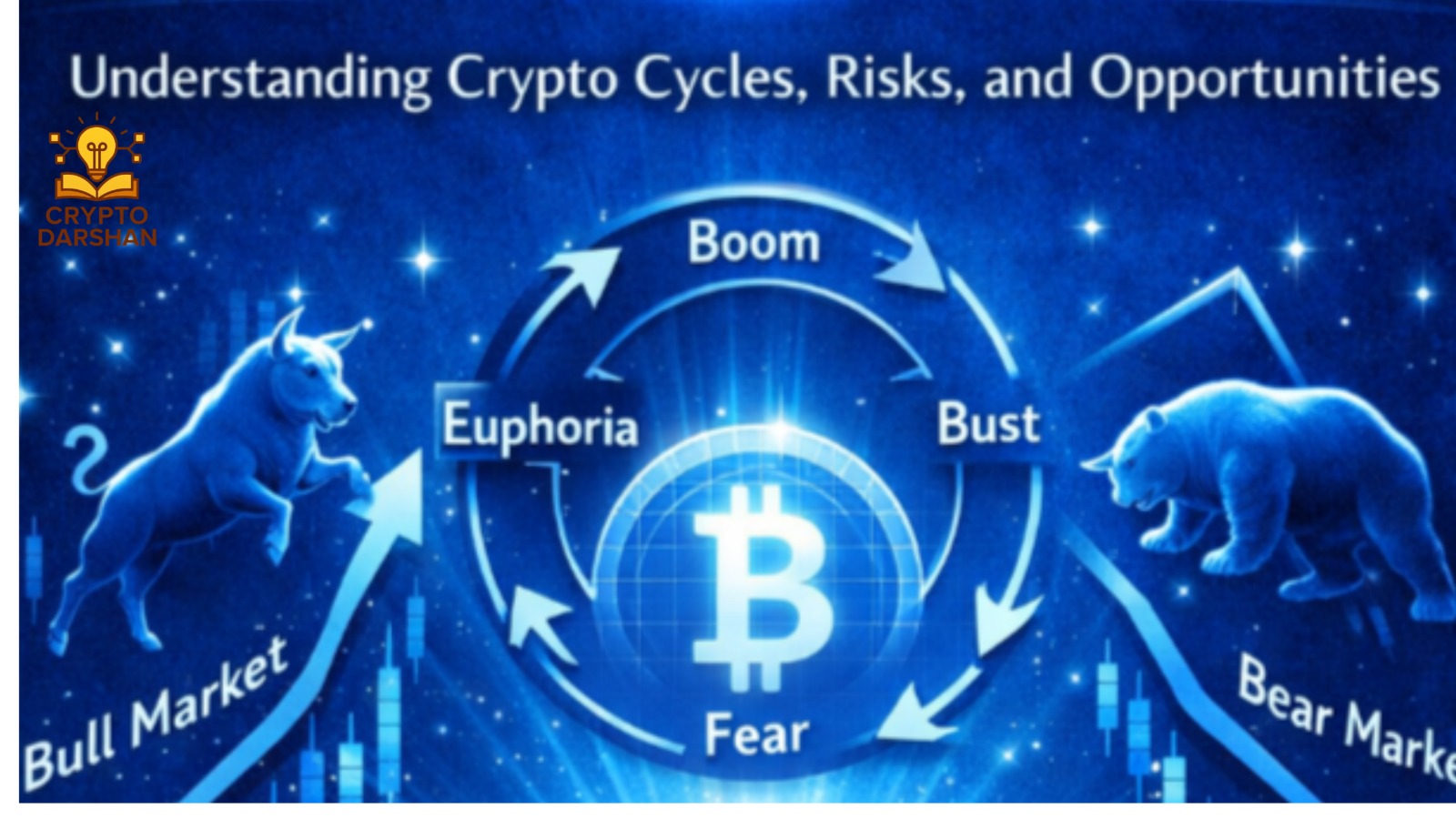
Crypto cycles refer to the recurring patterns of growth and decline observed in the cryptocurrency market over time. These cycles are influenced by a combination of technological innovation, investor sentiment, macroeconomic factors, and regulatory developments. Much like traditional financial markets, the crypto market experiences phases of expansion (bull markets) and contraction (bear markets).
However, crypto cycles tend to be more volatile and shorter in duration due to the market’s nascent nature and the speed at which information spreads in the digital age.
The 4 Phases of a Typical Crypto Cycle
- Accumulation Phase
This phase occurs after a prolonged bear market when prices stabilize and investor interest is low. Smart investors and institutions begin accumulating assets quietly, anticipating future growth. Market sentiment is generally neutral or pessimistic, and trading volumes are low. - Expansion (Bull Market) Phase
As confidence returns, prices start to rise steadily. Positive news, technological advancements, and increased adoption fuel optimism. Retail investors enter the market, driving prices higher. This phase often culminates in a parabolic rise, where euphoria and speculation dominate. - Distribution Phase
During this stage, early investors begin taking profits as prices reach unsustainable levels. Market sentiment shifts from greed to caution. Although prices may remain high for a while, volatility increases, signaling the beginning of a potential downturn. - Contraction (Bear Market) Phase
The market corrects sharply as overvalued assets lose momentum. Fear and panic selling dominate, leading to significant price declines. Many projects fail during this phase, but it also sets the stage for the next accumulation period.
Historical Examples of Crypto Cycles

- 2011 Cycle: Bitcoin’s first major bull run saw prices rise from under $1 to over $30 before crashing back to $2.
- 2013 Cycle: Bitcoin surged to $1,200, followed by a long bear market that lasted until 2015.
- 2017 Cycle: The ICO boom pushed Bitcoin to nearly $20,000, only to fall below $4,000 in 2018.
- 2021 Cycle: Fueled by institutional adoption and DeFi growth, Bitcoin reached $69,000 before entering another correction phase in 2022.
Each cycle has been driven by innovation—whether it was Bitcoin’s emergence, Ethereum’s smart contracts, or DeFi and NFTs. Understanding these patterns helps investors anticipate market movements and make strategic decisions.
Factors Influencing Crypto Cycles
1. Bitcoin Halving Events
Bitcoin’s halving events, which occur approximately every four years, reduce the block reward miners receive by half. This mechanism decreases the rate of new Bitcoin supply, creating scarcity. Historically, halvings have preceded major bull runs as reduced supply meets growing demand.
2. Technological Innovation
New technologies often trigger market optimism. The introduction of Ethereum’s smart contracts, the rise of decentralized finance (DeFi), and the explosion of non-fungible tokens (NFTs) have each sparked new waves of investment and speculation.
3. Market Sentiment and Media Influence
Crypto markets are highly sensitive to sentiment. Positive news, such as institutional adoption or regulatory clarity, can drive prices upward, while negative headlines like exchange hacks or government crackdowns can trigger sell-offs.
4. Macroeconomic Conditions
Global economic factors, including inflation, interest rates, and monetary policy, influence crypto markets. During periods of economic uncertainty, investors often view Bitcoin as a hedge against inflation, while rising interest rates can reduce speculative appetite.
5. Regulatory Developments
Regulation plays a dual role in crypto cycles. Clear and supportive regulations can boost confidence and attract institutional investors, while restrictive policies can dampen market enthusiasm. The evolving regulatory landscape remains one of the most significant factors shaping crypto’s future.
Understanding the Risks in the Crypto Market

1. Market Volatility
Cryptocurrencies are known for their extreme price fluctuations. While volatility creates opportunities for profit, it also exposes investors to significant losses. Sudden market corrections can wipe out large portions of portfolio value within hours.
2. Security Risks
Despite advancements in blockchain security, the crypto industry remains vulnerable to hacks, scams, and phishing attacks. Exchange breaches, rug pulls, and smart contract vulnerabilities have resulted in billions of dollars in losses.
3. Regulatory Uncertainty
The lack of uniform global regulation creates uncertainty for investors and businesses. Governments continue to debate how to classify and tax cryptocurrencies, leading to potential legal and compliance risks.
4. Technological Risks
Blockchain technology is still evolving. Bugs, network congestion, and scalability issues can impact performance and user experience. Additionally, competition among blockchains can lead to fragmentation and interoperability challenges.
5. Liquidity Risks
Smaller cryptocurrencies often suffer from low liquidity, making it difficult to buy or sell large amounts without affecting prices. This can lead to slippage and increased trading costs.
6. Psychological Risks
Emotional decision-making is one of the biggest pitfalls in crypto investing. Fear of missing out (FOMO) during bull markets and panic selling during downturns can lead to poor investment outcomes. Maintaining discipline and a long-term perspective is crucial.
Opportunities in the Crypto Ecosystem

1. Long-Term Investment Potential
Despite short-term volatility, the long-term outlook for cryptocurrencies remains promising. Bitcoin continues to be viewed as digital gold, while Ethereum and other smart contract platforms are driving innovation in decentralized applications.
2. Decentralized Finance (DeFi)
DeFi represents one of the most transformative opportunities in the crypto space. By eliminating intermediaries, DeFi platforms offer lending, borrowing, and trading services directly on the blockchain. This democratization of finance opens access to millions of unbanked individuals worldwide.
3. Non-Fungible Tokens (NFTs)
NFTs have revolutionized digital ownership, enabling creators to monetize art, music, and virtual assets. Beyond collectibles, NFTs are being integrated into gaming, real estate, and identity verification systems, expanding their utility.
4. Web3 and the Future of the Internet
Web3 envisions a decentralized internet where users control their data and digital identities. Cryptocurrencies and blockchain technology form the backbone of this new digital economy, offering opportunities for developers, investors, and entrepreneurs.
5. Institutional Adoption
The entry of institutional investors has added legitimacy and stability to the crypto market. Companies like Tesla, MicroStrategy, and major financial institutions have integrated crypto into their portfolios, signaling long-term confidence in digital assets.
6. Emerging Markets and Financial Inclusion
Cryptocurrencies are empowering individuals in developing countries by providing access to global financial systems. With just a smartphone, users can save, invest, and transact without relying on traditional banks.
Strategies for Navigating Crypto Cycles

1. Diversification
Diversifying across different cryptocurrencies and sectors—such as DeFi, NFTs, and infrastructure projects can reduce risk and enhance potential returns. A balanced portfolio helps mitigate the impact of market downturns.
2. Dollar-Cost Averaging (DCA)
DCA involves investing the same amount of money at regular intervals, regardless of market conditions. This strategy reduces the impact of volatility and helps build a position over time without trying to time the market.
3. Risk Management
Setting stop-loss orders, taking profits periodically, and avoiding over-leveraging are essential risk management practices. Investors should only allocate funds they can afford to lose.
4. Staying Informed
The crypto market evolves rapidly. Staying updated with news, technological developments, and regulatory changes is crucial. Reliable sources like Cryptodarshan provide insights and analysis to help investors make informed decisions.
5. Long-Term Perspective
Short-term price movements can be unpredictable, but the long-term trend of crypto adoption remains upward. Patience and conviction are key to benefiting from the full potential of blockchain technology.
For investors, check our guide on Best Cryptocurrency to Buy Today for Long-Term Growth
The Role of Cryptodarshan in the Crypto Ecosystem

Cryptodarshan is dedicated to bridging the gap between complex blockchain concepts and practical investment knowledge. By offering in-depth analysis, educational resources, and market insights, Cryptodarshan empowers individuals and institutions to navigate the crypto landscape confidently.
Key Focus Areas
- Market Analysis: Comprehensive coverage of crypto trends, price movements, and emerging technologies.
- Educational Content: Simplified explanations of blockchain, DeFi, NFTs, and Web3 concepts.
- Risk Awareness: Guidance on identifying and mitigating risks in crypto investments.
- Investment Insights: Strategic perspectives on long-term opportunities and portfolio management.
- Regulatory Updates: Timely information on global crypto regulations and compliance requirements.
Through these initiatives, Cryptodarshan aims to foster a deeper understanding of the crypto ecosystem and promote responsible participation in the digital economy.
The Future of Crypto: Trends to Watch

1. Integration with Traditional Finance
The line between traditional finance (TradFi) and decentralized finance (DeFi) is blurring. Hybrid models combining blockchain efficiency with institutional trust are emerging, paving the way for mainstream adoption.
2. Central Bank Digital Currencies (CBDCs)
Governments worldwide are exploring CBDCs as a bridge between fiat and crypto. These digital currencies could enhance payment efficiency while maintaining regulatory oversight.
3. Layer-2 Scaling Solutions
To address scalability issues, Layer-2 solutions like the Lightning Network and Optimistic Rollups are improving transaction speeds and reducing costs, making blockchain more practical for everyday use.
4. Sustainable Blockchain Development
Environmental concerns are driving innovation in energy-efficient consensus mechanisms such as Proof of Stake (PoS). Sustainable blockchain practices will play a key role in the industry’s future growth.
5. Interoperability and Cross-Chain Solutions
Projects like Polkadot, Cosmos, and Avalanche are enabling seamless communication between different blockchains, fostering a more connected and efficient crypto ecosystem.
Conclusion
The cryptocurrency market is a complex yet rewarding landscape characterized by cycles of innovation, growth, and correction. Understanding these cycles, along with the associated risks and opportunities, is essential for long-term success. While volatility and uncertainty remain inherent to the market, the potential for innovation and financial empowerment is unparalleled.
At Cryptodarshan, the goal is to illuminate the path for investors, traders, and enthusiasts seeking clarity in the crypto world. By combining education, analysis, and strategic insights, Cryptodarshan continues to guide the community toward informed and responsible participation in the digital economy.
The future of crypto is not just about price movements—it’s about redefining the global financial system. Those who understand its cycles, manage its risks, and seize its opportunities will be at the forefront of this revolutionary transformation.