Artificial Intelligence (AI) and cryptocurrency are two of the most powerful technological forces shaping the modern world. Both have disrupted industries, redefined economies, and sparked debates about the future of technology and society. Yet, while they often appear side by side in discussions about innovation, their relationship is not one of equals. In truth, AI needs crypto far more than crypto needs AI.
This article explores why AI depends on crypto’s decentralized, transparent, and trustless systems to reach its full potential. It also examines how blockchain technology can solve AI’s biggest challenges from data integrity and privacy to ownership, accountability, and economic fairness.
Understanding the Core of AI and Crypto
What Is Artificial Intelligence?
Artificial Intelligence refers to the simulation of human intelligence in machines. It enables computers to perform tasks that typically require human cognition, such as learning, reasoning, problem-solving, and decision-making. AI systems rely on algorithms, data, and computational power to identify patterns and make predictions.
AI is already embedded in daily life from recommendation engines on streaming platforms to voice assistants, autonomous vehicles, and predictive analytics in healthcare. However, as AI becomes more powerful, it also becomes more dependent on data, infrastructure, and ethical governance.
What Is Cryptocurrency and Blockchain?
Cryptocurrency is a digital form of money that operates on decentralized networks using blockchain technology. A blockchain is a distributed ledger that records transactions across multiple computers, ensuring transparency, security, and immutability.
Unlike traditional financial systems controlled by central authorities, crypto operates on peer-to-peer networks. This decentralization eliminates intermediaries, reduces costs, and enhances trust through cryptographic verification.
While crypto began as a financial innovation, its underlying technology blockchain has evolved into a foundation for decentralized applications, smart contracts, and digital identity systems.
The Unequal Relationship Between AI and Crypto

AI and crypto are often portrayed as complementary technologies. However, their interdependence is asymmetrical. Crypto can exist and thrive without AI, but AI faces fundamental limitations without the trust, transparency, and decentralization that crypto provides.
AI’s challenges — such as data bias, lack of transparency, privacy violations, and centralized control can be mitigated through blockchain-based solutions. Crypto offers the infrastructure AI needs to become more ethical, accountable, and accessible.
1. Decentralization Solves AI’s Trust Problem(AI needs crypto)
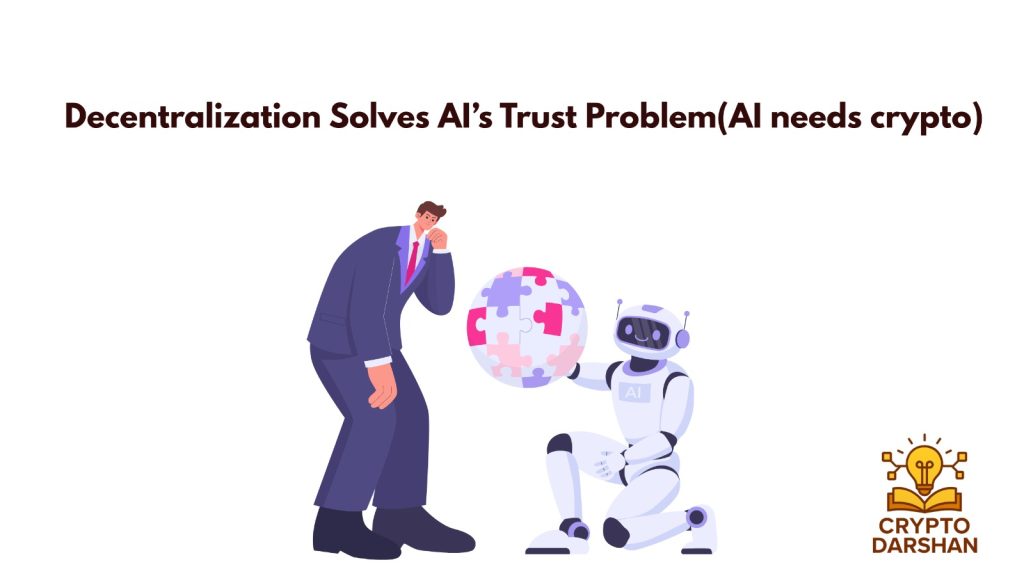
The Centralization Issue in AI
Most AI systems today are controlled by large corporations that own massive datasets and computing resources. This centralization creates a power imbalance. A handful of companies dictate how AI models are trained, what data they use, and how their outputs are applied.
This concentration of power raises concerns about bias, manipulation, and lack of accountability. Users have little visibility into how AI systems make decisions or how their data is used.
How Blockchain Restores Trust
Blockchain’s decentralized nature can solve AI’s trust problem. By distributing data and computation across a network, blockchain ensures that no single entity has complete control.
Each transaction or data entry on a blockchain is transparent and verifiable. When applied to AI, this means that training data, model updates, and decision-making processes can be recorded immutably. Anyone can audit the system to verify fairness and accuracy.
Example: Transparent AI Training
Imagine an AI model trained on medical data. Using blockchain, every dataset used in training could be logged with metadata about its source, consent, and usage rights. This transparency ensures that the AI’s predictions are based on verified, ethical data not hidden or biased information.
2. Token Incentives Can Power Open AI Ecosystems
The Cost of Building AI
Developing AI models requires enormous resources data, computing power, and human expertise. These costs limit participation to large corporations and research institutions. As a result, innovation becomes centralized, and smaller players are excluded.
Crypto’s Token Economy as a Solution
Crypto introduces a new economic model through tokens. Tokens can incentivize individuals and organizations to contribute resources such as data, computing power, or model improvements to a shared AI ecosystem.
Participants are rewarded with tokens for their contributions, creating a self-sustaining, decentralized AI network. This model democratizes AI development and reduces reliance on centralized entities.
Example: Decentralized AI Marketplaces
Projects like SingularityNET and Ocean Protocol are pioneering decentralized AI marketplaces. These platforms allow developers to share AI models and datasets securely, with transactions governed by smart contracts. Contributors earn tokens for their work, while users access AI services transparently.
3. Smart Contracts Enable Autonomous AI Agents
The Rise of Autonomous Agents
AI is evolving beyond passive systems into autonomous agents capable of making decisions and taking actions independently. These agents could manage digital assets, negotiate contracts, or even operate businesses without human intervention.
The Role of Smart Contracts
Smart contracts self-executing agreements on the blockchain provide the financial and operational infrastructure for autonomous AI agents. They allow AI systems to transact securely, enforce agreements, and manage resources automatically.
Example: AI-Powered Decentralized Organizations
Imagine an AI-driven decentralized autonomous organization (DAO) that invests in renewable energy projects. The AI analyzes data, identifies opportunities, and executes investments through smart contracts. All transactions are transparent and verifiable on the blockchain, ensuring accountability without human bias.
For AI systems to operate independently, they need neutral, programmable infrastructure not speculative assets. This is why Crypto as Digital Infrastructure, Not an Asset explains how blockchains provide the base layer AI needs for ownership, coordination, and value transfer.
4. Privacy and Ownership Through Cryptography

The Data Privacy Dilemma
AI thrives on data, but collecting and using personal information raises serious privacy concerns. Centralized data storage exposes users to risks of breaches, misuse, and surveillance.
People often lose control over their data once it’s shared with corporations or governments. This lack of ownership undermines trust in AI systems.
Cryptographic Solutions from the Crypto World
Crypto introduces advanced cryptographic techniques that can protect privacy while enabling data utility. Technologies like zero-knowledge proofs, homomorphic encryption, and secure multi-party computation allow AI to learn from data without directly accessing it.
Example: Privacy-Preserving AI
In healthcare, AI models could analyze patient data encrypted on a blockchain. The model learns from the data without revealing sensitive information. Patients retain ownership of their data and can grant or revoke access through smart contracts.
5. Crypto Can Verify AI Authenticity

The Problem of Deepfakes and Synthetic Media
AI-generated content from deepfakes to synthetic text is becoming increasingly realistic. While this technology has creative potential, it also poses risks of misinformation, fraud, and identity theft.
As AI-generated content floods the internet, distinguishing real from fake becomes a major challenge.
Blockchain as a Verification Layer
Blockchain can serve as a digital authenticity ledger. By timestamping and recording the origin of content, blockchain ensures that every piece of media can be traced back to its source.
When AI-generated content is registered on a blockchain, viewers can verify its authenticity and provenance. This helps combat misinformation and restores trust in digital media.
Example: Verified AI Content
A news organization could use blockchain to certify that its articles and images are human-created or AI-assisted. Readers could check the blockchain record to confirm authenticity, reducing the spread of fake news.
6. Data Provenance and Integrity

The Importance of Data Provenance
AI models are only as good as the data they are trained on. If the data is inaccurate, biased, or tampered with, the AI’s outputs will be flawed. Ensuring data integrity is therefore critical.
Blockchain’s Immutable Ledger
Blockchain provides an immutable record of data provenance. Every dataset can be traced back to its origin, with timestamps and verification records. This transparency ensures that AI models are trained on trustworthy data.
Example: Supply Chain AI
In supply chain management, AI systems can use blockchain-verified data to track products from origin to destination. This ensures accuracy in logistics, reduces fraud, and enhances accountability across the supply chain.
7. Democratizing AI Through Decentralization
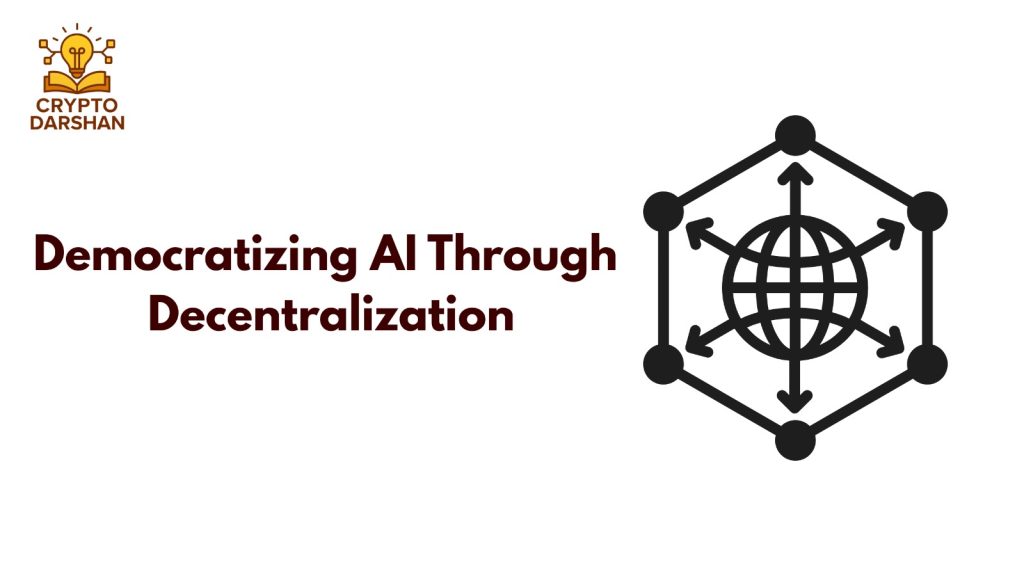
The Problem of AI Monopolies
Today’s AI landscape is dominated by a few tech giants that control data, infrastructure, and algorithms. This concentration of power limits innovation and creates ethical risks.
Decentralization can break these monopolies by distributing control across a global network of participants.
How Crypto Enables Decentralized AI
Crypto’s decentralized architecture allows anyone to participate in AI development and governance. Through token-based voting and decentralized governance models, communities can collectively decide how AI systems evolve; that’s why AI needs crypto.
Example: Community-Governed AI
A decentralized AI platform could allow token holders to vote on model updates, ethical guidelines, and data usage policies. This ensures that AI development aligns with community values rather than corporate interests.
8. Economic Alignment Between Humans and Machines
The Coming Machine Economy
As AI systems become more autonomous, they will increasingly interact with financial systems buying data, paying for compute power, or managing digital assets.
Traditional financial systems are not designed for machine-to-machine transactions. Crypto provides the infrastructure for this emerging machine economy.
Crypto as the Financial Layer for AI
Cryptocurrencies enable instant, borderless, and programmable payments. AI agents can use crypto to transact autonomously, creating a seamless economic ecosystem between humans and machines.
Example: AI-Powered IoT Devices
An AI-powered electric vehicle could automatically pay for charging using cryptocurrency. The transaction would be executed through a smart contract, ensuring transparency and efficiency without human involvement.
9. Accountability and Explainability in AI: A Detailed Explanation
Artificial Intelligence (AI) has become a cornerstone of modern innovation, influencing decisions in healthcare, finance, education, law enforcement, and countless other sectors. However, as AI systems grow more complex, they also become more opaque. This opacity raises two critical concerns — accountability and explainability.
These concepts are essential for ensuring that AI operates ethically, transparently, and responsibly. Understanding them in detail helps organizations, regulators, and users build trust in AI systems and mitigate potential harm.
1. What Is Accountability in AI?
Accountability in AI refers to the responsibility of individuals, organizations, or systems for the outcomes produced by AI models. It ensures that when an AI system makes a decision, whether approving a loan, diagnosing a disease, or recommending a sentence, there is a clear line of responsibility for that decision.
Key Aspects of Accountability
- Ownership of Decisions
Someone must be accountable for the actions and outcomes of an AI system. This could be the developer, the organization deploying the AI, or the end user. Accountability ensures that AI decisions are not dismissed as “machine errors” without human oversight. - Traceability
Every step in the AI lifecycle, from data collection to model training and deployment, should be traceable. This allows auditors or regulators to identify where errors or biases originated. - Governance and Oversight
Accountability requires governance frameworks that define roles, responsibilities, and ethical standards. These frameworks ensure that AI systems comply with laws, regulations, and societal values. - Liability and Redress
When AI systems cause harm such as discrimination, financial loss, or misinformation, accountability mechanisms determine who is liable and how victims can seek redress.
Why Accountability Matters
Without accountability, AI systems can cause harm without consequence. For example:
- A biased hiring algorithm could unfairly reject qualified candidates.
- A self-driving car could cause an accident due to faulty decision-making.
- A predictive policing system could target specific communities disproportionately.
In each case, accountability ensures that someone is responsible for investigating, correcting, and preventing future harm.
2. What Is Explainability in AI?
Explainability(also known as interpretability) refers to the ability to understand and articulate how an AI system arrives at its decisions. Explainable AI is used to describe an AI model, its expected impact, and potential biases. It answers questions like:
- Why did the AI make this prediction?
- What factors influenced the outcome?
- Can humans verify or challenge the decision?
Explainability is crucial for building trust, ensuring fairness, and enabling accountability.
While much of the focus is on how AI can enhance existing blockchain projects, the relationship also runs in the opposite direction. A growing number of networks are being designed specifically around autonomous agents, machine coordination, and on-chain intelligence, a shift explored in The Rise of AI-Powered Cryptocurrencies Explained, where crypto provides the economic and trust layer AI systems struggle to build on their own.
Levels of Explainability
- Global Explainability
Understanding how the entire AI model works, its structure, logic, and general decision-making process. This helps developers and regulators assess whether the model behaves as intended. - Local Explainability
Understanding why the AI made a specific decision or prediction. For example, why did the AI deny a particular loan application? Local explanations are vital for users affected by AI decisions. - Post-Hoc Explainability
Techniques used after a model has made a decision to interpret or visualize its reasoning. Examples include feature importance scores, decision trees, or heatmaps in image recognition.
3. The Black Box Problem
Many modern AI systems, especially deep learning models, operate as black boxes; they produce outputs without revealing how they reached them. These models contain millions of parameters and complex mathematical relationships that are difficult for humans to interpret.
This lack of transparency creates several issues:
- Bias and Discrimination: Hidden biases in training data can lead to unfair outcomes.
- Lack of Trust: Users and regulators may hesitate to rely on AI systems they cannot understand.
- Legal and Ethical Risks: In sectors like healthcare or finance, unexplained AI decisions can violate laws or ethical standards.
4. Techniques for Achieving Explainability

Several methods and tools have been developed to make AI systems more interpretable:
a. Feature Importance Analysis
Determines which input features (variables) most influenced the model’s decision. For example, in a credit scoring model, income and payment history might have higher importance than age or location.
b. LIME (Local Interpretable Model-Agnostic Explanations)
LIME explains individual predictions by approximating the complex model with a simpler, interpretable one around the specific instance being analyzed.
c. SHAP (SHapley Additive exPlanations)
SHAP assigns each feature a contribution value based on cooperative game theory, showing how much each feature pushed the prediction up or down.
d. Decision Trees and Rule-Based Models
Simpler models like decision trees are inherently interpretable because they follow clear, logical rules that humans can understand.
e. Visualization Tools
Heatmaps, saliency maps, and attention visualizations help explain how AI models process images or text, highlighting which parts of the input influenced the output.
5. The Role of Blockchain in Accountability and Explainability
Blockchain technology can enhance both accountability and explainability in AI by providing transparency, traceability, and immutability.
a. Immutable Audit Trails
Every step in the AI lifecycle, data collection, model training, and decision-making, can be recorded on a blockchain. This creates a permanent, tamper-proof record that auditors can review.
b. Data Provenance
Blockchain ensures that the origin and integrity of data used to train AI models are verifiable. This helps prevent data manipulation and bias.
c. Smart Contracts for Governance
Smart contracts can enforce accountability automatically. For example, if an AI system violates predefined ethical rules, a smart contract could trigger an alert or halt operations.
d. Transparent Decision Logs
AI decisions can be logged on-chain, allowing stakeholders to trace how and why a particular outcome occurred. This is especially useful in regulated industries like finance or healthcare.
10. The Future of AI-Crypto Integration
The Convergence of Two Revolutions
AI and crypto are converging to create a new digital paradigm one where intelligence and value flow seamlessly across decentralized networks.
AI provides the cognitive layer, enabling machines to learn and adapt. Crypto provides the trust layer, ensuring transparency, security, and fairness.
Emerging Use Cases
- Decentralized AI Networks: Platforms where AI models are trained and shared across blockchain-based ecosystems.
- AI-Powered DAOs: Organizations governed by AI algorithms and smart contracts.
- Data Marketplaces: Blockchain-based platforms where users can sell their data directly to AI developers.
- AI Identity Systems: Decentralized digital identities verified through blockchain to prevent fraud and impersonation.
11. Why Crypto Doesn’t Need AI as Much
While AI benefits immensely from crypto, the reverse is not as critical. Crypto’s core functions, decentralized finance, asset management, and secure transactions do not depend on AI, but AI needs crypto.
AI can enhance crypto systems through predictive analytics, fraud detection, and automation, but these are improvements, not necessities. Crypto’s foundational value lies in its ability to operate trustlessly and autonomously, independent of AI.
12. Challenges and Considerations
Scalability
Integrating AI with blockchain requires significant computational resources. Current blockchain networks may struggle with the data volume and speed AI demands. Layer-2 solutions and off-chain computation can help address this.
Regulation
Both AI and crypto face evolving regulatory landscapes. Ensuring compliance while maintaining decentralization will be a key challenge.
Ethical Governance
Decentralized AI systems must still adhere to ethical standards. Community governance models and transparent protocols will be essential to prevent misuse.
Frequently Asked Questions (FAQ)

Why does AI need crypto at all?
AI systems need a way to own resources, transact value, and operate without centralized permission. Crypto provides programmable money, decentralized identity, and trust-minimized coordination—things traditional financial systems aren’t designed to support.
What problem does crypto solve for AI that traditional systems can’t?
Traditional systems rely on banks, platforms, and intermediaries that require human approval. Autonomous AI agents can’t open bank accounts or sign contracts, but they can interact with blockchains, wallets, and smart contracts directly.
Does crypto need AI in the same way?
Not really. Crypto existed and functioned long before AI became mainstream. While AI can improve analytics, UX, and security, crypto’s core value, permissionless ownership and value transfer, doesn’t depend on AI.
How do AI agents use cryptocurrencies in practice?
AI agents can use crypto to pay for services, access compute, coordinate with other agents, and store value autonomously. Stablecoins are especially useful because they provide predictable value for automated payments.
Why are stablecoins important for AI-driven systems?
AI systems require consistency, not volatility. Stablecoins enable reliable, programmable payments that machines can use without worrying about sudden price swings or market timing.
What role do blockchains play in AI autonomy?
Blockchains act as neutral, always-on infrastructure. They allow AI systems to execute logic, verify actions, and transfer value without relying on centralized servers or institutions that could restrict access.
Is this what people mean by AI-powered cryptocurrencies?
Partially. Some projects embed AI directly into crypto networks, while others use blockchains as the economic layer that allows AI agents to operate independently. The key shift is crypto enabling AI not the other way around.
Conclusion
AI and crypto represent two sides of the same technological coin intelligence and trust. While crypto can thrive independently, AI’s future depends on the principles that crypto embodies: decentralization, transparency, and verifiable ownership.
Crypto provides the infrastructure AI needs to become open, fair, and accountable. It offers solutions to AI’s most pressing challenges from data privacy and bias to trust and economic inequality.
In the coming decade, the fusion of AI and crypto will redefine how technology interacts with society. But the direction of dependence is clear: AI needs crypto far more than crypto needs AI.
Together, they can build a digital world that is not only intelligent but also just, transparent, and truly decentralized.