
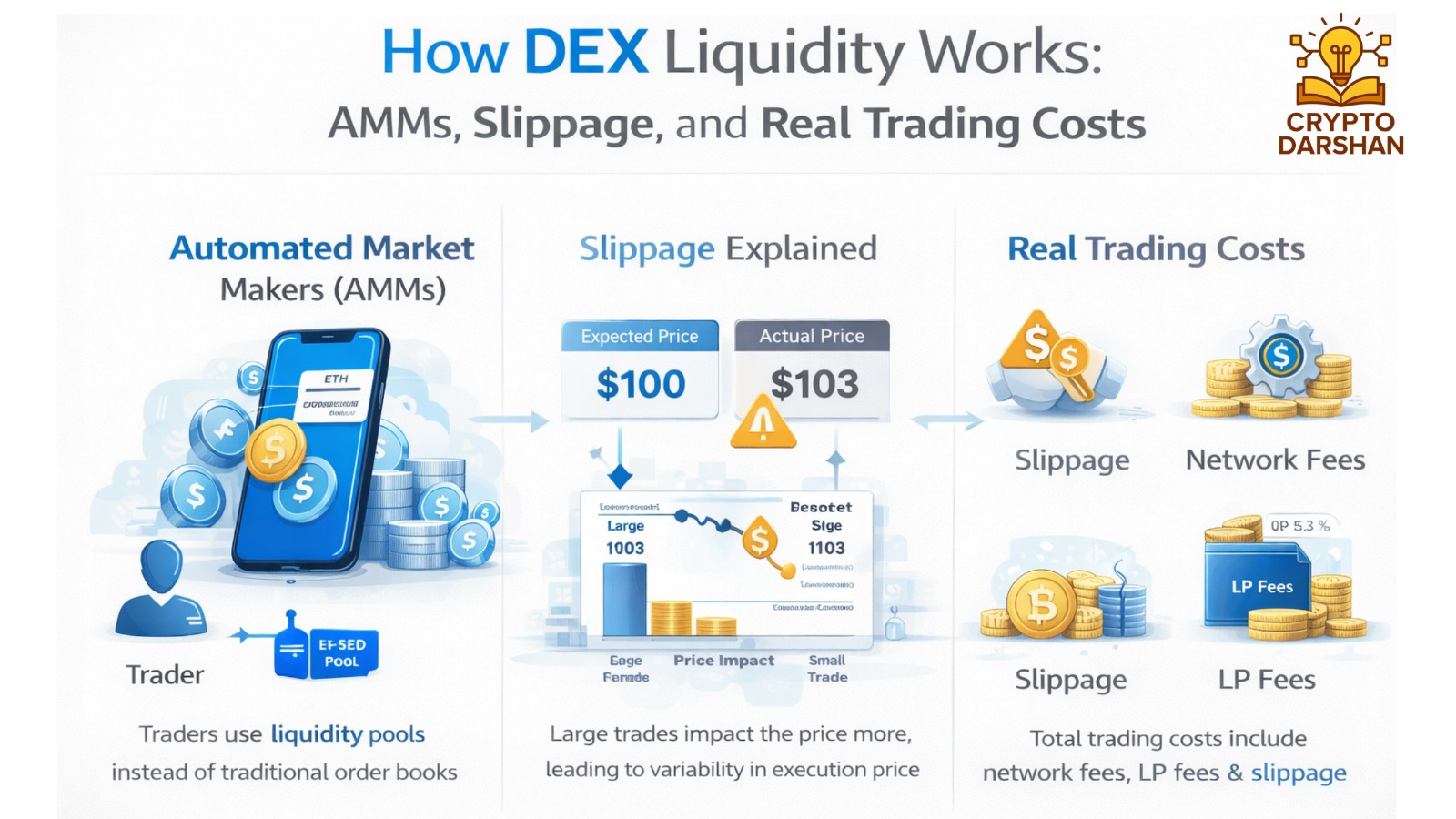
Decentralized exchanges (DEXs) have become the backbone of decentralized finance (DeFi), enabling peer-to-peer trading without intermediaries. Unlike centralized exchanges (CEXs), which rely on order books and custodial systems, DEXs use automated protocols to match buyers and sellers directly on the blockchain. The key to their success lies in liquidity. The ability to execute trades quickly and efficiently without causing significant price changes.
Liquidity determines how smoothly a market operates. In traditional finance, liquidity is provided by market makers and institutional investors. In decentralized finance, liquidity is powered by smart contracts and community participation. Automated Market Makers (AMMs) have revolutionized this process, allowing anyone to become a liquidity provider (LP) and earn rewards for contributing to the market.
This article explores how DEX liquidity works, focusing on the mechanics of AMMs, the concept of slippage, and the real trading costs that affect users. It also examines how innovations in 2026 are reshaping decentralized trading, making it more efficient, transparent, and accessible.
Understanding Decentralized Exchanges (DEX) Liquidity
What Is Liquidity?
Liquidity refers to how easily an asset can be bought or sold without significantly affecting its price. A highly liquid market allows large trades to occur with minimal price impact, while an illiquid market experiences volatility and slippage.
In DEXs, liquidity is provided by users who deposit pairs of tokens into liquidity pools. These pools enable continuous trading by ensuring that there are always tokens available for swaps. The more liquidity a pool has, the more stable and efficient the trading experience becomes.
Why DEX liquidity Matters
Liquidity is the lifeblood of any exchange. It affects:
- Price stability: High liquidity reduces volatility and prevents large price swings.
- Trading efficiency: Deep liquidity ensures faster execution and lower slippage.
- User confidence: Traders prefer platforms with consistent liquidity and predictable pricing.
- Ecosystem growth: Liquidity attracts more users, developers, and projects, creating a positive feedback loop.
The Rise of Automated Market Makers (AMMs)
What Are AMMs?
Automated Market Makers are smart contracts that facilitate trading by automatically determining prices based on mathematical formulas. Automated market makers (AMMs) allow digital assets to be traded without permission and automatically by using liquidity pools instead of a traditional market of buyers and sellers. On a traditional exchange platform, buyers and sellers offer up different prices for an asset.
Each pool contains two or more tokens, and the AMM algorithm adjusts prices according to supply and demand. This model eliminates the need for centralized order books and allows 24/7 trading without intermediaries.
Many traders comparing fees and execution eventually realize that understanding DEX liquidity is key to the broader DEX vs CEX debate. While centralized exchanges rely on order books and market makers, decentralized exchanges depend on AMMs and DEX liquidity pools, which explains why slippage and on-chain costs behave differently across the two models.
The Constant Product Formula
The most common AMM model, introduced by Uniswap, uses the constant product formula: x × y = k Where:
- x = quantity of token A in the pool
- y = quantity of token B in the pool
- k = constant value that must remain unchanged
When a trader swaps one token for another, the ratio between x and y changes, and the AMM automatically adjusts the price to maintain the constant product. This ensures continuous liquidity but introduces price impact depending on trade size.
Example of an AMM Trade
Suppose a liquidity pool contains 100 ETH and 100,000 USDC. The price of 1 ETH is 1,000 USDC. If a trader buys 10 ETH, they must add USDC to the pool, increasing the USDC balance and reducing the ETH balance. The new ratio changes the price, making ETH slightly more expensive for the next buyer. This dynamic pricing mechanism is what keeps the pool balanced.
Types of AMMs
- Constant Product AMMs (Uniswap, PancakeSwap):
Maintain liquidity across all price ranges using the x × y = k formula. - Constant Sum AMMs (Curve Finance):
Designed for stablecoins and similar assets, offering minimal slippage. - Hybrid AMMs (Balancer, DODO):
Combine multiple formulas to optimize liquidity and reduce impermanent loss. - Concentrated Liquidity AMMs (Uniswap v3):
Allow liquidity providers to allocate capital within specific price ranges, improving capital efficiency.
How Liquidity Providers Earn Rewards
Liquidity providers (LPs) deposit tokens into pools and receive LP tokens representing their share. In return, they earn:
- Trading fees: A percentage of each trade is distributed to LPs.
- Incentives: Many DEXs offer governance tokens or yield farming rewards.
- Protocol revenue sharing: Some platforms distribute a portion of protocol profits to LPs.
However, providing liquidity also carries risks, including impermanent loss, which occurs when token prices diverge significantly from their initial ratio.
Understanding Slippage in DEX Trading
What Is Slippage?
Slippage is the difference between the expected price of a trade and the actual price executed. Slippage does not denote a negative or positive movement because any difference between the intended execution price and actual execution price qualifies as slippage. When an order is executed, the security is purchased or sold at the most favorable price offered by an exchange or other market maker. when large trades move the market price due to limited liquidity in the pool.
For example, if a trader expects to buy 1 ETH for 1,000 USDC but ends up paying 1,010 USDC due to price impact, the 10 USDC difference is slippage.
Causes of Slippage
- Low Liquidity: Smaller pools experience higher price impact for large trades.
- High Volatility: Rapid price changes can cause discrepancies between expected and executed prices.
- Large Trade Size: Bigger trades consume more liquidity, shifting the price curve.
- Network Congestion: Delays in transaction confirmation can lead to outdated prices.
How AMMs Handle Slippage
AMMs use mathematical curves to determine prices dynamically. The more liquidity in a pool, the flatter the curve, and the lower the slippage. Traders can also set slippage tolerance a maximum acceptable deviation from the expected price to avoid unfavorable trades.
Reducing Slippage
- Trade in high-liquidity pools.
- Use DEX aggregators like 1inch or Matcha to find the best prices across multiple pools.
- Avoid trading during high volatility.
- Use limit orders on advanced DEXs that support them.
Real Trading Costs on DEXs liquidity
Trading on a DEX involves more than just token swaps. Several hidden costs affect the total expense of a trade.
1. Trading Fees
Most DEXs charge a small fee per trade, typically between 0.1% and 0.3%. These fees are distributed to liquidity providers as rewards. Some protocols also allocate a portion to governance or development funds.
2. Gas Fees
Since DEX transactions occur on-chain, users must pay gas fees to miners or validators. Gas costs vary depending on network congestion and blockchain type. Layer-2 solutions like Arbitrum and Optimism have significantly reduced these costs in 2026.
3. Slippage Costs
Slippage represents an indirect cost, as traders may receive fewer tokens than expected. This cost increases with trade size and decreases with higher liquidity.
4. Impermanent Loss for LPs
Liquidity providers face potential losses when token prices diverge. Although trading fees can offset this, impermanent loss remains a key consideration for LPs.
5. Opportunity Costs
Locking tokens in liquidity pools means they cannot be used elsewhere. This opportunity cost can affect overall portfolio performance, especially during volatile markets.
The Role of DEX Aggregators
Optimizing Trade Execution
DEX aggregators scan multiple decentralized exchanges simultaneously to find the best available prices for a trade. Instead of relying on a single liquidity pool, they split orders across several DEXs to minimize slippage and maximize returns. This ensures traders always get the most efficient execution possible.
Reducing Slippage and Price Impact
Large trades can cause significant price movement in a single liquidity pool. Aggregators solve this by dividing the trade into smaller portions and routing them through multiple pools. This reduces slippage the difference between expected and executed prices and maintains price stability.
Lowering Transaction Costs
By using smart routing algorithms, DEX aggregators minimize gas fees and trading costs. They batch transactions efficiently and select the most cost-effective paths, saving users money while maintaining fast execution speeds.
Enhancing Liquidity Access
Aggregators combine liquidity from various DEXs, effectively creating a unified liquidity layer. This expanded access allows traders to execute large orders without facing liquidity shortages, improving overall market depth and efficiency.
Providing Transparency and Analytics
Most DEX aggregators offer real-time data on token prices, liquidity depth, and trading volume. This transparency helps users make informed decisions and compare rates across platforms before executing trades.
Supporting Cross-Chain Trading
Modern aggregators integrate cross-chain functionality, allowing users to swap assets across different blockchains seamlessly. This interoperability expands trading opportunities and connects fragmented liquidity across ecosystems.
Improving User Experience
Aggregators simplify DeFi trading by offering a single, user-friendly interface. Traders no longer need to manually compare prices or switch between multiple DEXs, the aggregator handles everything automatically, making decentralized trading more accessible.
Examples of Leading DEX Aggregator
OpenOcean: Supports both DeFi and CeFi aggregation, bridging centralized and
1inch: Known for its Pathfinder algorithm that finds the most efficient trading routes.
Matcha: Focuses on simplicity and transparency, offering clear price comparisons.
Paraswap: Optimizes gas usage and integrates with multiple DeFi protocols.
Innovations in DEX Liquidity Models (2026)
1. Concentrated Liquidity
Introduced by Uniswap v3, concentrated liquidity allows LPs to allocate funds within specific price ranges. This increases capital efficiency and reduces idle liquidity. In 2026, most major DEXs have adopted this model, offering higher returns for LPs.
2. Dynamic Fee Structures
Modern DEXs use adaptive fee models that adjust based on market volatility and liquidity depth. This ensures fair compensation for LPs while maintaining competitive trading costs.
3. Cross-Chain Liquidity
Cross-chain bridges and interoperability protocols like LayerZero and Cosmos IBC enable liquidity sharing across multiple blockchains. Traders can now swap assets seamlessly between Ethereum, BNB Chain, Polygon, and other networks.
4. AI-Driven Liquidity Optimization
Artificial intelligence analyzes trading patterns, predicts demand, and automatically rebalances liquidity pools. This reduces slippage and enhances market stability.
5. Decentralized Liquidity Networks
Protocols like Thorchain and SushiXSwap have introduced decentralized liquidity networks that aggregate liquidity from multiple chains, creating a unified trading experience.
Most DEX liquidity pools are built around stable assets, making stablecoins the backbone of on-chain trading. Without reliable stablecoin liquidity, AMMs would struggle to offer tight spreads, low slippage, and consistent pricing across volatile markets.
The Economics of Liquidity Provision
Incentive Mechanisms
DEXs use tokenomics to attract DEX liquidity. Common incentives include:
- Liquidity mining: LPs earn governance tokens for providing liquidity.
- Staking rewards: Additional yields for locking LP tokens.
- Fee rebates: Reduced trading fees for active participants.
These incentives align user interests with protocol growth, creating sustainable ecosystems.
Balancing Rewards and Risks
While rewards can be lucrative, LPs must consider:
- Impermanent loss: Potential value loss due to price divergence.
- Market volatility: Rapid price changes affecting pool ratios.
- Protocol risk: Smart contract vulnerabilities or governance failures.
Sophisticated LPs use analytics tools to monitor pool performance and adjust strategies dynamically.
Case Studies: Leading DEX Liquidity Models
Uniswap v3
Uniswap remains the benchmark for AMM innovation. Its concentrated liquidity model allows LPs to provide liquidity within custom price ranges, maximizing capital efficiency. In 2026, Uniswap v5 integrates AI-driven liquidity management and cross-chain compatibility.
Curve Finance
Curve specializes in stablecoin trading, using a constant sum formula to minimize slippage. Its deep liquidity pools and DAO governance make it a cornerstone of DeFi’s stable asset ecosystem.
Balancer
Balancer allows customizable pools with multiple tokens and variable weights. This flexibility enables portfolio-style liquidity provision and automated rebalancing.
dYdX Chain
Operating as a decentralized Layer-1 blockchain, dYdX offers perpetual futures trading with deep liquidity and zero gas fees. Its hybrid model combines AMM efficiency with order book precision.
PancakeSwap
Built on BNB Chain, PancakeSwap has evolved into a multi-chain DEX Liquidity offering yield farming, NFTs, and gaming integrations. Its liquidity incentives attract millions of users globally.
Comparing DEX Liquidity and CEX Liquidity
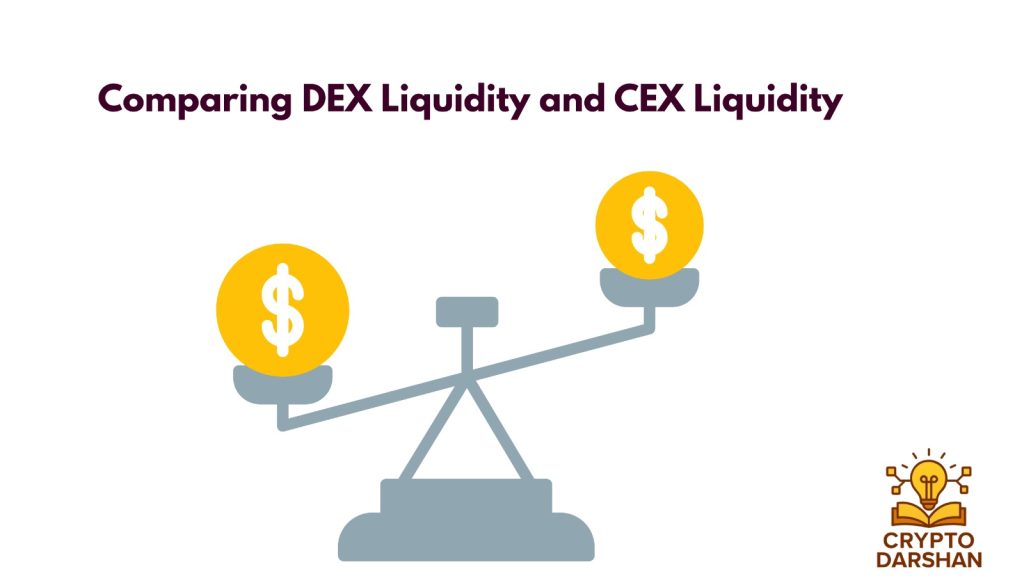
| Aspect | DEX Liquidity | CEX Liquidity |
| Custody | Non-custodial | Custodial |
| Price Discovery | Algorithmic (AMM) | Order book-based |
| Transparency | Fully on-chain | Limited |
| Accessibility | Permissionless | Regulated |
| Liquidity Depth | Varies by pool | Typically higher |
| Fees | Protocol-based | Exchange-determined |
| Innovation Speed | Rapid | Slower due to compliance |
While CEXs still dominate in liquidity depth, DEXs are rapidly catching up through technological innovation and cross-chain integration.
Common Misconceptions About DEX Liquidity
- “DEXs have low liquidity.”
Modern DEXs rival CEXs in liquidity, especially for major trading pairs. - “AMMs are inefficient.”
Advanced AMM models and concentrated liquidity have drastically improved efficiency. - “Slippage makes DEXs unusable.”
With aggregators and deep pools, slippage is now minimal for most trades. - “Providing liquidity is too risky.”
Risk management tools and dynamic fee models have made liquidity provision more predictable. - “DEXs can’t handle large trades.”
Cross-chain liquidity networks and institutional participation now support high-volume trading.
The Future of DEX Liquidity
1. Integration with Real-World Assets (RWAs)
Tokenized assets such as stocks, bonds, and commodities will soon be traded on DEXs. Liquidity pools will expand beyond crypto, bridging DeFi and traditional finance.
2. Institutional Liquidity Providers
Institutional investors are entering DeFi, providing large-scale liquidity and stability. This professionalization enhances market depth and reduces volatility.
3. Layer-2 Dominance
As Layer-2 networks mature, most DEX activity will migrate off-chain, offering near-instant transactions and negligible fees.
4. AI and Predictive Liquidity
AI algorithms will forecast liquidity demand, automatically adjusting pool parameters to maintain optimal efficiency.
5. Unified DEX Liquidity Networks
Future DEXs will operate as interconnected liquidity hubs, allowing seamless trading across chains and assets through decentralized routing protocols.
FAQs: How DEX Liquidity Works – AMMs, Slippage, and Real Trading Costs
What is liquidity on a decentralized exchange?
Liquidity on a DEX refers to how easily assets can be traded without causing large price changes. Instead of relying on order books like centralized exchanges, DEXs liquidity pools funded by users to enable continuous trading.
What are AMMs and how do they work?
Automated Market Makers (AMMs) are smart contracts that set token prices using mathematical formulas rather than buyers and sellers. Trades happen against a pool of tokens, and prices adjust automatically based on supply and demand within that pool.
Why do DEXs use AMMs instead of order books?
AMMs remove the need for centralized market makers and constant order matching. This allows DEXs to operate permissionlessly, stay online 24/7, and support long-tail tokens that would struggle to find liquidity on traditional order books.
What is slippage in DEX trading?
Slippage is the difference between the expected trade price and the price actually executed. On DEXs, slippage happens when a trade is large relative to the pool size, pushing the price along the AMM curve.
How can traders reduce slippage on DEXs?
Traders can reduce slippage by using deeper liquidity pools, splitting large trades into smaller ones, adjusting slippage tolerance, or trading on Layer-2 networks where liquidity is aggregated more efficiently.
What are the real trading costs on a DEX?
Real DEX trading costs include swap fees paid to liquidity providers, network gas fees, and slippage. While headline fees may look low, poor liquidity or high gas can make trades more expensive than expected.
Are DEX fees higher than CEX fees?
Not always. DEX fees are often transparent and predictable, especially on Layer-2 chains. However, during periods of high congestion or low liquidity, total costs on a DEX can exceed those of a centralized exchange.
Who provides liquidity on DEXs?
Liquidity is provided by users called liquidity providers (LPs) who deposit token pairs into pools. In return, they earn a share of trading fees and, in some cases, additional token incentives.
What is impermanent loss and why does it matter?
Impermanent loss occurs when the price of tokens in a liquidity pool changes compared to simply holding them. It’s a key risk for LPs and directly affects how attractive liquidity provision is on a DEX.
Conclusion
Decentralized exchanges have redefined how liquidity works in the digital economy. Through automated market makers, community-driven liquidity pools, and transparent on-chain operations, DEXs Liquidity have created a new financial paradigm that empowers users and democratizes trading.
Understanding AMMs, slippage, and real trading costs is essential for navigating this ecosystem effectively. As technology advances, DEXs are becoming faster, cheaper, and more efficient rivaling and, in many cases, surpassing centralized exchanges.
By 2026, DEX liquidity will have evolved into a sophisticated, global network that supports not only cryptocurrencies but also tokenized real-world assets. The future of trading is decentralized, transparent, and powered by liquidity that belongs to the people.