

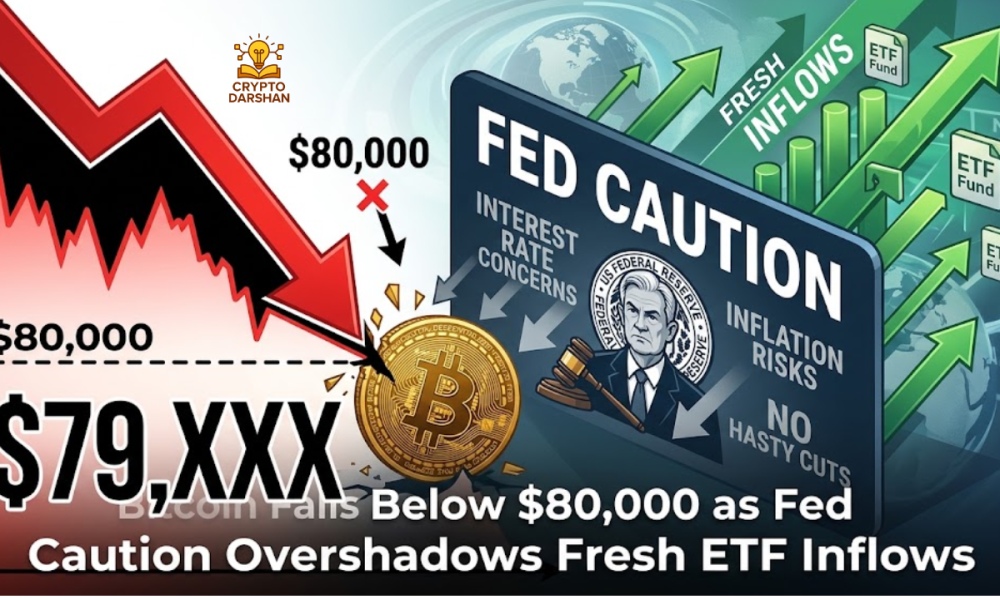
Bitcoin slipped below $80,000 on October 29, even though U.S. spot Bitcoin ETFs recorded more than $423 million in inflows over three straight trading sessions. The main reason is that investors are still worried about stubborn inflation, high borrowing costs, and weak on-chain demand
At press time, Bitcoin traded near $79,800, down 1.50% in 24 hours. The boader crypto market also fell about 1.57% over the same period.
Fed decision disappointed risk investors
The Federal Reserve kept its benchmark interest rate at 3.75% to 4% after its October 28 meeting. The decision passed in a 10-2 vote, with Governor Lisa Cook and Cleveland Fed President Beth Hammack supporting another quarter-point increase.
Fed Chair Kevin Warsh said inflation was still too high and that policymakers needed more evidence that monetary policy was restoring price stability. That cautious message reduced hopes for a quick return to lower interest rates.
Higher rates usually make risky assets such as Bitcoin less attractive. When borrowing costs stay elevated, investors often prefer safer yield-bearing assets instead of speculative markets.
Inflation and oil prices add pressure

Markets are now focused on the September Personal Consumption Expenditures inflation report, due October 29. Economists surveyed by the Associated Press expect annual PCE inflation to reach 3.6%, up from 3.4% in August.
Oil prices have made the outlook worse. Trading firm Wintermute highlighted inflation risks from Brent crude trading above $115 per barrel. Higher energy prices can raise household and business costs, making it harder for inflation to cool.
For Bitcoin, this creates a difficult setup. Investors want lower rates to support risk assets, but persistent inflation may keep the Fed cautious for longer.
ETF inflows did not stop the decline
Spot Bitcoin ETFs attracted $423.66 million across October 26, 27, and 28, according to SoSoValue. Daily inflows were $110.34 million, $175.99 million, and $137.33 million respectively.
That demand reversed part of the earlier outflows. On October 22 alone, spot ETFs lost about $635.6 million, followed by more withdrawals the next day.
However, ETF inflows do not automatically push Bitcoin’s price higher. They measure net subscriptions to investment funds, not direct buying pressure in the spot market. The timing, hedging activity, and overall market liquidity also matter.
By October 28, cumulative net inflows into U.S. spot Bitcoin ETFs reached $57.61 billion. The funds held about $104.88 billion in net assets, with $1.26 billion in trading volume during the latest session.
Weak network activity limits support
On-chain data also failed to confirm a strong recovery. Santiment found that Bitcoin’s weekday transaction count averaged 271,800 between October 14 and 27, below the 278,800 average recorded from July through September.
Active addresses also declined. They averaged 637,000 in the recent two-week period, compared with 662,000 during the summer.
This suggests that the latest ETF inflows have not yet translated into broader user activity. Without stronger spot demand and network usage, Bitcoin may struggle to hold key price levels.
Liquidations deepen selling pressure

Derivatives traders added to the pressure. More than $69 million in Bitcoin positions were liquidated over the past 24 hours, with long positions making up most of the losses.
On TradingView’s daily chart, Bitcoin briefly dropped to $79,710 before recovering to about $80,022. The relative strength index stood at 42.25, below its moving average of 46.71, while the MACD remained negative at -497.07.
Analyst Daan Crypto Trades noted repeated failures to sustain rebounds around $80,000. He pointed to a short-term downward trend that has continued since September 20.
Key Bitcoin price levels to watch
Bitcoin’s immediate support sits near $79,700 to $80,000. A break below that range could expose $78,000, followed by $75,000 to $76,000.
For a recovery, buyers need to reclaim $82,000. If Bitcoin clears that level, the next resistance zone is around $84,000 to $85,000.
Analyst Crypto Patel identified sell-side liquidity near $74,911 and a possible deeper support zone between $62,000 and $69,000. He stressed that this scenario depends on a further breakdown.
What comes next for Bitcoin

Bitcoin’s short-term direction will likely depend on the October 29 inflation report, oil-price movements, and upcoming technology earnings. These events could shape overall risk appetite across financial markets.
The Fed’s next policy meeting is scheduled for December 8-9, while minutes from the October meeting will be released on November 18. Until investors see clearer evidence that inflation is cooling, Bitcoin may remain vulnerable despite renewed institutional demand through ETFs.