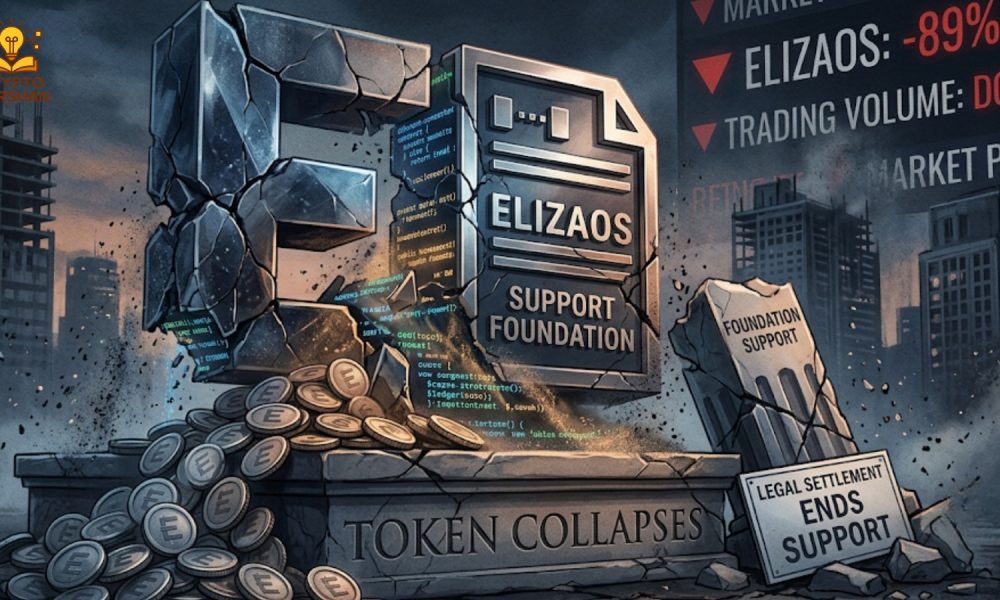
The ELIZAOS token has entered a major crisis after Eliza Labs founder Shaw Walters said the project’s foundation is winding down and will no longer support the cryptocurrency.
Walters reportedly described the token as “dead” after the project settled a federal class-action lawsuit filed by Burwick Law. According to reports, the settlement used the foundation’s remaining treasury and cash reserves, leaving no funds for future buybacks, token support, or additional project operations.
The announcement caused a sharp reaction across the crypto market. ELIZAOS reportedly fell about 19% in 24 hours and reached a new record low near $0.000289. The decline added to a much larger collapse from the token’s earlier market peak.
Lawsuit drains the project treasury

The legal dispute was reportedly connected to the AI16Z project and its later transition to ELIZAOS. Burwick Law filed a federal class-action lawsuit against Walters, Eliza Labs, and related parties.
The complaint reportedly included allegations of misleading marketing, deceptive business practices, negligent misrepresentation, and unjust enrichment. These claims remain allegations and should not be treated as findings of wrongdoing unless established in court.
Walters said the project did not have enough money to continue a long legal battle. Although he reportedly rejected the accusations, he said the foundation decided to settle by transferring its remaining funds to the group involved in the case.
This decision effectively removed the financial support behind the token. Without a treasury, the project cannot continue programs such as token buybacks, liquidity support, supply management, or other market-related initiatives.
If you’re trading volatile crypto assets, choosing a reputable exchange is essential. Check out our guide to the Best Crypto Exchanges With Lowest Fees in 2026.
What happened to AI16Z?
The ELIZAOS token was linked to AI16Z, an earlier crypto project that gained attention during the rise of artificial intelligence and AI-agent tokens.
AI agents are software systems designed to carry out tasks with limited human input. In the crypto sector, these projects often use blockchain networks, smart contracts, and tokens to support communities, payments, governance, or access to digital services.
The AI16Z and ELIZAOS story attracted considerable interest during the AI-token boom. At one point, the project was reportedly valued at about $2.4 billion. However, the token later suffered a decline of roughly 97% from its peak, according to market reports.
The project also faced criticism over its token migration, supply changes, market performance, and falling community confidence. The lawsuit became the final pressure point for a foundation that was already dealing with financial and reputational problems.
ElizaOS software will continue

The end of the ELIZAOS token does not necessarily mean that all Eliza-related development will stop.
Walters has said that the underlying ElizaOS software will continue as an open-source artificial intelligence project. Open-source software allows developers to inspect, use, modify, and contribute to code under the terms of its license.
Reports indicate that Walters plans to focus on the software without launching another token. He has also said that future development will continue independently from the cryptocurrency that previously supported the project.
This creates a clear separation between the technology and the token. The code may continue to receive development, while the ELIZAOS cryptocurrency no longer has official foundation support. ELIZAOS is a utility token whose value depends heavily on ecosystem development and adoption. Learn more about utility tokens here.
For investors, however, this difference is important. Continued software development does not automatically create value for a token. A project can remain active as a technology platform even when its cryptocurrency loses liquidity, market demand, and community support.
No more buybacks or treasury support
Token buybacks are programs in which a project uses treasury funds to purchase tokens from the market. Some crypto communities view buybacks as a way to support demand or reduce circulating supply.
Walters reportedly confirmed that ELIZAOS will no longer have a buyback fund. He also said there would be no new supply measures or additional foundation funding for the token.
This news may make trading more difficult. With fewer official liquidity programs and no treasury backing, holders could face wider spreads, lower trading volume, and increased price volatility.
The situation also shows why investors should examine a token’s treasury, governance structure, and funding model before buying. A token that depends heavily on one foundation may become vulnerable if that organization runs out of money or faces legal problems.
What ELIZAOS holders should consider
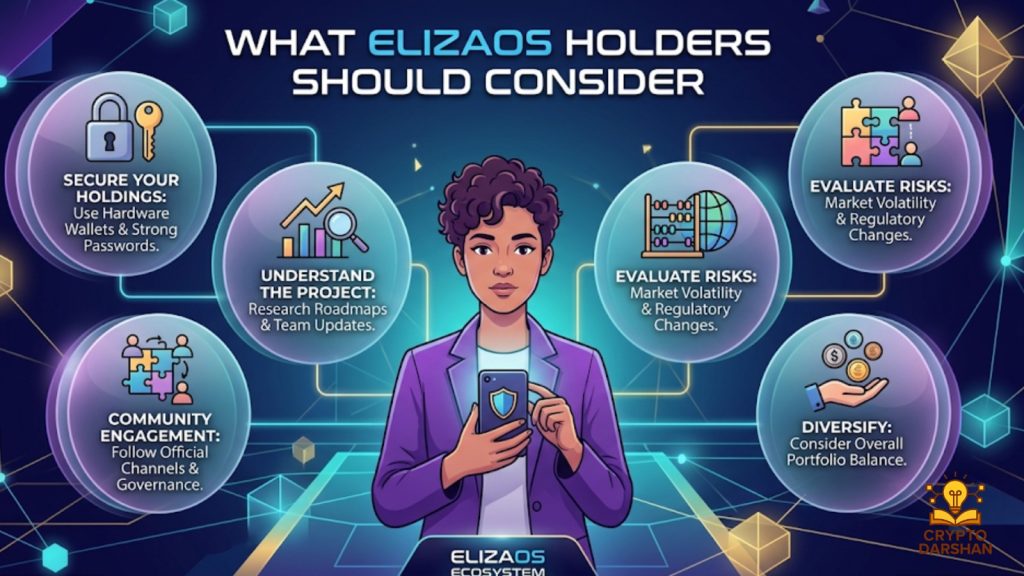
ELIZAOS holders are now facing significant uncertainty. The founder’s statement does not guarantee that exchanges will immediately delist the asset, but market support may weaken as investors reassess the project’s future.
Key risks include:
- No foundation treasury to fund token support.
- No planned buybacks or price-support programs.
- Possible declines in liquidity and trading activity.
- Continued legal and reputational uncertainty.
- Greater price volatility for remaining holders.
- A possible separation between the token and the open-source software.
Investors should avoid making decisions based only on social media posts or hopes of a short-term price rebound. They should review official announcements, exchange notices, wallet activity, and legal updates before taking action.
The ELIZAOS case is another reminder that a strong technology narrative does not guarantee long-term token value. Even a project connected to artificial intelligence can face severe pressure when legal costs, falling prices, weak liquidity, and limited treasury funds come together.