
Bitcoin vs gold, beginners often debate which asset offers the best entry point for new investors, balancing growth and stability. For centuries, gold has been the ultimate symbol of wealth and stability. It has served as a store of value, a hedge against inflation, and a haven during economic uncertainty. In recent years, however, a new contender has emerged: Bitcoin, often referred to as “digital gold.” As the world becomes increasingly digital, investors are now comparing these two assets to determine which one offers better opportunities, especially for beginners.
This comprehensive guide explores the similarities and differences between Bitcoin and gold, their investment potential, risks, and long-term outlook. It also provides practical insights for beginners who want to understand which asset might suit their financial goals in 2026 and beyond.
Understanding the Basics
What Is Gold?

Gold is a precious metal that has been used as money, jewelry, and a store of value for thousands of years. It is tangible, durable, and universally recognized. Central banks, governments, and investors hold gold as a hedge against inflation and currency devaluation. Its value is influenced by supply, demand, and global economic conditions.
What Is Bitcoin?
Bitcoin is a decentralized digital currency created in 2009 by an anonymous person or group known as Satoshi Nakamoto. It operates on blockchain technology, which records transactions on a public ledger. Unlike gold, Bitcoin exists only in digital form and is not controlled by any government or institution. Its supply is limited to 21 million coins, making it scarce and deflationary by design.
Historical Perspective

Gold’s Legacy
Gold has been a trusted store of value for over 5,000 years. Ancient civilizations used it for trade, jewelry, and wealth preservation. Even today, central banks hold gold reserves as part of their monetary policy. Its stability and universal acceptance make it a cornerstone of traditional investment portfolios.
Bitcoin’s Rise
Bitcoin, on the other hand, is just over a decade old. Initially dismissed as a speculative experiment, it has grown into a trillion-dollar asset class. Early adopters saw massive returns, and institutional investors have since joined the market. Bitcoin’s rise represents a shift toward digital finance and decentralized systems.
Why Investors Compare Bitcoin and Gold

Investors often compare Bitcoin and gold because both assets share similar characteristics that make them attractive as stores of value and hedges against economic uncertainty. While one is a centuries-old physical commodity and the other a modern digital currency, they serve comparable purposes in investment portfolios. Understanding why investors draw parallels between Bitcoin and gold helps explain their roles in today’s financial landscape.
1. Both Are Considered Stores of Value
A store of value is an asset that maintains its worth over time without depreciating. Gold has served this role for thousands of years, preserving wealth across generations. Bitcoin, though much newer, was designed with the same principle in mind to hold value over time, independent of government-issued currencies.
Investor’s view both assets as ways to protect their purchasing power, especially when traditional currencies lose value due to inflation or economic instability.
2. Scarcity Creates Value
Scarcity is a key factor that drives the value of both Bitcoin and gold.
- Gold is rare in nature and difficult to mine, which limits its supply.
- Bitcoin has a fixed supply of 21 million coins, coded into its protocol.
This limited availability means that as demand increases, the value of each asset tends to rise. Investors appreciate this scarcity because it prevents inflationary dilution unlike fiat currencies that can be printed in unlimited quantities.
3. Hedge Against Inflation
Both Bitcoin and gold are seen as hedges against inflation. When central banks print more money, the value of fiat currencies decreases. Gold has historically performed well during such times, maintaining or increasing its value. Bitcoin, with its fixed supply and decentralized nature, is often viewed as a modern alternative to gold for protecting wealth from inflation.
4. Independence from Governments and Banks
Gold and Bitcoin operate outside the control of central authorities.
- Gold is not issued by any government and holds value globally.
- Bitcoin is decentralized, meaning no single entity can manipulate its supply or transactions.
This independence appeals to investors who want to diversify away from traditional financial systems and reduce exposure to political or economic instability.
5. Global Acceptance and Liquidity
Both assets are recognized and traded worldwide.
- Gold is universally accepted and can be exchanged in almost any country.
- Bitcoin, though digital, can be traded 24/7 on global exchanges and transferred instantly across borders.
Their global nature makes them highly liquid assets that investors can easily buy, sell, or convert into other currencies when needed.
6. Psychological and Historical Parallels

Gold has a long history of being associated with wealth and security. Bitcoin, often called “digital gold,” has inherited this perception in the digital age. Both assets attract investors seeking safety during uncertain times.
The psychological comfort of owning something scarce and valuable, whether physical or digital, drives the comparison between the two.
7. Diversification Benefits
Investors compare Bitcoin and gold because both can serve as diversification tools in a portfolio. They often behave differently from traditional assets like stocks or bonds.
- Gold tends to rise when markets fall, acting as a safe haven.
- Bitcoin, while more volatile, sometimes moves independently of traditional markets, offering potential for higher returns.
Holding either or both can help balance risk and reward in an investment strategy.
8. Technological vs. Traditional Value
Gold represents traditional, tangible wealth, while Bitcoin symbolizes technological innovation and digital finance. Investors compare them to understand how old and new forms of value coexist in the modern economy.
Gold appeals to those who trust physical assets, while Bitcoin attracts those who believe in the future of decentralized technology. The comparison highlights the evolution of money — from physical metals to digital code.
9. Market Sentiment and Media Influence
Media coverage often fuels comparisons between Bitcoin and gold. Headlines describing Bitcoin as “digital gold” reinforce the idea that both assets serve similar purposes. As Bitcoin gains mainstream attention, investors naturally evaluate how it stacks up against gold’s long-standing reputation.
10. Long-Term Wealth Preservation
Ultimately, both Bitcoin and gold are viewed as tools for preserving wealth over the long term. Investors compare them to determine which asset better protects value in different economic conditions. Gold offers proven stability, while Bitcoin offers innovation and potential for higher growth.
Key Differences Between Bitcoin and Gold

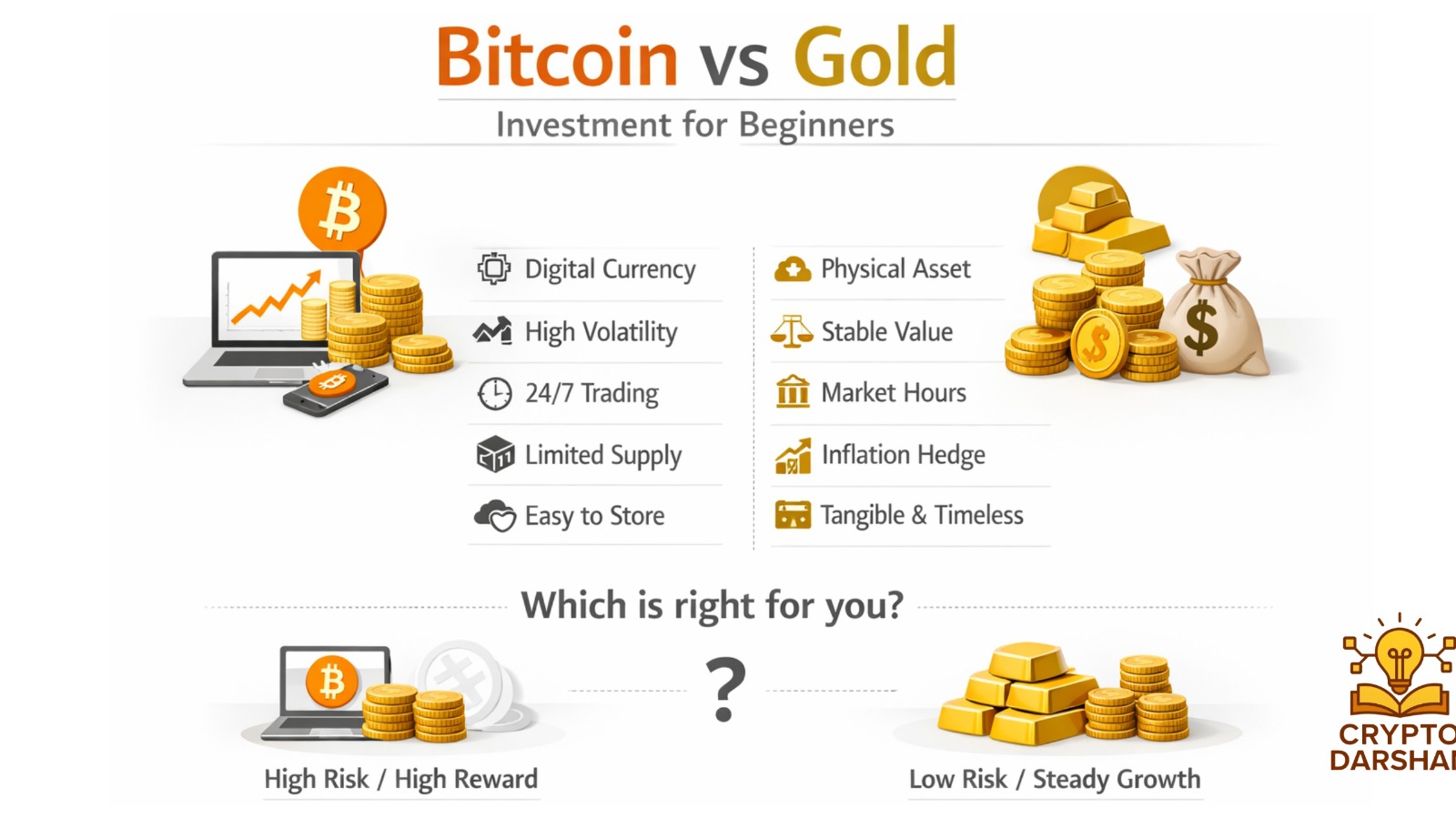
| Feature | Bitcoin | Gold |
| Nature | Digital asset | Physical commodity |
| Storage | Digital wallets | Vaults or safes |
| Portability | Easily transferable online | Difficult to transport |
| Divisibility | Highly divisible (up to 1 satoshi) | Limited divisibility |
| Volatility | High | Low |
| Regulation | Evolving | Well-established |
| Liquidity | High on exchanges | High in physical and ETF markets |
| Adoption | Growing rapidly | Globally established |
| Environmental Impact | Energy-intensive mining | Mining also impacts the environment |
| Supply Limit | 21 million coins | Finite but still mined |
Why Beginners Are Interested in Bitcoin and Gold

Bitcoin and gold have become two of the most talked-about investment options for beginners. While they belong to completely different worlds, one digital and one physical, both attract new investors for similar reasons: stability, potential growth, and protection against economic uncertainty. Understanding why beginners are drawn to these assets helps explain their growing popularity in modern investment portfolios.
1. Accessibility and Ease of Investment
One of the main reasons beginners are interested in Bitcoin and gold is accessibility.
- Bitcoin can be purchased online through exchanges or mobile apps with just a few clicks. Investors can start with small amounts, even fractions of a coin, making it easy for anyone to participate.
- Gold is also widely available in various forms, such as coins, bars, jewelry, or digital gold. Beginners can buy physical gold from dealers or invest in gold ETFs without needing large capital.
This ease of entry makes both assets appealing to first-time investors who want to start small and gradually build their portfolios.
2. Perceived Safety and Stability
Gold has a long-standing reputation as a safe and stable investment. It has preserved wealth for centuries and tends to perform well during economic downturns. Bitcoin, though newer, is often seen as a modern version of gold, a digital asset that offers independence from traditional financial systems.
Beginners are drawn to them because they provide a sense of security. Gold offers historical reliability, while Bitcoin offers technological innovation and decentralization.
3. Protection Against Inflation
Inflation reduces the purchasing power of money over time. Both Bitcoin and gold are viewed as hedges against inflation because they are scarce assets.
- Gold has historically maintained its value when fiat currencies weaken.
- Bitcoin has a fixed supply of 21 million coins, meaning it cannot be inflated by governments or central banks.
Beginners who are concerned about rising prices and currency devaluation often turn to these assets to preserve their wealth.
4. Diversification Opportunities
New investors are learning the importance of diversification spreading investments across different asset types to reduce risk. Bitcoin and gold offer diversification benefits because they behave differently from traditional assets like stocks or bonds.
- Gold tends to rise when markets fall, acting as a safe haven.
- Bitcoin, while more volatile, sometimes moves independently of traditional markets, offering potential for higher returns.
By including both in a portfolio, beginners can balance risk and reward.
5. Regulation of Gold and Bitcoin
Gold’s established system for trading, weighing, and tracking is pristine. It’s very hard to steal or fake; it’s also highly regulated. In many countries, you cannot cross borders while carrying gold without regulatory permission.
Bitcoin is also difficult to steal and fake, thanks to its encrypted and decentralized system. It is generally legal to use across the borders of different countries, with a few exceptions. However, the regulatory infrastructure that could exist to ensure that users are safe is not yet in place in many countries the pseudonymous nature of cryptocurrency also makes it challenging to regulate.
6. Potential for High Returns
While gold is known for stability, Bitcoin attracts beginners with its potential for high returns. Over the past decade, Bitcoin has outperformed most traditional assets, delivering exponential growth for early investors.
Beginners who are willing to take calculated risks see Bitcoin as an opportunity to grow their wealth faster, while gold provides a safety net for preserving value.
7. Technological and Cultural Appeal

Bitcoin represents innovation and the future of finance. It appeals to younger generations who are comfortable with technology and digital platforms. The idea of owning a decentralized, borderless currency aligns with modern values of independence and digital freedom.
Gold, on the other hand, carries cultural and emotional significance. It is often associated with wealth, tradition, and security. Beginners are drawn to gold for its tangible nature and historical prestige.
8. Low Entry Barriers
Both Bitcoin and gold allow investors to start small.
- With Bitcoin, investors can buy fractions of a coin, known as satoshis.
- With gold, digital platforms now offer fractional ownership, allowing investors to buy small quantities without needing to store physical gold.
This flexibility makes both assets beginner-friendly, removing the traditional barriers of high capital requirements.
9. Desire for Financial Independence
Many beginners are drawn to Bitcoin and gold because they represent financial independence.
- Bitcoin allows individuals to control their money without relying on banks or governments.
- Gold provides a tangible asset that can be held privately and used in times of crisis.
Both assets empower investors to take control of their financial future, which is especially appealing in uncertain economic times.
Advantages of Investing in Bitcoin

1. High Growth Potential
Bitcoin’s price history shows exponential growth since its inception. Despite volatility, long-term investors have seen substantial returns. Its limited supply and increasing demand could drive future appreciation.
2. Decentralization
Bitcoin operates without central control. This independence appeals to investors seeking financial freedom and protection from government interference.
3. Liquidity and Accessibility
Bitcoin can be traded 24/7 on global exchanges. Transactions are fast, and investors can buy or sell anytime without intermediaries.
4. Transparency and Security
All Bitcoin transactions are recorded on a public blockchain, ensuring transparency. The network’s cryptographic security makes it resistant to fraud and tampering.
5. Portability
Bitcoin can be transferred across borders instantly. Unlike gold, it doesn’t require physical transportation or storage.
Disadvantages of Investing in Bitcoin

1. Volatility
Bitcoin’s price can fluctuate dramatically within short periods. This volatility can lead to significant gains or losses, making it risky for beginners.
2. Regulatory Uncertainty
Governments worldwide are still developing cryptocurrency regulations. Sudden policy changes can impact Bitcoin’s price and accessibility.
3. Security Risks
While the blockchain is secure, investors must protect their private keys and wallets. Hacks, scams, and phishing attacks remain common.
4. Limited Historical Data
Bitcoin’s short history makes it difficult to predict long-term performance compared to gold’s centuries of stability.
Advantages of Investing in Gold

1. Stability and Reliability
Gold has maintained its value for thousands of years. It performs well during economic downturns and market crises, offering stability to investors.
2. Inflation Hedge
Gold’s value often rises when inflation increases, making it a reliable hedge against currency depreciation.
3. Tangible Asset
Gold is physical and can be held, stored, or passed down through generations. This tangibility provides psychological comfort to many investors.
4. Low Volatility
Gold prices move gradually compared to Bitcoin’s sharp fluctuations. This makes it suitable for conservative investors.
5. Universal Acceptance
Gold is recognized and valued worldwide. It can be easily sold or exchanged in almost any country.
Disadvantages of Investing in Gold

1. Limited Growth Potential
Gold’s price tends to rise slowly over time. While it preserves wealth, it rarely delivers high returns like Bitcoin.
2. Storage and Insurance Costs
Physical gold requires secure storage and insurance, which can add to investment costs.
3. Lack of Passive Income
Gold doesn’t generate interest or dividends. Its value depends solely on market demand.
4. Difficult to Transport
Large quantities of gold are heavy and expensive to move, limiting portability.
Comparing Investment Performance

Historical Returns
Over the past decade, Bitcoin has significantly outperformed gold in terms of returns. Early Bitcoin investors saw gains of thousands of percent, while gold’s growth remained modest. However, Bitcoin’s volatility means these returns come with higher risk.
Volatility Comparison
Gold’s price movements are relatively stable, making it a haven during market turbulence. Bitcoin, in contrast, experiences sharp price swings, which can be both an opportunity and a risk for beginners.
Correlation with Traditional Markets
Gold often moves inversely to stock markets, providing diversification benefits. Bitcoin’s correlation with traditional assets has varied, sometimes acting as a hedge and other times moving in tandem with risk assets.
Bitcoin vs Gold as an Inflation Hedge

Inflation is one of the biggest concerns for investors. When the cost of goods and services rises, the purchasing power of money decreases. To protect their wealth, investors often turn to assets that can hold or increase in value during inflationary periods. Historically, gold has been the go-to inflation hedge, but in recent years, Bitcoin has emerged as a modern alternative.
Understanding how both assets perform during inflation helps beginners decide which one might be better suited for their investment goals.
1. Understanding Inflation and Its Impact on Investments
Inflation occurs when the supply of money grows faster than the supply of goods and services, leading to higher prices. Traditional currencies lose value because central banks can print more money, reducing each unit’s purchasing power.
Investors seek inflation-hedge assets that maintain or increase in value as inflation rises. Both Bitcoin and gold are considered inflation-resistant because they are scarce and not directly tied to government monetary policies.
2. Gold as a Traditional Inflation Hedge
Gold has been used as a store of value for thousands of years. Its physical scarcity, durability, and universal acceptance make it a reliable hedge against inflation.
Why Gold Works as an Inflation Hedge
- Limited Supply: Gold cannot be created at will. Mining new gold is slow and costly, which keeps supply growth low.
- Intrinsic Value: Gold has industrial, cultural, and monetary uses, giving it inherent demand.
- Historical Performance: During periods of high inflation, such as the 1970s, gold prices surged as investors sought safety from declining currency values.
- Global Recognition: Gold is accepted worldwide, making it a trusted asset in uncertain economic times.
Limitations of Gold as an Inflation Hedge
- Storage and Insurance Costs: Physical gold requires secure storage, which adds expenses.
- Slow Growth: Gold preserves value but rarely delivers high returns.
- Limited Liquidity in Physical Form: Selling physical gold can take time and may involve transaction fees.
Despite these drawbacks, gold remains a cornerstone of inflation protection due to its long history and proven reliability.
3. Bitcoin as a Modern Inflation Hedge

Bitcoin was designed to mimic gold’s scarcity but in digital form. Its supply is capped at 21 million coins, making it immune to inflation caused by excessive money printing.
Why Bitcoin Is Seen as an Inflation Hedge
- Fixed Supply: No central authority can increase Bitcoin’s supply, ensuring scarcity.
- Decentralization: Bitcoin operates outside government control, protecting it from monetary manipulation.
- Global Accessibility: Bitcoin can be traded 24/7 across borders, offering liquidity and flexibility.
- Growing Adoption: As more institutions and individuals adopt Bitcoin, its demand increases, potentially driving up its value.
Limitations of Bitcoin as an Inflation Hedge
- Volatility: Bitcoin’s price can fluctuate dramatically, which may concern conservative investors.
- Short History: Bitcoin has existed for just over a decade, so it lacks the long-term track record that gold has.
- Regulatory Uncertainty: Government policies and regulations can impact Bitcoin’s price and accessibility.
- Market Sentiment: Bitcoin’s value is heavily influenced by investor psychology and media coverage.
While Bitcoin’s volatility makes it riskier, its deflationary design and growing adoption suggest it could become a stronger inflation hedge over time.
4. Comparing Bitcoin and Gold During Inflationary Periods
Both assets protect against inflation, but they do so in different ways. Gold relies on its physical scarcity and historical trust, while Bitcoin depends on its algorithmic scarcity and decentralized nature.
5. Performance During Recent Inflationary Periods
In recent years, global inflation has surged due to economic disruptions, supply chain issues, and monetary stimulus.
- Gold’s Performance: Gold prices typically rise during inflationary periods but may stagnate when interest rates increase. For example, gold performed well during the 2008 financial crisis and the early 2020 pandemic period.
- Bitcoin’s Performance: Bitcoin has shown mixed results. It surged during periods of monetary expansion but also experienced sharp corrections. Its long-term trend, however, remains upward, reflecting growing adoption and belief in its value as “digital gold.”
6. Psychological and Generational Differences
Investor preferences often depend on age and mindset.
- Older investors tend to trust gold because of its tangible nature and historical reliability.
- Younger investors are more comfortable with digital assets and view Bitcoin as the future of money.
This generational divide highlights how Bitcoin and gold appeal to different audiences while serving similar purposes.
7. Diversification: Using Both as Inflation Hedges
Many experts suggest that Bitcoin and gold can complement each other in a portfolio.
- Gold provides stability and long-term security.
- Bitcoin offers growth potential and exposure to digital innovation.
By holding both, investors can balance risk and reward gold cushions against volatility, while Bitcoin offers upside potential during periods of monetary expansion.
Risk Factors to Consider

Market Volatility
Bitcoin’s price can change rapidly, while gold’s movements are more predictable. Beginners must assess their risk tolerance before investing.
Regulatory Environment
Gold is well-regulated globally, while Bitcoin faces evolving laws that can affect its use and taxation.
Technological Risks
Bitcoin depends on digital infrastructure. Network attacks, software bugs, or technological failures could impact its value.
Economic Conditions
Gold tends to perform well during recessions, while Bitcoin’s performance depends on investor sentiment and adoption trends.
Although gold is considered stable, Bitcoin offers higher growth potential with increased risk. Beginners should be aware of price volatility, security risks, and market sentiment, which are discussed in Hidden Risks in Crypto Investments Beginners Should Know before investing.
How to Invest in Bitcoin
- Choose a Reliable Exchange: Select a reputable platform like Binance, Coinbase, or Kraken.
- Create an Account: Complete identity verification and enable two-factor authentication.
- Deposit Funds: Add fiat currency using bank transfer or card payment.
- Buy Bitcoin: Start with small amounts and gradually increase holdings.
- Store securely: Use hardware wallets like Ledger or Trezor for maximum security.
- Monitor and Manage: Track market trends and adjust strategy as needed.
How to Invest in Gold
- Physical Gold: Buy coins or bars from trusted dealers.
- Gold ETFs: Invest in exchange-traded funds that track gold prices.
- Gold Mining Stocks: Purchase shares in companies that produce gold.
- Digital Gold: Use online platforms offering fractional ownership of gold.
- Storage: Keep physical gold in secure vaults or insured facilities.
Which Is Better for Beginners?

Bitcoin for Growth-Oriented Investors
Beginners seeking high returns and willing to accept volatility may prefer Bitcoin. It offers innovation, accessibility, and long-term potential but requires careful risk management.
Gold for Conservative Investors
Those prioritizing stability and wealth preservation may find gold more suitable. It provides security and reliability, especially during economic uncertainty.
Balanced Approach
A diversified portfolio combining both Bitcoin and gold can balance risk and reward. Gold offers stability, while Bitcoin provides growth potential.
The Future Outlook

Bitcoin’s Future
Bitcoin’s adoption continues to grow among institutions, governments, and individuals. Technological upgrades like the Lightning Network improve scalability and usability. As digital finance expands, Bitcoin’s role as “digital gold” may strengthen.
Gold’s Future
Gold will likely remain a cornerstone of global finance. Central banks continue to hold reserves, and demand from jewelry and industry ensures long-term stability. While it may not offer explosive growth, gold’s reliability will endure.
Practical Tips for Beginners
- Start small and invest gradually.
- Diversify between Bitcoin, gold, and other assets.
- Use secure platforms and wallets.
- Stay informed about market trends and regulations.
- Avoid emotional decisions during price fluctuations.
Conclusion
Both Bitcoin and gold have unique strengths that appeal to different types of investors. Gold offers time-tested stability and security, while Bitcoin provides innovation and high growth potential. For beginners, the choice depends on financial goals, risk tolerance, and investment horizon.
In 2026, Bitcoin continues to evolve as a digital alternative to gold, while gold remains a trusted store of value. A balanced approach combining the old and the new can help beginners build a resilient portfolio that thrives in both traditional and digital economies.
Bitcoin and gold are not rivals but complementary assets, each playing a vital role in the modern investment landscape.