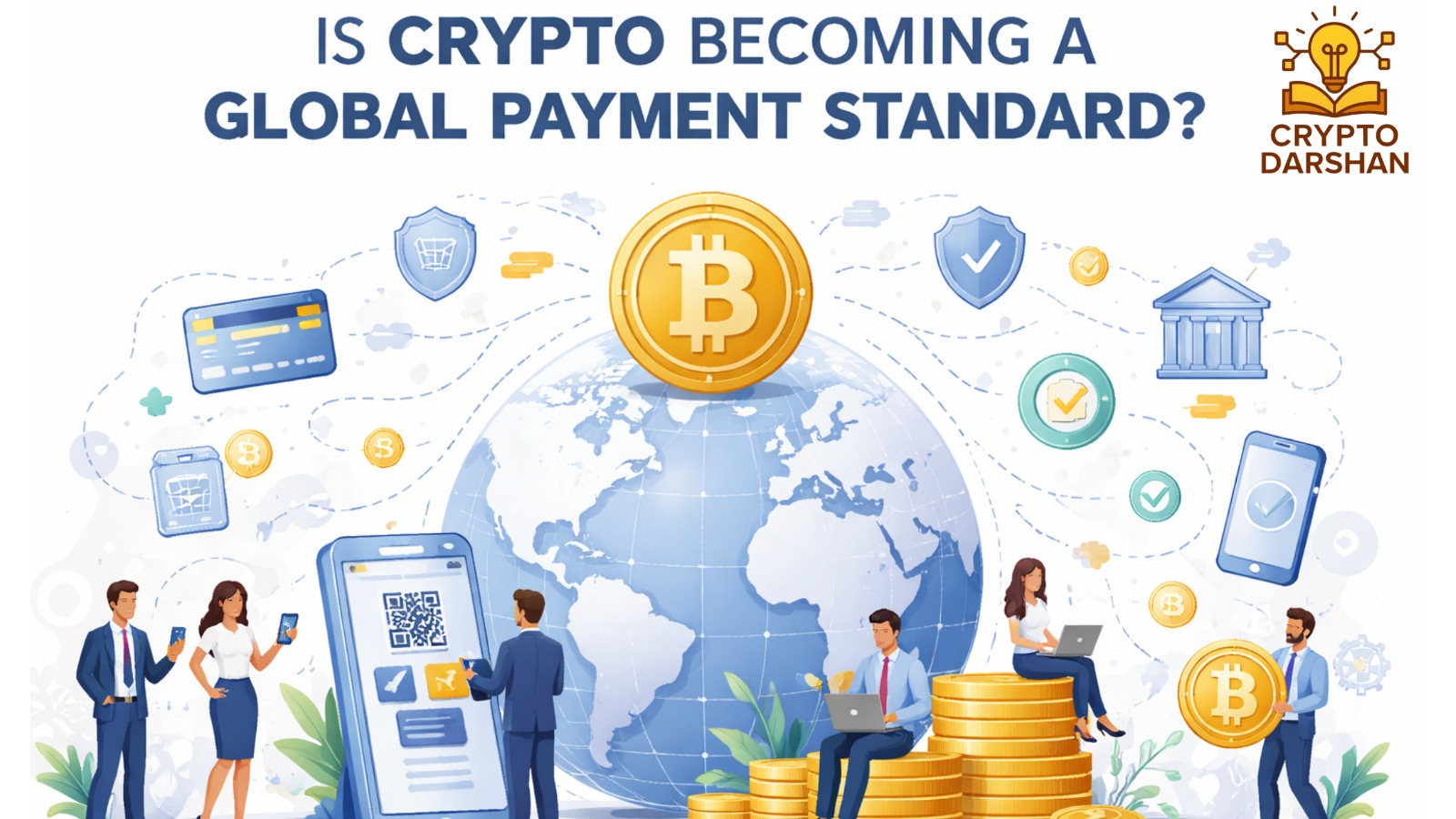
The financial world is changing rapidly. Cryptocurrencies, once seen as digital investments, are now becoming possible alternatives for standard payment systems. From Bitcoin’s launch in 2009 to the development of stablecoins and central bank digital currencies (CBDCs), the growth of crypto has been fast and disruptive. A key question in financial discussions today is whether crypto is becoming the standard way to pay globally. This review looks at the technology, economic, and regulatory aspects influencing this change, examining the opportunities and challenges that shape crypto’s path toward global payment acceptance.
The Evolution of Money and Digital Payments.
From Barter to Blockchain
Money has evolved through several stages: barter, commodity money, paper currency, electronic payments, and now digital assets. Each stage aimed to improve efficiency, trust, and accessibility. The introduction of blockchain technology was a major change, allowing secure and transparent transactions without needing a central authority.
The Rise of Digital Payments
In the 21st century, digital payment systems like PayPal, Alipay, and mobile banking became very common. These platforms simplified cross-border transactions and reduced dependency on cash. However, they still rely on centralized institutions, which can impose fees, restrictions, and delays. Cryptocurrencies emerged as an alternative, offering peer-to-peer transactions that bypass traditional financial gatekeepers.
Understanding Cryptocurrency as a Payment System.

Cryptocurrency is more than just a digital asset; it’s anew type of payment system that works without traditional banking networks. It allows people to send and receive money directly, securely, and globally without relying on intermediaries like banks or payment processors. To understand how cryptocurrency functions as a payment system, it’s important to explore its structure, features, and the reasons behind its growing adoption.
1. What Makes Cryptocurrency Unique?
Traditional payment systems depend on centralized authorities such as banks or governments to verify and process transactions. Cryptocurrencies, on the other hand, operate on blockchain technology, a decentralized digital ledger that records every transaction across a network of computers.
Each transaction is verified by network participants (called miners or validators) through cryptographic algorithms, ensuring transparency and security without the need for a central authority.
This decentralized nature means that no single entity controls the system, making it resistant to censorship, fraud, and manipulation. It also allows users to transact directly with one another, reducing costs and increasing efficiency.
2. Key Features Driving Crypto Payments
Several characteristics make cryptocurrencies effective as payment systems:
- Decentralization: Transactions occur directly between users, eliminating intermediaries and reducing transaction fees.
- Transparency: Every transaction is recorded on a public ledger, allowing anyone to verify it.
- Security: Advanced cryptography protects user data and funds from unauthorized access.
- Speed: Cross-border payments that take days through banks can be completed in minutes using crypto.
- Accessibility: Anyone with internet access can use cryptocurrencies, making them especially valuable in regions with limited banking infrastructure.
3. How Crypto Transactions Work?

When a user sends cryptocurrency, the transaction is shared with the blockchain network. Validators confirm that the sender has sufficient funds and that the transaction follows network rules. Once verified, the transaction is added to a block and permanently recorded on the blockchain.
This process ensures that transactions are immutable (cannot be altered) and trustless (do not require trust in a third party).
For example, if you send Bitcoin to someone in another country, the transaction is verified by the Bitcoin network and recorded on its blockchain. The recipient receives the funds directly, without needing a bank or payment processor.
Popular Cryptocurrencies for Payments

Cryptocurrencies are no longer just investment tools; they are being used for everyday transactions. Several digital currencies are now widely used for payments due to their speed, security, and global accessibility. Below is an explanation of the most popular ones:
1. Bitcoin (BTC)
Bitcoin is the first and most recognized cryptocurrency. It was created in 2009 by a group known as Satoshi Nakamoto. Bitcoin operates on a decentralized network, allowing peer-to-peer transactions without intermediaries like banks.
- Use in payments: Many merchants accept Bitcoin for goods and services, both online and offline.
- Advantages: High security, global acceptance, and brand recognition.
- Limitations: Transaction speed and fees can fluctuate depending on network congestion.
Bitcoin often leads discussions around crypto payments due to its decentralized and borderless nature. While many view it primarily as an investment, Bitcoin is also being used for international transactions and merchant payments. This dual role is explored further in Bitcoin Investment Strategy: Maximize Returns 2026, where Bitcoin’s long-term utility supports its relevance in global payment conversations.
2. Ethereum (ETH)
Ethereum is more than just a cryptocurrency; it’s a platform for decentralized applications (dApps) and smart contracts. Its native token, Ether (ETH), is used to pay for transactions and computational services on the network.
- Use in payments: ETH is accepted by many businesses and is also used to power decentralized finance (DeFi) platforms.
- Advantages: Fast transactions, programmable payments, and wide developer support.
- Limitations: Gas fees can be high during peak usage periods.
3. Litecoin (LTC)
Litecoin was created in 2011 by Charlie Lee as a “lighter” version of Bitcoin. It offers faster block generation times and lower transaction fees.
- Use in payments: Ideal for small, everyday purchases due to its speed and affordability.
- Advantages: Quick confirmations and low fees.
- Limitations: Less adoption compared to Bitcoin and Ethereum.
4. Ripple (XRP)
Ripple focuses on facilitating fast and low-cost international payments. Unlike most cryptocurrencies, XRP is designed primarily for financial institutions rather than individual users.
- Use in payments: Banks and payment providers use Ripple’s network to settle cross-border transactions efficiently.
- Advantages: Extremely fast transactions (a few seconds) and minimal fees.
- Limitations: Centralization concerns due to Ripple Labs’ control over XRP supply.
5. Stablecoins (USDT, USDC, DAI)
Stablecoins are cryptocurrencies pegged to stable assets like the US dollar or gold. They combine the benefits of blockchain technology with price stability, making them ideal for payments.
- Use in payments: Commonly used for remittances, e-commerce, and DeFi transactions.
- Advantages: Stable value, fast transfers, and low fees.
- Limitations: Dependence on the stability and transparency of the issuing entity.
The Global Shift Toward Crypto Payments
Adoption by Businesses
Larger companies such as Tesla, Microsoft, and Shopify have integrated crypto global payment options. Payment processors like BitPay and Coinbase Commerce allow merchants to accept crypto seamlessly. This growing acceptance signals a shift in perception from speculative investment to a legitimate payment method.
Consumer Behavior and Demand
Younger generations especially Millennials and Gen Z, are playing a key role in pushing crypto adoption forward. Their comfort with digital technology, combined with a growing mistrust of traditional banking systems, makes them more open to decentralized finance (DeFi). Many surveys show that these users value the speed, privacy, and borderless nature of crypto transactions, reinforcing crypto’s potential to evolve into a global payment solution rather than just an investment asset.
Cross-Border Transactions
Traditional cross-border payments are often slow and expensive due to intermediaries and currency conversion fees. Cryptocurrencies eliminate these barriers, enabling instant global payment transfers at minimal cost. This advantage is particularly significant for remittances, where crypto offers a lifeline to millions of unbanked individuals.
The Role of Stablecoins and CBDCs
Stablecoins: Bridging Volatility and Usability
One of the main challenges of using cryptocurrencies for global payments is price volatility. Stablecoins address this issue by pegging their value to stable assets like the US dollar or gold. They combine the efficiency of blockchain with the stability of fiat currencies, making them ideal for everyday transactions.
Central Bank Digital Currencies (CBDCs)
Central Bank Digital Currency (CBDC) is a new form of money that exists only in digital form. Instead of printing money, the central bank issues widely accessible digital coins so that digital transactions and transfers become simple.. They aim to modernize payment systems, improve financial inclusion, and maintain monetary sovereignty in a digital age, offering a stable, risk-free alternative to private stablecoins or volatile cryptocurrencies, with many nations actively researching or piloting them. Countries like China (with the digital yuan) and the Bahamas (with the Sand Dollar) are leading this movement.
The Coexistence of Crypto and CBDCs
While CBDCs represent a centralized approach, cryptocurrencies embody decentralization. The future may see a hybrid ecosystem where both coexist CBDCs for regulated transactions and cryptocurrencies for decentralized, borderless payments.
Technological Innovations Driving Crypto Payments
Layer 2 Solutions
Scalability has been a major hurdle for cryptocurrencies like Bitcoin and Ethereum. Layer 2 solutions such as the Lightning Network and Optimistic Rollups enhance transaction speed and reduce fees, making crypto more practical for daily use.
Smart Contracts and DeFi Integration
Smart contracts automate transactions based on predefined conditions, eliminating the need for intermediaries. This innovation powers decentralized finance (DeFi), enabling lending, borrowing, and trading directly on blockchain networks
Payment Gateways and Wallets
User-friendly wallets and payment gateways are simplifying crypto transactions. Platforms like MetaMask, Trust Wallet, and Binance Pay allow users to send, receive, and store crypto effortlessly. Integration with point-of-sale systems further bridges the gap between digital and physical commerce
Regulatory Landscape and Challenges

Global Regulatory Diversity
Regulation remains one of the most significant factors influencing crypto’s path to becoming a global payment standard. Different countries adopt varying approaches some embrace innovation, while others impose strict restrictions.
- Pro-Crypto Nations: El Salvador, Switzerland, and Singapore have established favorable frameworks for crypto adoption.
- Cautious Regulators: The United States and the European Union are developing comprehensive guidelines to balance innovation with consumer protection.
- Restrictive Environments: Countries like China have imposed bans on crypto trading and mining, focusing instead on CBDCs.
Compliance and Anti-Money Laundering (AML)
To gain mainstream acceptance, crypto payment systems must comply with AML and Know Your Customer (KYC) regulations. Blockchain analytics tools are improving transparency, helping authorities trace illicit activities while preserving user privacy.
Taxation and Legal Recognition
Tax treatment of cryptocurrencies varies globally. Some jurisdictions classify crypto as property, others as currency. Clear legal definitions are essential for businesses and consumers to adopt crypto confidently.
Economic Implications of Crypto Payments

The rise of cryptocurrency as a payment method is reshaping global economic systems. Beyond being a technological innovation, crypto payments have far-reaching effects on financial inclusion, transaction efficiency, inflation management, and the structure of traditional banking. Understanding these implications helps explain how digital currencies are influencing both developed and emerging economies.
1. Financial Inclusion
One of the most significant economic benefits of crypto payments is their potential to promote financial inclusion. In many parts of the world, millions of people remain unbanked due to lack of access to traditional financial institutions. Cryptocurrencies eliminate this barrier by allowing anyone with a smartphone and internet connection to participate in the global economy.
- Empowering the unbanked: People in developing countries can receive remittances, store value, and make payments without needing a bank account.
- Reducing dependency on intermediaries: Users can transact directly, avoiding high fees and bureaucratic restrictions.
- Encouraging entrepreneurship: Small businesses can accept crypto payments globally, expanding their customer base and revenue streams.
This democratization of finance can stimulate local economies, increase trade, and reduce poverty by giving individuals more control over their money.
2. Reduced Transaction Costs
Traditional payment systems often involve multiple intermediaries banks, payment processors, and clearinghouses each charging fees. Cryptocurrencies streamline this process by enabling peer-to-peer transactions, significantly lowering costs.
- Cross-border efficiency: International transfers that typically take days and incur high fees can be completed in minutes at a fraction of the cost.
- Business benefits: Lower transaction fees mean higher profit margins for merchants, especially small and medium-sized enterprises (SMEs).
- Consumer savings: Reduced costs make goods and services more affordable for consumers.
By minimizing transaction expenses, crypto payments can enhance global trade efficiency and stimulate economic growth.
3. Inflation Hedge and Store of Value

In countries facing high inflation or unstable currencies, cryptocurrencies particularly Bitcoin serve as an alternative store of value.
Because many cryptocurrencies have limited supply (for example, Bitcoin’s 21 million cap), they are resistant to inflationary pressures caused by excessive money printing.
- Protection against currency devaluation: Citizens in inflation-prone economies use crypto to preserve purchasing power.
- Diversification of assets: Investors and businesses use crypto as a hedge against economic uncertainty.
- Stabilizing effect: Stablecoins pegged to fiat currencies provide a balance between stability and digital efficiency.
This function strengthens individual financial security and can stabilize economies suffering from weak monetary policies.
4. Impact on Traditional Banking Systems
The growing use of crypto global payments challenges the dominance of traditional banks and financial institutions.
As more people adopt decentralized finance (DeFi) platforms, banks may lose their intermediary role in payments, lending, and remittances.
- Disintermediation: Crypto allows direct transactions, reducing the need for banks in payment processing.
- Innovation pressure: Banks are now exploring blockchain technology to remain competitive.
- New business models: Financial institutions are offering crypto custody, trading, and payment services to adapt to changing consumer preferences.
While this shift may disrupt traditional banking, it also encourages modernization and efficiency within the financial sector.
5. Enhanced Global Trade and Economic Integration
Cryptocurrencies facilitate borderless transactions, making international trade faster and more accessible.
Businesses can transact directly with partners across the world without worrying about currency conversion or banking delays.
- Simplified cross-border commerce: Crypto payments eliminate exchange rate complexities.
- Support for freelancers and remote workers: Individuals can receive payments globally without relying on costly wire transfers.
- Boost to developing economies: Easier access to global markets encourages exports and foreign investment.
This increased connectivity fosters economic integration and supports the growth of a more inclusive global economy.
6. Government and Monetary Policy Implications
Widespread crypto adoption could influence how governments manage monetary policy.
If citizens increasingly use decentralized currencies, central banks may lose some control over money supply and interest rates.
- Reduced policy effectiveness: Traditional tools like inflation targeting may become less effective.
- Rise of Central Bank Digital Currencies (CBDCs): Governments are developing their own digital currencies to maintain control while embracing innovation.
- Tax and compliance adaptation: Authorities are creating new frameworks to monitor and regulate crypto transactions.
This evolution could lead to a hybrid financial system where both decentralized cryptocurrencies and government-backed digital currencies coexist.
7. Long-Term Economic Outlook
In the long run, crypto global payments could reshape the global economy by promoting transparency, efficiency, and inclusivity.
As blockchain technology matures and regulations stabilize, cryptocurrencies may become a standard component of financial systems worldwide.
- Increased economic participation: More people and businesses will engage in digital commerce.
- Innovation-driven growth: Blockchain-based solutions will create new industries and job opportunities.
- Resilient global economy: Decentralized systems reduce dependency on single points of failure, enhancing financial stability.
Barriers to Global Standardization

Volatility and Price Instability
Despite the growing adoption of crypto, volatility continues to be one of its biggest challenges. Sudden price swings can make it hard for businesses to confidently price goods and services in digital currencies. While stablecoins and hedging tools are helping reduce this risk, the market still needs more consistent stability before crypto can feel practical for everyday payments.
Energy Consumption
Proof-of-work cryptocurrencies like Bitcoin consume significant energy. The shift toward proof-of-stake and other eco-friendly consensus mechanisms aims to reduce environmental impact and improve sustainability.
User Education and Trust
Mass adoption requires public understanding of how crypto works. Misconceptions, security concerns, and fear of loss hinder participation. Education and user-friendly interfaces are key to building trust.
Interoperability
Different blockchains often operate in isolation, limiting seamless transactions across networks. Interoperability solutions like Polkadot and Cosmos are addressing this challenge, enabling cross-chain communication and unified payment systems.
The Role of Institutions and Governments

Institutional Adoption
Financial institutions are increasingly integrating crypto into their operations. Payment giants like Visa and Mastercard now support crypto transactions, while banks explore blockchain for settlement and remittance services.
Government Initiatives
Governments are recognizing the potential of blockchain for transparency and efficiency. Some are developing national crypto strategies, while others collaborate with private sectors to pilot blockchain-based payment systems.
A major factor determining whether crypto can function as a global payment system is regulation. Different countries have adopted different approaches, some encouraging innovation, others imposing strict controls. Insights from Crypto Regulations 2026: Global Policy Changes help explain how legal frameworks directly influence crypto’s ability to operate as a trusted and widely accepted payment method.
Public-Private Partnerships
Collaboration between governments, fintech companies, and blockchain developers is essential for creating a balanced ecosystem. Such partnerships can ensure innovation while maintaining regulatory oversight.
The Future of Global Payments

Integration with the Internet of Things (IoT)
As IoT devices proliferate, automated microtransactions will become common. Cryptocurrencies can facilitate these transactions securely and efficiently, enabling machine-to-machine payments in smart cities and industries.
Metaverse and Digital Economies
The rise of virtual worlds and digital assets is expanding crypto’s role in online economies. Cryptocurrencies serve as the primary medium of exchange in metaverse platforms, reinforcing their position as global digital money.
Artificial Intelligence and Blockchain Synergy
AI and blockchain integration can enhance fraud detection, automate compliance, and optimize transaction efficiency. This synergy will further strengthen crypto’s viability as a global payment standard.
Predictions and Expert Insights

Short-Term Outlook
In the next five years, crypto payments are expected to grow significantly, driven by stablecoin adoption, improved infrastructure, and regulatory clarity. Businesses will increasingly accept crypto as a global payment option, especially for cross-border commerce.
Long-Term Vision
Over the next decade, a hybrid financial system may emerge combining decentralized cryptocurrencies, stablecoins, and CBDCs. This ecosystem will redefine global payments, offering speed, inclusivity, and transparency.
Expert Opinions
- Economists predict that crypto will complement rather than replace fiat currencies.
- Technologists foresee blockchain becoming the backbone of global financial infrastructure.
- Regulators emphasize the need for international cooperation to ensure stability and security.
Conclusion
Cryptocurrencies are steadily transforming from speculative assets into practical tools for global payment. Their decentralized nature, speed, and accessibility make them attractive alternatives to traditional systems. However, issues such as volatility, regulation, and scalability must be addressed before cryptocurrency can gain widespread acceptance.
The future of global payment is likely to be a mix of innovation and regulation, with cryptocurrencies, stablecoins, and CBDCs coexisting to give consumers and businesses unprecedented flexibility. As technology advances and trust rises, crypto’s function as a worldwide payment standard becomes not only viable, but more necessary.